





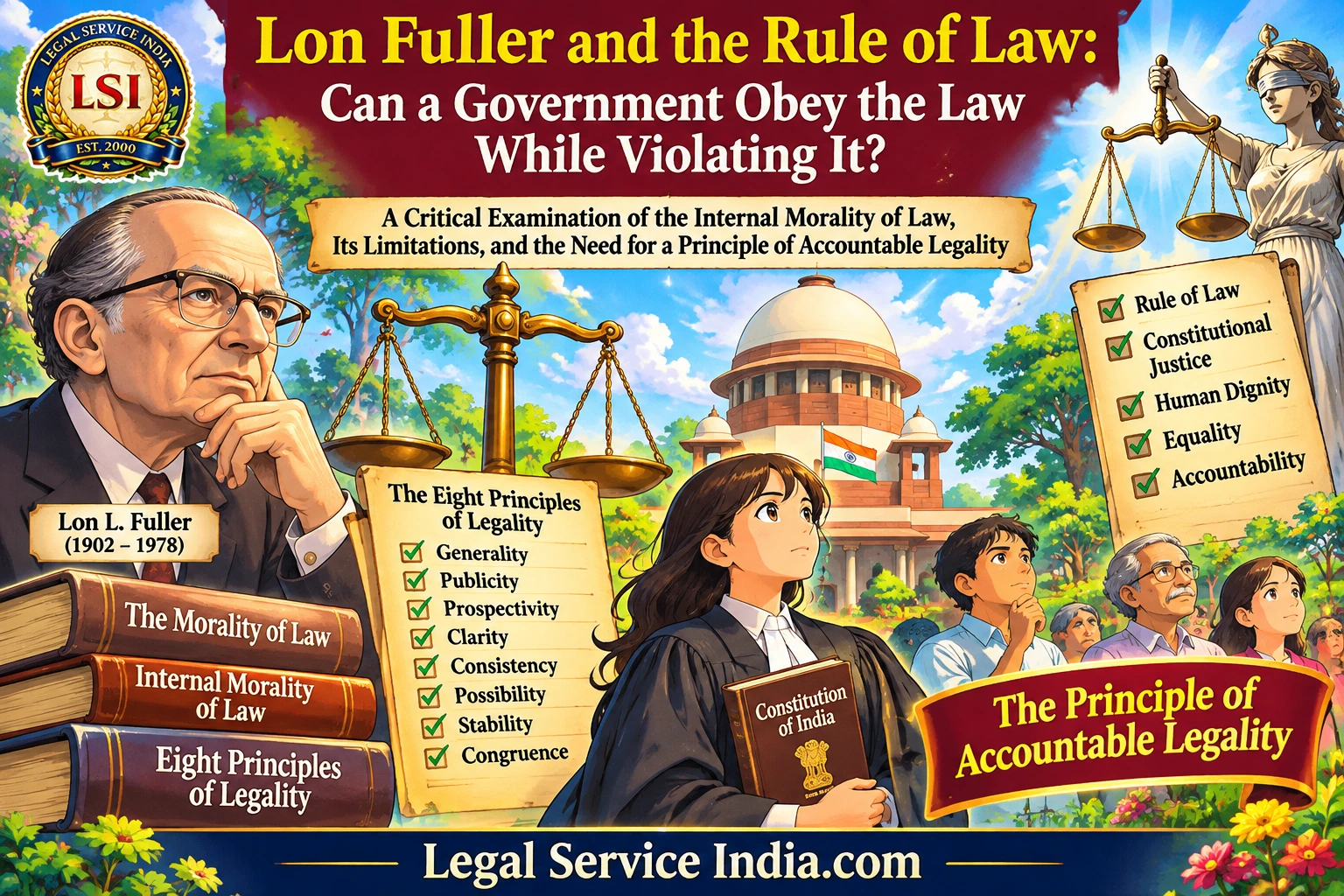
Lon Fuller and the Rule of Law: Can a Government Obey the Law While Violating It?
A Critical Examination of the Internal Morality of Law, Its Limitations, and the Need for a Principle of Accountable Legality
By Adv. Tarun Choudhury
Supreme Court Advocate | 25+ Years of Legal Experience
1. Introduction: When the Government Follows the Law, but the Rule of Law Fails
Can a government obey the law and still violate the rule of law?
At first glance, the question appears contradictory. If the government acts under legislation enacted by the competent legislature, follows the prescribed procedure and exercises powers authorised by statute, how can its conduct be inconsistent with the rule of law?
Yet constitutional history repeatedly demonstrates that the existence of laws does not necessarily establish the existence of lawful government in the deeper sense.
A government may enact legislation through constitutionally recognised institutions, publish it in an official gazette, apply it consistently and enforce it through established administrative machinery. Nevertheless, the resulting legal system may deny equality, suppress liberty, institutionalise discrimination or leave individuals without an effective remedy.
The difficulty, therefore, is not simply whether government acts according to law. It is whether the law itself and the manner in which it is administered satisfy the conditions that make legal authority worthy of obedience.
This question takes us to the jurisprudence of Lon L. Fuller, one of the most important legal philosophers of the twentieth century.
In The Morality of Law, first published in 1964, Fuller advanced a distinctive proposition: law is not merely a collection of commands issued by a sovereign. It is a purposive enterprise through which human conduct is governed by rules. For that enterprise to function as law, certain requirements of legality must be respected.
Fuller identified eight such requirements. He described them as the internal morality of law.
His argument deserves serious attention because it challenges a familiar assumption: that law and morality can always be understood as entirely separate questions.
But Fuller’s theory also raises a difficult objection. Can a legal system satisfy all eight requirements and still be profoundly unjust?
A discriminatory law may be clearly drafted. An oppressive statute may be published in advance. An authoritarian government may enforce its rules consistently. A legal system may provide stability without providing justice.
If so, has Fuller explained the rule of law—or only the conditions under which an effective system of governance can operate?
I agree with Fuller that legality is not morally neutral in every respect. But I respectfully disagree with any suggestion that the internal morality of law, by itself, provides a sufficient foundation for the rule of law.
The distinction is fundamental.
A government must not merely govern through rules. It must govern through rules that remain answerable to constitutional justice, human dignity and meaningful public accountability.
2. Understanding Lon Fuller: The Thinker Behind the Theory
Lon Luvois Fuller (1902–1978) was an American legal philosopher and professor at Harvard Law School. His work addressed the nature of law, the relationship between law and morality, legal reasoning and the institutional responsibilities of legal systems.
Fuller is particularly associated with the debate between natural-law thinking and legal positivism.
Legal positivism, in broad terms, maintains that the existence and validity of law are determined by social sources and institutional criteria rather than by whether the law is morally good.
This does not mean that legal positivists approve of unjust laws. It means that they distinguish the question of what the law is from the question of whether it deserves moral approval.
Fuller challenged the adequacy of this separation.
His argument was not that every unjust law automatically ceases to be law. Rather, he sought to demonstrate that the very activity of creating and administering law contains moral requirements.
The central question was therefore not simply whether a rule had been enacted by an authorised institution.
It was whether the system genuinely respected the conditions necessary to guide human conduct through rules.
2.1 The Hart–Fuller Debate
Fuller’s disagreement with H.L.A. Hart became one of the defining controversies in modern jurisprudence.
Hart, in his 1958 article Positivism and the Separation of Law and Morals, defended the analytical distinction between legal validity and moral merit.
Fuller responded in Positivism and Fidelity to Law: A Reply to Professor Hart, also published in 1958.
The disagreement was deeper than a dispute about terminology.
Hart was concerned that identifying law with morality could obscure the important distinction between describing an existing legal system and evaluating its moral character.
Fuller, on the other hand, believed that the enterprise of law itself could not be adequately understood without recognising its internal moral dimensions.
The disagreement remains relevant today.
A court may identify a statute as legally valid while recognising that it is unjust. But can a government claim to respect the rule of law if it systematically makes its rules secret, contradictory, retrospective or impossible to follow?
Fuller’s answer was that legality has an internal structure that cannot be ignored.
3. Fuller’s Central Proposition: Law Is a Purposive Enterprise
Fuller understood law as an enterprise of subjecting human conduct to the governance of rules.
This formulation is important.
A command issued by a ruler may produce obedience through fear. But a legal system seeks to guide conduct through norms that people can understand and follow.
That distinction places responsibilities on the lawmaker.
If citizens are expected to comply with rules, the government must make those rules capable of being known, understood and followed. It must also administer them consistently with what it has declared.
The relationship is therefore not entirely one-sided.
The State demands obedience, but it must also respect the conditions that make obedience to law possible.
Fuller developed this argument through his famous account of a fictional ruler named Rex, who repeatedly fails in his attempts to create a functioning legal system.
Through Rex’s failures, Fuller identifies eight principles of legality.
These principles are not simply recommendations for better legislative drafting. They are connected aspects of a single ideal: governing through rules rather than through unpredictable personal commands.
4. The Eight Principles of the Internal Morality of Law
4.1 Generality: Law Must Govern Through Rules
Law should ordinarily operate through general rules rather than arbitrary individual commands.
Generality allows people to understand the standards governing their conduct and provides a framework for consistent decision-making.
A system in which every individual is governed by unpredictable personal instructions is not meaningfully a system of rule-based governance.
However, generality alone does not guarantee equality.
A discriminatory statute can be expressed in general language. A law may apply consistently to every member of a particular class while creating an unjust classification in the first place.
This is where constitutional equality must go beyond Fuller’s formal requirement.
4.2 Promulgation: Secret Law Is Incompatible with Legality
People cannot reasonably be expected to obey rules that have not been made known to them.
Publication is therefore essential.
The government must communicate the rules that regulate conduct before expecting citizens to comply with them.
This principle has immediate relevance to modern administration.
Restrictions imposed through unpublished orders, inaccessible notifications or undisclosed executive instructions raise a fundamental problem: how can citizens challenge or obey a rule whose existence or contents they cannot ascertain?
Publication is not a technical formality. It is a condition of accountable government.
4.3 Prospectivity: Law Should Ordinarily Govern Future Conduct
Fuller considered retrospective lawmaking a serious threat to legality.
A person should ordinarily be able to know the legal consequences of conduct before acting.
If the State changes the rules after an event and then punishes a person under the new standard, it undermines the capacity of law to guide behaviour.
Prospectivity protects planning, certainty and individual autonomy.
There may be exceptional constitutional or transitional contexts in which retrospective legislation is considered. But those exceptions must be carefully justified and remain subject to constitutional limitations.
4.4 Clarity: Law Must Be Understandable
A rule that cannot be understood cannot effectively guide conduct.
Legal language may necessarily involve technical concepts. However, excessive ambiguity, inconsistent drafting and unintelligible provisions can create opportunities for arbitrary enforcement.
The problem becomes particularly serious where citizens cannot determine what conduct is prohibited or what legal consequences may follow.
Clarity is therefore not merely a matter of legislative elegance. It is closely connected with fairness.
4.5 Consistency: Laws Must Not Contradict One Another
A legal system cannot effectively guide conduct if its rules require people to do incompatible things.
Contradictory legal obligations create uncertainty and place individuals in an impossible position.
Consistency is also important for courts and administrators. If different provisions impose irreconcilable duties, the resulting uncertainty may increase discretionary power.
The principle therefore protects the coherence of the legal system.
4.6 Possibility of Compliance: Law Must Not Demand the Impossible
A legal rule should not command conduct that is impossible to perform.
A government cannot fairly punish individuals for failing to do something that lies beyond their practical or legal capacity.
This principle has particular significance in regulatory governance.
A compliance obligation may appear reasonable on paper but become impossible because of contradictory instructions, inaccessible procedures, technological limitations or administrative failures.
The State must not create an obligation and then punish citizens for its own failure to make compliance possible.
4.7 Relative Stability: Law Should Not Change Constantly
A legal system must provide a reasonable degree of continuity.
If rules change so frequently that people cannot plan their conduct, law loses its guiding function.
Stability is important for commercial transactions, public administration, property rights and individual decision-making.
However, stability must not become an excuse for preserving injustice.
A legal system must remain capable of reform. The objective should be reasonable continuity, not permanent resistance to change.
4.8 Congruence: Official Action Must Match Declared Law
This may be the most practically significant of Fuller’s eight principles.
The rules announced by the government must correspond with the way government officials actually behave.
If legislation promises procedural safeguards but officials routinely disregard them, the legal system suffers a fundamental failure of congruence.
The same problem arises when administrative authorities selectively enforce rules, ignore statutory limits or exercise powers in ways that contradict the declared legal framework.
A government cannot establish legality merely by publishing impressive legislation. Its conduct must reflect the standards it announces.
Summary: The Eight Principles of Legality
| No. | Principle | Core Requirement |
|---|---|---|
| 1 | Generality | Law should operate through general rules. |
| 2 | Promulgation | Laws must be made publicly known. |
| 3 | Prospectivity | Law should ordinarily govern future conduct. |
| 4 | Clarity | Legal rules must be understandable. |
| 5 | Consistency | Laws must not impose contradictory obligations. |
| 6 | Possibility of Compliance | Law must not demand the impossible. |
| 7 | Relative Stability | Legal rules should provide reasonable continuity. |
| 8 | Congruence | Official conduct must match declared law. |
5. Why Fuller’s Theory Matters: The Moral Value of Legality
Fuller’s theory deserves recognition for identifying something that legal systems sometimes overlook.
The rule of law is not established merely because a legislature has passed statutes and courts exist to interpret them.
Citizens must be able to orient their conduct around legal rules.
This requires a relationship of reciprocity.
The government expects individuals to comply with the law. In return, the government must make compliance reasonably possible and must itself act consistently with the legal standards it has established.
This is an important moral insight.
A government that demands obedience while refusing to disclose its rules, changes them unpredictably or selectively enforces them treats citizens as objects of administrative power rather than as responsible legal persons.
Fuller’s theory therefore provides a valuable account of the relationship between legality and human agency.
I agree with this central insight.
But agreement with Fuller’s starting point does not require accepting that his framework is sufficient.
The limitations of the theory become visible when we examine legal systems that are procedurally organised but substantively oppressive.
6. Where I Respectfully Agree With Fuller
6.1 Law Cannot Function Through Unpredictable Commands
A legal system based entirely on the changing will of officials cannot provide reliable guidance.
Citizens need to know the standards governing their conduct.
This is particularly important in a constitutional democracy, where governmental power is supposed to be limited by law.
6.2 Publication Is a Condition of Meaningful Accountability
The State cannot fairly expect compliance with undisclosed rules.
Publication also enables legal challenge. A person who does not know the legal basis of an executive restriction may be unable to question its legality.
Fuller’s insight is therefore especially relevant to administrative transparency.
6.3 Congruence Is More Important Than Legislative Appearance
A government may have an elaborate statute book and still govern arbitrarily.
The true test of legality is not only what the law declares but what public authorities actually do.
This is where Fuller’s theory has considerable practical force.
6.4 Legality Is a Matter of Degree
Fuller recognised that the eight principles cannot always be achieved perfectly.
Legal systems operate in difficult social circumstances. Rules may require interpretation; emergencies may create practical complications; legislative reform may disturb stability.
The principles should therefore be understood as interconnected requirements of a legal ideal rather than as a mechanical checklist.
6.5 Law Must Respect the Individual as a Participant
Fuller’s theory is strongest when understood as a recognition that individuals are capable of understanding and responding to rules.
A system that deliberately makes legal obligations unknowable or impossible to follow denies that capacity.
This is a powerful foundation for a more accountable conception of public authority.
7. Where I Respectfully Disagree With Fuller
The most important contribution of a critical examination is not to repeat a philosopher’s propositions but to identify where those propositions cease to provide adequate answers.
Fuller’s eight principles tell us much about the form of legality. They do not, by themselves, resolve the deeper question of justice.
7.1 A Procedurally Perfect Law Can Still Be Unjust
Consider a hypothetical statute that creates a discriminatory classification.
The statute is:
- General in its wording.
- Properly published.
- Prospective.
- Clearly drafted.
- Internally consistent.
- Possible to obey.
- Relatively stable.
- Consistently enforced.
It may satisfy all eight principles.
Yet it may still deny a section of society equal dignity, liberty or opportunity.
This exposes the central limitation of Fuller’s theory.
The principles of legality can make a legal system more orderly without necessarily making its substantive rules just.
History provides examples of legal systems in which oppressive classifications were expressed through formal legislation and administered through established institutions.
The problem is not that such systems lacked rules. It is that the rules themselves were unjust.
Fuller’s framework needs to be supplemented by substantive standards of justice.
7.2 The Rule of Law Must Be Distinguished from the Rule by Law
There is a difference between government through law and government under the rule of law.
A government may use legislation as an instrument of control.
It may enact clear rules, establish enforcement machinery and ensure administrative consistency while concentrating power and suppressing opposition.
Such a system may display considerable formal regularity.
But it does not necessarily embody constitutional government.
The rule of law requires more than the existence of rules. It requires limits on public power, independent institutions, effective remedies and protection against arbitrary interference.
This distinction is particularly important in constitutional democracies.
7.3 Generality Does Not Necessarily Produce Equality
A law may be general and still discriminate.
Generality asks whether a rule is framed in general terms. Equality asks whether the classification or differential treatment is constitutionally justified.
These are different inquiries.
A law may apply equally to everyone within a defined class while creating an unreasonable or discriminatory class.
The Indian constitutional guarantee under Article 14 addresses this deeper problem through equality before the law and equal protection of the laws.
Fuller’s generality principle is valuable, but it cannot replace constitutional equality.
7.4 Stability Can Become an Instrument of Injustice
Fuller rightly identifies the danger of constantly changing laws.
But excessive stability can also preserve unjust arrangements.
Constitutional progress often requires legal transformation.
A system that protects discriminatory laws merely because they have existed for a long time cannot claim legitimacy on the strength of continuity alone.
Stability must therefore be balanced against constitutional development, social reform and the protection of fundamental rights.
7.5 Publication Does Not Guarantee Accessibility
A law may be formally published and still remain practically inaccessible.
Modern legal systems are increasingly complex. Rules may be scattered across notifications, subordinate legislation, circulars, administrative directions and technical regulations.
Digital publication does not automatically solve the problem.
Citizens may lack reliable internet access, legal literacy, language support or the resources needed to understand complicated regulatory requirements.
The distinction between publication and accessibility is crucial.
A rule that exists in an official database but cannot realistically be located or understood by the people it governs may satisfy the formal requirement of promulgation while failing the broader purpose of legal guidance.
7.6 Congruence Does Not Guarantee Constitutional Legitimacy
Suppose an executive authority consistently enforces a law that violates fundamental rights.
There may be complete congruence between the statute and official action.
But consistency cannot transform unconstitutional conduct into legitimate government.
Congruence is necessary for legality in Fuller’s sense. It is not sufficient for constitutional legitimacy.
The administration must also remain within the limits imposed by constitutional rights, judicial review and the principles governing public power.
7.7 Fuller Underestimates the Importance of Remedies and Institutional Accountability
A citizen may know the law, understand the applicable rule and identify an unlawful administrative action.
But what happens if the citizen cannot obtain an effective remedy?
A right without a meaningful mechanism of enforcement may become practically hollow.
Fuller’s framework gives important attention to the relationship between announced rules and official conduct. Yet modern constitutional governance requires a more explicit examination of institutions capable of correcting official departures from law.
Independent courts, accessible procedures, reasoned decisions and enforceable remedies are indispensable.
The rule of law cannot depend entirely on the good faith of those who exercise power.
8. The Indian Constitutional Experience: Fuller’s Theory Tested Against Judicial Reality
India offers a particularly rich constitutional setting in which to examine Fuller’s ideas.
The Constitution does not merely establish institutions and distribute governmental powers. It limits public authority through fundamental rights, constitutional supremacy, judicial review and enforceable remedies.
Its conception of legality is therefore broader than the formal regularity of enacted rules.
8.1 Article 14: Equality as a Restraint on Arbitrary Power
In E.P. Royappa v. State of Tamil Nadu, (1974) 4 SCC 3, the Supreme Court developed the important relationship between equality and non-arbitrariness.
The Court observed that arbitrariness is antithetical to equality.
This principle moves beyond Fuller’s requirement of generality.
A rule may be general in form but arbitrary in substance. Article 14 requires the State to justify its classifications and exercise of power within constitutional limits.
The Indian approach therefore adds a substantive constitutional dimension to the formal requirements of legality.
8.2 Article 21: Procedure Must Be Fair, Just and Reasonable
In Maneka Gandhi v. Union of India, (1978) 1 SCC 248, the Supreme Court transformed the understanding of personal liberty under Article 21.
The Court held that the procedure established by law must be fair, just and reasonable, and not arbitrary, fanciful or oppressive.
The judgment also strengthened the relationship between Articles 14, 19 and 21.
This is important for the Fuller debate.
A procedure does not become constitutionally acceptable merely because it has been enacted.
Its fairness and reasonableness must also be examined.
The Indian constitutional position thus moves beyond the proposition that law must be clear, prospective and consistently administered. It asks whether the procedure itself respects constitutional liberty.
8.3 ADM Jabalpur: When Legal Authority Fails the Test of Liberty
The decision in Additional District Magistrate, Jabalpur v. Shivkant Shukla, (1976) 2 SCC 521, remains one of the most troubling episodes in Indian constitutional history.
During the Emergency, the Supreme Court majority accepted a position that effectively denied the availability of habeas corpus in the circumstances before it, where the Presidential Order under Article 359 was in force.
Justice H.R. Khanna dissented.
His dissent insisted that the protection of life and liberty could not be reduced to the existence of a formal constitutional remedy that the executive could suspend in the manner argued before the Court.
The decision demonstrates why the existence of legal rules and institutional procedures cannot be the final measure of constitutional legitimacy.
A legal system may continue to operate through statutes, executive orders and judicial proceedings while fundamental protection becomes gravely weakened.
In Justice K.S. Puttaswamy (Retd.) v. Union of India, (2017) 10 SCC 1, the Supreme Court expressly repudiated the majority position in ADM Jabalpur.
The historical lesson is profound.
The rule of law requires institutions willing and able to protect individuals when the exercise of governmental power threatens liberty.
8.4 Puttaswamy: Legality, Legitimate Aim and Proportionality
The nine-judge Bench in Justice K.S. Puttaswamy (Retd.) v. Union of India recognised privacy as a fundamental right protected by the Constitution.
The judgment also examined the conditions under which State action affecting privacy may be justified.
The legality of State interference is not the end of the inquiry.
The State must demonstrate a lawful basis, a legitimate objective and proportionality between the measure adopted and the purpose sought to be achieved.
This framework illustrates a crucial distinction.
Fuller asks whether governance through rules satisfies the internal requirements of legality.
Constitutional proportionality asks whether the State’s interference with rights is justified.
Both inquiries matter, but they are not interchangeable.
8.5 A.K. Kraipak: Fairness in Administrative Decision-Making
In A.K. Kraipak v. Union of India, (1969) 2 SCC 262, the Supreme Court addressed the importance of natural justice in administrative action.
The judgment recognised that the distinction between administrative and quasi-judicial functions cannot be used to avoid basic requirements of fairness.
This complements Fuller’s concern with congruence.
An authority that announces procedural safeguards but fails to respect fairness in actual decision-making undermines the integrity of legal administration.
8.6 Anuradha Bhasin: Publication, Transparency and the Right to Challenge
In Anuradha Bhasin v. Union of India, (2020) 3 SCC 637, the Supreme Court considered restrictions imposed in Jammu and Kashmir, including restrictions affecting internet access.
The Court directed the publication of orders relating to restrictions under Section 144 of the Code of Criminal Procedure and suspension of telecom services, so that affected persons could challenge them.
It also held that indefinite suspension of internet services was impermissible under the applicable suspension rules and that restrictions were subject to proportionality and judicial review.
This judgment has a close analytical connection with Fuller’s principle of promulgation.
A person cannot effectively challenge an executive restriction without knowing the order, its legal basis and its terms.
But the judgment also demonstrates why publication alone is insufficient. The restrictions must remain temporary, proportionate and open to judicial scrutiny.
The case therefore supports a more developed conception of legality: public authorities must disclose their decisions and remain answerable for their justification.
9. The Indian Constitution Goes Beyond Fuller
The Indian constitutional framework provides safeguards that cannot be reduced to Fuller’s eight principles.
These include:
- Constitutional supremacy.
- Fundamental rights.
- Equality and non-arbitrariness.
- Judicial review.
- Separation of powers.
- Natural justice.
- Proportionality.
- Constitutional remedies under Articles 32 and 226.
- The basic structure limitation on constitutional amendment.
The significance of these safeguards is that they do not merely regulate the form in which government makes rules.
They also limit what government may legitimately do.
Fuller’s theory helps explain why legal systems require procedural integrity. The Indian Constitution adds the proposition that public power must remain substantively justified and institutionally accountable.
This distinction should not be overstated. Fuller was not indifferent to justice, and his work cannot fairly be reduced to a drafting manual. Nevertheless, the Indian constitutional experience demonstrates that internal legality alone cannot answer every question of constitutional legitimacy.
10. Comparative Constitutional Perspectives
Fuller’s theory also becomes more illuminating when placed alongside developments in other legal systems.
10.1 The United Kingdom: The Principle of Legality
The British constitutional tradition has developed the principle that fundamental rights should not be overridden by general or ambiguous statutory language without clear legislative intention.
The decision in R v. Secretary of State for the Home Department, ex parte Simms [2000] 2 AC 115 is an important illustration.
The principle reflects a deeper concern: executive convenience should not be allowed to displace fundamental rights through vague or insufficiently clear legal authority.
This complements Fuller’s concern with clarity, but it goes further by protecting substantive constitutional interests.
10.2 The United States: Due Process and Legal Certainty
American constitutional jurisprudence has developed doctrines addressing vague criminal laws and fair notice.
The void-for-vagueness doctrine reflects the concern that individuals must be able to understand what the law prohibits and that enforcement authorities must not be given uncontrolled discretion.
This has a clear relationship with Fuller’s principles of clarity and promulgation.
However, American due process jurisprudence also raises questions about liberty and the limits of governmental power that extend beyond formal legality.
10.3 Germany: The Rechtsstaat Tradition
The German conception of the Rechtsstaat is commonly associated with a state governed and limited by law.
Its modern constitutional form connects legality with fundamental rights, human dignity, constitutional review and institutional restraints.
It therefore illustrates a more integrated approach.
Formal legality is essential, but it operates within a constitutional order that imposes substantive limits on public authority.
10.4 The European Convention System: Accessibility and Foreseeability
Under the European Convention on Human Rights, the requirement that an interference be “in accordance with the law” has been interpreted to require accessibility and a degree of foreseeability.
The point is not merely that a legal provision exists.
People must have a reasonable opportunity to understand the legal consequences of their conduct, and the law must contain safeguards against arbitrary interference.
This provides a useful comparative perspective for Fuller’s principles of promulgation and clarity.
11. What Fuller Did Not Fully Anticipate: The Challenges of Modern Governance
Fuller died in 1978. Many of the institutional and technological challenges facing contemporary legal systems have since become more complex.
His framework remains relevant, but it must be tested against new forms of governmental power.
11.1 Algorithmic Government
Public authorities increasingly use automated systems to assess eligibility, allocate benefits, detect suspected violations and make administrative recommendations.
A citizen may be adversely affected by an algorithm without knowing how the decision was reached.
A system may apply rules consistently but remain opaque, discriminatory or impossible to challenge.
The question is no longer simply whether the rule has been published.
It is whether the individual can understand the reasoning behind the decision and obtain meaningful review.
11.2 Digital Exclusion
Making legal information available online does not guarantee that everyone can access it.
Digital publication may leave behind people without reliable connectivity, appropriate devices, language support or digital literacy.
The formal availability of a rule must be distinguished from its practical accessibility.
11.3 Emergency Governance
Emergencies create pressure for executive discretion.
But the existence of an emergency cannot eliminate the need for legal authority, transparency, proportionality and review.
The challenge is to ensure that exceptional powers remain genuinely exceptional.
11.4 Administrative Complexity
Modern citizens are governed not only by statutes but by a dense network of rules, regulations, circulars, notifications and departmental instructions.
Even where each instrument is technically valid, the cumulative system may become difficult to understand.
A legal system that is practically unintelligible risks defeating its own purpose.
These challenges suggest that Fuller’s theory should be developed rather than discarded.
12. My Original Contribution: The Principle of Accountable Legality
Fuller’s internal morality of law provides an essential starting point. But the modern constitutional State requires a further question:
Can citizens meaningfully understand, question and challenge the exercise of public power?
I propose that the rule of law should be examined through an additional framework: the Principle of Accountable Legality.
This is a proposed synthesis, not a claim that the underlying ideas have never appeared in constitutional or administrative law. Its purpose is to bring established principles of transparency, fairness, reasoned decision-making, proportionality and review into a single evaluative framework.
The central proposition is that legality is not complete merely because government acts through rules. It must also be possible for those governed by the rules to understand the exercise of power, demand reasons and obtain an effective remedy.
The principle has six dimensions.
12.1 Institutional Transparency
Public authorities should disclose the legal basis, scope and operative terms of decisions that materially affect individuals.
Transparency is not satisfied by the mere existence of an internal government record.
Where a decision affects rights or imposes obligations, the relevant legal basis should ordinarily be accessible, subject to properly justified limitations.
12.2 Practical Accessibility
Legal information must be accessible in practice, not merely in theory.
This requires attention to language, format, digital access, clarity and the ability of ordinary citizens to locate the applicable rules.
A legal system should not treat formal publication as proof that the public can realistically understand its obligations.
12.3 Reasoned Decision-Making
Where public authorities exercise discretion in a manner affecting rights or interests, they should ordinarily provide reasons appropriate to the nature of the decision.
Reasons discipline administrative power.
They enable the affected person to understand the decision and allow a reviewing court or authority to assess whether the power was lawfully exercised.
12.4 Effective Contestability
A person must have a meaningful opportunity to question an adverse exercise of public power.
This requires more than a theoretical right to approach a court.
Procedures must be reasonably accessible, timely and capable of providing effective relief.
12.5 Constitutional Justification
Even a clearly enacted and consistently enforced law must remain subject to constitutional scrutiny.
Legality must be accompanied by legitimate purpose, equality, proportionality and respect for fundamental rights.
12.6 Algorithmic Accountability
Where automated systems materially influence governmental decisions, affected individuals should have appropriate safeguards.
These may include:
- Disclosure that an automated system materially influenced the decision.
- An intelligible explanation of the relevant grounds.
- Human review where appropriate.
- Mechanisms to challenge inaccurate data.
- Auditing for discriminatory or unlawful outcomes.
- Clear institutional responsibility for the final decision.
The State should not be permitted to avoid legal accountability by transferring public decision-making into an opaque technological system.
13. Why Accountable Legality Is Necessary
Fuller’s theory is concerned with the relationship between the lawmaker and the person governed by law.
The Principle of Accountable Legality extends that relationship.
It asks whether the citizen has the practical capacity to understand and challenge the exercise of authority.
The distinction may be expressed in three stages:
The Three Stages of Legality
| Stage | Central Question | Requirement |
|---|---|---|
| Formal Legality | Is the rule properly made and expressed? | Fuller’s principles of legality |
| Constitutional Legitimacy | Is the rule and its application consistent with constitutional rights? | Equality, liberty, proportionality and judicial review |
| Accountable Legality | Can affected persons understand, question and obtain review of the exercise of power? | Transparency, reasons, accessibility and effective remedies |
These stages should not be understood as rigidly separate compartments. They are interconnected dimensions of constitutional government.
A system may satisfy formal legality while failing constitutional legitimacy.
It may also recognise constitutional rights on paper while making them practically inaccessible.
The final test must therefore include the citizen’s ability to hold public authority answerable.
This is particularly important in a constitutional democracy, where government is not the owner of public power. It is its trustee.
14. The Central Question Revisited: Can Government Obey Law While Violating the Rule of Law?
The answer depends on what is meant by obedience to law.
If obedience means that government officials act under enacted statutes and follow prescribed procedures, then yes: a government may comply with formal legal requirements while undermining the deeper values of the rule of law.
But if the rule of law is understood as a constitutional ideal that includes equality, liberty, accountability and effective remedies, such formal compliance is plainly insufficient.
Fuller helps us understand why law must possess an internal structure of legality.
The Indian Constitution helps us understand why that structure must remain subject to substantive rights and institutional restraints.
The proposed Principle of Accountable Legality adds another dimension: the governed must have the practical ability to know, question and challenge the exercise of public power.
The three perspectives are complementary, but they are not identical.
Conclusion: Law Must Govern the Government Too
Lon Fuller made an enduring contribution to jurisprudence by demonstrating that law is not merely an instrument through which the powerful issue commands.
A genuine legal system must respect the conditions that allow human beings to organise their conduct through rules.
His eight principles remain important because they expose the failures of secret, retrospective, contradictory, unintelligible and inconsistently administered governance.
Yet the limitations of his theory must also be acknowledged.
A procedurally regular legal system may still be unjust. A general law may discriminate. A stable legal order may preserve oppression. A government may act consistently with its own rules while violating constitutional rights.
The Indian constitutional experience demonstrates that legality must be accompanied by equality, liberty, proportionality, judicial review and effective remedies.
The ultimate purpose of the rule of law is not to make citizens obedient to government.
It is to ensure that government itself remains governed by law.
That is where I respectfully depart from the sufficiency of Fuller’s theory.
The rule of law should not be measured only by the quality of the rules a government makes. It must also be measured by the quality of the reasons it gives, the fairness of the decisions it takes, the remedies it makes available and the accountability it accepts.
A government that asks citizens to obey the law must itself be prepared to explain, justify and defend the exercise of its power.
The true test of the rule of law is not whether the State can command obedience through law. It is whether the State can itself be held accountable under law.
Facing a Legal Challenge? Protect Your Rights With Experienced Legal Guidance.
Understanding the law is important. Knowing how to use it to protect your rights is even more important.
Whether you are facing a constitutional issue, an arbitrary government decision, a violation of your legal rights, or a complex dispute requiring strategic legal intervention, the right legal advice can make a significant difference.
Do not let uncertainty delay an important legal decision. Discuss your matter with an experienced legal professional and understand the legal remedies available to you.
Adv. Tarun Choudhury
Supreme Court Advocate | 25+ Years of Legal Experience
For legal consultation and professional assistance:
- 📞 Call: 9650499965
- 💬 WhatsApp: 8851978611
- ✉️ Email: [email protected]
LegalServiceIndia.com – Experienced Legal Guidance. Informed Decisions. Protection of Your Rights.
Reach out to discuss your legal concerns and explore the appropriate course of legal action.
EDITOR’S RECOMMENDATION

JURISPRUDENCE • LEGAL PHILOSOPHY
The Morality of Law
By Lon L. Fuller
What makes a law truly worthy of obedience? Explore one of the most influential works in legal philosophy on the relationship between law, morality and justice.
Why Read This Book?
Understand the internal morality of law and the principles that distinguish the Rule of Law from the mere exercise of power.
Paperback Edition | By Lon L. Fuller
Recommended Reading for Law Students, Advocates & Legal Scholars
References and Further Reading
A. Primary Jurisprudential Sources
- Lon L. Fuller, The Morality of Law, revised edition, Yale University Press, 1969 (first published 1964).
- Lon L. Fuller, “Positivism and Fidelity to Law: A Reply to Professor Hart,” Harvard Law Review, Vol. 71, No. 4 (1958), pp. 630–672.
- H.L.A. Hart, “Positivism and the Separation of Law and Morals,” Harvard Law Review, Vol. 71, No. 4 (1958), pp. 593–629.
- H.L.A. Hart, The Concept of Law, Oxford University Press, 1961.
- Lon L. Fuller, The Law in Quest of Itself, Beacon Press, 1940.
B. Critical Scholarship
- Matthew H. Kramer, “Scrupulousness Without Scruples: A Critique of Lon Fuller and His Defenders,” Oxford Journal of Legal Studies, Vol. 18, No. 2 (1998), pp. 235–263.
- Jeremy Waldron, “Positivism and Legality: Hart’s Equivocal Response to Fuller,” NYU Law Review, Vol. 83, No. 4 (2008).
- Kenneth I. Winston, scholarship on Lon Fuller, legality and the morality of law.
C. Indian Judicial Authorities
- Kesavananda Bharati v. State of Kerala, (1973) 4 SCC 225.
- A.K. Kraipak v. Union of India, (1969) 2 SCC 262.
- E.P. Royappa v. State of Tamil Nadu, (1974) 4 SCC 3.
- ADM Jabalpur v. Shivkant Shukla, (1976) 2 SCC 521.
- Maneka Gandhi v. Union of India, (1978) 1 SCC 248.
- Justice K.S. Puttaswamy (Retd.) v. Union of India, (2017) 10 SCC 1.
- Shayara Bano v. Union of India, (2017) 9 SCC 1.
- Anuradha Bhasin v. Union of India, (2020) 3 SCC 637.
D. Comparative Authority
- R v. Secretary of State for the Home Department, ex parte Simms, [2000] 2 AC 115.
- European Convention on Human Rights, particularly Articles 5, 6, 8 and 10, as relevant to legality, foreseeability and procedural safeguards.
Frequently Asked Questions
1. Who was Lon Fuller and what was his contribution to jurisprudence?
Lon L. Fuller was an American legal philosopher best known for The Morality of Law. His major contribution was the theory of the internal morality of law, according to which a functioning legal system must respect eight principles of legality.
2. What are the eight principles of legality formulated by Lon Fuller?
Fuller identified generality, promulgation, prospectivity, clarity, consistency, possibility of compliance, relative stability and congruence between declared rules and official action.
3. What is the internal morality of law?
The internal morality of law refers to the procedural requirements that make it possible to govern human conduct through rules. Fuller argued that a legal system must respect these requirements if it is to function as a genuine system of law.
4. What was the Hart–Fuller debate?
The Hart–Fuller debate concerned the relationship between law and morality. Hart defended the distinction between legal validity and moral merit, while Fuller argued that the very enterprise of law contains inherent moral requirements.
5. Can a law be legally valid but violate the rule of law?
Yes. A law may be enacted by a competent legislature and administered consistently while still violating constitutional rights, equality or human dignity. Formal legality does not automatically establish constitutional legitimacy.
6. How is Lon Fuller’s theory relevant to Indian constitutional law?
Fuller’s theory is relevant to Indian constitutional principles concerning legal certainty, publication, fair procedure and consistency in administrative action. However, Articles 14 and 21 and judicial review impose additional substantive constitutional requirements.
7. What is the Principle of Accountable Legality proposed in this article?
The Principle of Accountable Legality is a proposed framework that supplements Fuller’s principles with institutional transparency, practical accessibility, reasoned administrative decisions, effective contestability, constitutional justification and algorithmic accountability.
8. Did the Supreme Court of India expressly adopt Lon Fuller’s theory?
The judgments discussed in this article are examined as constitutional illustrations of principles comparable to Fuller’s concerns. This article does not claim that the Supreme Court expressly adopted Fuller’s eight principles as a unified jurisprudential test.
Key Takeaways: Lon Fuller and the Rule of Law
- Lon Fuller’s Theory of the Rule of Law: Lon Fuller argued that a functioning legal system must satisfy eight principles of legality, collectively known as the internal morality of law. These principles explain why law must guide human conduct through rules rather than arbitrary commands.
- The Eight Principles of Legality: Fuller identified generality, promulgation, prospectivity, clarity, consistency, possibility of compliance, relative stability and congruence between declared law and official action as essential requirements of legality.
- Internal Morality of Law: Fuller maintained that law has an inherent procedural morality because governments must respect certain standards when creating, publishing and enforcing legal rules.
- The Hart–Fuller Debate: The disagreement between Lon Fuller and H.L.A. Hart concerns whether law and morality can be separated. Hart distinguished legal validity from moral merit, while Fuller argued that the process of governing through law necessarily involves moral requirements.
- Legality Does Not Always Mean Justice: A law may be properly enacted, clearly worded and consistently enforced while remaining discriminatory or oppressive. Therefore, procedural legality alone cannot guarantee substantive justice.
- Generality and Constitutional Equality: Fuller’s principle of generality does not automatically ensure equality. Under Article 14 of the Indian Constitution, State action must also satisfy constitutional standards of equality and non-arbitrariness.
- Article 21 and Fair Legal Procedure: In Maneka Gandhi v. Union of India (1978), the Supreme Court established that the procedure under Article 21 must be fair, just and reasonable, strengthening the constitutional protection of personal liberty.
- ADM Jabalpur and Constitutional Liberty: The Emergency-era decision in ADM Jabalpur v. Shivkant Shukla (1976), subsequently expressly repudiated in Justice K.S. Puttaswamy v. Union of India (2017), demonstrates why legal institutions must protect fundamental rights even during extraordinary political circumstances.
- Transparency and Government Accountability: In Anuradha Bhasin v. Union of India (2020), the Supreme Court emphasised the publication of restriction orders and subjected restrictions affecting internet access to requirements including proportionality and judicial review.
- The Limitations of Fuller’s Theory: Fuller’s eight principles do not independently resolve questions of substantive equality, constitutional legitimacy, proportionality, democratic accountability or effective remedies.
- The Principle of Accountable Legality: This article proposes an additional framework based on institutional transparency, practical accessibility of legal information, reasoned administrative decisions, effective opportunities to challenge State action, constitutional justification and algorithmic accountability.
- The Future of the Rule of Law: In an era of digital governance, automated decision-making and expanding executive powers, the rule of law must ensure that citizens can understand, question and challenge decisions affecting their rights.
The Central Argument
The true test of the rule of law is not whether citizens are required to obey the law, but whether the government itself remains accountable under law.
