





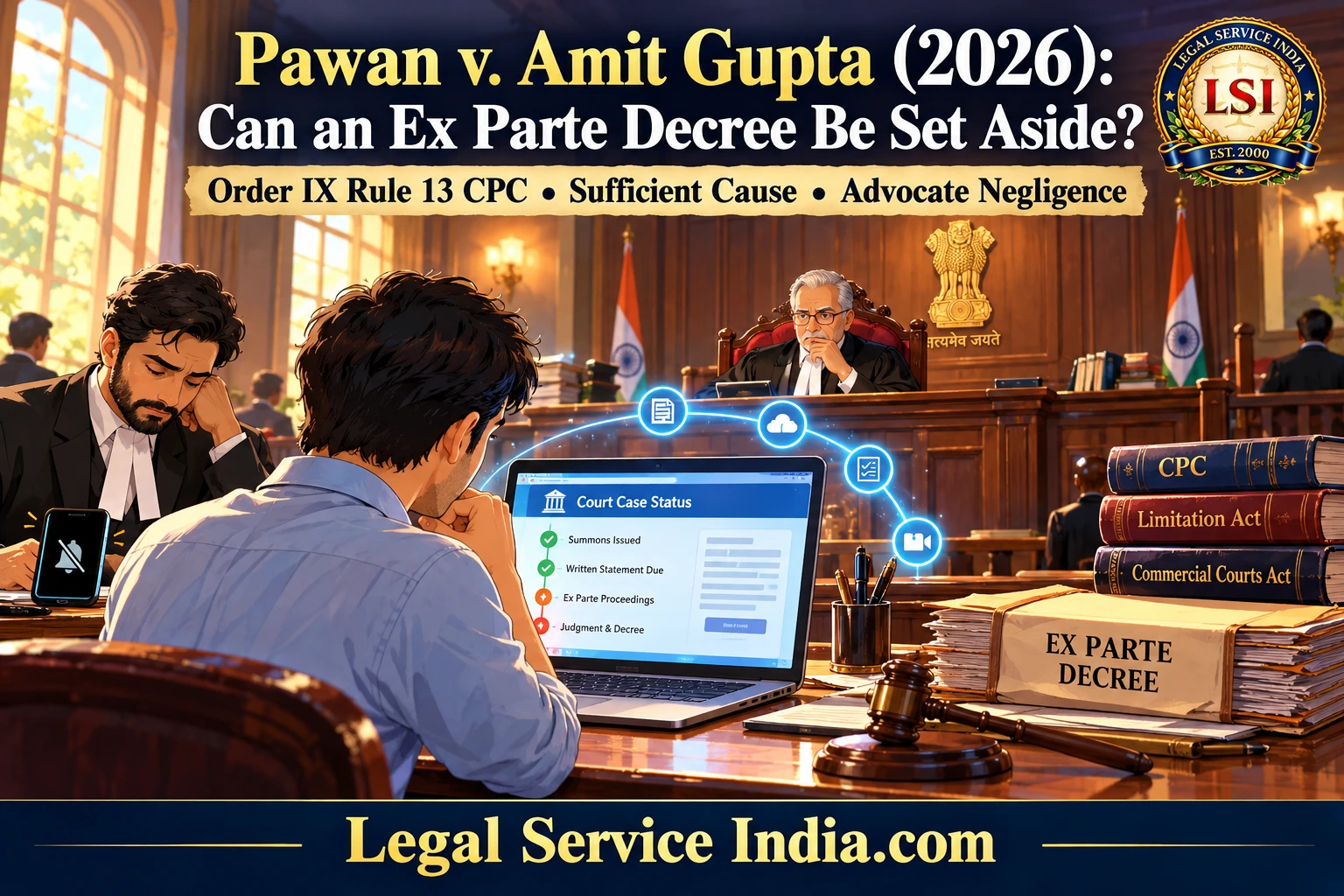
Digital Vigilance Is the New “Sufficient Cause”
Litigant Diligence, Counsel’s Silence and Order IX Rule 13 CPC after Pawan v. Amit Gupta (Delhi High Court, 2026)
I. Core Proposition
In Pawan v. Amit Gupta, FAO (COMM) 297/2025, 2026:DHC:9215-DB (decided 15 October 2026), a Division Bench of Justice Dinesh Mehta and Dr Justice Aditi Choudhary (judgement authored by Choudhary J.) upheld the refusal to set aside a commercial ex parte decree. The defendant had personally appeared after service of summons, yet blamed counsel who “did not answer calls”. The Court held that such a plea, unsupported by dates, particulars or any effort to inspect the record, cannot amount to “sufficient cause” under Order IX Rule 13 CPC, particularly where online case status, uploaded orders and video-conferencing are available to every litigant.
The decision does not abolish the rule that an innocent litigant should not suffer for his advocate’s default. It conditions that indulgence on proof that the litigant himself was honest, sincere and diligent. In the Court’s own formulation, borrowed from Parimal v. Veena, the test is whether the defendant honestly and sincerely intended to remain present and did his best to do so.
II. The Facts at a Glance
| Date | Event |
|---|---|
| 16.09.2023 | Suit for recovery of ₹12,24,939 (CS (COMM) 520/2023) first listed; summons issued. |
| 22.01.2024 | The defendant receives a summons. |
| 25.01.2024 | Appears in person, without counsel. Directed to file a written statement within 30 days. |
| 01.04.2024 | No written statement was filed; the right to file it is closed. Notional issues framed; evidence assigned to the local commissioner. Defendant does not cross-examine. |
| 29.07.2024 – 05.11.2024 | None appears for the defendant on 29.07.2024; proxy counsel appears on 05.11.2024. |
| 23.11.2024 | None appears; the plaintiff’s final arguments are heard. |
| 26.11.2024 | Ex parte judgement and decree. |
| 19.01.2025 / 20.01.2025 | Defendant says he learnt of the decree (how, unexplained); Order IX Rule 13 application filed the next day. |
| 07.08.2025 | District Judge (Commercial Court), Rohini, dismisses it (Misc. DJ 161/2025). |
| 15.10.2026 | Appeal under Section 13, Commercial Courts Act, 2015, dismissed (reserved 05.10.2026). |
III. Statutory Framework
Order IX Rule 13 CPC lets a defendant against whom a decree has been passed ex parte apply to set it aside on either of two grounds: that the summons was not duly served or that he was prevented by “sufficient cause” from appearing when the suit was called on for hearing. The first proviso permits partial setting aside where the decree is indivisible. The second proviso bars relief on a mere irregularity in service where the defendant had notice and sufficient time. The Explanation bars the application where an appeal against the ex parte decree has been disposed of on any ground other than withdrawal.
The application is governed by Article 123 of the Limitation Act, 1963 (thirty days from the decree, or from knowledge where the summons was not duly served), with Section 5 available for delay. In commercial suits, the timelines of Order VIII Rule 1 as amended by the Commercial Courts Act, 2015, are mandatory: the Supreme Court in SCG Contracts India Pvt. Ltd. v. K.S. Chamankar Infrastructure Pvt. Ltd. (2019) 12 SCC 210 held that a written statement filed beyond 120 days cannot be taken on record, a position reiterated in Desh Raj v. Balkishan (2020) 2 SCC 708. That strictness explains why Pawan (para 19) viewed the defendant’s inertia against a time-bound commercial framework.
IV. What the Court Actually Held
Knowledge from Personal Appearance
Having appeared in person on 25.01.2024, the defendant knew of the suit and must have been taken to know of the online facilities for tracking it.
Presumed Capability
A man who runs a proprietorship and worries about his CIBIL score can be presumed able to protect his interests. The plea of inability to use the court website was “difficult to believe”, and the fear that a Computer Service Centre visit would harm his credit score was rejected.
Vagueness Is Fatal
The pleading gave no date of any attempt to reach counsel, did not explain why he never visited counsel or the court, offered nothing for 23 and 26 November 2024, and did not say how he learnt of the decree.
Duty to Follow Up
A party must be vigilant, follow court directions, press his counsel, and inspect court records if counsel is silent.
Commercial Context
The time-bound scheme of the 2015 Act sharpens the expectation of diligence.
Note the structure of the reasoning. The Court did not hold that online availability by itself defeats a plea. It used availability to test the credibility of the explanation: an applicant who pleads helplessness must show that the helplessness was real. This is how the decision should be cited.
V. The Authorities: Two Lines and How They Reconcile
A. The Liberal Line: Construction of “Sufficient Cause”
- Sangram Singh v. Election Tribunal, Kotah, AIR 1955 SC 425 (22.03.1955): the foundational authority on the effect of non-appearance and on the court’s discretion under Order IX; procedural law is a handmaid of justice.
- Arjun Singh v. Mohindra Kumar, AIR 1964 SC 993: every good cause is a sufficient cause, differing only in the degree of proof required (as recalled in Parimal, para 14).
- G.P. Srivastava v. R.K. Raizada, (2000) 3 SCC 54 (03.03.2000): “sufficient cause” is elastic; it must relate to the date on which the defendant’s absence led to the ex parte order and cannot be stretched to rely on circumstances anterior in time; if cause is shown for that date, he is not to be penalised for earlier negligence that was overlooked. Discretion is normally exercised in favour of a defendant who approaches promptly and was not mala fide, with costs as compensation.
- Parimal v. Veena @ Bharti, (2011) 3 SCC 545 (08.02.2011): sufficient cause means the party did not act negligently, lacked no bona fide, and was not inactive; the test is whether the defendant honestly and sincerely intended to be present and did his best; the applicant must also approach the court with a reasonable defence.
- A. Murugesan v. Jamuna Rani, (2019) 20 SCC 803 (07.02.2019): reaffirmed G.P. Srivastava; courts below erred in rejecting an Order IX Rule 13 application on grounds irrelevant to the date-specific inquiry.
B. The Counsel’s Default Line
- Rafiq v. Munshilal, (1981) 2 SCC 788: AIR 1981 SC 1400 (16.04.1981): an innocent litigant who has done all in his power should not suffer for his advocate’s inaction; costs to be recovered from the absent advocate.
- Salil Dutta v. T.M. & M.C. (P) Ltd., (1993) 2 SCC 185 (05.02.1993): the advocate is the agent of the party; Rafiq is not an absolute proposition, and no party may disown counsel at will; a company managed by educated businessmen cannot put the entire blame on its advocate.
- Bharat Barrel & Drum Mfg. Co. v. ESI Corporation, (1971) 2 SCC 860: relied upon in Rajneesh Kumar on the burden of showing that the litigant’s own conduct was not negligent.
- Rajneesh Kumar v. Ved Prakash, 2024 INSC 891 (21.11.2024; SLP (C) Nos. 935-936 of 2021; Pardiwala and Mahadevan JJ.): noting a tendency of litigants to blame lawyers, the Court held that even assuming counsel’s negligence, long inordinate delay is not condoned, as the litigant must be vigilant about proceedings he himself initiated.
- Nitin Mahadeo Jawale v. Bhaskar Mahadeo Mutke, 2024 INSC 902 (22.11.2024): same bench; a delay of 4½ years in filing the written statement was not condoned on the same reasoning.
- Esha Bhattacharjee v. Managing Committee of Raghunathpur Nafar Academy, (2013) 12 SCC 649 (13.09.2013): the court’s synthesis of principles on condonation: a liberal approach and preference for merits, but a lack of bona fides, negligence and a casual approach are significant and relevant to the Section 5 limb of an Order IX Rule 13 application.
C. The Counterweight: When the Litigant Is Innocent
- Dwarika Prasad (D) thr. LRs v. Prithvi Raj Singh, 2024 INSC 1030 (20.12.2024; Vikram Nath and Varale JJ.): the Supreme Court restored the trial court’s order setting aside an ex parte decree where an uneducated, elderly defendant had trusted counsel who did not tell him of the decree. It held that technicalities must not shut out a case and a party must not suffer for counsel’s fault, noting that the defendant had acted bona fide and diligently.
- Pratibha Verma v. Abhishek Kumar, MAT.APP.(F.C.) 56/2024, Delhi High Court Division Bench (Vivek Chaudhary and Renu Bhatnagar JJ.), 29.05.2026: a deserted wife in a matrimonial case, with proceedings overlapping the pandemic, obtained relief. The Bench added that filing a complaint against the earlier advocate is not a precondition for relief under Order IX Rule 13.
D. Reconciling Them
The two lines answer different questions. G.P. Srivastava and Parimal set the standard (elastic, date-specific, bona fide, diligent). Salil Dutta and Rajneesh Kumar allocate the risk of counsel’s default: it is the litigant’s risk unless he is shown to be an innocent and vigilant litigant. Dwarika Prasad and Pratibha Verma show how the standard is met in practice: by a particular, credible account of vulnerability, reliance, and prompt action on discovery. Pawan sits squarely at the junction. Its contribution is to hold that, in the era of online case information, a bare allegation of counsel’s non-responsiveness does not discharge the burden of showing that vulnerability or diligence.
E. Delhi High Court Application
Pawan followed Kalu Ram Dhingra v. Jee Financial Consultant LLP, 2025 SCC OnLine Del 6806 (FAO (COMM) 165/2025), where the Coordinate Bench rejected an uncorroborated plea blaming erstwhile counsel, and the SLP was dismissed. A similar approach appears in Surya Prakash Gupta, FAO 307/2025 (Delhi High Court, 11.11.2025), which treats counsel’s negligence, unless coupled with exceptional circumstances or fraud, as insufficient and applies Rajneesh Kumar.
| Comparison | Pawan (2026) | Dwarika Prasad (2024) | Pratibha Verma (2026) |
|---|---|---|---|
| Litigant | Businessman, proprietorship, appeared in person | Elderly, uneducated, relied wholly on counsel | Deserted wife, financial distress, pandemic |
| Own conduct | Vague, undated, no inquiry of court or record | Bona fide and diligent; learnt through new counsel | Counsel was appearing; hardship pleaded specifically |
| Outcome | Decree stands | Decree set aside | Decree set aside, remanded |
VI. Doctrinal Significance
Pawan does not dilute the liberal construction of “sufficient cause” associated with Sangram Singh and G.P. Srivastava. It supplies a modern evidentiary yardstick for the bona fides and diligence that those cases already require. The Court did not cite Sangram Singh; that harmonisation is the commentator’s, not the Court’s, and should be presented as such.
It also tightens the Rafiq principle. Through Salil Dutta and Rajneesh Kumar the Court reinforced that counsel’s default is not a blanket shield; the litigant must plead dates of attempts to contact counsel, efforts to verify listing, access to records, and promptness after discovery.
Limits and Cautions
- Fact-bound. The finding rested on this defendant’s profile and pleading. It does not lay down that every litigant is deemed digitally literate; Dwarika Prasad remains good law for the genuinely vulnerable.
- Delay-context authorities. Rajneesh Kumar and Nitin Mahadeo Jawale are short SLP orders on delay (an appeal against an ex parte decree, and a written statement). Pawan applies them by analogy to Order IX Rule 13. Counsel should say so openly when relying on them.
- Literacy argument. The defendant pleaded he was only tenth-pass. The Court still held that the trial court’s fallback (a Computer Service Centre or a visit to the court) was available. Future litigants will need to plead why those fallbacks were realistically unavailable.
- The date-specific rule survives. Under G.P. Srivastava the focus is the date of non-appearance. Pawan itself insisted on an explanation for 23 and 26 November 2024, not merely general slackness.
VII. Practical Drafting Checklist
An Order IX Rule 13 application, supported by an affidavit, should now preferably allege and substantiate:
- The exact date of service and of any personal appearance.
- Dates and modes of attempts to contact counsel, with call logs, messages or correspondence.
- Steps taken to check the court website, case-status portal, e-filing portal or cause list.
- Any visit to the court, filing counter, Nazarat or Computer Service Centre; if none, a credible reason.
- A specific explanation for absence on each date on which the matter proceeded ex parte.
- The date and manner of learning of the decree, and the promptness of the application (Article 123; Section 5 where needed).
- Why the alleged counsel default actually prevented appearance, not merely delayed communication.
- A reasonable defence on merits (Parimal, para 16), and, in commercial suits, why the Order VIII Rule 1 timelines were missed.
- Willingness to bear costs (G.P. Srivastava) and, where facts support it, steps taken against counsel (helpful but, per Pratibha Verma, not a pre-condition).
For the decree-holder: build a record-based chronology of every date the defendant was present, represented or served, so that the vagueness identified in Pawan is exposed on the record itself.
VIII. Conclusion
Pawan v. Amit Gupta is best understood not as a departure from the liberal tradition of Sangram Singh and G.P. Srivastava but as its digital-age application. Justice-oriented construction of Order IX Rule 13 remains. What has changed is the proof demanded: a litigant who has appeared once, who has online access to court records, and who still makes no effort to learn the status of his case will find it difficult to establish “sufficient cause” by alleging only that counsel did not answer calls.
IX. Citation Table
- Pawan v. Amit Gupta, FAO (COMM) 297/2025, 2026:DHC:9215-DB
- Rajneesh Kumar v. Ved Prakash, 2024 INSC 891
- Nitin Mahadeo Jawale v. Bhaskar Mahadeo Mutke, 2024 INSC 902
- G.P. Srivastava v. R.K. Raizada, (2000) 3 SCC 54
- Parimal v. Veena @ Bharti, (2011) 3 SCC 545
- Salil Dutta v. T.M. & M.C. (P) Ltd., (1993) 2 SCC 185
- Rafiq v. Munshilal, (1981) 2 SCC 788
- Sangram Singh v. Election Tribunal, Kotah, AIR 1955 SC 425; 1955 INSC 15, 22.03.1955.
- Dwarika Prasad v. Prithvi Raj Singh, 2024 INSC 1030
- A. Murugesan v. Jamuna Rani, (2019) 20 SCC 803
- Arjun Singh v. Mohindra Kumar, AIR 1964 SC 993
- Bharat Barrel & Drum Mfg. Co. Ltd. & Anr. v. Employees State Insurance Corporation, (1971) 2 SCC 860
- Esha Bhattacharjee vs. Mg. Commit. of Raghunathpur Nafar, (2013) 12 SCC 649
- 13 September, 2013
- Desh Raj v. Balkishan, (2020) 2 SCC 708
- M/S Scg Contracts India Pvt. Ltd. Vs. Ks Chamankar Infrastructure Pvt. Ltd. on 12 February, 2019; (2019) 12 SCC 210
- Kalu Ram Dhingra v. Jee Financial Consultant LLP, 2025 SCC OnLine Del 6806
- Delhi High Court
- Jul 22, 2025
- Surya Prakash Gupta v. N S Chahal & Others, FAO 307/2025 (Delhi High Court) Nov 11, 2025
- Pratibha Verma v. Abhishek Kumar, MAT.APP.(F.C.) 56/2024 (Del), 29.05.2026
- Article 123 Limitation Act, 1963 (30 days)
Written By: Inder Chand Jain
Ph no: 8279945021, Email: [email protected]

