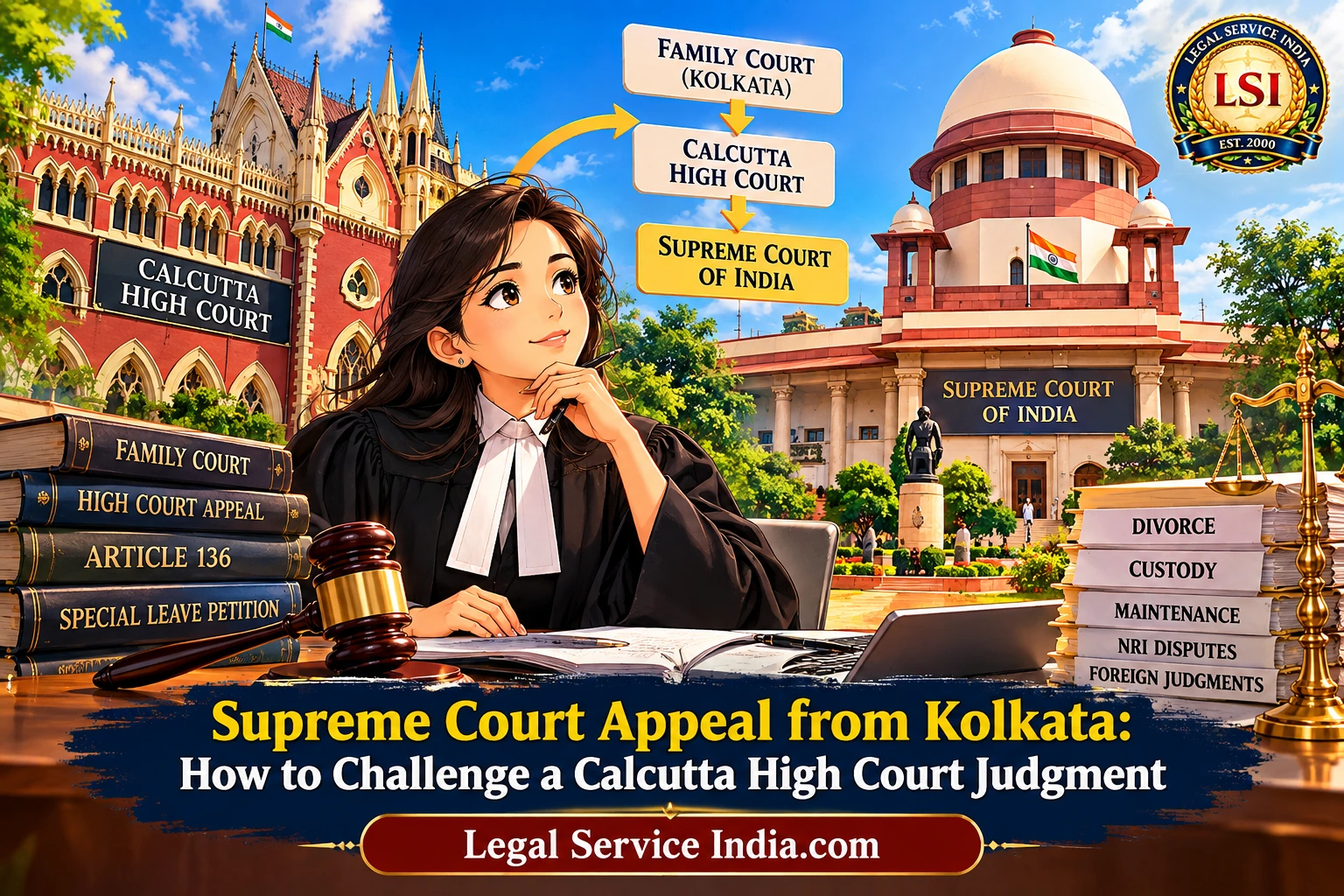
Supreme Court Appeal from Kolkata: How to Challenge a Family Court or Calcutta High Court Judgment
What Does “Supreme Court Appeal from Kolkata” Mean?
If you have received an adverse judgment from a Family Court, District Court or the Calcutta High Court, you may be wondering whether you can take the matter to the Supreme Court of India.
People commonly search for this as a “Supreme Court Appeal from Kolkata.”
There is, however, no separate statutory proceeding called a “Supreme Court Appeal from Kolkata.” The expression simply describes a case originating in Kolkata or elsewhere in West Bengal that is sought to be taken to the Supreme Court.
In many matrimonial and family disputes, the litigation may follow this broad path:
Family Court → Calcutta High Court → Supreme Court of India
But this is not an automatic three-stage process in every case. The appropriate remedy depends upon the nature of the order, the statute under which the case was decided, the available appellate remedy and the procedural history.
Where a civil or family dispute has already been decided by the Calcutta High Court, the usual constitutional route to the Supreme Court is a Special Leave Petition (SLP) under Article 136 of the Constitution of India.
That distinction is important.
An SLP is initially a request asking the Supreme Court to grant special leave to appeal. Until leave is granted, technically there is no appeal before the Supreme Court.
How Does a Family Court Case From Kolkata Reach the Supreme Court?
Consider a common matrimonial situation.
A husband and wife marry in Kolkata. After several years, one spouse moves to another country. The marriage breaks down. Proceedings concerning divorce, maintenance, custody or property are initiated in India. At the same time, proceedings may also be initiated abroad.
The Family Court decides the matter.
An appeal may then lie to the Calcutta High Court under the applicable law. If the High Court subsequently gives a judgment against one of the parties, that party may, where appropriate, approach the Supreme Court under Article 136.
| Stage | Possible Proceeding | Forum |
|---|---|---|
| 1 | Original matrimonial or family proceeding | Family Court |
| 2 | Statutory appeal or other appropriate remedy | Calcutta High Court |
| 3 | Special Leave Petition | Supreme Court of India |
| 4 | Appeal, if special leave is granted | Supreme Court of India |
The first task, therefore, is not to ask simply, “Can I go to the Supreme Court?”
The first task is to identify which order has been passed, by which court, under which statute, on what date and through which appellate route.
Also Read: Contested Divorce in Delhi: Grounds, Procedure, Evidence & Supreme Court Law 2026.
Article 136 and Special Leave Petition: The Route to the Supreme Court
Article 136 gives the Supreme Court a wide discretionary power to grant special leave to appeal from judgments, decrees, determinations, sentences or orders passed by courts and tribunals in India.
It is an exceptional constitutional jurisdiction. It is not simply another routine appeal after the High Court.
This is why the question in an SLP is not merely:
“Why do I disagree with the High Court?”
The more important question is:
“What legal, jurisdictional, procedural or constitutional error justifies the Supreme Court’s intervention?”
Depending upon the facts, a case may warrant consideration where there is:
- a serious jurisdictional error;
- an incorrect interpretation or application of the governing statute;
- a substantial legal error;
- a violation of natural justice;
- material evidence being ignored or misunderstood;
- an incorrect approach to a foreign judgment;
- a serious error concerning child custody or welfare;
- an important procedural irregularity causing prejudice; or
- circumstances resulting in a grave miscarriage of justice.
At the same time, the Supreme Court does not ordinarily function as a routine third court of facts merely because a litigant is dissatisfied with concurrent findings of the courts below.
That is why an SLP has to be carefully structured around the legal significance of the error rather than simply repeating every grievance raised in the earlier litigation.
Family Court Appeal Under Section 19 of the Family Courts Act
For a person beginning with a Family Court in Kolkata or elsewhere in West Bengal, Section 19 of the Family Courts Act, 1984 is particularly important.
Section 19 provides for an appeal to the High Court from a Family Court judgment or order, other than an interlocutory order, subject to the statutory exceptions.
The provision states that the appeal lies on both facts and law. It also contains provisions dealing with consent orders, certain criminal proceedings, revision and the exclusion of other appellate or revisional remedies.
West Bengal is within the operation of the Family Courts Act.
Therefore, where a Family Court in Kolkata has passed a judgment or order from which an appeal lies, the appropriate High Court appellate remedy generally has to be considered before approaching the Supreme Court.
Family Court Appeal Limitation: 30 Days or 90 Days?
This is one of the most important practical issues in the entire subject.
Section 19(3) of the Family Courts Act states that an appeal under Section 19 is to be preferred within 30 days from the date of the Family Court judgment or order.
The Family Courts Act also contains an overriding provision in Section 20.
The Supreme Court considered the interaction between the Family Courts Act and matrimonial appellate limitation in Arunoday Singh v. Lee Anne Elton, SLP (C) No. 10751/2021, decided on 23 July 2021. In the statutory context before it, the Supreme Court gave effect to the 30-day period under Section 19 of the Family Courts Act.
However, limitation should not be calculated mechanically from a generic article on the internet.
The applicable limitation can depend upon:
- the matrimonial statute involved;
- whether the proceeding is governed by the Family Courts Act;
- the nature of the decree or order;
- whether the order is interlocutory;
- the particular statutory appellate provision;
- the effect of the Family Courts Act’s overriding clause; and
- the binding judicial authorities applicable in the relevant High Court.
There has been judicial disagreement in different High Courts concerning the interaction between the Family Courts Act’s 30-day provision and longer matrimonial appellate limitation periods under particular statutes.
For a litigant in West Bengal, the safe course is therefore to have limitation calculated specifically from the actual Family Court judgment, the statute involved and the applicable Calcutta High Court and Supreme Court authorities.
Do not assume that you automatically have either 30 days or 90 days without a case-specific limitation calculation.
A missed limitation period can create an entirely avoidable procedural problem.
Also Read: Wills, Succession, Inheritance & Probate in India: Complete 2026 Guide.
How Much Time Do You Have to File an SLP?
The limitation applicable to an SLP is governed by the Supreme Court Rules and depends upon the nature and procedural circumstances of the case.
In civil matters, the commonly encountered limitation periods include 90 days in the ordinary situation and 60 days in specified circumstances involving refusal of a certificate, subject to the applicable Rules and the facts of the case.
The calculation should be made from the relevant judgment or order after taking into account the applicable procedural rules, exclusion of legally excludable time and any question of condonation.
If the petition is filed beyond the applicable period, an appropriate application for condonation of delay may be required.
For this reason, the safest practical advice is simple:
Do not wait until the last few days to decide whether to challenge a Calcutta High Court judgment in the Supreme Court.
Foreign Divorce Decree: Can a Foreign Court’s Divorce Be Recognised in India?
Cross-border matrimonial disputes require a different level of legal analysis.
Imagine that a Hindu couple married in Kolkata. One spouse subsequently moved to the United States or United Kingdom. After the marriage broke down, the spouse living abroad obtained a divorce decree from a foreign court.
The foreign decree is then produced before an Indian court.
The foreign spouse says:
“The marriage has already ended.”
The Indian spouse says:
“That foreign divorce is not legally effective in India.”
At that point, the existence of the foreign decree is only the beginning of the legal analysis.
The important question becomes whether the foreign judgment is entitled to recognition or conclusiveness in India under Indian law.
Section 13 CPC and Foreign Judgments
Section 13 of the Code of Civil Procedure, 1908 provides the principal statutory framework for considering when a foreign judgment is or is not conclusive in India.
A foreign judgment may not be conclusive where, among other circumstances, it:
- has not been pronounced by a court of competent jurisdiction;
- has not been given on the merits of the case;
- appears to be founded on an incorrect view of international law or a refusal to recognise Indian law where such law is applicable;
- proceeds from proceedings opposed to natural justice;
- has been obtained by fraud; or
- sustains a claim founded on a breach of Indian law.
Consequently, neither of the following propositions is safe:
“Every foreign divorce is automatically valid in India.”
or
“No foreign divorce can ever be recognised in India.”
The answer depends upon the particular foreign court, its jurisdiction, the law governing the marriage, the ground on which the decree was granted, participation by the parties, service, natural justice, fraud and the other requirements of Section 13 CPC.
Satya v. Teja Singh: Foreign Divorce and Jurisdiction
One of the foundational Supreme Court authorities is Satya v. Teja Singh, (1975) 1 SCC 120.
The case involved a foreign divorce decree and a dispute concerning the jurisdiction exercised by the foreign court.
The Supreme Court examined whether the foreign decree satisfied the requirements for recognition under Indian law.
The decision remains an important authority for the proposition that an Indian court must examine the legal basis on which a foreign matrimonial decree was obtained rather than treating the foreign decree as automatically conclusive.
Also Read: Ancestral Property Delhi: Daughter’s Rights, Partition, Sale & Legal Remedies.
Y. Narasimha Rao v. Y. Venkata Lakshmi
The Supreme Court’s decision in Y. Narasimha Rao v. Y. Venkata Lakshmi, (1991) 3 SCC 451 is another leading authority.
The Court considered the effect in India of a foreign divorce decree and examined the relationship between foreign jurisdiction and the matrimonial law governing the parties.
The case is frequently relied upon for the proposition that an Indian court must examine whether the foreign court exercised jurisdiction recognised by Indian law and whether the basis of the foreign decree corresponds to the applicable matrimonial law, subject to the principles and exceptions recognised by the Supreme Court.
It is also important to distinguish service from submission to jurisdiction.
A person receiving notice of proceedings in another country has not necessarily, merely by receiving that notice, voluntarily submitted to the jurisdiction of the foreign court.
The complete procedural history therefore matters.
Kishorekumar Mohan Kale: A Crucial 2026 Example
The Supreme Court’s 2026 decision in Kishorekumar Mohan Kale v. Kashmira Kale, Civil Appeal No. 1342 of 2013, decided on 15 January 2026, provides an especially useful illustration of how foreign divorce decrees and Article 142 can operate differently.
The case concerned a U.S. divorce decree based upon irretrievable breakdown.
The Supreme Court considered, among other matters, the effect of the foreign decree under Indian matrimonial law. The Court found that the foreign decree could not simply be treated as conclusive in India on the facts and legal framework applicable to the case.
But that was not the end of the matter.
After considering the extraordinary circumstances and the prolonged separation between the parties, the Supreme Court separately exercised its constitutional power under Article 142 and dissolved the marriage.
This is a particularly important distinction.
| Issue | Question |
|---|---|
| Foreign decree | Is the foreign judgment entitled to recognition or conclusiveness in India under Indian law? |
| Article 142 | Can the Supreme Court itself grant appropriate matrimonial relief in the circumstances of the case? |
Rejecting a foreign divorce decree under Section 13 CPC and dissolving the marriage under Article 142 are therefore not contradictory outcomes.
They involve different legal questions and different sources of judicial power.
Article 142 and Irretrievable Breakdown of Marriage
The Supreme Court’s constitutional jurisdiction under Article 142 has particular significance in matrimonial disputes.
In Shilpa Sailesh v. Varun Sreenivasan, 2023 SCC OnLine SC 544, the Supreme Court recognised its power, in appropriate circumstances, to dissolve a marriage on the ground of irretrievable breakdown.
This power should not, however, be confused with the statutory grounds available before ordinary matrimonial courts.
Nor does the existence of Article 142 mean that a foreign decree based upon irretrievable breakdown automatically becomes valid in India.
Kishorekumar Mohan Kale is particularly instructive because it demonstrates both principles in the same case: the foreign decree was not simply accepted as conclusive under Indian matrimonial law, but the Supreme Court separately exercised Article 142 to bring the marriage to an end in light of the circumstances before it.
For lawyers dealing with international matrimonial disputes, that distinction can be decisive.
Mihir Prakash Bajoria: A Recent Supreme Court Case Directly Relevant to Kolkata
A particularly relevant recent authority for anyone dealing with cross-border matrimonial proceedings connected with Kolkata is Mihir Prakash Bajoria v. Vidushi Jain Bajoria, 2026 INSC 1034.
The case has a direct Kolkata connection. The underlying proceedings included litigation before the Civil Judge at Alipore, South 24 Parganas, followed by proceedings before the Calcutta High Court and ultimately the Supreme Court.
The dispute involved parallel matrimonial proceedings in India and the United Kingdom and an attempt to restrain the foreign proceedings through an anti-suit injunction.
The Indian court had granted an injunction affecting the foreign proceedings. The Calcutta High Court subsequently vacated that protection, and the matter reached the Supreme Court.
The Supreme Court upheld the Calcutta High Court’s decision and did not restrain the UK proceedings on the facts before it.
The decision is important for another reason: an anti-suit injunction and recognition of a completed foreign judgment are not the same legal question.
An anti-suit injunction concerns whether a foreign proceeding should be restrained. Questions such as forum, appropriateness of the foreign proceeding, comity and the circumstances in which an Indian court should interfere may arise.
Recognition of a foreign judgment arises at a different stage and may involve Section 13 CPC.
These two issues should not be conflated.
For a Kolkata litigant, the practical lesson is equally important: the mere fact that matrimonial proceedings are pending in India does not mean that an Indian court will automatically restrain a foreign matrimonial proceeding.
International Child Custody and Supreme Court Appeals
Cross-border matrimonial litigation often involves an even more sensitive question: where should the child live?
A parent may take a child abroad. The other parent may commence proceedings in India. A foreign court may make a custody or residence order. The Indian court may then be asked to return the child or to recognise the foreign order.
Indian law does not reduce this question to a mechanical rule that a foreign custody order must always be followed.
The welfare and best interests of the child remain central.
The Supreme Court has considered international custody questions in authorities including:
- Dhanwanti Joshi v. Madhav Unde;
- V. Ravi Chandran v. Union of India;
- Nithya Anand Raghavan v. State (NCT of Delhi);
- Lahari Sakhamuri v. Sobhan Kodali; and
- Rajeswari Chandrasekar Ganesh v. State of Tamil Nadu.
Comity between courts can be an important consideration, but it does not mean that the welfare of the child becomes irrelevant.
Depending upon the facts, the Indian court may examine:
- the child’s age;
- the child’s relationship with each parent;
- education;
- residence;
- emotional and psychological circumstances;
- safety;
- the circumstances in which the child was taken abroad;
- foreign custody orders;
- the status of proceedings in both countries; and
- the overall welfare of the child.
An SLP involving international custody should therefore be prepared as a child-welfare case, not merely as a jurisdictional dispute between two parents.
What Does the Supreme Court Examine?
When an SLP is presented, the Supreme Court has to understand the litigation from the record.
This means that the quality of the lower-court record becomes extremely important.
The relevant material may include:
- the original matrimonial petition;
- written statements and replies;
- issues framed by the Family Court;
- evidence and exhibits;
- orders passed during the case;
- the Family Court judgment;
- the memorandum of appeal before the High Court;
- the Calcutta High Court judgment;
- documents relating to foreign proceedings;
- orders concerning maintenance or custody;
- settlement proposals;
- earlier proceedings before Indian or foreign courts; and
- the specific material relied upon for the proposed Supreme Court challenge.
This is why an SLP cannot safely be prepared merely by reading the final paragraph of the High Court judgment.
The Supreme Court does not know the marriage. It knows the paper book.
The lawyer’s task is therefore to make that paper book communicate the relevant facts, procedural history and legal error as clearly as possible.
What Grounds Can Be Raised in a Supreme Court Appeal from Kolkata?
Every SLP must be based on the actual record. There is no universal list of grounds that guarantees admission.
Depending upon the case, possible grounds may include:
1. Jurisdictional Error
The court may have assumed jurisdiction which the law did not confer upon it, or failed to exercise jurisdiction which it was required to exercise.
2. Wrong Legal Test
The court may have applied the wrong statutory provision or adopted a legally incorrect test.
3. Incorrect Treatment of a Foreign Judgment
The court may have treated a foreign decree as automatically binding without properly examining the requirements of Section 13 CPC or the applicable matrimonial law.
4. Violation of Natural Justice
A serious denial of a meaningful opportunity to present one’s case can raise an important legal issue.
5. Failure to Consider Material Evidence
If material evidence or a significant document was ignored or misunderstood in a manner affecting the result, that issue may require consideration.
6. Serious Error in Child-Custody Determination
Where the welfare of the child has been approached through an incorrect legal framework or important circumstances have been overlooked, Supreme Court intervention may be sought.
7. Grave Miscarriage of Justice
The petition should explain why the particular case deserves the Supreme Court’s discretionary intervention rather than merely stating that the judgment is wrong.
Documents Required for a Supreme Court Appeal from Kolkata
A complicated Supreme Court matter should begin with a complete documentary record.
Depending upon the case, the following may be required:
- certified copy of the Calcutta High Court judgment or order;
- Family Court judgment;
- Family Court orders;
- pleadings;
- written statements and replies;
- relevant evidence and exhibits;
- High Court pleadings and applications;
- marriage certificate;
- divorce petition;
- maintenance and custody orders;
- passport and immigration records where relevant;
- foreign divorce petition;
- foreign judgment;
- foreign summons and proof of service;
- documents showing appearance or objection to jurisdiction;
- foreign custody orders;
- school and residence records relating to a child;
- settlement agreements;
- details of previous Indian and foreign proceedings; and
- any other documents necessary to establish the grounds of the proposed SLP.
Where foreign-language documents are involved, appropriate translation and filing requirements must also be considered.
How Is a Special Leave Petition Structured?
A civil SLP is not simply a long letter to the Supreme Court.
It is a formal court proceeding that has to comply with the applicable Supreme Court Rules and filing requirements.
Depending upon the case, the petition may include:
- the prescribed SLP form;
- cause title;
- synopsis;
- list of dates and events;
- questions of law, where appropriate;
- grounds;
- interim-relief application;
- condonation application, where necessary;
- annexures;
- supporting affidavit;
- vakalatnama and Advocate-on-Record documentation; and
- other applications required by the facts of the matter.
The objective should not be to make the petition unnecessarily long.
The objective is to make the legal error understandable to the Court quickly and accurately.
Can New Evidence Be Produced for the First Time in the Supreme Court?
An SLP is not ordinarily an opportunity to start the entire trial again with a new collection of documents.
The Supreme Court Rules contain procedural requirements concerning the material that can be relied upon in an SLP.
If genuinely new evidence becomes important, the appropriate application and legal basis for bringing that material on record should be considered.
Simply attaching documents to an SLP does not automatically make them part of the evidentiary record.
Can the Supreme Court Grant Interim Relief?
Yes, depending upon the facts.
But filing an SLP does not automatically stay the operation of the High Court judgment.
Where immediate protection is necessary, an appropriate interim-relief application should be considered.
Depending upon the case, the requested relief may concern:
- implementation of the impugned judgment;
- custody of a child;
- travel of a child;
- maintenance;
- execution of monetary directions;
- property-related consequences;
- continuation of proceedings; or
- other consequences that may become difficult to reverse.
In cross-border matrimonial cases, a party may also seek an anti-suit injunction against foreign proceedings. However, such relief is not automatic merely because parallel proceedings exist in India and another country. The court may consider issues including comity, the circumstances of the foreign proceedings and whether interference with the foreign proceeding is justified.
Mihir Prakash Bajoria v. Vidushi Jain Bajoria demonstrates why an anti-suit injunction should not be presented to a client as a routine remedy.
If Your Spouse Lives Abroad, What Documents Should You Collect?
If the dispute involves a foreign spouse or foreign proceedings, obtain the complete foreign litigation record wherever possible.
This may include:
- foreign divorce petition;
- summons;
- proof of service;
- appearance documents;
- objections to jurisdiction;
- foreign court orders;
- final decree;
- emails concerning the proceedings;
- settlement agreements;
- foreign custody orders;
- immigration records;
- evidence of residence or domicile;
- documents relating to the place of marriage; and
- documents identifying the law under which the marriage was solemnised.
Do not rely upon a single-page foreign divorce decree if recognition is disputed.
The procedural history behind the decree may be just as important as the decree itself.
Why Service in a Foreign Divorce Case Is Not the Whole Story
A common misconception is that a foreign divorce decree must be valid in India because the Indian spouse was served with the foreign proceedings.
That is too simplistic.
The Indian court may need to examine whether the party merely received notice or actually submitted to the foreign jurisdiction, what objections were raised, what law governed the marriage and whether the foreign court’s jurisdiction and grounds satisfy Indian law.
If you received a foreign divorce petition but objected to the jurisdiction of the foreign court, preserve all documents showing that objection.
Emails, pleadings, affidavits, written objections and foreign court orders can become important evidence.
Practical Strategy After an Adverse Calcutta High Court Judgment
Step 1: Read the Entire Judgment
Do not begin drafting the SLP merely from the operative portion of the judgment.
Identify the findings, evidence relied upon, legal provisions applied and reasoning adopted by the High Court.
Step 2: Reconstruct the Complete Record
Collect the Family Court pleadings, evidence, orders, judgment and complete High Court record.
Step 3: Calculate Limitation Immediately
Determine the applicable limitation period from the actual order, statute and procedural history.
Do not rely upon a generic internet statement that every matrimonial appeal has the same limitation.
Step 4: Identify the Real Legal Error
Do not confuse a factual grievance with an issue capable of attracting Article 136 jurisdiction.
Step 5: Consider Interim Relief
If the judgment is creating an immediate and potentially irreversible consequence, consider whether interim protection is necessary.
Step 6: Analyse Foreign Proceedings Separately
If there is a foreign decree or pending foreign case, analyse jurisdiction, service, submission, governing law, Section 13 CPC, comity and the precise relief sought.
Step 7: Prepare the Supreme Court Record
The final petition should tell the story efficiently while demonstrating the legal basis for Supreme Court intervention.
What Happens After Filing an SLP?
After filing, the matter is subject to scrutiny by the Supreme Court Registry and the applicable filing procedure.
If defects are identified, they may have to be cured.
The matter may then come before the Court at the appropriate stage.
At the admission stage, the Supreme Court may decline to grant special leave or may grant leave.
If special leave is granted, the matter proceeds as an appeal.
This is an important distinction for clients:
Filing an SLP does not mean that the Supreme Court has already agreed to hear the case on merits.
What Happens If the Supreme Court Dismisses the SLP?
The legal consequences depend upon the nature and wording of the Supreme Court’s order and the stage at which the matter is disposed of.
The doctrine of merger discussed in Kunhayammed v. State of Kerala, (2000) 6 SCC 359 remains important in understanding the distinction between refusal of special leave and an appeal heard after leave has been granted.
A dismissal of an SLP at the threshold should not automatically be described as though the Supreme Court has affirmed the High Court judgment after a full appellate adjudication on merits.
The actual Supreme Court order must be examined.
Common Mistakes in a Supreme Court Appeal from Kolkata
1. Waiting Too Long
Limitation should be examined immediately after the judgment.
2. Filing Without the Complete Record
A complicated matrimonial case cannot normally be understood from the last judgment alone.
3. Turning the SLP Into an Emotional Narrative
Matrimonial disputes can involve betrayal, separation, financial hardship and years of litigation.
Those facts may matter, but they must be connected to legally relevant grounds.
4. Assuming a Foreign Divorce Automatically Ends the Indian Case
The effect of a foreign decree must be examined under Indian law.
5. Attempting to Rebuild the Entire Case in the Supreme Court
The SLP should ordinarily be based upon the existing record, subject to the applicable procedure for introducing additional material.
6. Assuming Filing Automatically Gives a Stay
If protection is required, appropriate interim relief must be sought.
7. Using a Generic SLP Draft
A case involving an international divorce, foreign court proceedings and child custody requires a very different legal strategy from an ordinary property or contractual dispute.
Supreme Court Appeal from Kolkata: Practical Checklist
| Issue | What Should Be Checked |
|---|---|
| Impugned judgment | Certified copy of the Calcutta High Court judgment/order |
| Family Court record | Pleadings, evidence, orders and judgment |
| Limitation | Case-specific calculation under the applicable statute and Supreme Court Rules |
| Legal grounds | Specific errors capable of supporting Article 136 intervention |
| Foreign proceedings | Complete foreign petition, service record, objections and decree |
| Child custody | Residence, education, travel and welfare-related material |
| Interim relief | Evidence of urgency and potential prejudice |
| Previous litigation | Complete history of relevant Indian and foreign proceedings |
Frequently Asked Questions
What is a Supreme Court Appeal from Kolkata?
It generally refers to taking a case originating in Kolkata or West Bengal to the Supreme Court. After a Calcutta High Court judgment in an appropriate civil or family matter, this commonly involves a Special Leave Petition under Article 136.
Can I challenge a Calcutta High Court matrimonial judgment in the Supreme Court?
Yes, where the case is otherwise maintainable, an aggrieved party may approach the Supreme Court under Article 136. However, an SLP is discretionary and there is no automatic right to have every High Court judgment reconsidered.
Can I directly approach the Supreme Court after a Family Court judgment?
The applicable appellate structure must first be examined. Where an appeal lies to the High Court under Section 19 of the Family Courts Act, the High Court remedy ordinarily has to be considered. The exact route depends upon the nature of the order and governing statute.
What is the limitation for a Family Court appeal?
Section 19(3) of the Family Courts Act provides a 30-day period for an appeal under Section 19. However, matrimonial limitation questions can involve interaction with other statutory provisions and judicial authorities. The applicable period should therefore be calculated from the particular decree or order and legal framework rather than assumed from a general rule.
How much time do I have to file an SLP?
The applicable period depends upon the type of proceeding and the circumstances under the Supreme Court Rules. Civil SLPs commonly involve a 90-day limitation period, with specific provisions applying in certain certificate-related situations. A case-specific calculation should always be obtained.
Will a US or UK divorce automatically be recognised in India?
No. Recognition may depend upon jurisdiction, the applicable matrimonial law, the ground of divorce, participation or submission to the foreign jurisdiction, service, natural justice, fraud and the requirements of Section 13 CPC.
What is Section 13 CPC in a foreign divorce case?
Section 13 CPC sets out circumstances in which a foreign judgment may or may not be conclusive in India. It is a central provision when the legal effect of a foreign divorce decree is disputed.
Can the Supreme Court dissolve a marriage under Article 142?
In appropriate cases, the Supreme Court has exercised Article 142 to dissolve marriages, including cases involving irretrievable breakdown. This constitutional power is distinct from the question of whether a foreign divorce decree is recognised under Section 13 CPC.
Can an international child-custody dispute reach the Supreme Court?
Yes. The Supreme Court has considered numerous cross-border custody disputes. The welfare and best interests of the child remain central considerations, along with the circumstances of the child, foreign orders, comity and the overall factual situation.
Does filing an SLP automatically stay a High Court judgment?
No. Filing an SLP does not automatically operate as a stay. Where urgent protection is necessary, an appropriate interim application should be considered.
Can an Indian court stop a foreign divorce proceeding?
An Indian court can, in appropriate circumstances, consider an anti-suit injunction or other protective relief. But such relief is not automatic merely because proceedings are pending in India. The court may consider the circumstances of the foreign proceeding, comity and whether interference is justified. The recent Supreme Court decision in Mihir Prakash Bajoria v. Vidushi Jain Bajoria illustrates the importance of this distinction.
Do I have to travel from Kolkata to Delhi to pursue an SLP?
The practical requirements depend upon the stage of the case and the manner in which the matter is being handled. Supreme Court proceedings are subject to the Court’s filing and appearance procedures, including the role of an Advocate-on-Record. The specific arrangements should be discussed with the lawyer handling the matter.
Key Takeaways: Supreme Court Appeal from Kolkata
- A “Supreme Court Appeal from Kolkata” generally means taking a case originating in Kolkata or West Bengal to the Supreme Court.
- After an appropriate Calcutta High Court judgment, Article 136 and an SLP are often the relevant Supreme Court route.
- An SLP is initially a request for special leave and is not automatically an appeal on merits.
- Family Court appeals are governed by the applicable statutory framework, including Section 19 of the Family Courts Act where applicable.
- Section 19(3) provides a 30-day period, but limitation should be calculated from the actual case and applicable legal framework.
- A foreign divorce decree does not automatically determine its own legal effect in India.
- Section 13 CPC is central to the recognition and conclusiveness of foreign judgments.
- Satya v. Teja Singh and Y. Narasimha Rao v. Y. Venkata Lakshmi remain important foreign-divorce authorities.
- Kishorekumar Mohan Kale demonstrates the distinction between rejecting a foreign decree under Indian law and separately exercising Article 142.
- Mihir Prakash Bajoria is particularly relevant to cross-border matrimonial proceedings connected with Kolkata and demonstrates that an anti-suit injunction is not automatic.
- International child custody is determined with the welfare and best interests of the child at the centre of the inquiry.
- Filing an SLP does not automatically stay the High Court judgment.
- The complete Family Court and High Court record can be critical to the success of a Supreme Court challenge.
Need to Challenge a Judgment From Kolkata in the Supreme Court?
A Supreme Court challenge should ideally be assessed before the limitation period becomes a problem.
This becomes particularly important where the case involves:
- a Calcutta High Court matrimonial judgment;
- a Family Court decree;
- a foreign divorce decree;
- an NRI or foreign-national spouse;
- international child custody;
- parallel proceedings in India and another country;
- maintenance or property consequences; or
- an urgent need for interim protection.
At the Supreme Court stage, the question is not simply whether the judgment below appears unfair.
The real task is to identify the specific legal, jurisdictional, procedural or constitutional issue that can justify intervention under Article 136 and then present that issue clearly from the existing record.
If your case has come from Kolkata, West Bengal or the Calcutta High Court and you are considering a Special Leave Petition, the judgment and complete case record should be examined before deciding the next legal step.
Adv. Tarun Choudhury
Supreme Court Advocate | 25+ Years of Legal Experience
For consultation regarding a Supreme Court Appeal from Kolkata, Special Leave Petition, matrimonial appeal, foreign divorce decree, NRI family dispute, international child-custody matter or other civil and family litigation:
WhatsApp / Call: 9881244487
Email: [email protected]
When contacting, please provide your name, city, email address, brief case history, date of the impugned judgment and copies of the relevant judgment/orders. This will help in understanding the procedural position and the appropriate legal course.
Also Read: File Legal Notice in India: Complete Guide to Drafting, Procedure, Cost & Legal Rights
Important Supreme Court Authorities
- Satya v. Teja Singh, (1975) 1 SCC 120 — foreign matrimonial decree and jurisdiction.
- Y. Narasimha Rao v. Y. Venkata Lakshmi, (1991) 3 SCC 451 — recognition of foreign divorce decrees in India.
- Kunhayammed v. State of Kerala, (2000) 6 SCC 359 — SLP, merger and consequences of dismissal.
- Arunoday Singh v. Lee Anne Elton, SLP (C) No. 10751/2021, decided 23 July 2021 — Family Court appellate limitation in the statutory context considered by the Supreme Court.
- Shilpa Sailesh v. Varun Sreenivasan, 2023 SCC OnLine SC 544 — Article 142 and irretrievable breakdown of marriage.
- Kishorekumar Mohan Kale v. Kashmira Kale, Civil Appeal No. 1342/2013, decided 15 January 2026 — foreign divorce decree, Indian matrimonial law and Article 142.
- Mihir Prakash Bajoria v. Vidushi Jain Bajoria, 2026 INSC 1034 — parallel matrimonial proceedings and anti-suit injunction in an India-UK dispute connected with proceedings in West Bengal.
- Dhanwanti Joshi v. Madhav Unde — international child custody and welfare.
- V. Ravi Chandran v. Union of India — cross-border child custody.
- Nithya Anand Raghavan v. State (NCT of Delhi) — foreign custody orders and child welfare.
- Lahari Sakhamuri v. Sobhan Kodali — international child custody.
- Rajeswari Chandrasekar Ganesh v. State of Tamil Nadu — cross-border child custody and welfare considerations.
Related Legal Resources
This article can be internally connected with detailed resources on:
- Recognition and Enforcement of Foreign Court Judgments in India — anchor text: “recognition of foreign judgments in India”
- NRI Divorce in India — anchor text: “NRI divorce in India”
- International Litigation Lawyer in India — anchor text: “international litigation lawyer in India”
- International Child Custody in India — anchor text: “international child custody”
- How to File a Civil Appeal in the Supreme Court of India — anchor text: “civil appeal in the Supreme Court”
- Special Leave Petition in the Supreme Court — anchor text: “Special Leave Petition”
- Foreign Divorce Decree in India — anchor text: “foreign divorce decree in India”
- Enforcement of Foreign Judgments in India — anchor text: “enforcement of foreign judgments”
Legal Disclaimer
This article is intended for general legal information and should not be treated as a substitute for advice on the facts of a particular case. Limitation, maintainability, jurisdiction, recognition of foreign judgments, child custody and the appropriate Supreme Court remedy depend upon the actual pleadings, orders, procedural history, and governing law. The applicable limitation should be specifically calculated before allowing any appellate period to expire.