




How to Get a Payment Aggregator License in India
A payment aggregator is an intermediary that receives payments from customers on behalf of merchants, holds the money briefly, and settles it to those merchants. The RBI’s framework is the Reserve Bank of India (Regulation of Payment Aggregators) Directions, 2025, issued on 15 September 2025 (RBI/DPSS/2025-26/141). It took effect immediately and brought the earlier payment aggregator and payment gateway guidelines, plus the cross-border directions of 2023, into one document.
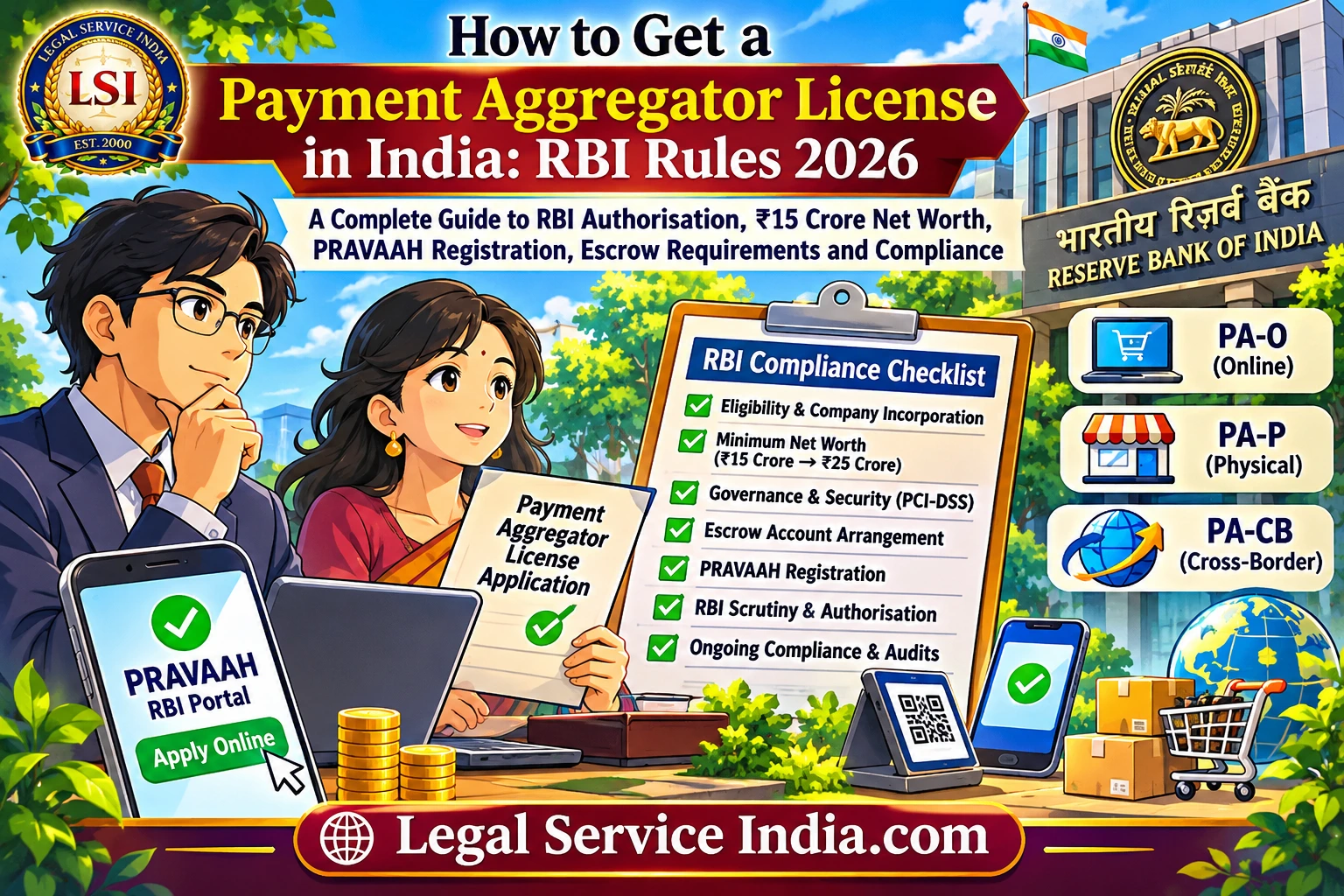
Types of Payment Aggregators Recognised by the RBI
The Directions recognise three kinds of aggregator:
- PA-O (Online): Collects payments for e-commerce and other remote transactions.
- PA-P (Physical): Handles face-to-face payments, such as card or QR acceptance at a store.
- PA-CB (Cross-Border): Facilitates cross-border import or export payments.
Banks do not need a separate PA authorisation because they already operate under RBI’s banking regulation. Pure payment gateways, which only provide technology and never touch merchant funds, sit under a lighter-touch regime. If your platform ever holds or routes funds between buyer and seller, even briefly, assume you are in aggregator territory and confirm it before you launch.
Step-by-Step Process to Get a Payment Aggregator License in India
Step 1: Check Your Eligibility Before Spending on Anything Else
Start with the structural basics, because an application that fails them is simply returned.
Incorporation
A non-bank applicant must be a company incorporated in India under the Companies Act, 2013. Sole proprietorships, LLPs and partnerships do not qualify.
Objects Clause
Your Memorandum of Association should cover payment aggregation as a business activity. If it does not, amend it first.
Professional Management
The Directions expect a PA to be professionally managed, with promoters and directors who clear the RBI’s fit-and-proper tests.
Other Regulators
If you are already regulated by SEBI, IRDAI or another financial-sector regulator, expect to need a no-objection certificate from that regulator. Secondary commentary reports a 45-day window to file with the RBI after receiving it, so confirm the current requirement against the directions before you rely on it.
Step 2: Get the Net Worth Right
This is where most applications stall, because capital takes longer to arrange than paperwork.
| Milestone | Minimum Net Worth |
|---|---|
| At the time of application | ₹15 crore |
| By the end of the 3rd financial year after authorisation | ₹25 crore |
| Afterwards | Maintained on an ongoing basis |
Three practical points:
- The net worth must be certified by your statutory auditor in the RBI’s prescribed format (Annexure 2.1 to the Directions).
- Net worth is computed under the RBI’s computation of net worth norms. Reported commentary indicates that compulsorily convertible preference shares count while deferred tax assets do not, so do not assume your balance sheet number equals the RBI’s number.
- A newly incorporated company without audited accounts can use a certificate based on a provisional balance sheet, but the threshold itself is not relaxed.
If you are short, close the gap with fresh equity before filing. An application that does not meet the minimum is returned rather than held in a queue.
Step 3: Build Your Governance and Technology Foundation
The RBI wants to see that the business is already built to handle other people’s money safely. Before you file, have the following ready:
- A board-approved information security policy, reviewed at least once a year.
- PCI-DSS readiness for any system that processes card data, shown as something in place rather than a roadmap.
- Merchant onboarding and due diligence procedures covering KYC, business-legitimacy checks and ongoing monitoring.
- Data localisation: payment system data must be stored in India.
- Grievance redressal and a dispute-handling process for customers and merchants.
- AML/CFT controls aligned with applicable prevention-of-money-laundering requirements. For background on how enforcement works in this area, see our guide to PMLA rules in India: compliance, penalties and ED powers.
Step 4: Set Up the Escrow Arrangement
Money collected from customers must be kept apart from your own funds. Practically, that means an escrow account with a scheduled commercial bank, backed by an escrow agreement that follows the Directions on permitted credits and debits, settlement timelines and what the account cannot be used for. Reported summaries note that settlement timelines have tightened under the new framework and that escrow accounts cannot be used for cash-on-delivery collections.
Start bank conversations early. The bank runs its own compliance review of your business, and that review often takes longer than founders plan for.
Step 5: Register on PRAVAAH and Prepare the Application
Applications are filed online through PRAVAAH (Platform for Regulatory Application, Validation and Authorisation), the RBI’s portal for licensing and regulatory applications. PRAVAAH is the filing channel; the substantive rules still come from the Directions.
Typical working sequence:
- Create a PRAVAAH account in the company’s name using a monitored corporate email ID, since status updates and queries arrive there.
- Assemble the application form with supporting documents.
- Upload the auditor’s net worth certificate.
- Submit declarations for promoters and directors.
- Attach board resolutions authorising the application.
- Add your information security and governance policies.
- Include a business plan describing the PA category you are applying for (PA-O, PA-P or PA-CB), merchant profile, expected volumes and escrow bank.
The exact document list and forms are in the RBI’s Directions and the portal itself, so treat the list above as a working checklist and verify it against the current form before filing.
Step 6: Prepare for Scrutiny
Once your application is accepted for processing, the RBI examines it. Expect attention on:
- Fit and proper status of promoters and directors: Integrity, financial soundness and absence of disqualifying regulatory or criminal history.
- Source of funds: The source of funds for your net worth.
- Technology and security posture: Including whether your stated controls actually exist.
- Business model clarity: Whether your flow of funds matches what you described.
Respond to RBI queries quickly and consistently. Inconsistencies between your business plan, escrow agreement and technology documentation are a common reason for delay.
Step 7: Receive Authorisation and Meet Ongoing Obligations
Authorisation is the start of compliance, not the end. Reported ongoing requirements include:
- An annual net worth certificate from the statutory auditor, submitted with audited accounts.
- An annual information systems and cybersecurity audit by a CERT-In empanelled auditor.
- Prompt reporting of cybersecurity incidents to the RBI.
- Periodic escrow compliance certifications.
- Reporting any change in promoters, directors or key managerial personnel, with fresh fit-and-proper declarations.
- Reaching ₹25 crore by the end of the third financial year after authorisation, and staying above it.
The RBI’s June 2026 Master Direction on Authorisation to Operate a Payment System also introduced perpetual validity for new payment system authorisations, subject to continued compliance and no supervisory concerns, with a one-year renewal where conditions are not met. It also allows a one-year cooling-off period after revocation, non-renewal, surrender or rejection. How this interacts with the PA-specific Directions has been flagged as an open question in professional commentary, so ask your advisor to confirm how it applies to your authorisation.
Common Mistakes That Delay or Sink Applications
Applicants should pay particular attention to the following mistakes:
- Assuming a payment gateway is not a payment aggregator. What matters is whether you handle merchant funds, not what you call yourself.
- Counting capital that does not qualify toward net worth.
- Filing with policies on paper only. Security and governance need to exist in practice.
- Leaving escrow until last.
- Underestimating fit and proper scrutiny of every promoter and director, including past regulatory history.
- Treating the application as one-off. Annual audits, certificates and change notifications are continuous.
Frequently Asked Questions About Payment Aggregator Licenses in India
Is an RBI Licence Mandatory to Operate as a Payment Aggregator in India?
Yes. A non-bank entity that carries on payment aggregator business needs authorisation from the RBI under the Regulation of Payment Aggregators Directions, 2025. Banks are exempt from separate authorisation.
What Is the Minimum Net Worth for a Payment Aggregator License?
A non-bank applicant needs ₹15 crore at the time of application and must reach ₹25 crore by the end of the third financial year after authorisation, then maintain it on an ongoing basis.
Where Do I Apply for a Payment Aggregator License?
Online through the RBI’s PRAVAAH portal.
Can an LLP or Partnership Firm Apply?
No. A non-bank applicant must be a company incorporated under the Companies Act, 2013.
What Are PA-O, PA-P and PA-CB?
PA-O covers online payments, PA-P covers physical point-of-sale payments, and PA-CB covers cross-border import and export payments.
How Long Does It Take to Get the License?
There is no fixed timeline you should rely on. Duration depends on how complete your application is, how quickly you answer RBI queries, and how long capital and escrow arrangements take. Plan in months, not weeks.
Does a Payment Aggregator Need to Do KYC on Merchants?
Yes. The Directions require merchant due diligence and KYC, and the aggregator remains responsible for the merchants it onboards.
What Happens If I Operate Without Authorisation?
Operating a payment system without authorisation can attract enforcement under the Payment and Settlement Systems Act, 2007. Speak to a lawyer before continuing operations if you are unsure of your status.