





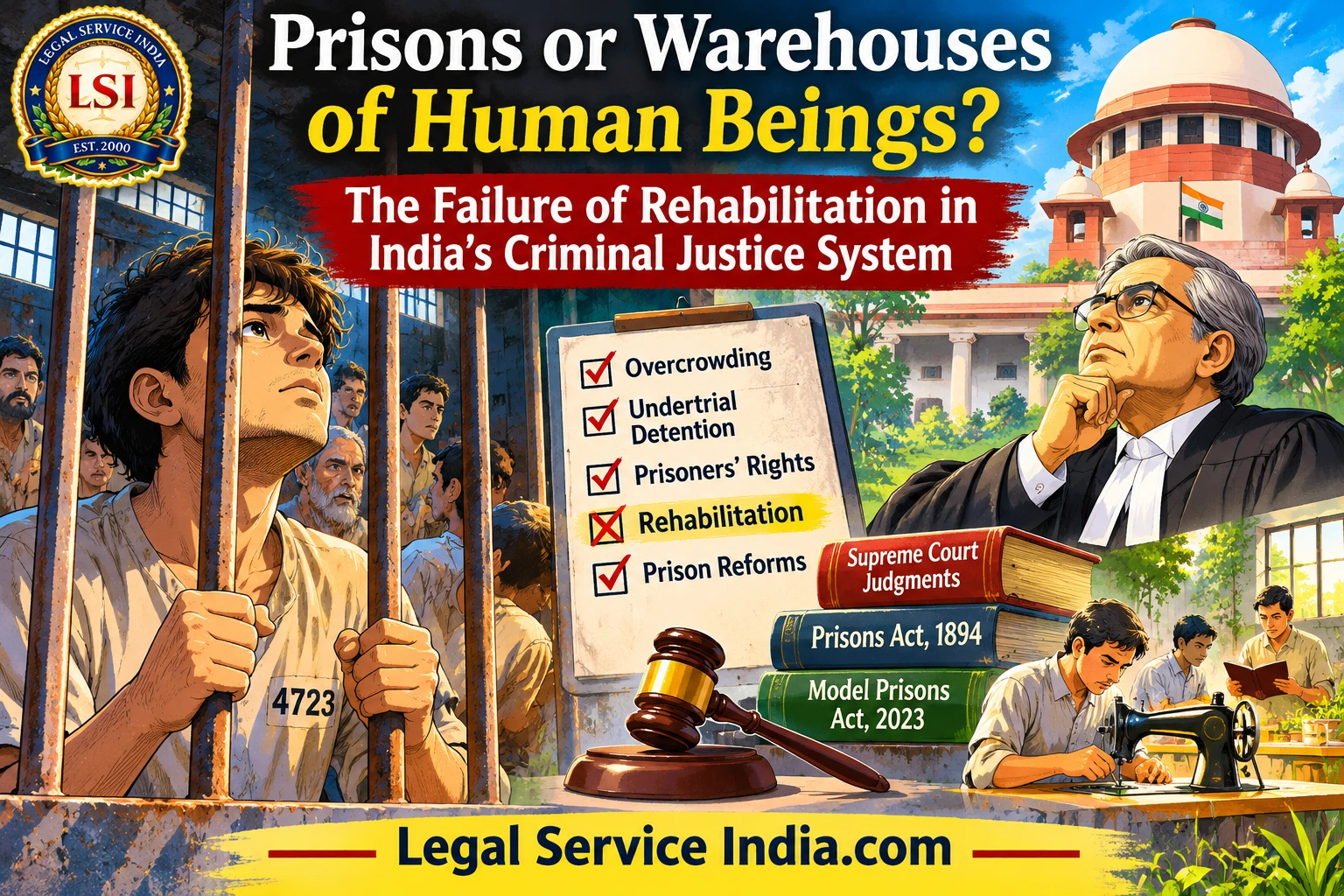
Prisons or Warehouses of Human Beings? The Failure of Rehabilitation in India’s Criminal Justice System
“It is cheaper to hang than to heal.” – Justice V.R. Krishna Iyer [1]
The Godown Test: Are Indian Prisons Designed for Rehabilitation?
A godown has one duty: to make sure what goes in does not go missing. Nobody expects the grain stored there to leave better than it arrived. If the sacks come out the way they went in, the godown has done its job.
Hold an Indian prison against that standard, and a strange thing happens. It passes the godown test only in the narrowest sense, because people do not go missing. But the law expects something a godown never has to deliver. It expects the person who walks out to be less likely to harm anyone than the person who walked in. That is what rehabilitation means, and it is the one thing the system is not organised to produce.
India’s Prison Overcrowding: The Numbers Behind the Crisis
On the last day of 2022, 573,220 people were inside 1,330 prisons built to hold 436,266. That is an occupancy of 131.4 per cent. [2] A railway compartment at that level of crowding would make the evening news. Inside a prison, it is a statistic that arrives two years late.
This article argues that the failure of rehabilitation in India is not an accident of poor management. It is built into how the system is funded, staffed, litigated and ignored. The law is not short of good intentions. What is missing is any institution that is obliged, and equipped, to turn those intentions into daily practice.
A Promise Written Before the Bricks Were Laid: The Legal Foundation of Prison Rehabilitation
The Supreme Court has been unusually clear about what a prison sentence is for. In Mohammad Giasuddin, Justice Krishna Iyer treated reformation as the purpose that should shape sentencing, not a pleasant afterthought. [3] A year later, Sunil Batra rejected the old “hands-off” doctrine under which courts looked away from what happened behind prison walls. Fundamental rights, the Court said, do not flee a person on entering prison, though they may shrink under the needs of confinement. [4] In Charles Sobraj, Justice Krishna Iyer put it more bluntly: imprisonment does not spell a farewell to fundamental rights. [5]
Supreme Court Judgements on Prisoners’ Rights and Rehabilitation
Batra’s second case added that the loss of freedom is meant to serve a social good and that the Court has a continuing duty to see that prison administration does not defeat that purpose. [6] In T.K. Gopal, the Court asked for a therapeutic approach, reminding the State that a prisoner is still entitled to human dignity and sympathy. [7] In Sheela Barse, the Court insisted that children do not belong in jails at all. [8]
The Prisons Act of 1894: A Colonial Law Without Rehabilitation Provisions
Notice the dates. Most of this was said between 1978 and 2000. Now notice the statute that governs how most prisons actually run. It is the Prisons Act of 1894, which the Ministry of Home Affairs itself has admitted focuses on custody and discipline and has no provision for reform or rehabilitation. [9]
Think of a tenant who has been handed a glossy agreement promising modern facilities, while the landlord continues to run the building under rules written for a colonial barracks. The agreement is real. It is simply not what governs the lift, the water or the lock on the gate. That is the gap between the Supreme Court’s prison jurisprudence and the Indian prison.
Three Out of Four Have Not Been Convicted
Before asking how well prisons rehabilitate convicts, we should ask who is actually inside. At the end of 2022, undertrials made up about 75.8 per cent of the prison population. [10] Later figures show only a modest dip, to about 73 per cent in 2024, with occupancy at 112.7 per cent. [11] Roughly two in three undertrials belong to the Scheduled Castes, Scheduled Tribes or Other Backward Classes. [12]
This changes the whole conversation. Rehabilitation is a concept designed for people who have been found guilty. For the majority who have not, the prison is not correcting anything. It is simply holding them, often for years, in conditions that would be hard to defend even for the guilty.
This is not a new discovery. In Hussainara Khatoon in 1979, the Court was told of undertrials in Bihar who had spent longer in jail than the maximum sentence for the offences they were accused of. That case gave India the right to a speedy trial under Article 21 and the idea that free legal aid is part of a fair procedure. [13] Forty-seven years later the numbers have grown, and the same class of person is waiting.
Consider what happens to an institution when most of its residents are temporary. Think of a railway waiting room. Nobody paints it, nobody teaches in it, and nobody improves it, because everyone in it is assumed to be leaving soon. The trains, in this case trials, simply do not come on time. Prison workshops, classrooms and counselling are planned, if at all, for a stable population of convicts. A population in constant, indefinite transit receives neither.
The law has already provided a way out. Section 436A of the Code of Criminal Procedure provides for the release of undertrials who have spent half the maximum sentence in custody, and Section 479 of the Bharatiya Nagarik Suraksha Sanhita improves on it, with one-third for first-time offenders, in cases not punishable with death or life imprisonment. [14] A statute that allows release is only as good as the lawyer, the jail official and the magistrate who put it to use.
A Hospital Without Doctors
Rehabilitation is not a policy that can be declared. It is labour. It needs teachers, counsellors, trainers, doctors and officers who know the people in their charge. The India Justice Report 2025 shows how thin that workforce is.
About 30 per cent of sanctioned prison posts were vacant in 2022. The Model Prison Manual suggests one doctor for every 300 inmates, but the national average is one for 775. For mental health, the report counts 25 psychologists and psychiatrists serving about 5.7 lakh prisoners, which works out to one for every 22,929 people. [15] Prisoner suicides in 2022 ran at 20.8 per lakh, about two-thirds higher than the rate in the general population. [16]
The money tells the same story. India spends on average Rs 121 per prisoner per day, but Andhra Pradesh spends Rs 733 and Maharashtra Rs 47. [15] A prisoner’s chance of receiving anything beyond bare custody is, in effect, an accident of geography.
Picture a school where one teacher is assigned to every few hundred students. You can enrol the children, mark attendance and issue a timetable. Nobody would call it education. In the same way, NCRB’s own welfare tables record fewer than 60,000 prisoners in vocational courses in 2023, against more than 5.3 lakh inmates, barely one in nine. [17] Whatever else this is, it is not a rehabilitation system. It is a custody system with a few rehabilitation programmes attached to it.
Forty Years of Reports, Forty Years of Shelving
If the problem were ignorance, it would have been solved long ago. The Mulla Committee examined Indian prisons between 1980 and 1983 and recommended, among other things, better living conditions, trained and organised prison staff, and an all-India prison and correctional service. [18] By 2003, the Ministry of Home Affairs had commissioned a separate volume simply to track what had been done about those recommendations. [19]
In 1997, Rama Murthy v. State of Karnataka named nine pressing problems: overcrowding, delay in trial, torture and ill-treatment, neglect of health and hygiene, poor food and clothing, prison vices, weak communication, irregular jail visits and open prisons. [20] Between them, those nine items could have served as a work plan. In 2016, in the case now known as In Re: Inhuman Conditions in 1382 Prisons, Justice Madan Lokur repeated the list and observed that the country was still struggling with at least some of those problems. [21]
The same story continued. In 2024 the Court had to pull up States for failing to file affidavits about jail infrastructure. [22] In 2026, in Suhas Chakma v. Union of India, the Court described the response of several States on open prisons as marked by “rank apathy and indifference”. [23]
Anyone who lives in an apartment complex knows this pattern. Every monsoon the terrace leaks. A committee is formed, a report is prepared, a contractor is invited, and by the next monsoon the same stain is back on the same ceiling. The reason is simple. A report is not a repair, and no one’s job depends on whether the stain returns.
The Model Prisons Act, 2023, may finally fill the gap left by the 1894 Act, with provisions on individual sentence plans, grievance redress and separate accommodation for women, transgender persons and persons with disabilities. But prisons are a state subject under Entry 4 of List II, and the Model Act is only a model. [24] It guides. It cannot compel. Even the Court’s attempts at compulsion, such as its 2016 directions on Undertrial Review Committees and legal aid, depend on thirty-six governments choosing to comply.
When the Wall Also Keeps Caste
Perhaps the clearest evidence that rehabilitation has been neglected is what Indian prison manuals themselves have said about who should do what work.
In Sukanya Shantha v. Union of India, decided on 3 October 2024, a bench led by Chief Justice Chandrachud examined provisions in the prison manuals of several States that assigned cleaning and sweeping to marginalised castes, allowed cooking for others, and labelled members of denotified tribes as “habitual offenders”. The Court held these practices unconstitutional under Articles 14, 15, 17, 21 and 23. [25]
The judgement is important, but the detail that matters for this article is simpler. Rehabilitation rests on one belief: that a person can change. A manual that decides what a prisoner may do, where he may sleep and what he is presumed to be on the basis of his caste has already decided that he cannot. The institution was never neutral between reform and stigma. It had chosen stigma in writing.
Even the correction has been slow. By January 2025 the Court was still waiting for compliance reports from many States and Union Territories.[26] The Court continues to monitor the matter on its own motion.[27]
The Door That Opens Outward
Every prison is a temporary arrangement. In 2019 alone, over 1.8 lakh convicts were released from Indian prisons.[28] The honest test of the system is therefore not what happens inside the gate. It is what happens on the other side.
Official figures put recorded recidivism at 1.9 per cent in 2022.[29] This looks reassuring, but it deserves a question: how is it measured, and who follows a released person for years after the gate closes? A figure is only as trustworthy as the system that collects it.
What is more visible is the exit itself. A person who leaves prison carries a record, and often little else: no certified skill, no savings, no employer waiting. The job market treats a prison background as a risk. Think of being discharged from a hospital without a discharge summary, medicine or a follow-up appointment. Nobody would blame the patient for coming back sicker.
“But What About the Victim?”
A serious critique has to meet the strongest objection. A victim of crime does not feel the prison’s failure as a policy problem. Society has a legitimate interest in punishment, in condemnation and in keeping dangerous people away from others. Nothing here argues for leniency towards serious offenders.
The answer lies in what the system actually does. First, incapacitation is temporary. With rare exceptions, everyone inside will one day be outside. Second, as seen above, most of the people held are undertrials, so the language of toughness describes a population that is not really there. Third, a prison that returns embittered, untrained and unemployable people to the same street is not protecting the next victim. It is creating one, and billing the future for it.
The case for rehabilitation, then, is also the case for safety. The Court said as much when it opened Suhas Chakma with Nelson Mandela’s reminder that a nation is judged by how it treats its lowest citizens, not its highest.[30]
What Honest Reform Would Look Like
None of what follows is exotic. All of it is already in a judgment, a statute or a committee report.
1. Stop Filling Prisons With People Who Should Not Be There
Sections 436A CrPC and 479 BNSS should operate by default, not by petition. Justice Krishna Iyer’s old question, bail or jail, remains the right one, along with his reminder that sympathy, not sternness, is the judicial response to poverty.[31]
2. Staff for Reform, Not Just for Security
Treat counsellors, teachers, psychologists and doctors as a constitutional minimum, and publish vacancies State by State.
3. Make Open Prisons the Norm for Those Who Qualify
The Court has told States to expand them and directed every High Court to monitor compliance through continuing mandamus.[32] That direction should be used as the pressure point it is meant to be.
4. Write Individual Sentence Plans Into State Law
The Model Prisons Act contemplates them. Without a statute in each State, the plan remains a good idea.
5. Fund After-Care and Rehabilitation
Link release to District Legal Services Authorities, certified skills and a real first job, not just a gate pass.
6. Open the Walls Through Independent Inspection
Independent inspection and visitors’ boards were recommended in 1983. The Court observed long ago that prisoners are invisible and their voices inaudible.[33] The fix is to make them audible.
The Mirror Behind the Wall
A godown does not hold grudges. Grain does not vote, remember or return. People do all three.
That is the real difficulty with treating prisons as warehouses. The goods we store come back, and what they carry with them is whatever the storage did to them. Every sentence in India ends at a gate, and that gate opens onto a lane, a village or a locality where someone will meet this person again.
So the question in the title is not rhetorical. A prison is either a place where the State takes responsibility for what happens to a person it has taken from society, or it is a warehouse that postpones the problem and increases it. The judgments have already chosen the first answer. The budgets, the vacancies and the waiting rooms have chosen the second.
A country is entitled to ask what it expects of its prisons. It is not entitled to be surprised by the answer it gets.
Notes and Legal References
- Rajendra Prasad v. State of Uttar Pradesh, (1979) 3 SCC 646.
- National Crime Records Bureau, “Prison Statistics India 2022” (Ministry of Home Affairs, Government of India, 2023); Udit Singh, “Prison Statistics India 2022: Above 75% Prisoners Are Under Trials”, LiveLaw, Dec. 7, 2023.
- Mohammad Giasuddin v. State of Andhra Pradesh, (1978) 1 SCR 153.
- Sunil Batra v. Delhi Administration, AIR 1978 SC 1675.
- Charles Sobraj v. Superintendent, Central Jail, Tihar, AIR 1978 SC 1514.
- Sunil Batra v. Delhi Administration (II), (1980) 3 SCC 488.
- T.K. Gopal v. State of Karnataka, (2000) 6 SCC 168.
- Sheela Barse v. Union of India, (1986) 3 SCC 596.
- Ministry of Home Affairs, “Model Prisons Act, 2023”, available at: www.drishtiias.com (last visited on Nov 2, 2026).
- National Crime Records Bureau, “Prison Statistics India 2022” (2022).
- National Crime Records Bureau, “Prison Statistics India 2023 and 2024” (2024); “India’s prisons reach 112.7 pc occupancy in 2024”, ThePrint (PTI), Aug 5, 2026.
- Shreehari Paliath, “Half a Million Indians behind Bars, 74% Still Awaiting Trial”, IndiaSpend, 14 Oct. 14, 2025.
- Hussainara Khatoon v. Home Secretary, State of Bihar, AIR 1979 SC 1369.
- The Bharatiya Nagarik Suraksha Sanhita, 2023, s. 479.
- “Undertrial prisoners form 76% of the prison population”, The News Minute, 2025.
- “Prison Statistics India 2022”, available at: Scroll.in (last visited on Nov 2, 2026).
- National Crime Records Bureau, “Rehabilitation and Welfare of Prisoners tables” (2023).
- Government of India Press, “Report of the All India Committee on Jail Reforms 1980-83” (1983).
- Bureau of Police Research and Development, “Implementation of the Recommendations of the All-India Committee on Jail Reforms (1980-83)” Vol. I (Ministry of Home Affairs, 2003).
- Rama Murthy v. State of Karnataka, (1997) 2 SCC 642.
- Re: Inhuman Conditions in 1382 Prisons, (2016) 1 SCR 1090.
- “Inhuman Conditions in Prisons: Supreme Court Issues Directions to States/UTs”, LiveLaw, July 11, 2024.
- Suhas Chakma v. Union of India, 2026 INSC 198, W.P. (C) No. 1082 of 2020.
- The Constitution of India, Seventh Schedule, List II, Entry 4.
- Sukanya Shantha v. Union of India, 2024 INSC 753.
- “India Supreme Court Grants Opportunity for States and Union Territories to Enforce Directives on Caste Discrimination in Prisons”, JURIST, Jan., 2025.
- In re: Discrimination inside Prisons in India, SMW (C) No. 10 of 2024.
- National Crime Records Bureau, “Prison Statistics India 2019” (2019).
- National Crime Records Bureau, “Prison Statistics India 2022 (recidivism data)”, available at: LiveLaw (last visited on Nov 3, 2026).
- Suhas Chakma v. Union of India, 2026 INSC 198.
- Gudikanti Narasimhulu v. Public Prosecutor, (1978) 2 SCR 371.
- Suhas Chakma v. Union of India, 2026 INSC 198.
- Sunil Batra v. Delhi Administration, (1978) 4 SCC 494.
Bibliography
- Government of India, “Report of the All India Committee on Jail Reforms (1980-83)” (Government of India Press, 1983).
- National Crime Records Bureau, “Prison Statistics India” (2019, 2022, 2023, 2024).
- India Justice Report 2025.
- The Constitution of India.
- Code of Criminal Procedure, 1973.
- Bharatiya Nagarik Suraksha Sanhita, 2023.
- Prisons Act, 1894.

