





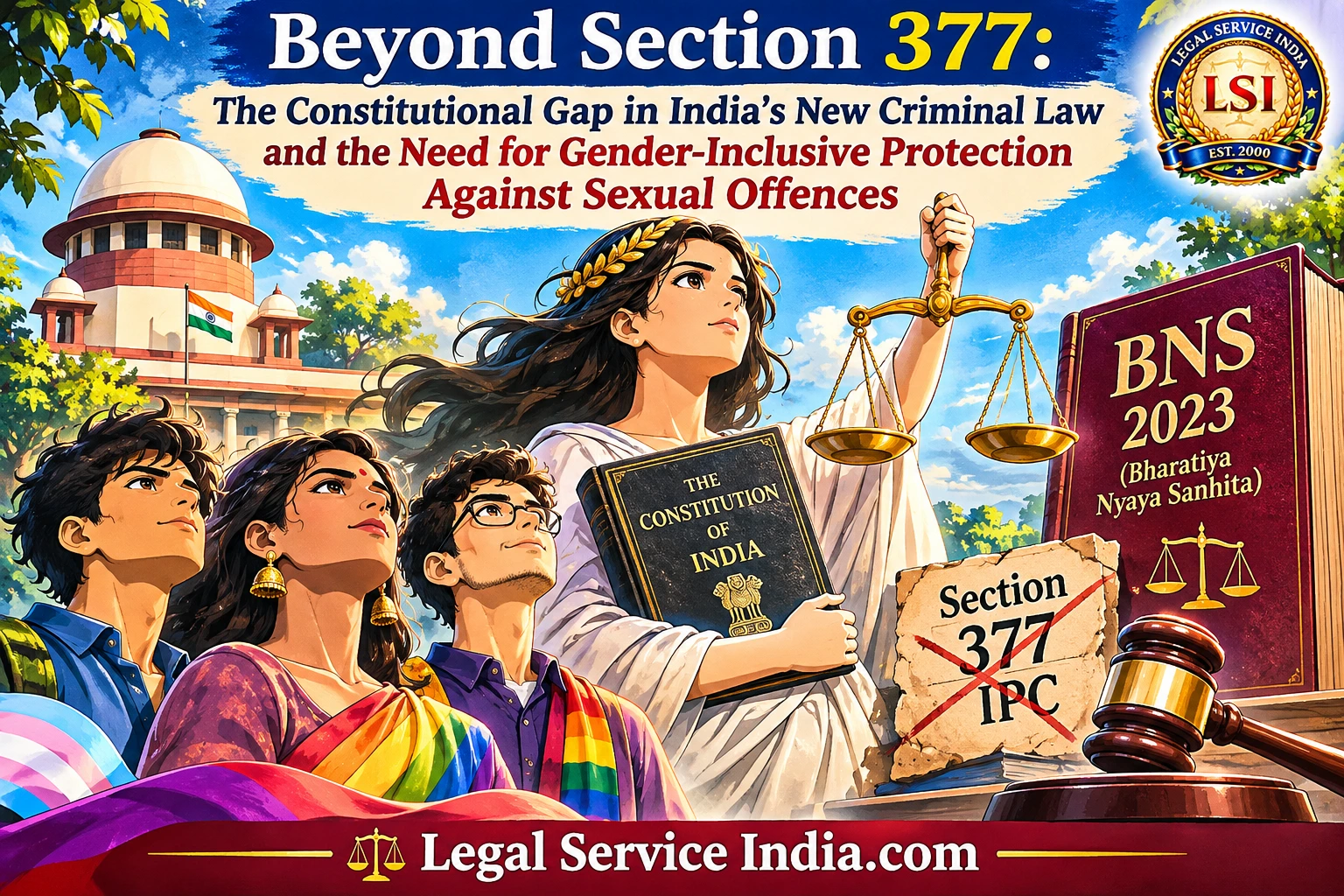
Beyond Section 377: The Constitutional Gap in India’s New Criminal Law and the Need for Gender-Inclusive Protection Against Sexual Offences
1. Introduction
The enactment of the Bharatiya Nyaya Sanhita, 2023 (BNS), replacing the Indian Penal Code, 1860 (IPC), marked a significant transformation in India’s criminal justice system. However, every legislative reform must be examined not only by what it introduces but also by what it leaves behind.
One such important issue concerns the omission of Section 377 of the IPC from the BNS.
The issue has once again attracted judicial attention following a Public Interest Litigation (PIL) before the Delhi High Court seeking gender-neutral protection against sexual offences, particularly for men and transgender persons.
The central constitutional question is straightforward but significant:
Can a criminal justice system claim to provide equal protection of law when the legal framework does not expressly recognise certain categories of individuals as victims of specific sexual offences?
The question deserves serious consideration because the protection of personal dignity, bodily autonomy and individual liberty is not dependent upon a person’s gender or sexual identity.
In my opinion, the objective of criminal law should be to protect every individual against non-consensual sexual acts while simultaneously respecting the constitutional freedom of adults to engage in consensual private relationships.
2. Background: What Happened to Section 377 IPC?
Section 377 of the Indian Penal Code criminalised certain carnal intercourse described as being against the order of nature, irrespective of whether the other person was a man, woman or animal.
However, the constitutional validity of this provision was substantially reconsidered by the Supreme Court in 2018.
Navtej Singh Johar v. Union of India (2018)
In Navtej Singh Johar v. Union of India, (2018) 10 SCC 1, the Supreme Court read down Section 377 and held that consensual sexual relations between adults in private could not be criminalised merely on the basis of their sexual orientation or the nature of their consensual relationship.
Importantly, the judgement did not decriminalise non-consensual sexual acts or sexual acts involving minors or animals.
Consequently, the provision continued to have a limited field of operation even after the 2018 judgement.
However, when the BNS came into force on 1 July 2024, Section 377 was not retained in the new legislation.
This omission has raised an important question: whether the new criminal law provides adequate and specific protection against non-consensual sexual acts committed against persons who do not fall within the gender-specific framework of certain existing sexual offences.
The issue is therefore not simply about restoring an old provision. It is about ensuring that the constitutional protection against sexual violence remains effective under the new criminal justice framework.
3. The Delhi High Court PIL: A Significant Legal Development
In August 2026, the Delhi High Court considered a public interest litigation filed by advocates Shubhi Srivastava and others, seeking gender-neutral protection under the sexual-offence provisions of the BNS.
The petition raised concerns regarding the absence of adequate specific criminal provisions dealing with certain non-consensual sexual acts committed against men, transgender persons and other individuals.
The petitioners questioned whether the existing statutory framework sufficiently protects persons who may become victims of sexual violence but do not fall within the traditional gender-specific definition of rape.
The matter was heard by a division bench comprising Chief Justice Devendra Kumar Upadhyaya and Justice Tejas Karia.
The Court’s Observations on 12 August 2026
During the hearing on 12 August 2026, the Court observed, in substance, that the creation of a criminal offence falls within the domain of legislative policy and that courts cannot independently create an offence which has not been enacted by the legislature.
The Court also indicated that the matter could be considered along with similar pending petitions.
This observation is significant because it identifies the constitutional boundary between judicial review and legislative power.
It is important to clarify that the Court’s observation was not a final declaration that the entire BNS is unconstitutional. Rather, it concerned the limits of judicial authority in creating criminal offences.
The PIL was reported as listed for further consideration on 7 October 2026. The subsequent final procedural status should be verified from the latest court order before publication.
4. Understanding the Legal Gap Under the BNS
Chapter V of the Bharatiya Nyaya Sanhita, 2023 deals with offences against women and children.
Section 63 defines rape through a framework in which the perpetrator is a man and the victim is a woman.
Section 64 prescribes punishment for rape.
Several other provisions concerning sexual offences also operate within gender-specific statutory frameworks.
Who May Be Affected by the Legal Gap?
The difficulty arises when a person who is not covered by the relevant statutory definition becomes a victim of a non-consensual sexual act.
For example:
- A man subjected to a forced sexual act by another man.
- A transgender person subjected to non-consensual sexual violence.
- A person subjected to a sexual act involving penetration or other prohibited sexual conduct that does not fall within the existing statutory definition of rape.
The question is whether the existing provisions adequately recognise these acts as specific sexual offences and provide proportionate punishment.
It would, however, be legally incorrect to suggest that every such act is necessarily outside the entire criminal law. Depending on the facts, provisions concerning hurt, grievous hurt, wrongful confinement, assault, intimidation or other offences may apply.
The real concern is the absence of a comprehensive and clearly defined offence specifically addressing the nature of such sexual violence.
A person subjected to sexual violence should not have to depend entirely upon general provisions dealing with bodily injury when the actual nature of the wrong is sexual in character.
5. Constitutional Analysis
A. Article 14: Equality Before Law and Equal Protection of Laws
Article 14 guarantees equality before the law and equal protection of the laws to every person within the territory of India.
The expression ‘every person’ is significant. Constitutional protection is not restricted to citizens alone or to any particular gender.
The principle of equality requires the State to avoid arbitrary discrimination and to ensure that similarly situated persons receive equal legal protection.
In the present context, a legitimate constitutional question arises:
If two individuals suffer comparable non-consensual sexual violations, should the availability of an effective criminal remedy depend merely upon the gender of the victim?
In my considered opinion, the nature of the violation, the absence of consent and the harm caused should be central considerations in determining criminal liability.
This does not mean that every sexual offence must have identical ingredients or punishment. Different offences may require different classifications based on the nature of the conduct and the vulnerability of the victim.
However, any such classification must satisfy the constitutional test of reasonable classification and must have a rational connection with the object of the legislation.
A statutory framework that leaves a category of victims without adequate protection requires careful legislative examination under Article 14.
B. Article 15: Prohibition of Discrimination
Article 15 prohibits discrimination on specified grounds, including sex.
The constitutional understanding of sex discrimination cannot be confined to narrow biological classifications.
In National Legal Services Authority v. Union of India, (2014) 5 SCC 438, the Supreme Court recognised the constitutional rights and gender identity of transgender persons.
The judgement affirmed that gender identity is an essential aspect of individual dignity and constitutional protection.
Therefore, the legislative framework dealing with sexual offences must be examined in the light of the constitutional recognition of transgender identity.
At the same time, Article 15(3) permits special provisions for women and children.
Accordingly, gender-inclusive protection for other victims does not require the removal of special legal protections available to women and children.
The constitutional objective should be inclusion without weakening existing protections.
C. Article 21: Right to Life, Dignity and Bodily Autonomy
Article 21 is perhaps the most important constitutional provision in this discussion.
The right to life is not merely a guarantee of physical existence. It includes the right to live with dignity, privacy, bodily autonomy and personal liberty.
Sexual violence directly affects the dignity and bodily autonomy of an individual.
The State has a constitutional responsibility to establish an effective legal framework that protects individuals against serious violations of bodily integrity.
In Justice K.S. Puttaswamy (Retd.) v. Union of India, (2017) 10 SCC 1, the Supreme Court recognised privacy as a fundamental right and discussed the importance of autonomy, dignity and individual choice.
The principle of bodily autonomy necessarily includes the right to refuse unwanted sexual contact.
Therefore, the absence of a sufficiently comprehensive criminal-law framework for certain categories of sexual violence raises a legitimate question concerning the effectiveness of the State’s obligation to protect life and dignity under Article 21.
D. Article 20(1): Protection Against Retrospective Criminal Liability
Any proposed legislative solution must also respect Article 20(1) of the Constitution.
No person can be convicted for an act which was not an offence under the law in force when the act was committed, nor can a greater penalty be imposed retrospectively.
Therefore, Parliament may enact a new gender-inclusive sexual offence, but such a provision must operate prospectively in accordance with constitutional requirements.
The protection of victims cannot justify violating the fundamental rights of accused persons.
Constitutional criminal justice must protect both the victim and the accused within the framework of law.
6. Important Supreme Court Judgments
The constitutional debate surrounding Section 377 and gender-inclusive protection must be understood through the following judicial precedents.
| No. | Supreme Court Judgment | Citation |
|---|---|---|
| 1 | Navtej Singh Johar v. Union of India | (2018) 10 SCC 1 |
| 2 | National Legal Services Authority v. Union of India | (2014) 5 SCC 438 |
| 3 | Justice K.S. Puttaswamy (Retd.) v. Union of India | (2017) 10 SCC 1 |
| 4 | Independent Thought v. Union of India | (2017) 10 SCC 800 |
| 5 | Sakshi v. Union of India | (2004) 5 SCC 518 |
1. Navtej Singh Johar v. Union of India (2018) 10 SCC 1
The Supreme Court held that consensual sexual relations between adults in private cannot be criminalised merely because they do not conform to traditional notions of sexuality.
The judgment recognised dignity, privacy, equality and individual autonomy as essential constitutional values.
Its importance in the present discussion is that the protection against non-consensual sexual acts must be separated from the criminalisation of consensual adult relationships.
2. National Legal Services Authority v. Union of India (2014) 5 SCC 438
The Supreme Court recognised the right of transgender persons to self-identify their gender and affirmed their constitutional protection under fundamental rights.
This judgment provides an important constitutional foundation for ensuring that transgender individuals are not excluded from the protection of criminal law.
3. Justice K.S. Puttaswamy (Retd.) v. Union of India (2017) 10 SCC 1
The Supreme Court recognised privacy as a fundamental right under Article 21 and connected privacy with dignity, autonomy and individual liberty.
The decision is relevant to the principle that every individual has the right to make personal choices concerning their body and private life, subject to constitutionally valid restrictions.
4. Independent Thought v. Union of India (2017) 10 SCC 800
The Supreme Court examined the protection of minor girls against sexual exploitation and interpreted criminal law in a manner consistent with constitutional guarantees and child protection.
The judgment demonstrates that the protection of vulnerable persons must remain a central consideration in the interpretation and development of criminal law.
5. Sakshi v. Union of India (2004) 5 SCC 518
The Supreme Court considered issues concerning sexual violence and the interpretation of rape under the then-existing criminal law.
The judgment is relevant to the broader discussion on the interpretation and development of legal protections against sexual abuse.
These judgments collectively establish that dignity, equality, autonomy and protection against sexual exploitation are fundamental considerations in India’s constitutional framework.
7. The Role and Limitations of the Judiciary
One of the most important aspects of the Delhi High Court proceedings is the question of institutional responsibility.
The judiciary is the guardian of constitutional rights. It has the authority to examine the constitutional validity of legislation, interpret statutory provisions and grant appropriate relief where a legal right has been violated.
However, the power to define a new criminal offence and prescribe its essential ingredients and punishment primarily belongs to the legislature.
This distinction is particularly important in criminal law.
Article 20(1) reinforces the requirement that criminal liability must be based on law.
A court cannot simply insert a completely new offence into a statute and prescribe punishment for conduct that Parliament has not criminalised.
The observation of the Delhi High Court regarding legislative responsibility must therefore be understood in this constitutional context.
Nevertheless, judicial restraint does not mean judicial silence.
Where a statutory omission raises serious constitutional concerns, courts can examine the validity of the relevant legal framework, interpret existing provisions within permissible limits and issue appropriate directions within their constitutional jurisdiction.
The final responsibility for creating a comprehensive penal framework, however, rests with Parliament.
8. My Legal Opinion: What Should Parliament Do?
In my considered opinion, the omission of Section 377 from the BNS should be addressed through a carefully drafted legislative amendment.
However, the solution should not be a simple restoration of the old Section 377 in its original form.
The Supreme Court has already established that consensual adult relationships are protected by constitutional guarantees.
Any new provision must preserve that constitutional position.
I believe that the following legislative measures deserve serious consideration:
First: Introduce a Gender-Inclusive Sexual Offence Provision
The law should expressly recognise non-consensual sexual acts committed against persons irrespective of their gender identity.
Second: Define the Offence with Clarity
The legislature should clearly specify the prohibited conduct, the essential ingredients of the offence, the requirement of consent and the applicable exceptions.
Vague expressions such as ‘against the order of nature’ should not be used as a substitute for precise statutory language.
Third: Prescribe Proportionate Punishment
Punishment should reflect the seriousness of the offence, the nature of the conduct, the degree of harm and the circumstances of the victim.
Fourth: Preserve Existing Protections for Women and Children
Gender-inclusive criminal law should not become a reason to dilute the special protections already available to women and children.
Fifth: Recognise the Specific Vulnerabilities of Transgender Persons
Legislation should address discrimination, sexual exploitation, custodial abuse and barriers to reporting offences.
Sixth: Strengthen Procedural and Evidentiary Safeguards
The criminal justice system must ensure appropriate medical assistance, sensitive investigation, confidentiality and protection against secondary victimisation.
A legal amendment will be meaningful only when victims can actually access justice through police stations, hospitals, prosecution agencies and courts.
9. A Necessary Distinction: Gender-Neutral Law Does Not Mean Gender-Blind Law
An important concern in this debate is that making every sexual offence gender-neutral may not, by itself, resolve all issues of gender-based violence.
Women, men and transgender persons may experience sexual violence in different social and institutional circumstances.
A uniform statutory framework must therefore recognise different vulnerabilities without creating unjustified exclusions.
In my view, the objective should be a gender-inclusive criminal justice system rather than a system that ignores gender-specific realities.
The law must recognise both equality and the need for appropriate protective measures.
Constitutional equality does not always require identical treatment. It requires fair, reasonable and non-arbitrary treatment.
10. Conclusion: Justice Must Not Depend Upon the Gender of the Victim
The debate surrounding the omission of Section 377 from the Bharatiya Nyaya Sanhita raises a fundamental question about the future of India’s criminal justice system.
The Constitution guarantees equality, dignity, privacy and personal liberty to every individual.
These guarantees cannot become ineffective merely because a person does not fall within a particular statutory definition.
At the same time, constitutional freedom requires that consensual adult relationships must remain protected from unnecessary criminalisation.
The challenge before Parliament is therefore to maintain a careful balance between two essential constitutional objectives:
- Protecting every individual against non-consensual sexual violence.
- Preserving the freedom and dignity of adults to make consensual personal choices.
The Delhi High Court’s observation that the creation of criminal offences is a legislative responsibility highlights the need for Parliament to examine this issue seriously.
In my opinion, criminal law should neither be influenced by social stereotypes nor restricted by traditional assumptions about who can be a victim of sexual violence.
A person’s dignity does not depend upon gender. Similarly, the seriousness of sexual violence does not diminish because its victim is a man or a transgender person.
Justice must be determined by the nature of the violation, not by the gender of the victim.
The ultimate objective of criminal justice should be simple: no person should be left without meaningful legal protection merely because the existing law has failed to recognise their circumstances.
The Constitution promises equality to every person. It is the responsibility of the legislature to ensure that this promise is reflected in every meaningful provision of criminal law.
Written By: Advocate Suraj Nihal
Legal Research | Constitutional Law | Criminal Justice System
This article represents the author’s independent legal opinion based on constitutional principles, statutory provisions and reported judicial observations. The views expressed herein are those of the author and should not be construed as the final findings of any court.
Disclaimer: This article is intended for legal awareness, academic discussion and professional commentary. It does not constitute legal advice in any individual case.

