




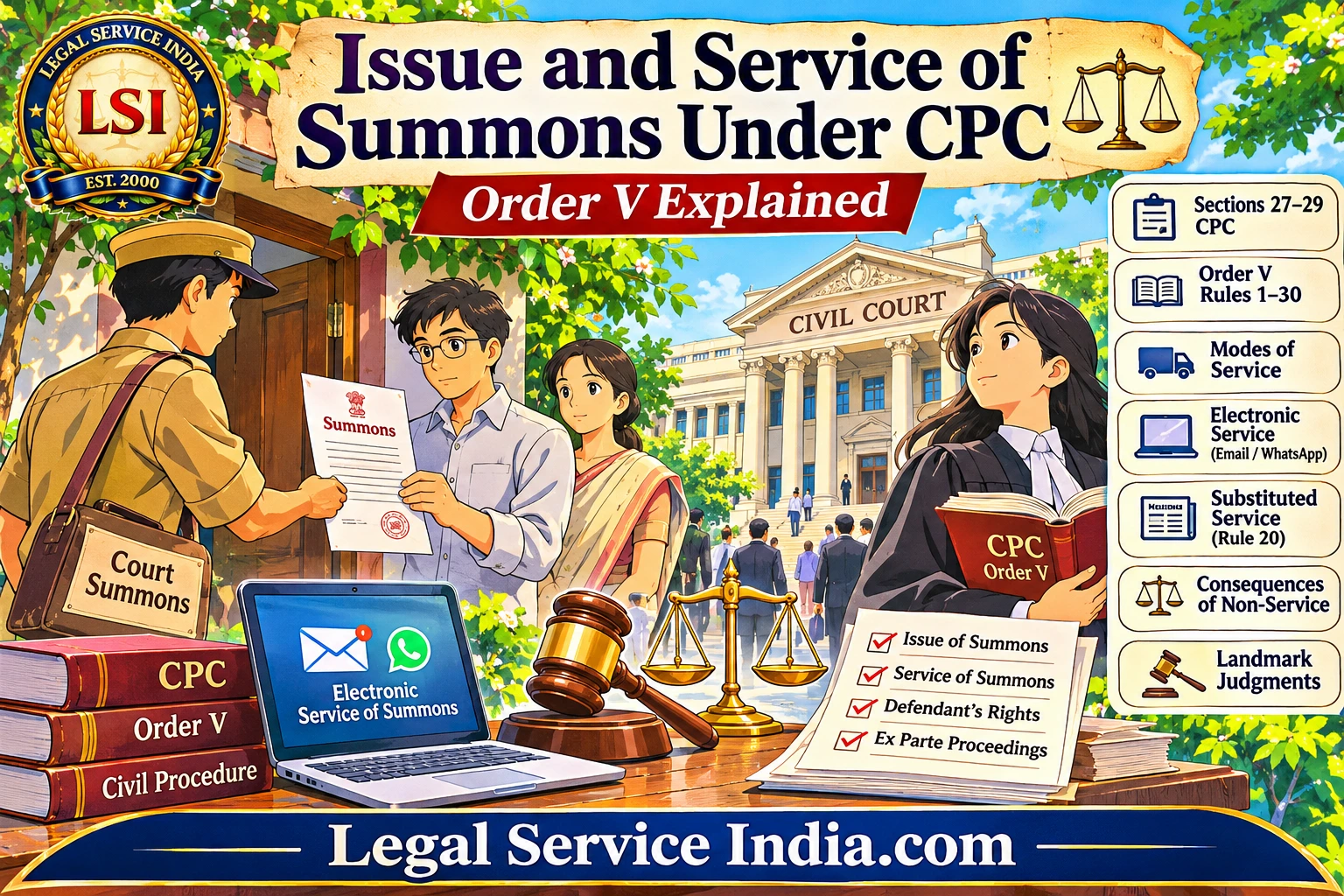
Issue and Service of Summons Under the Code of Civil Procedure, 1908
A summons is an official notice issued by a civil court requiring a person to appear before it or to produce a document. It is a foundational step in civil proceedings because it informs the defendant that a suit has been instituted against him and affords him a fair opportunity to defend himself.
The issue and service of summons are principally governed by Sections 27 to 29 and Order V, Rules 1 to 30 of the Code of Civil Procedure, 1908 (CPC). The underlying principle is audi alteram partem—no person should be condemned unheard—a cardinal rule of natural justice.
Meaning and Purpose of Summons
A summons is a written order of the court directing a person to appear before it on a specified date. Its principal purposes are:
- To inform the defendant of the institution of the suit;
- To furnish the defendant with a copy of the plaint;
- To afford the defendant an opportunity to appear and contest the claim;
- To require production of documents, where necessary; and
- To secure compliance with the principles of natural justice.
Statutory Provisions: Sections 27 to 29 CPC
Section 27 – Summons to Defendants
Where a suit has been duly instituted, a summons may be issued to the defendant to appear and answer the claim. The summons is to be served in the prescribed manner on a day not beyond thirty days from the date of institution of the suit. This outer limit is treated as directory so as to prevent injustice arising from practical difficulties in service.
Section 28 – Service in Another State
Where the defendant resides in another State, the summons may be sent for service to a court in that State. The receiving court serves it in accordance with its own procedure and returns the report of service.
Section 29 – Service of Foreign Summons
This section provides for the service in India of summons issued by certain foreign courts (including courts established under the authority of the Central Government outside India and other courts notified under the section).
Issue of Summons: Order V, Rules 1–8
Rule 1 – Issue of Summons and Written Statement
When a suit has been duly instituted, a summons may be issued to the defendant to appear and answer the claim and to file a written statement.
Ordinarily, the written statement must be filed within thirty days of service of summons. The court may, for reasons to be recorded, extend the time, but not beyond ninety days from the date of service (Order VIII Rule 1). In commercial disputes of specified value governed by the Commercial Courts Act, 2015, the outer limit is 120 days from service; thereafter the defendant forfeits the right to file the written statement and the court cannot take it on record.
No summons need be issued where the defendant appears at the presentation of the plaint and admits the plaintiff’s claim.
Rule 2 – Copy of the Plaint
Every summons must be accompanied by a copy of the plaint.
Rule 3 – Personal Appearance
The court may direct personal appearance of the plaintiff or defendant where necessary.
Rule 4 – Distance and Personal Appearance
A person cannot ordinarily be ordered to appear personally if he resides more than fifty miles (or two hundred miles where public conveyance is available for the greater part of the journey) from the court.
Rule 5 – Purpose of Summons
The summons must indicate whether it is for settlement of issues or for final disposal of the suit. In suits before a Court of Small Causes, it is ordinarily for final disposal.
Rule 6 – Date of Appearance
A suitable date of appearance must be fixed, allowing sufficient time for service.
Rule 7 – Production of Documents
The defendant may be directed to produce documents on which he relies.
Rule 8 – Production of Witnesses
Where the summons is for final disposal, the defendant may also be directed to produce his witnesses.
Service of Summons: Order V, Rules 9–19
Service means delivery or transmission of the summons in the manner prescribed by law.
Rule 9 – Modes of Service
Summons may be delivered or transmitted through the proper officer, an approved courier service, registered post with acknowledgment due, speed post, or other modes (including fax or electronic mail) provided by rules made by the High Court.
Rule 9A – Service by Plaintiff
The court may permit the plaintiff to effect service personally, subject to prescribed safeguards.
Rule 10 – Manner of Service
Service is ordinarily effected by delivering or tendering a copy signed by the Judge (or authorised officer) and sealed with the seal of the court.
Rule 11 – Service on Several Defendants
Where there are several defendants, summons must generally be served on each separately.
Rule 12 – Personal Service
Personal service on the defendant (or on an agent empowered to accept service) is preferred wherever practicable.
Rule 13 – Service on Business Agent
Service may be effected on an agent through whom the defendant carries on business within the jurisdiction, in suits connected with that business.
Rule 14 – Service in Suits Relating to Immovable Property
In suits relating to immovable property, service may be made on the agent in charge of the property when the defendant cannot be found and has no authorised agent.
Rule 15 – Service on an Adult Family Member
If the defendant is absent and cannot be found within a reasonable time, service may be made on an adult member of the family residing with him. A servant is not treated as a family member.
Rule 16 – Acknowledgment of Service
The person served must ordinarily acknowledge receipt.
Rule 17 – Refusal and Affixation of Summons
If the defendant refuses to accept service or cannot be found after due diligence, the serving officer may affix a copy on the outer door or other conspicuous part of the house where the defendant ordinarily resides, carries on business, or works for gain, and must submit a report of the circumstances.
Rule 18 – Endorsement of Service
The serving officer must endorse the date, time, manner of service and particulars of the person served.
Rule 19 – Examination of Serving Officer
Where the summons is returned under Rule 17, the court must examine the serving officer on oath (unless the return is verified by affidavit) and decide whether service is sufficient or further service is required.
Substituted Service: Order V, Rule 20
Where the court is satisfied that the defendant is keeping out of the way to avoid service, or that for any other reason ordinary service cannot be effected, it may order substituted service. This may include:
- Affixing a copy in a conspicuous place in the court-house and on the last known residence or place of business of the defendant; and/or
- Publication in a newspaper circulating in the locality where the defendant last resided, carried on business or worked for gain; or
- Any other manner the court considers fit.
Substituted service is an exception and cannot be ordered mechanically. The court must record its satisfaction of the statutory preconditions. Once properly effected, it is as effective as personal service.
Special Modes of Service: Order V, Rules 21–30
Order V also provides special procedures for serving summons in different circumstances. The following table summarises these provisions:
| Rule | Subject |
|---|---|
| 21 | Service where the defendant resides within the jurisdiction of another court. |
| 22 | Service within Presidency towns of summons issued by courts outside those towns. |
| 23 | Duties of the court receiving summons for service. |
| 24 | Service on a defendant in prison through the officer in charge. |
| 25 | Service on a defendant residing outside India who has no agent in India empowered to accept service. |
| 26 | Service in a foreign territory through a Political Agent or court. |
| 26A | Service through a designated foreign officer. |
| 27 | Service on public officers and servants of railways or local authorities. |
| 28 | Service on soldiers, sailors or airmen. |
| 29 | Duty of the person to whom summons is delivered or sent for service under Rules 24, 27 or 28. |
| 30 | Substitution of a letter for a summons where the defendant is, in the opinion of the court, of a rank entitling him to such consideration. The letter must contain all particulars of a summons and is treated as a summons. |
Note: Section 31 makes it clear that the same foundational provisions also apply when the court issues a summons to a witness. Section 32 empowers the court to compel the attendance of a person to whom a summons has been issued, including through coercive measures permitted by law.
Electronic Service of Summons
Order V Rule 9(3), as amended, expressly contemplates service by registered post acknowledgment due, speed post, approved courier, fax and electronic mail where High Court rules so provide. Various High Courts and the Supreme Court have, in appropriate cases, permitted service through other electronic means (including messaging applications such as WhatsApp) when clear proof of transmission and receipt is available.
Electronic service does not displace the special statutory modes applicable to certain categories of persons (for example, members of the Armed Forces). The court must be satisfied that the mode is authorised and that proof of service is adequate.
Distinction Between Issue and Service of Summons
| Issue of Summons | Service of Summons |
|---|---|
| Preparation and formal issuance of the notice by the court. | Delivery or communication of that notice to the defendant. |
| An act of the court. | Carried out by an authorised officer or permitted method. |
| Commences the process of notifying the defendant. | Completes the process by bringing the proceedings to the defendant’s notice. |
| Primarily governed by Section 27 and Order V Rules 1–8. | Primarily governed by Order V Rules 9–30. |
Consequences of Non-Service or Improper Service
Proper service is essential to a fair trial.
- If summons is not served, the court ordinarily directs fresh service.
- If the defendant refuses service and the requirements of the Rules are satisfied, the court may declare service sufficient.
- Where summons has been duly served and the defendant fails to appear, the court may proceed ex parte under Order IX Rule 6.
- An ex parte decree may be set aside under Order IX Rule 13 if the defendant shows that summons was not duly served or that sufficient cause prevented his appearance. An irregularity in service alone is not a ground if the defendant had notice of the hearing and sufficient opportunity to appear.
Important Judicial Decisions on Issue and Service of Summons
The following Supreme Court decisions explain important principles relating to procedural fairness, substituted service, written statements and ex parte decrees:
1. Sangram Singh v. Election Tribunal, Kotah
Citation: AIR 1955 SC 425
Procedural law is intended to facilitate justice; a party should ordinarily be given a fair opportunity to participate.
2. Neerja Realtors (P) Ltd. v. Janglu (Dead) through LRs
Citation: (2018) 2 SCC 649
Substituted service under Order V Rule 20 cannot be ordered mechanically. The court must record its satisfaction that ordinary service is not possible or that the defendant is avoiding service.
3. Sunil Poddar v. Union Bank of India
Citation: (2008) 2 SCC 326
An ex parte decree need not be set aside merely because of an irregularity in service when the defendant had knowledge of the proceedings and sufficient opportunity to appear.
4. Salem Advocate Bar Association (II) v. Union of India
Citation: (2005) 6 SCC 344
Emphasised the need for efficient civil procedure, including improved methods of service.
5. Kailash v. Nanhku
Citation: (2005) 4 SCC 480
The time limit under Order VIII Rule 1 is directory in ordinary civil suits; extensions may be granted for sufficient cause.
6. SCG Contracts India Pvt. Ltd. v. K.S. Chamankar Infrastructure Pvt. Ltd.
Citation: (2019) 12 SCC 210
In commercial suits of specified value, the maximum period of 120 days from service of summons for filing a written statement is mandatory. After expiry, the defendant forfeits the right to file it and the court cannot take it on record.
Important Points to Remember
- Summons is the formal notice issued by the court to the defendant.
- Sections 27–29 and Order V Rules 1–30 contain the principal provisions.
- A copy of the plaint must accompany the summons.
- Personal service is preferred; service on an authorised agent or adult family member is permitted in specified circumstances.
- Refusal to accept summons does not necessarily invalidate service.
- Substituted service requires recorded judicial satisfaction under Rule 20.
- Electronic service is permissible only through authorised modes and with adequate proof.
- Proper proof of service is essential before proceeding ex parte.
- Relief against an ex parte decree may be sought under Order IX Rule 13.
Conclusion
The issue and service of summons are indispensable to the fairness of civil proceedings. Their object is to ensure that the defendant receives proper notice of the suit and a reasonable opportunity to defend it. The CPC provides multiple modes—personal service, service through agents or family members, postal and courier service, substituted service and authorised electronic service—to meet practical difficulties while preserving the principle that no person should ordinarily be subjected to an adverse decision without notice and a hearing.
Proper compliance with these provisions promotes fairness, transparency and the effective administration of civil justice.