





India is one of the largest democracies in the world. A robust opposition is an integral part of a healthy democracy; it keeps the people in power under check and protects the diverse voices of citizens in Parliament. People vote for candidates of political parties in hope that they will bring good governance by raising their constituents’ voices. When an elected representative defects from their political party for personal political benefit, without regard for the people who voted for them, it goes against the very basic principles of democracy.
Recent political turmoil involving AAP, TMC, and Shiv Sena (UBT) has further complicated the constitutional jurisprudence surrounding the Anti-Defection Law. Political parties run on specific manifestos prior to an election, which guide both candidate selection and voters’ choices. Floor crossing weakens the people’s trust in political parties and erodes the purity of the electoral process. Although the Anti-Defection Law was introduced in 1985 to curb the ‘Aya Ram Gaya Ram’ culture, multiple state governments have continued to collapse—particularly over the last decade—demonstrating the structural limitations of the law.
History of Anti-Defection Law in India
Following the passing of Mr Jawaharlal Nehru, political instability surged in India, peaking around 1967. Between 1967 and 1968, there were 438 recorded incidents of defection, which resulted in the collapse of several state governments. This political horse-trading was driven by cash incentives and the lure of cabinet positions.
In light of the recommendations by the Committee on Defections, the 32nd and 48th Constitutional Amendment Bills were introduced in 1973 and 1979, respectively. While both of those early bills lapsed, the Fifty-Second Amendment Bill was finally introduced in 1985. Its Statement of Objects and Reasons stated that defection had the capacity to erode the principles and roots of Indian democracy.
This amendment introduced the Tenth Schedule and amended Articles 101, 102, 190, and 191 of the Constitution.
Timeline of the Anti-Defection Law
| Year | Development |
|---|---|
| 1967–1968 | 438 recorded incidents of political defection leading to instability. |
| 1973 | The 32nd Constitutional Amendment Bill was introduced. |
| 1979 | 48th Constitutional Amendment Bill introduced. |
| 1985 | The Fifty-Second Constitutional Amendment introduced the Tenth Schedule and amended Articles 101, 102, 190, and 191. |
Constitutional Framework
Schedule 10 provides the disqualification on grounds of defection with certain exemptions. The speaker of the house has the power to decide whether the question arises under this schedule and proceedings shall be parliamentary or legislature proceedings, as the case may be.
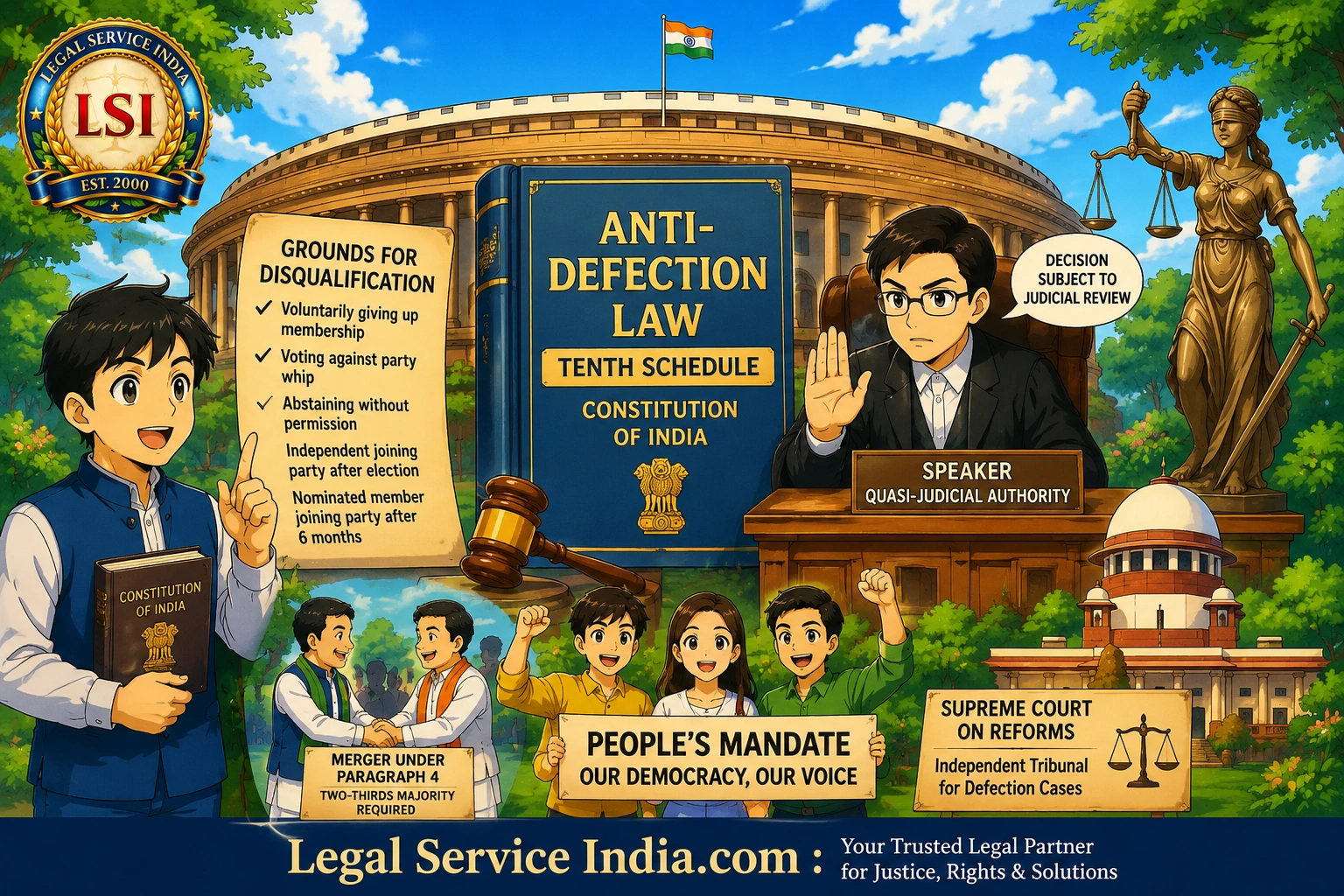
Disqualification of a member of the house is given under Paragraph 2; a member shall be disqualified if they have voluntarily given up membership (either expressly or impliedly) of their political party, voted against the direction of the political party or abstained without prior permission and such voting or abstention has not been condoned by their political party.
For the purpose of giving up membership and voting contrary to the party, the party shall be the political party whose symbol he had won the election with. If an independent candidate joins the political party after winning an election and a nominated member joins any political party after 6 months of such nomination, it shall be grounds for disqualification.
Grounds for Disqualification Under Paragraph 2
- Voluntarily giving up membership of the political party (either expressly or impliedly).
- Voting against the direction of the political party.
- Abstaining from voting without prior permission when such abstention has not been condoned by the political party.
- An independent candidate joining a political party after winning the election.
- A nominated member joining a political party after six months of nomination.
Merger
The only exemption to disqualification is given under Paragraph 4, i.e., merger. When a merger takes place between the members’ original political party and another party, resulting in members joining the newly formed or merged entity.
A merger of the original political party shall only be deemed to take place when a two-thirds majority of the members of the legislature party agree to such a merger. Those who have not accepted the merger can operate as a separate group.
Conditions for a Valid Merger
- The merger must involve the original political party and another political party.
- A two-thirds majority of the members of the legislature party must agree to the merger.
- Members who do not accept the merger may continue to function as a separate group.
Quick Overview
| Provision | Purpose |
|---|---|
| Tenth Schedule | Provides disqualification on the ground of defection. |
| Paragraph 2 | Specifies the grounds for disqualification. |
| Paragraph 4 | Provides the exception relating to merger. |
| Speaker of the House | Decides questions relating to disqualification under the Tenth Schedule. |
| Articles 101, 102, 190 & 191 | Amended by the Fifty-Second Constitutional Amendment in 1985. |
The Gaps: Where the Law Breaks Down
The following discussion highlights the key legal and constitutional gaps in the operation of the anti-defection law under the Tenth Schedule of the Constitution of India.
Relation Between Political Party & Legislature Party for Merger
A political party is not defined under Schedule 10, whereas a legislature party is defined as a member of the house belonging to any political party.
The legislature party is in itself a unit of the political party and works as a link between the house and the political party.
A legal issue arises when a merger is recognised solely based on the endorsement of two-thirds of the legislature party, while completely ignoring the primary prerequisite: an actual merger between the original political parties.
The explanation to Paragraph 2 provides that an elected member of a House shall be deemed to belong to the political party by which they were set up as a candidate for election.
‘Political party’ and ‘legislature party’ cannot be conflated.
The law only gives the legislature party a distinct legal identity for limited purposes.
Legislature parties cannot act independently of the political party, so such a disconnect would defeat the purpose of the anti-defection law.
The Tenth Schedule draws a “clear demarcation” between the two, and that legislative majority alone cannot determine the identity or decisions of the political party as held in Subhash Desai v. Principal Secretary, Governor of Maharashtra & Ors.
A valid merger should be according to the party constitution and endorsed by 2/3 of the members, and an inquiry is necessary to verify a valid merger.
Key Legal Principles for Valid Merger
| Legal Requirement | Position Under the Tenth Schedule |
|---|---|
| Political Party Merger | Actual merger between the original political parties is the primary requirement. |
| Legislature Party | Acts only as a unit of the political party and cannot function independently. |
| Two-Thirds Support | Endorsement by 2/3 members alone is not sufficient without a valid political party merger. |
| Party Constitution | A merger should be according to the party constitution. |
| Verification | An inquiry is necessary to verify the validity of the merger. |
Important Legal Observations
- A political party and a legislature party are distinct legal concepts.
- The legislature party derives its identity from the political party.
- A legislative majority cannot determine the identity of the political party.
- A valid merger requires compliance with the party constitution.
- An inquiry is necessary before recognizing a merger.
Speaker’s Power v. Judicial Review
Adjudication of the question of disqualification on the ground of defection shall only be decided by the speaker of the house, and the decision shall be final.
The Speaker of the House functions as a quasi-judicial tribunal for this purpose.
Consequently, proceedings are conducted before the Speaker in their capacity as a tribunal rather than before the House itself; thus, the decision of the Speaker enjoys no immunity under Articles 122 and 212 from judicial intervention.
The scope of judicial review is limited and generally available only after the Speaker has rendered a final decision of the Speaker and is restricted to cases of a breach of a constitutional mandate, mala fide and non-compliance with natural justice.
Judicial review cannot be invoked at the initial or interlocutory stage.
The speaker does not have the power to take suo motu cognizance of the matter, and the interested party may have to file a disqualification petition.
The speaker shall decide the disqualification subject to the exemption of merger; it means the speaker will only decide the validity of the merger when a question of disqualification arises.
When the position of speaker is in itself challenged, then he is unable to decide the petition, as held in Nabam Rebia v. Deputy Speaker; this position is pending adjudication by a 7-judge bench.
Scope of Judicial Review
| Issue | Legal Position |
|---|---|
| Authority to Decide Defection | Speaker of the House. |
| Nature of Speaker’s Role | Quasi-judicial Tribunal. |
| Judicial Review | Available only after the speaker’s final decision. |
| Grounds of Judicial Review | Breach of constitutional mandate, malfeasance and non-compliance with natural justice. |
| Interlocutory Challenge | Not ordinarily maintainable. |
| Suo Motu Power | The speaker does not possess suo motu power to initiate proceedings. |
| Merger Issue | The speaker examines the validity of a merger only when deciding a disqualification petition. |
| Pending Constitutional Issue | The effect of a pending removal motion against the Speaker, as discussed in Nabam Rebia v. Deputy Speaker, awaits adjudication by a 7 judges bench. |
Key Takeaways
- The speaker acts as a quasi-judicial authority while deciding defection cases.
- The Speaker’s decision is subject to judicial review.
- Judicial review is generally available only after the final decision.
- The Speaker cannot ordinarily initiate disqualification proceedings suo motu.
- The validity of a merger is examined only when a disqualification dispute arises.
- The constitutional issue arising from Nabam Rebia v. Deputy Speaker remains pending before a seven-judge bench.
Why Does India Lack an Independent Adjudicatory Body for the Tenth Schedule?
The speaker usually belongs to the majority party; it creates the demand of an independent body to adjudicate the question related to Schedule 10. The answer lies in the sanctity of the Office of Speaker in democracy. Speakers represent the dignity and freedom of the House and the symbol of the nation’s freedom & liberty. An honoured position should be occupied by a person of outstanding ability and impartiality.
The Apex Court held that it would be unfair to interfere and doubt the power and jurisdiction of this highly valued office in democracy.
Constitutional Position of the Speaker
While the scheme frames the speaker as an impartial adjudicator, practical experience reveals that the office often suffers from severe partisan bias. Because the speaker remains a member of the ruling majority party, their decisions are frequently criticised for favouring their own political alignment.
Supreme Court’s View on an Independent Tribunal
The Supreme Court in Keisham Meghachandra Singh v. Hon’ble Speaker, Manipur Legislative Assembly, suggested Parliament rethink vesting Speakers with the quasi-judicial power to decide defection disputes under the Tenth Schedule, given their ongoing political affiliations. Instead, the Court suggested amending the Constitution to replace the Speaker with an independent, permanent tribunal.
Key Reasons for the Demand of an Independent Adjudicatory Body
- Speaker usually belongs to the ruling majority party.
- Questions are frequently raised regarding impartiality in defection cases.
- Political affiliations may influence quasi-judicial decisions.
- An independent Tribunal could strengthen public confidence in the anti-defection mechanism.
- The Supreme Court has suggested constitutional reconsideration of the present framework.
| Current System | Suggested Reform |
|---|---|
| Speaker decides disqualification petitions under the Tenth Schedule. | An independent, permanent tribunal decides defection disputes. |
| Speaker continues to be a member of a political party. | Independent adjudicator without political affiliation. |
| Frequent allegations of partisan bias. | Greater institutional neutrality and public confidence. |
Conclusion
Whenever a democracy faces a concentration of power or political instability, it often leads to the unethical switching of parties by elected members.
Recent developments stem from conflicting interpretations of what constitutes the “Legislature Party” versus the “Political Party”. This ambiguity has allowed factions of rebel members to claim legitimacy and merge with other parties based solely on securing a two-thirds majority within the legislative wing, a move that frequently appears driven by the lure of power.
Such developments amount to the independent operation of a legislature party without the backing of its parent political party, directly contradicting established decisions of the Supreme Court’s constitutional bench.
The mandate of the electorate must be respected by elected representatives to strengthen the principle of popular sovereignty.
Half a century on, “Aaya Ram, Gaya Ram” has only changed its vocabulary — from open floor-crossing to engineered legislature-party majorities. Until the Tenth Schedule’s gaps are closed, the story keeps being rewritten under new names.
It is high time for members of the House to align their conduct with the political party that fielded them in order to preserve the sanctity of elections and for Parliament to seriously reconsider establishing an independent adjudicatory body for the Tenth Schedule.
Key Takeaways
- The Office of the Speaker is constitutionally expected to function with impartiality.
- Practical experience has raised concerns regarding partisan decision-making.
- The Supreme Court has suggested replacing the Speaker with an independent tribunal for deciding defection disputes.
- Conflicting interpretations of “Legislature Party” and “Political Party” continue to create constitutional challenges.
- Strengthening the Tenth Schedule is essential to preserve electoral mandates and democratic accountability.
Written By:
- Tapan Nagar, Law Students &
- Priyanshi Gupta, Law Students

