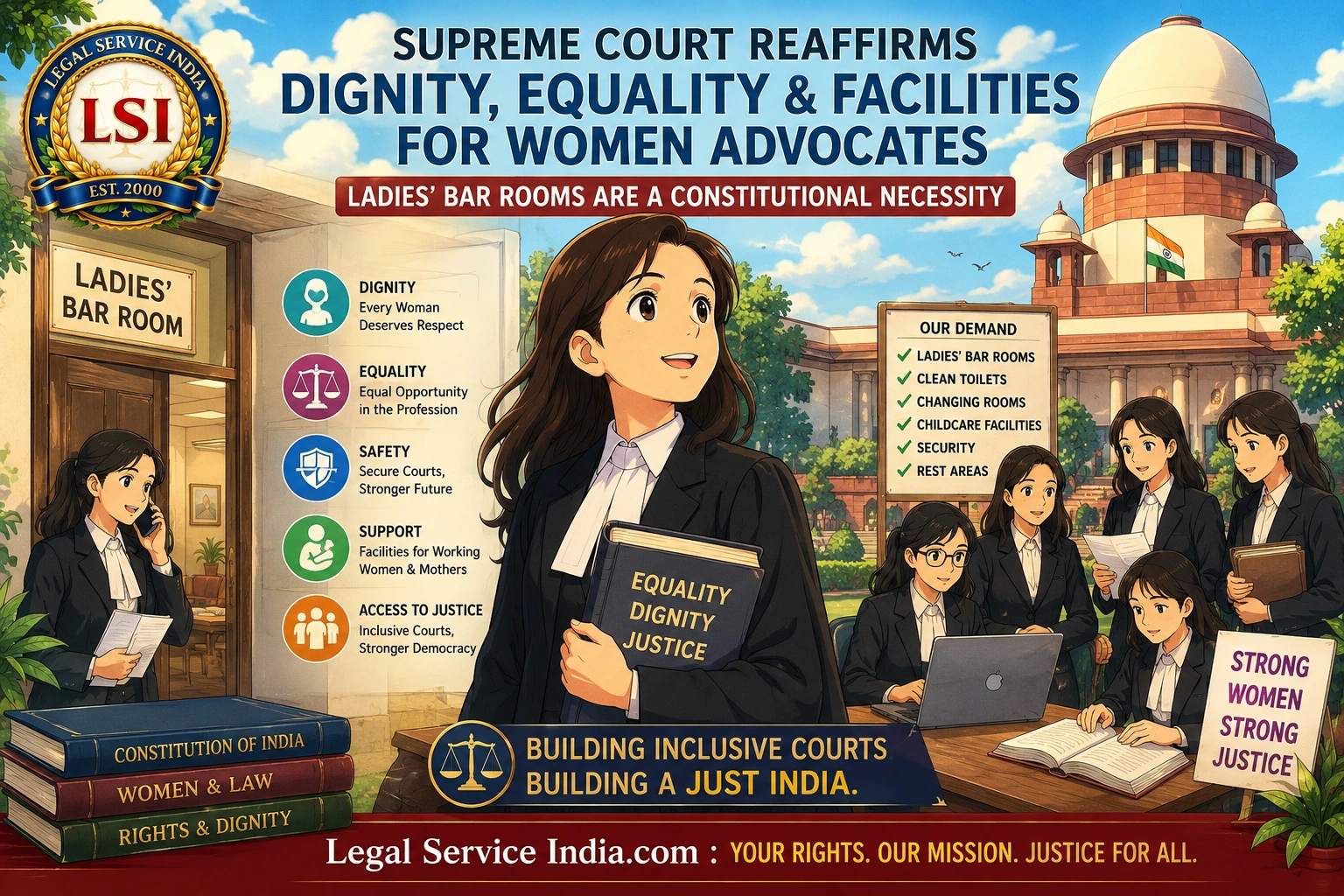
No Ladies’ Bar Rooms in Most Trial Courts: Supreme Court Holds That Basic Facilities for Women Advocates Are Integral to Dignity
A Landmark Reminder That Gender Equality in the Legal Profession Begins With Infrastructure
Introduction
The Supreme Court’s recent observations on the absence of ladies’ bar rooms in a large number of trial courts across India may appear to concern a simple question of infrastructure. In reality, however, the issue strikes at the heart of constitutional values, gender equality, professional dignity, and access to justice.
For decades, women have steadily increased their presence in the legal profession. Today, women serve as judges, senior advocates, law officers, academicians, corporate counsel, and litigators across every level of the justice delivery system. Yet, despite this progress, many court complexes continue to function with infrastructure designed for a legal profession that historically excluded women.
Against this backdrop, the Supreme Court’s observation that basic facilities for women advocates are an integral component of dignity assumes enormous significance. The Court has effectively recognized that equal participation in the legal profession cannot be achieved merely through formal rights. It requires institutional support, physical infrastructure, and working conditions that enable women advocates to practice with safety, privacy, efficiency, and self-respect.
This is not merely a facilities issue. It is a constitutional issue.
The Court’s intervention is likely to trigger an important national conversation regarding the state of judicial infrastructure, the professional realities faced by women lawyers, and the responsibility of the State and legal institutions to create genuinely inclusive workplaces.
The Background: A Long-Ignored Reality in Indian Courts
The issue emerged from concerns regarding the lack of separate ladies’ bar rooms and other basic facilities in numerous district and subordinate courts across India.
For many outside the profession, a bar room may appear to be a simple waiting area. In practice, it functions as the operational nerve centre of an advocate’s professional life. Lawyers prepare cases, hold client conferences, draft pleadings, review files, coordinate with colleagues, conduct research, and await court proceedings from these spaces.
The absence of dedicated facilities for women advocates creates practical difficulties that affect professional performance on a daily basis.
Challenges Faced by Women Lawyers
Many women lawyers have long reported challenges including:
- Lack of private workspaces.
- Inadequate sanitation facilities.
- Absence of changing rooms.
- Lack of nursing and childcare facilities.
- Overcrowded common rooms.
- Security concerns in court premises.
- Insufficient resting spaces during long court hours.
These deficiencies become particularly acute in district courts, where the overwhelming majority of India’s litigation takes place.
The Supreme Court’s observations have therefore brought national attention to a problem that women advocates have been highlighting for years.
Key Infrastructure Gaps Highlighted
| Infrastructure Requirement | Common Deficiency Reported | Impact on Women Advocates |
|---|---|---|
| Ladies’ Bar Rooms | Unavailable in many courts | Lack of privacy and dedicated workspace |
| Sanitation Facilities | Inadequate or poorly maintained | Health, hygiene, and dignity concerns |
| Changing Rooms | Often absent | Professional inconvenience |
| Childcare Facilities | Limited availability | Challenges for working mothers |
| Security Measures | Insufficient in some premises | Safety concerns during court hours |
| Rest Areas | Inadequate space | Reduced workplace comfort and efficiency |
Why This Case Is About Constitutional Dignity
The most important aspect of the Court’s observation is that it elevates the discussion from administrative inconvenience to constitutional necessity.
The Constitution of India does not merely guarantee survival. It guarantees dignity.
Over the years, the Supreme Court has consistently expanded the meaning of dignity under Article 21. Dignity has been interpreted to include privacy, safety, bodily autonomy, equal opportunity, and humane working conditions.
Viewed through this constitutional lens, the absence of basic facilities for women advocates ceases to be a logistical issue.
It becomes a question of whether women lawyers can participate in the legal profession on equal terms.
The Court’s approach is consistent with a long line of constitutional jurisprudence recognizing that rights become illusory when supporting infrastructure is absent.
A right without the means to exercise it effectively is often no right at all.
Constitutional Principles Involved
| Constitutional Principle | Relevance to the Issue |
|---|---|
| Dignity | Ensures respectful and humane working conditions |
| Equality | Supports equal participation in the legal profession |
| Access to Justice | Requires inclusive judicial infrastructure |
| Professional Freedom | Enables advocates to work effectively and safely |
| Institutional Inclusivity | Promotes gender-sensitive court administration |
The Constitutional Framework Supporting the Court’s View
The issue engages multiple constitutional guarantees.
Article 14 – Equality Before Law
True equality requires more than identical treatment.
Where women advocates face distinct challenges because of inadequate facilities, equality may require proactive measures to remove structural barriers.
Providing separate bar rooms is therefore not preferential treatment; it is an equality-enhancing measure.
Article 15 – Protection Against Discrimination
The Constitution permits affirmative measures designed to address historical disadvantages faced by women.
Ensuring appropriate facilities in court complexes aligns with the broader constitutional commitment to substantive gender equality.
Article 19(1)(g) – Freedom to Practice a Profession
Advocates possess a constitutional right to practice their profession.
However, the meaningful exercise of that right depends upon the availability of basic professional infrastructure.
The right to practice law cannot be divorced from the conditions necessary to practice effectively.
Article 21 – Right to Life and Dignity
The Supreme Court’s jurisprudence has repeatedly emphasized that dignity is the core of Article 21.
Women advocates cannot be expected to perform professional duties in environments that fail to respect their privacy, safety, and basic workplace needs.
| Constitutional Provision | Key Principle | Relevance to Women Advocates |
|---|---|---|
| Article 14 | Equality Before Law | Supports measures that remove structural barriers and promote genuine equality. |
| Article 15 | Protection Against Discrimination | Allows affirmative measures addressing historical disadvantages faced by women. |
| Article 19(1)(g) | Freedom to Practice a Profession | Requires adequate professional infrastructure for effective legal practice. |
| Article 21 | Right to Life and Dignity | Protects privacy, safety, dignity, and basic workplace needs. |
The Hidden Gender Gap in the Legal Profession
The Court’s observations expose a deeper structural issue.
Despite substantial progress, women remain underrepresented in several segments of the legal profession.
Although law schools today often report near parity in admissions, the number of women decreases significantly at successive stages of professional advancement.
This phenomenon is frequently described as the “leaky pipeline.”
Women enter legal education in large numbers but face increasing barriers as careers progress.
Factors Contributing to Attrition
Factors contributing to attrition include:
- Lack of mentorship.
- Unequal briefing opportunities.
- Family-care responsibilities.
- Safety concerns.
- Gender stereotypes.
- Inadequate workplace infrastructure.
The absence of proper facilities in court complexes contributes directly to this attrition.
When young women lawyers encounter hostile or inconvenient working environments, many eventually migrate to corporate practice, academia, compliance, or in-house legal roles.
The result is a loss of talent within litigation practice.
| Stage | Observation |
|---|---|
| Legal Education | Women enter law schools in large numbers. |
| Early Career | Structural and workplace challenges begin to emerge. |
| Professional Advancement | Representation declines significantly. |
| Litigation Practice | Many women leave due to persistent barriers. |
Why This Matters for Access to Justice
The issue extends beyond lawyers.
It affects litigants as well.
A diverse legal profession strengthens access to justice.
Women litigants often feel more comfortable consulting women lawyers in matters involving domestic violence, sexual offences, matrimonial disputes, workplace harassment, child custody, and family law.
Impact on the Justice System
- Improves representation within the legal profession.
- Enhances accessibility for women litigants.
- Promotes trust in the justice delivery system.
- Encourages diversity in legal advocacy.
- Strengthens substantive access to justice.
When institutional barriers discourage women from remaining in litigation practice, the justice system itself becomes less representative and less accessible.
Thus, improving facilities for women advocates is not merely an employment issue.
It is an access-to-justice issue.
The quality of justice depends significantly on the diversity and inclusiveness of those who deliver it.
Court Infrastructure: The Forgotten Pillar of Judicial Reform
India’s judicial reform discourse traditionally focuses on several critical areas:
- Judicial vacancies
- Case backlog
- Technology adoption
- E-filing systems
- Alternative dispute resolution
- Judicial appointments
While these issues are undoubtedly important, court infrastructure often receives insufficient attention.
Yet infrastructure forms the foundation upon which every other reform depends.
A modern justice system requires:
| Infrastructure Requirement | Purpose |
|---|---|
| Adequate courtrooms | Ensure efficient judicial functioning and reduce congestion. |
| Functional waiting areas | Provide comfort and convenience to litigants and advocates. |
| Safe sanitation facilities | Maintain dignity, hygiene, and public health standards. |
| Digital infrastructure | Support technology-driven judicial reforms. |
| Accessibility measures | Enable equal access for persons with disabilities. |
| Gender-sensitive facilities | Create an inclusive and equitable professional environment. |
The Supreme Court’s observations serve as a reminder that infrastructure reform must remain central to judicial modernization.
International Perspectives and Global Best Practices
Globally, modern court systems increasingly recognize gender-responsive infrastructure as an essential component of judicial administration.
Several jurisdictions have adopted policies that include:
- Dedicated professional workspaces
- Childcare facilities
- Nursing rooms
- Enhanced security measures
- Gender-sensitive building design
| Global Best Practice | Objective |
|---|---|
| Dedicated professional workspaces | Support productivity and professional development. |
| Childcare facilities | Assist working parents in balancing professional responsibilities. |
| Nursing rooms | Provide privacy and support for nursing mothers. |
| Enhanced security measures | Ensure safety for legal professionals and court users. |
| Gender-sensitive building design | Promote inclusivity and equal access. |
India’s judiciary has made substantial progress in many areas, but the present issue demonstrates that significant work remains.
The future of judicial infrastructure planning must incorporate gender considerations at the design stage rather than as an afterthought.
The Importance of Representation in Bar Governance
The issue also highlights another important reality.
Infrastructure decisions are often made by institutions where women remain underrepresented.
Bar Associations and Bar Councils play a critical role in determining priorities concerning welfare, facilities, and professional development.
Greater representation of women in these bodies is likely to result in more responsive decision-making regarding workplace needs.
The Supreme Court’s observations may therefore revive broader discussions about women’s participation in legal governance institutions.
Why Representation Matters
- Improves understanding of workplace challenges faced by women lawyers.
- Encourages inclusive infrastructure planning.
- Strengthens welfare and professional development initiatives.
- Promotes equitable decision-making within legal institutions.
The Real Test: Implementation
Judicial recognition is only the beginning.
The ultimate success of this intervention will depend upon implementation.
Meaningful reform requires coordinated action from:
- High Courts
- State Governments
- Public Works Departments
- Bar Councils
- District Judges
- Bar Associations
Potential Measures for Reform
- Construction of ladies’ bar rooms in every district court.
- Dedicated budget allocations.
- Periodic infrastructure audits.
- Childcare and nursing facilities.
- Improved sanitation and hygiene standards.
- Enhanced security measures.
- Uniform infrastructure guidelines across States.
- Monitoring and compliance mechanisms.
| Reform Measure | Expected Impact |
|---|---|
| Ladies’ bar rooms | Improved dignity and professional support for women advocates. |
| Dedicated budgets | Ensures sustained infrastructure development. |
| Infrastructure audits | Identifies gaps and tracks compliance. |
| Childcare and nursing facilities | Supports work-life balance for legal professionals. |
| Enhanced security measures | Improves safety within court premises. |
| Uniform guidelines | Promotes consistency across States. |
Without sustained follow-through, even the most progressive judicial observations risk remaining symbolic.
A Turning Point for Women Lawyers in India
The Supreme Court’s intervention may ultimately prove significant for reasons extending far beyond physical infrastructure.
For decades, women advocates have demonstrated that they possess the talent, resilience, and professional competence necessary to excel at every level of the legal profession.
What they have often lacked is institutional support.
By recognizing that basic facilities are inseparable from dignity, the Court has acknowledged a reality that many women lawyers experience every day but which has too often remained invisible in public discourse.
The decision reinforces an important constitutional principle: inclusion cannot be achieved through rhetoric alone. It requires tangible institutional commitment.
Conclusion
The Supreme Court’s observation that basic facilities for women advocates are integral to dignity represents an important milestone in the continuing evolution of gender equality within the Indian legal profession.
At one level, the issue concerns ladies’ bar rooms.
At a deeper level, it concerns the constitutional promise that every professional, irrespective of gender, should be able to work in conditions consistent with dignity, equality, and respect.
The absence of such facilities is not merely an infrastructural shortcoming. It is a reflection of historical assumptions that no longer have a place in a modern constitutional democracy.
The Court has sent a clear message: women advocates are not peripheral participants in the justice system. They are indispensable stakeholders in its functioning.
The challenge now lies with governments, High Courts, Bar Councils, and Bar Associations across India. The constitutional principle has been articulated. The infrastructure must now follow.
If implemented effectively, this development may be remembered not simply as a discussion about court facilities, but as a defining step toward a more inclusive, representative, and dignified legal profession—one that truly reflects the values embodied in the Constitution of India.
Key Takeaways
Supreme Court Links Infrastructure To Dignity
The Supreme Court held that providing basic facilities such as ladies’ bar rooms for women advocates is not merely an administrative matter but a question of constitutional dignity and equality.
Equal Participation Requires More Than Legal Rights
Women lawyers may have the formal right to practice law, but meaningful participation requires safe, private, and functional workspaces within court complexes.
Many Courts Still Lack Basic Facilities
Numerous trial and district courts reportedly do not provide adequate facilities such as:
- Separate bar rooms
- Proper sanitation
- Changing rooms
- Childcare and nursing facilities
- Safe resting and working spaces
The Issue Involves Multiple Constitutional Rights
The Court’s view is supported by the following constitutional provisions:
| Article | Constitutional Principle |
|---|---|
| Article 14 | Equality before law |
| Article 15 | Gender equality and affirmative measures |
| Article 19(1)(g) | Freedom to practice a profession |
| Article 21 | Right to life and dignity |
Infrastructure Gaps Contribute To The “Leaky Pipeline”
While many women enter law schools, fewer remain in litigation and advance professionally due to structural barriers, including poor workplace infrastructure.
This Is Also An Access-To-Justice Issue
A stronger presence of women lawyers improves access to justice, especially for women litigants in sensitive matters such as domestic violence, sexual offences, family disputes, and workplace harassment cases.
Judicial Reform Must Include Infrastructure
Discussions on judicial reform often focus on vacancies, backlogs, and technology, but the Court’s observations highlight that court infrastructure is a foundational requirement for an effective justice system.
Global Best Practices Support Gender-Responsive Courts
Modern court systems worldwide increasingly provide childcare facilities, nursing rooms, dedicated workspaces, and gender-sensitive designs to support women professionals.
Greater Representation Of Women In Bar Governance Is Important
Increased participation of women in Bar Associations and Bar Councils can help ensure that workplace and welfare concerns receive appropriate attention.
Implementation Is The Real Challenge
The article emphasizes that meaningful change will require coordinated action by High Courts, State Governments, Bar Councils, District Judges, and Bar Associations through funding, infrastructure development, audits, and monitoring.
Summary Table
| Key Issue | Main Observation |
|---|---|
| Women Advocates’ Facilities | Linked directly to dignity and equality |
| Constitutional Basis | Articles 14, 15, 19(1)(g), and 21 |
| Infrastructure Deficiencies | Bar rooms, sanitation, childcare, and safe workspaces |
| Impact On Profession | Contributes to reduced retention of women in litigation |
| Access To Justice | Improves representation for women litigants |
| Implementation Responsibility | High Courts, Governments, Bar Councils, and Bar Associations |
One-Line Summary
The Supreme Court has signaled that providing proper facilities for women advocates is not a matter of convenience but a constitutional obligation tied to dignity, equality, and effective access to justice.