





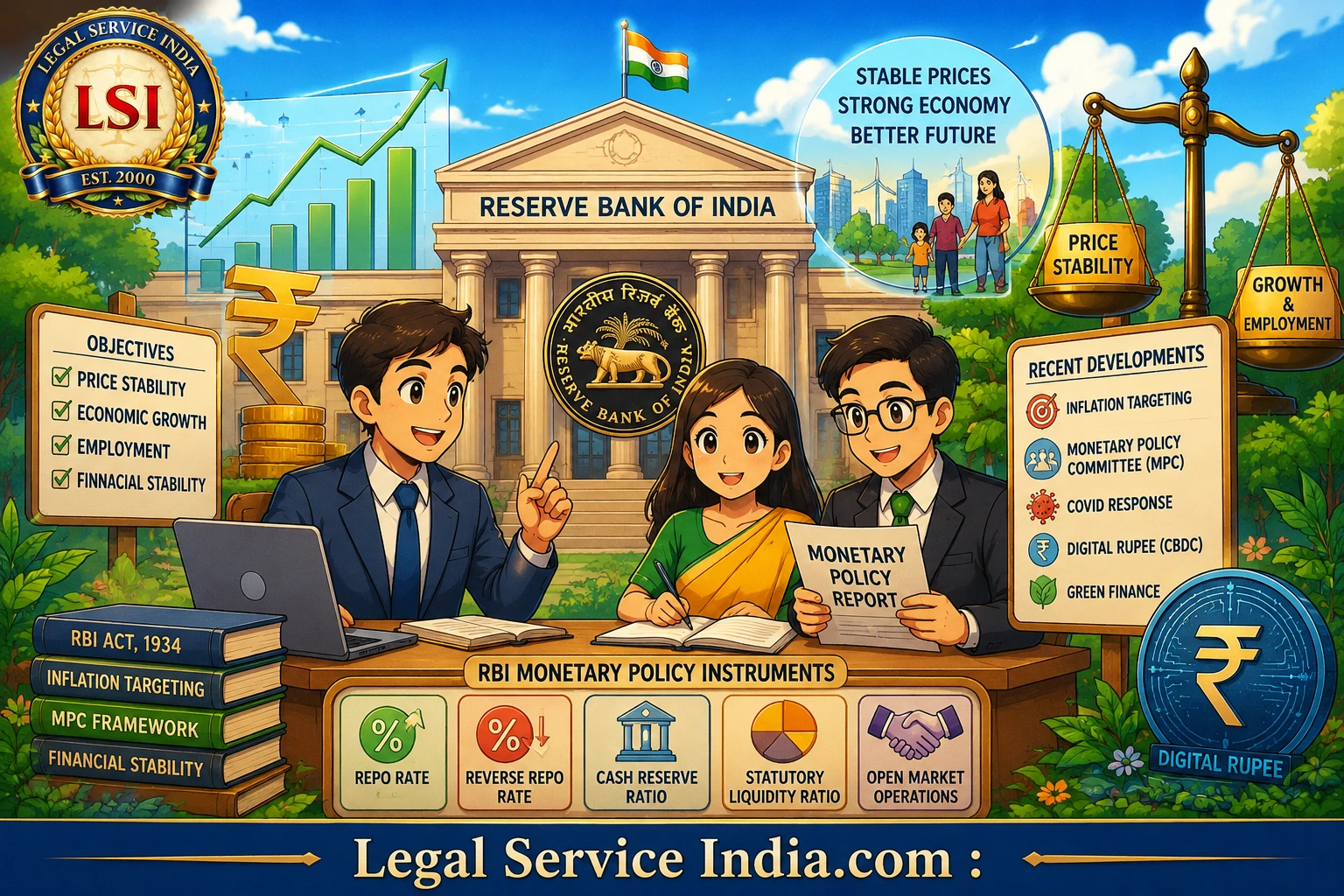
Introduction
Monetary policy is used by the central bank as a tool to control money supply and credit in an economy, and it plays a crucial role in achieving price stability and growth [1]. In India, this responsibility lies with the Reserve Bank of India (RBI), established by the RBI Act of 1934. The RBI came into being in a tumultuous global economic environment (the Great Depression), and the Preamble of the RBI Act provided “the edifice for the evolution of the monetary policy framework” in India [2].
Early policy focused on maintaining exchange rate parity through liquidity regulation and instruments such as open market operations (OMOs), bank rate and cash reserve ratio (CRR). Over time, the objectives of RBI’s monetary policy have expanded to balancing dual mandates of price stability (inflation control) and sustainable economic growth, with “price stability as the primary objective of monetary policy” after the 2016 RBI Act amendment [3].
Role of Monetary Policy in India
- Controls money supply and credit in the economy.
- Supports price stability and economic growth.
- Implemented by the Reserve Bank of India (RBI).
- Uses instruments such as OMOs, Bank Rate and CRR.
- Focuses on inflation control and sustainable development.
Evolution of RBI Monetary Policy Framework
| Period | Key Focus | Major Features |
|---|---|---|
| Early Years | Exchange Rate Stability | Liquidity regulation through OMOs, Bank Rate and CRR |
| Post-Independence | Growth and Development | Support for planned economic development |
| Post-2016 Framework | Inflation Targeting | Price stability as the primary objective of monetary policy |
Study Focus and Objectives
This study investigates the instruments through which RBI implements monetary policy and assesses their effectiveness in the Indian context. Specifically, it examines:
- (a) the major quantitative and qualitative tools of RBI’s monetary policy,
- (b) how these tools affect India’s macroeconomic objectives (price stability, growth, employment), and
- (c) the challenges in transmission and governance of policy.
The objectives are to provide a comprehensive analysis of the RBI’s policy framework and to address the question:
How effective are RBI’s instruments of monetary policy in achieving its macroeconomic goals?
Scope of the Study
The scope covers both historical evolution (post-independence to present) and recent innovations (inflation targeting, MPC, COVID response, digital currency, green finance).
| Area Covered | Scope |
|---|---|
| Historical Evolution | Post-independence monetary policy developments to the present |
| Policy Framework | RBI monetary policy instruments and implementation mechanisms |
| Macroeconomic Objectives | Price stability, economic growth and employment |
| Institutional Reforms | Inflation targeting and Monetary Policy Committee (MPC) |
| Recent Innovations | COVID response, digital currency and green finance initiatives |
Research Methodology
This paper adopts a descriptive and analytical approach. Primary sources include official RBI publications (Annual Reports, Monetary Policy Reports, and Press Releases) and government reports (e.g., Press Information Bureau releases). Secondary sources include academic journals, central bank research (e.g., BIS papers) and expert analyses. These sources are used to outline the conceptual framework and legal foundation of RBI’s policy and to trace the evolution and impact of specific instruments. Quantitative analysis uses historical data on key policy rates, reserve ratios, inflation, and growth; qualitative analysis examines institutional arrangements and policy debates.
Research Sources
| Source Category | Examples | Purpose |
|---|---|---|
| Primary Sources | RBI Annual Reports, Monetary Policy Reports, Press Releases, Government Reports, PIB Releases | Understanding the legal and policy framework |
| Secondary Sources | Academic Journals, BIS Papers, Expert Analyses | Evaluating policy evolution and impact |
| Quantitative Analysis | Policy Rates, Reserve Ratios, Inflation Data, Growth Data | Assessing economic outcomes |
| Qualitative Analysis | Institutional Arrangements, Policy Debates | Examining governance and implementation issues |
Statement Of Problem
India’s monetary policy framework rests on a statutory mandate that prioritises price stability while also supporting growth. As amended in 2016, the RBI Act enshrines an inflation target (4% CPI with a ±2% band) as the primary objective, with growth as a secondary consideration. In practice, the Reserve Bank must balance this dual mandate with other legal responsibilities (e.g., ensuring adequate credit flow) and constraints. This balance is made difficult by institutional factors such as fiscal dominance.
Structural and operational challenges compound these legal-institutional issues. For example, India’s banking sector has long suffered from asset quality problems and weak balance sheets. As RBI Deputy Governor Viral Acharya notes, when banks are under stress, monetary easing can fail to spur new lending; instead, banks may engage in “evergreening of bad loans” and ‘zombie’ lending to postpone defaults, leading to misallocation, productivity loss and muted growth.
In such a situation, traditional quantitative tools (rate cuts and liquidity injection) have limited impact on credit and demand. Meanwhile, India has been transitioning from old-style “direct” controls (high CRR/SLR ratios and credit ceilings) toward market-based “indirect” instruments (repo auctions and open market operations). This shift is enabled by liberalisation and financial deregulation, which were intended to improve flexibility.
Yet legacy reserve requirements and segmented financial markets can still blunt transmission and delay the pass-through of policy changes. In short, India’s evolving macroeconomic context (post-liberalisation growth and recent inflation-targeting regime) has outpaced some institutional and market reforms.
The core problem, then, is how these policy, legal, and structural factors impede the effective use of the RBI’s monetary instruments: despite a clear legal mandate, operational lags, sectoral rigidities, and legacy constraints can prevent monetary impulses from fully achieving price stability and growth objectives.
Key Challenges Identified
- Balancing price stability with economic growth objectives.
- Institutional constraints, including fiscal dominance.
- Asset quality concerns and weak banking sector balance sheets.
- Limited effectiveness of monetary easing during banking stress.
- Persistence of “evergreening” and “zombie” lending practices.
- Transition from direct monetary controls to market-based instruments.
- Legacy reserve requirements affecting policy transmission.
- Segmented financial markets delaying pass-through effects.
- Operational lags and structural rigidities reducing policy effectiveness.
Research Questions
- What statutory provisions define the RBI’s mandate and powers to deploy monetary policy instruments?
- How has the RBI’s institutional framework been structured by law to formulate and implement monetary policy, and what legal checks affect its independence and accountability?
- How have recent legal changes altered the objectives and constraints of RBI’s policy framework?
- How are the RBI’s monetary policy tools classified?
- What are the operational mechanisms of the main instruments (e.g., repo and reverse repo under the Liquidity Adjustment Facility, bank rate, cash reserve ratio, statutory liquidity ratio, open market operations, marginal standing facility, etc.) in India’s context?
Thematic Classification Of Research Questions
| Theme | Focus Area |
|---|---|
| Legal Framework | Statutory provisions governing RBI’s powers and mandate |
| Institutional Structure | Monetary policy formulation, implementation, accountability, and independence |
| Legislative Reforms | Impact of recent legal changes on monetary policy objectives |
| Policy Instruments | Classification of RBI monetary policy tools |
| Operational Mechanisms | Working of repo, reverse repo, CRR, SLR, OMO, MSF, and related instruments |
Scope and Limitations
This study investigates the instruments through which RBI implements monetary policy and assesses their effectiveness in the Indian context. Specifically, it examines:
- The major quantitative and qualitative tools of RBI’s monetary policy.
- How these tools affect India’s macroeconomic objectives (price stability, growth, employment).
- The challenges in transmission and governance of policy.
The objectives are to provide a comprehensive analysis of RBI’s policy framework and to address the question: how effective are RBI’s instruments of monetary policy in achieving its macroeconomic goals?
The scope covers both historical evolution (post-independence to present) and recent innovations (inflation targeting, MPC, COVID response, digital currency, green finance).
The paper explicitly excludes in-depth treatment of fiscal policy and budgetary matters. In sum, the scope is confined to the RBI’s monetary toolkit and its operating environment and not to broader macroeconomic policy (e.g., fiscal, trade, or supply-side policies).
Conceptual Framework of Monetary Policy
Objectives
Monetary policy aims to anchor inflation expectations, ensure financial stability, and support sustainable growth. In India, RBI’s mandate is primarily to maintain price stability while supporting growth.
By law, after 2016 the RBI Act explicitly states price stability as the primary objective and tasks the Monetary Policy Committee (MPC) to achieve a CPI inflation target (currently 4% within a ±2% band) [4].
In practice, RBI considers multiple goals:
- CPI inflation control.
- Financial market liquidity.
- Credit flow.
- Employment (indirectly).
Types of Policy
RBI has operated in a framework of flexible inflation targeting since 2016 but used various frameworks before that.
Policies can be:
- Expansionary (Easing)
- Contractionary (Tightening)
They are implemented through two broad categories of instruments:
| Category | Description | Examples |
|---|---|---|
| Quantitative (General) Tools | Affect overall liquidity and credit conditions across the economy. | Repo Rate, Reserve Requirements, Open Market Operations |
| Qualitative (Selective) Tools | Direct credit toward or away from specific sectors. | Priority Sector Lending, Moral Suasion |
Quantitative tools control the cost and quantity of credit economy-wide, while qualitative tools influence the allocation of credit.
Transmission Mechanisms
Monetary policy operates through several channels to influence output and inflation.
Classic channels include:
- Interest Rate Channel: Policy rate changes alter market rates and the cost of loans, affecting investment and consumption.
- Credit Channel: Liquidity conditions affect banks’ lending capacity. [5]
The relative importance of each channel in India depends on financial development and market depth.
RBI research indicates the interest-rate channel has generally been dominant, but transmission has often been sluggish due to structural factors. [6]
Institutional and Legal Framework of RBI
Statutory Basis
The RBI was established by the Reserve Bank of India Act of 1934. The Act spells out the RBI’s mandate and structure.
After amendments in 2016, Section 45ZB[7] introduced a six-member Monetary Policy Committee (three RBI officials, three government nominees) for setting the policy rate.
Section 45ZL[8] mandates that the RBI publish MPC minutes within 14 days.
The RBI Act also provides the RBI with powers over the following:
- Currency issue.
- Monetary control.
- Banking regulation.
The Banking Regulation Act of 1949 further empowers RBI in supervising and regulating banks.
Together, these statutes grant RBI significant authority as a central bank (e.g., setting reserve requirements and acting as lender of last resort) but do not fully insulate it from government oversight.
RBI is a statutory body under the Ministry of Finance, though its independence has been recognised in practice.
Organizational Structure
The central board of the RBI (headed by the Governor and Deputy Governors) oversees policy.
The governor is ex officio chairman of the MPC and the executive board.
The MPC has transparency obligations:
- It must meet every two months.
- It must publish minutes and voting patterns.
The Act also reserves seats for government-nominated members, ensuring coordination.
Beneath the top leadership, RBI’s Monetary Policy Department provides technical analysis for decisions.
Evolution of Policy Framework
In the post-independence era, monetary policy evolved from administered credit controls to market-based tools.
| Period | Key Features | Major Instruments |
|---|---|---|
| 1935–1949 | Focus on exchange stability. | Bank Rate, CRR, Selective Credit Measures |
| 1950–1969 | Planned economy phase with directed credit. | Statutory Reserve Ratios, Priority Lending |
| 1969 Onwards | Bank nationalisation expanded credit access. | Directed Credit Programmes |
| 1980s | Monetary targeting framework. | CRR as principal policy instrument |
| 1991 Reforms | Financial liberalisation and fiscal reforms. | Ways and Means Advances System, Market-Based Tools |
| 1998 | A multiple indicator approach was adopted. | Interest Rates, Open Market Operations |
| 2003 | The FRBM Act strengthened fiscal discipline. | Enhanced Monetary Control Flexibility |
| 2016 Onwards | Formal inflation targeting and MPC framework. | Repo Rate-Based Monetary Policy |
The fiscal crisis of 1991 led to major reforms: automatic treasury financing was abolished (the Ways and Means Advances system was introduced), and markets were liberalised.
By 1998, the RBI adopted a multiple indicator approach, relying on interest rates and open market operations more, rather than strict money supply targets.
The Fiscal Responsibility and Budget Management (FRBM) Act 2003 was pivotal: by imposing fiscal discipline, it gave RBI more freedom in monetary control.
“Increased market orientation” after the 1990s allowed a shift “from direct to indirect instruments”, and the RBI began using short-term interest rates (e.g., repo) to signal its stance.
The adoption of formal inflation targeting in 2016 was a watershed: the RBI Act amendment enshrined price stability (4% CPI target) as the RBI’s main goal and institutionalised decision-making via the MPC.
Since then, the RBI’s policy stance (accommodative, neutral, or calibrating) has been explicitly guided by inflation forecasts and targets.
Instruments of Monetary Policy
The RBI uses different instruments, broadly categorised as quantitative (general) and qualitative (selective). The choice and mix of tools have evolved with financial development. We examine each category, with examples and data.
Quantitative Instruments
These are general tools affecting overall liquidity and interest rates in the economy.
| Instrument | Primary Purpose | Impact on Economy |
|---|---|---|
| Bank Rate Policy | Influence borrowing costs | Affects liquidity and credit availability |
| Open Market Operations (OMOs) | Manage liquidity | Influences interest rates and money supply |
| Cash Reserve Ratio (CRR) | Control bank liquidity | Directly impacts lending capacity |
| Statutory Liquidity Ratio (SLR) | Ensure liquid asset holdings | Regulates credit growth and stability |
| Repo & Reverse Repo Rates | Short-term liquidity management | Signals monetary policy stance |
| MSF & SDF | Manage liquidity fluctuations | Supports financial system stability |
Bank Rate Policy
The bank rate is RBI’s longstanding lending rate, i.e., the rate at which RBI stands ready to discount bills of exchange. Historically, raising the bank rate was meant to tighten money by making borrowing from the RBI more expensive [9]. Over time, its direct use diminished as banks had ample liquidity, but it remains legally defined and typically aligned with the Marginal Standing Facility (MSF) rate. For example, the bank rate was aligned with the MSF in 2016.
Open Market Operations (OMOs)
The RBI conducts outright purchases and sales of government securities to inject or absorb liquidity. OMOs are the primary tool for managing enduring liquidity surpluses or deficits.
- Purchase of securities injects liquidity into the banking system.
- Sale of securities absorbs liquidity from the banking system.
- Influences interest rates across the yield curve.
- Supports long-term liquidity management.
For instance, during 2020-21, RBI purchased a significant number of securities (through OMOs and special long-term repo operations) to ensure durable liquidity amid the pandemic. OMOs influence interest rates across the yield curve: buying securities injects money and pushes rates down, while selling withdraws funds and raises yields. Historically, OMOs began in the 1950s, but their role expanded sharply post-1990s as government securities markets deepened.
Cash Reserve Ratio (CRR)
CRR is the fraction of bank deposits that must be held as cash with RBI. Changing the CRR drains or adds liquidity immediately.
| Period | CRR Level | Purpose |
|---|---|---|
| March 2020 | 3.0% | Liquidity injection during COVID-19 |
| May 2025 | 4.0% | Normalization after stabilization |
For example, RBI lowered the CRR from 4.0% to 3.0% of net demand and time liabilities during March 2020 to inject liquidity during COVID-19, raising it later to 4.0% by May 2025 as conditions stabilised. By law, CRR adjustments take effect within a fortnight and apply uniformly to all banks.
Statutory Liquidity Ratio (SLR)
SLR requires banks to maintain a minimum percentage of net liabilities in specified liquid assets (primarily government securities, cash, and gold). SLR serves dual purposes, i.e., promoting government bond market stability and acting as liquidity regulation.
- Promotes stability in the government securities market.
- Acts as a liquidity regulation mechanism.
- Helps moderate excessive credit expansion.
During the 1960s and 70s, SLR was frequently tweaked to control credit growth. By Section 24 of the RBI Act, the RBI notifies the SLR percentage.
Repo Rate and Reverse Repo Rate (LAF)
Under the Liquidity Adjustment Facility (LAF), RBI conducts repurchase and reverse-repo auctions.
- Repo Rate: The rate at which banks can borrow overnight funds by pledging government securities.
- Reverse Repo Rate: The rate RBI pays banks for overnight deposits, thereby absorbing liquidity.
The LAF framework was introduced in 2000 to stabilise short-term rates. Today, the RBI’s six-member MPC sets the repo rate and the reverse repo. Shifts in the repo rate are the principal signal of monetary policy stance.
Marginal Standing Facility (MSF) and Standing Deposit Facility (SDF)
The MSF allows banks to borrow overnight above the SLR up to a certain limit, at a penal rate. The SDF (introduced in 2022) allows RBI to absorb excess liquidity by accepting deposits at a rate 25 bps below the repo.
- MSF provides emergency liquidity support.
- SDF absorbs excess liquidity without collateral.
- Both tools widen the LAF corridor.
- Help manage unexpected liquidity mismatches.
Together, MSF and SDF widen the LAF corridor. These tools manage intraday and unforeseen liquidity shortfalls (MSF) or surpluses (SDF). For example, during the pandemic, when banks faced sudden cash drags, the MSF provided a safety valve. These rates automatically move with the policy repo rate.
Summary of Quantitative Tools
In summary, RBI’s quantitative tools operate mainly through the LAF (repo/reverse repo/SDF/MSF) and reserve ratios (CRR/SLR), supplemented by OMOs. The LAF is the “main liquidity management tool”, with OMOs and forex swaps as additional tools. Over the last two decades, RBI has shifted to a nearly complete reliance on these market-based instruments.
Qualitative Instruments
Qualitative tools are aimed at influencing the allocation of credit or anchoring expectations.
| Instrument | Objective |
|---|---|
| Credit Rationing/Regulation | Guide sectoral credit allocation |
| Moral Suasion and Communication | Influence expectations and lending behaviour |
| Direct Actions | Ensure regulatory compliance |
| Regulatory Policies | Support targeted credit flow |
Credit Rationing and Regulation
Historically, RBI used selective credit controls in the planned economy era to curb credit to speculative or undesired sectors (e.g., higher margin requirements on commodity loans). Today, direct credit rationing is largely phased out, but the RBI still prescribes priority sector lending targets for banks (mandating a fraction of loans go to agriculture, SMEs, etc.). These directives indirectly guide credit flows, complementing broader monetary policy. For example, RBI may raise priority sector targets or adjust them as part of developmental objectives.
Moral Suasion and Communication
RBI often uses moral suasion, i.e., persuasive appeals to banks to encourage or discourage certain lending behaviour. This is an informal but potent tool in India’s banking culture.
- Public speeches influence market expectations.
- Forward guidance supports policy transmission.
- Inflation and growth forecasts shape economic sentiment.
- Policy stance announcements influence financial markets.
RBI’s public comments and speeches (e.g., the governor’s statements) also guide markets’ expectations. Since the formation of the MPC, the RBI has emphasised forward guidance: publishing inflation and growth forecasts and explaining policy stances. Effective communication is now considered an instrument, as shaping expectations is part of the transmission “expectations channel”. For example, RBI’s announcement of an “accommodative stance” signals to markets that the repo rate will remain supportive of growth until inflation is under control.
Direct Actions
RBI retains powers to penalise banks for non-compliance or imprudent practices (e.g., penalties for exceeding PLR, failing CRR/SLR, or unsafe banking practices). These “direct actions” are more macroprudential but also influence credit conditions by enforcing discipline.
Regulatory Policies
In the COVID crisis, RBI introduced unconventional measures that are quasi-monetary: it provided targeted refinancing (e.g., long-term repo operations to sectors like NBFCs or small industries) to ensure credit flow. While not classic “monetary policy”, these central bank actions to direct credit were part of the monetary response package.
Conclusion on RBI Policy Toolkit
Quantitative and qualitative instruments together form RBI’s policy toolkit. Generally, the RBI emphasises quantitative tools and uses qualitative ones sparingly. In practice today, the qualitative tools are less frequently used for routine policy and more for development or financial stability purposes. However, they remain part of RBI’s authority to “steer” credit when needed.
Effectiveness and Limitations of RBI’s Monetary Policy
RBI’s instruments have had mixed success in achieving targets in India’s complex economy.
Effectiveness
In recent years, RBI has largely succeeded in anchoring inflation near its 4% target. For instance, headline CPI inflation moderated to about 3.2% in April 2025, well within the RBI’s 4%±2% range. Over 2017–2020, CPI inflation averaged around 4.7%, compared to double-digit inflation in the previous decade. These outcomes are partly credited to RBI’s rate actions and communication.
Furthermore, financial markets have stabilised. For example, short-term money market rates have generally tracked the policy repo rate. The declining inflation in food and core segments in recent quarters suggests monetary policy transmission to inflation has been effective.
| Key Indicator | Outcome | Significance |
|---|---|---|
| Headline CPI Inflation (April 2025) | ~3.2% | Within RBI’s target range |
| Average CPI Inflation (2017–2020) | ~4.7% | Lower than the double-digit inflation seen earlier |
| Money Market Rates | Closely tracked repo rate | Indicates effective policy transmission |
| Food and Core Inflation | Declining trend | Reflects improved inflation management |
Limitations and Challenges
Several structural factors limit the RBI’s control over macro-outcomes.
1. Fiscal Dominance
First, fiscal dominance can undermine policy. If government borrowing is high, yields on government debt may rise (crowding out private credit), counteracting RBI’s efforts. In the past decade, though fiscal deficits have been lowered, they remain elevated by international standards.
2. Banking Sector Health
Second, banking sector health poses constraints. High non-performing assets (NPAs) in banks have prompted a cautious lending stance. Weaker banks may not expand credit despite easier policy.
3. Liquidity Conditions and Capital Flows
Third, liquidity conditions and capital flows can blunt policy. For instance, during 2017–2018, substantial foreign inflows put the RBI in a net liquidity absorption mode through reverse repo even as it was cutting the policy rate. This complex interplay meant easing had less impact on actual market rates. Conversely, during tight global cycles, e.g., 2022, RBI rate hikes were partly offset by rupee pressures and outflows.
4. Structural Breaks and External Shocks
Fourth, structural breaks weaken policy signals. Large exogenous shocks (like food-fuel inflation and pandemic disruptions) can dominate the inflation dynamics, limiting how much monetary tools can achieve alone.
| Challenge | Impact on Monetary Policy |
|---|---|
| Fiscal Dominance | High government borrowing can reduce policy effectiveness |
| High NPAs | Banks may remain reluctant to lend |
| Capital Flows | Can distort liquidity and interest rate transmission |
| External Shocks | Inflation may be driven by factors beyond RBI control |
Recent Developments
Monetary Policy Committee (MPC)
Since October 2016, RBI’s policy rate has been set by a six-member MPC, as mandated by the amended RBI Act [10]. This committee format with three members from the RBI and three government nominees was intended to depoliticise rate decisions and improve transparency.
The MPC meets at least four times a year, and its voting record and minutes are made public. This development has brought Indian central banking in line with global norms.
It has increased accountability. For example, if inflation is missed, the MPC must explain why and what the risks are. The MPC’s decision communications, including statements and minutes, are now a key part of the RBI’s toolset.
This institutional reform is relatively new, but initial experience suggests the MPC has functioned smoothly. RBI officials and external experts have all, in public MPC statements, highlighted the focus on inflation vs growth and the need to ensure an anchor for expectations.
- Six-member committee structure.
- Three RBI representatives and three government nominees.
- Regular publication of voting records and minutes.
- Enhanced transparency and accountability.
- Alignment with global central banking practices.
Inflation Targeting Regime
Under the flexible inflation targeting framework, the RBI aims for CPI inflation of 4% (±2%) on average in the medium term. The mandate changed RBI’s legal objective and strategy.
Inflation targeting has coincided with a period of relatively low and stable inflation in India. However, challenges remain. For example, since the FIT adoption, there have been episodes of volatile commodity prices (e.g., oil shocks or food price spikes) that tested the framework.
Some critics argue that the ±2% band is too wide given persistent inflation above 6% until mid-2020. RBI has responded by focusing on the centre of the band (4%), as noted in MPC discussions.
In practice, RBI has calibrated its stance (neutral or accommodative) based on inflation and growth forecasts, which is a hallmark of the FIT approach.
| Feature | Details |
|---|---|
| Target Inflation | 4% |
| Tolerance Band | ±2% |
| Framework | Flexible Inflation Targeting (FIT) |
| Policy Objective | Price stability with growth considerations |
Digital Currency (CBDC)
A very recent innovation is RBI’s exploration of a Central Bank Digital Currency (CBDC), termed the digital rupee (e₹). RBI launched a pilot of the retail CBDC in late 2022 (the “first retail e-rupee pilot” began December 1, 2022) [11].
As of 2025, about 7 million users are on the RBI’s digital currency platform, with several banks and fintechs participating in the testing environment.
While still a developmental project, the CBDC has implications for monetary policy. It could alter the currency and deposit’s structure (e.g., potentially shifting some cash holdings to digital form) and provides the RBI with a novel way to manage currency and liquidity at the retail level.
The full impact on policy transmission is yet unclear, but the RBI’s movement into digital currency reflects global trends and a push for modernisation of monetary instruments.
- Retail CBDC pilot launched in December 2022.
- Approximately 7 million users by 2025.
- Participation from banks and fintech companies.
- Potential transformation of currency management and liquidity operations.
- Supports modernisation of monetary policy infrastructure.
Green and Sustainable Finance
RBI has recently begun to integrate sustainability into its financial sector mandate. While not a traditional monetary instrument, RBI’s stance on climate risks is evolving.
Governor Sanjay Malhotra and other RBI officials have emphasised that climate change can have systemic financial impacts. For example, the RBI has proposed requiring banks to disclose their climate risk exposures and management strategies [12].
In March 2025, the RBI governor urged the creation of a “bankable projects” pool to finance green technologies.
These initiatives suggest RBI may use its regulatory powers and possibly differential lending facilities to channel funds toward sustainable sectors. While still nascent, this could lead to “green credit” guidelines or preferential refinance rates for green projects in the future.
In sum, RBI’s policy framework is expanding beyond conventional economics to include climate-related financial stability goals, reflecting global central banking trends.
| Green Finance Initiative | Potential Impact |
|---|---|
| Climate Risk Disclosures | Improved transparency in the banking sector |
| Green Technology Financing | Increased funding for sustainable projects |
| Potential Green Credit Guidelines | Encouragement of environmentally responsible investments |
| Preferential Refinance Facilities | Support for climate-friendly sectors |
Recommendations and Way Forward
Based on the analysis above, the following recommendations could enhance RBI’s policy effectiveness and responsiveness:
| Recommendation Area | Suggested Measures | Expected Impact |
|---|---|---|
| Deepen Financial Markets | Further development of the government bond market (e.g., by increasing issuance of long-term inflation-indexed bonds). | Improves monetary transmission, enhances RBI’s fine-tuning capabilities, strengthens OMOs, and helps influence longer-term yields. |
| Enhance Policy Transmission | Continue reforms encouraging faster pass-through from policy rates to bank lending, strengthen the External Benchmark Lending Rate regime, promote financial innovation, reduce NPAs, strengthen bank balance sheets, and ensure monetary-fiscal coordination. | Improves credit flow, enhances responsiveness to policy changes, and supports effective transmission mechanisms. |
| Enhance Data and Analytics | Invest in high-frequency indicators, digital payments data, inflation expectation surveys, and financial market metrics. | Supports better inflation forecasting and informed MPC decision-making. |
| Preserve Autonomy, Increase Accountability | Maintain RBI’s institutional independence while strengthening transparent communication, parliamentary reporting, and explanatory briefings. | Balances policy credibility with democratic oversight. |
| Leverage Innovation | Utilise digital tools such as the digital rupee and digital platforms for liquidity management. | Enhances policy precision and operational efficiency. |
| Integrate Sustainability | Incorporate climate risk into policy frameworks through green loans, green refinance facilities, and climate-sensitive monetary stability analysis. | Mobilises sustainable finance and reduces climate-related financial risks. |
| Continuous Policy Review | Regularly review policy tools in response to cryptocurrency developments, global financial cycles, demographic changes, and evolving trade patterns. | Ensures policy remains adaptive and relevant to emerging economic challenges. |
Deepen Financial Markets
Further development of the government bond market (e.g., by increasing issuance of long-term inflation-indexed bonds) would improve monetary transmission and give the RBI more fine-tuning tools. A more liquid and diversified debt market makes OMOs more potent and helps the central bank influence longer-term yields.
Enhance Policy Transmission
RBI should continue reforms that encourage faster pass-through from policy rates to bank lending. The External Benchmark Lending Rate regime (which ties loan pricing to market benchmarks) is a step in this direction. Encouraging financial innovation (e.g., digital lending platforms) could also reduce dependence on banks.
Additionally, reducing NPAs and strengthening banks’ balance sheets is essential so that banks can respond to policy easing by expanding credit. Continued monetary-fiscal coordination (ensuring government borrowing does not push yields up) will help transmission.
Enhance Data and Analytics
Effective inflation forecasting and real-time data are crucial. RBI could invest in better high-frequency indicators (e.g., via digital payments data) to detect emerging demand or price pressures. Improved inflation expectations surveys and financial market metrics would aid the MPC in decision-making.
Preserve Autonomy, Increase Accountability
RBI’s institutional independence is vital. Maintaining a legally secure policy mandate and clear decision-making process (as with the MPC) should be preserved.
At the same time, RBI should continue transparent communication so the public understands its trade-offs. The balance between RBI’s autonomy and democratic oversight can be managed through regular reporting and explanatory briefings to Parliament, as is now done.
Leverage Innovation
RBI should harness digital tools (like the digital rupee) to make monetary policy more precise. For instance, CBDC may eventually allow micro-level policy implementation (e.g., direct transfers). RBI can also use digital platforms for smoother liquidity management.
Integrate Sustainability
RBI should gradually build climate risk into its core frameworks. For example, it could consider adjusting risk weights for green loans or establishing a green refinance facility to further mobilise capital toward sustainable sectors. Ensuring that climate risks are reflected in monetary stability analysis will help pre-empt financial shocks.
Continuous Policy Review
Finally, the RBI should periodically review its policy tools, considering evolving challenges like cryptocurrency, global financial cycles, or demographic changes. For example, if structural shifts increase the importance of global trade, RBI’s policy might need more coordination with exchange rate policy.
Conclusion
The Reserve Bank of India today employs a comprehensive set of instruments from conventional rate and reserve requirements to newer tools like the MPC and CBDC to fulfil its mandate of price stability and growth support. This paper has traced the historical evolution of RBI’s policy framework, outlined its key tools, and analysed their performance.
RBI’s shift from direct credit controls to market-based instruments (repo rate, LAF, OMOs) has aligned it with global central banking practices. The recent inflation-targeting regime and MPC framework have added transparency and focus to policy. Empirically, these changes have helped lower and stabilise inflation and moderate credit growth, although challenges remain in transmission and in managing external shocks.
The analysis finds that RBI’s instruments are broadly effective but not omnipotent:
- Transmission lags continue to affect policy outcomes.
- Banking sector issues create structural constraints.
- Fiscal pressures can limit the speed and extent of policy impact.
- External shocks remain a significant challenge.
Looking ahead, RBI is innovating with digital currency and climate finance considerations, which may reshape future policy.
In sum, RBI’s monetary policy has come a long way from the administered controls of the past to a modern, rules-based framework. To continue improving, RBI will need to:
- Deepen financial markets.
- Enhance its analytical toolkit.
- Adapt to emerging challenges in the digital economy.
- Address climate-related financial risks.
Future research could examine empirical case studies of policy interventions (e.g., specific OMOs and TLTROs) and develop models of emerging channels (such as CBDC impacts) to further strengthen India’s monetary policy design.
Bibliography
- Reserve Bank of India Act, 1934
- Banking Regulation Act, 1949
- Fiscal Responsibility and Budget Management Act, 2003
- Reserve Bank of India (Amendment) Act, 2016
- Government of India, ‘RBI Issues June 2025 Monetary Policy Update’ (Press Information Bureau, 6 June 2025).
- Shaktikanta Das, ‘Seven Ages of India’s Monetary Policy’ (Speech at St Stephen’s College, University of Delhi, 24 January 2020).
- Reserve Bank of India, ‘How RBI’s Inflation Targeting Regime Has Had a Stabilising Influence on Price Rise in India’ (Annual Report, 2022).
- Reserve Bank of India, ‘Minutes of the Monetary Policy Committee Meeting, March 24, 26 and 27, 2020’ (Reserve Bank of India, 27 March 2020).
- Rakesh Mohan, ‘Monetary Policy Transmission in India’ (Reserve Bank of India Bulletin, 2011).
- Nomura, ‘India: From Repo to Reality – Mapping Monetary Policy Transmission’ (7 August 2025).
- Reuters, ‘India’s Central Bank Launches Digital Currency Retail Sandbox’ (8 October 2025).
- Reuters, ‘India Central Bank Chief Urges Common Pool of Climate-Focused Projects to Enhance Financing’ (13 March 2025).
End Notes
- Government of India, ‘RBI Issues June 2025 Monetary Policy Update’ (Press Information Bureau, 6 June 2025).
- Shaktikanta Das, ‘Seven Ages of India’s Monetary Policy’ (Speech at St Stephen’s College, University of Delhi, 24 January 2020).
- Reserve Bank of India, ‘How RBI’s Inflation Targeting Regime Has Had a Stabilising Influence on Price Rise in India’ (Annual Report, 2022).
- Reserve Bank of India, ‘Minutes of the Monetary Policy Committee Meeting, March 24, 26 and 27, 2020’ (Reserve Bank of India, 27 March 2020).
- Rakesh Mohan, ‘Monetary Policy Transmission in India’ (Reserve Bank of India Bulletin, 2011).
- Nomura, ‘India: From Repo to Reality – Mapping Monetary Policy Transmission’ (7 August 2025).
- Reserve Bank of India Act, 1934, s. 45ZB.
- Reserve Bank of India Act, 1934, s. 45ZL.
- RBI (n=1).
- Reserve Bank of India Act, 1934.
- Reuters, ‘India’s Central Bank Launches Digital Currency Retail Sandbox’ (8 October 2025).
- Reuters, ‘India Central Bank Chief Urges Common Pool of Climate-Focused Projects to Enhance Financing’ (13 March 2025).

