Introduction
India has witnessed several incidents over the years that have tested its criminal justice system, emergency response mechanisms, and public safety infrastructure. However, the alleged attempt to distribute poisonous capsules during a Muharram procession in Mumbai stands out because of the potentially devastating consequences it could have produced had the alleged plan not been detected in time.
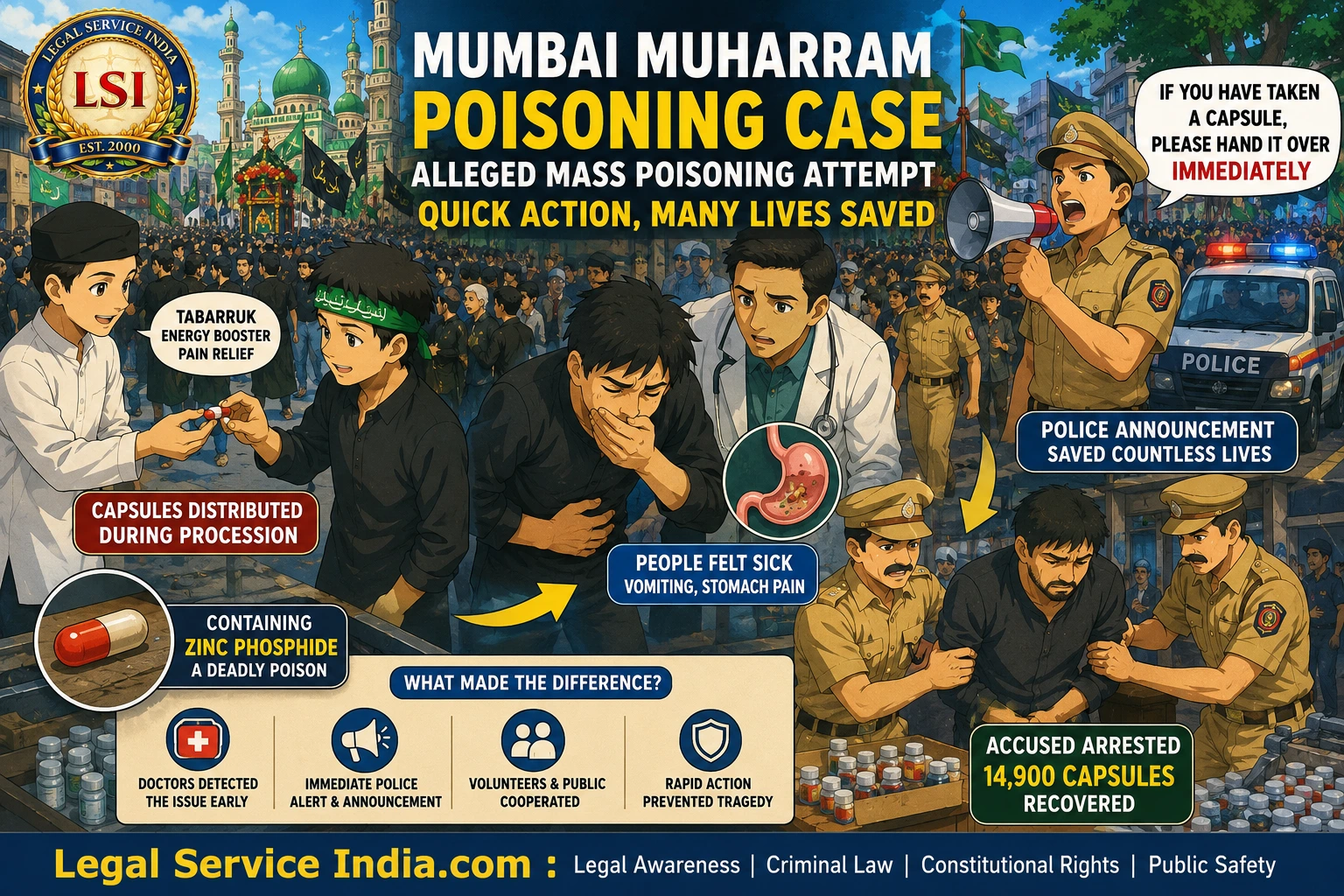
According to the Mumbai Police, a 39-year-old Pune resident was arrested after allegedly distributing capsules containing zinc phosphide, a highly toxic rodenticide, among participants of a Muharram procession. The capsules were reportedly presented as tabarruk (religious offerings) or health supplements intended to relieve pain and fatigue during the procession. Shortly after consuming the capsules, several participants experienced severe vomiting and abdominal pain, prompting immediate medical attention and triggering a rapid police response.
While the allegations are grave, it is important to emphasise at the outset that the criminal investigation is still in progress. Under the fundamental principles of Indian criminal jurisprudence, every accused person is presumed innocent until proven guilty before a competent court of law. Therefore, the facts discussed in this article are based on official police statements, publicly available reports, and the ongoing investigation. Any conclusions regarding motive, conspiracy, or criminal liability will ultimately depend upon evidence tested during trial.
This article examines the incident from a legal, forensic, medical, and constitutional perspective while avoiding speculation that is not supported by verified evidence.
The Incident: What Allegedly Happened?
According to Mumbai Police, the accused allegedly prepared thousands of capsules containing zinc phosphide and distributed them during a Muharram procession in Mumbai. The capsules were reportedly represented as pain-relief medicine, energy boosters, or tabarruk to encourage unsuspecting participants to consume them.
Police have alleged that approximately 14,900 capsules had been prepared for distribution. The capsules were reportedly handed over to participants through volunteers and members of the crowd, allowing them to circulate quickly among thousands of people attending the religious gathering.
The incident took a serious turn when multiple participants began experiencing similar medical symptoms shortly after consuming the capsules.
Symptoms Reported
- Severe vomiting
- Acute abdominal pain
- Nausea
- Signs consistent with suspected poisoning
Fortunately, medical professionals noticed the unusual pattern almost immediately.
How the Incident Was Detected
One of the most remarkable aspects of this case is the speed with which the suspected poisoning was identified.
Instead of treating each patient as an isolated medical emergency, healthcare professionals recognised that several individuals arriving from the same religious procession were exhibiting nearly identical symptoms. This raised immediate concerns that the illnesses were not coincidental.
Hospital staff promptly informed the police. The communication between medical personnel and law enforcement proved to be the turning point that prevented the alleged incident from escalating into a far larger public health disaster.
Rapid Police Response
Upon receiving information from the hospital, Mumbai Police immediately deployed personnel to the procession. According to reports, police officers did not wait for detailed forensic confirmation before initiating preventive measures. Instead, they adopted a precautionary approach aimed at protecting public safety.
Instructions to Participants
- Not to consume any capsules received from unknown individuals.
- To surrender any capsules already received.
- Not to discard them in public places where someone else might unknowingly consume them.
- To immediately report anyone distributing similar capsules.
The swift dissemination of information reportedly prevented many more capsules from being consumed.
The Role of Volunteers
Equally significant was the contribution made by volunteers assisting with the Muharram procession.
- Alerting participants
- Identifying the alleged distributor
- Helping recover remaining capsules
- Assisting elderly participants and children
- Facilitating crowd management during the emergency
The coordinated response between police, healthcare workers, volunteers, and members of the public significantly reduced the likelihood of widespread casualties.
Understanding Zinc Phosphide
What is zinc phosphide?
Zinc phosphide is commonly employed for pest control because it reacts rapidly with moisture and acids inside the stomach. When ingested, it combines with hydrochloric acid present in gastric fluid to release phosphine gas, an extremely poisonous compound. Phosphine gas interferes with cellular respiration and may rapidly damage multiple organs.
Medical Effects of Zinc Phosphide Poisoning
| Stage | Symptoms |
|---|---|
| Early Symptoms | Nausea, repeated vomiting Burning sensation in the stomach Abdominal pain Weakness Dizziness |
| Serious Symptoms | Respiratory distress, cardiac complications Liver injury, kidney failure Circulatory collapse Multi-organ dysfunction |
Because there is no universally effective antidote, treatment generally focuses on supportive care, intensive monitoring, and management of complications.
Why Medical Professionals Exercise Extra Caution
One lesser-known characteristic of zinc phosphide poisoning is the release of phosphine gas from the patient’s stomach contents. Medical personnel treating such patients must therefore exercise additional precautions.
Standard Safety Measures
- Adequate ventilation
- Personal protective equipment
- Careful handling of vomitus
- Isolation protocols where necessary
These precautions are designed to minimise occupational exposure to phosphine gas.
Why the Incident Could Have Been Far More Serious
The seriousness of this case lies not merely in the number of people who reportedly became ill but in the nature of the alleged conduct.
Large religious gatherings often involve the following:
- Dense crowds
- Continuous movement
- Distribution of food and beverages
- Public trust among participants
If a harmful substance is distributed under the guise of medicine or religious offerings, the number of potential victims may increase rapidly before authorities become aware of the danger.
Fortunately, in the present case, early medical detection and immediate police intervention reportedly interrupted further distribution.
Chronology of Events
| Time | Alleged Development |
|---|---|
| Preparation Stage | Capsules allegedly prepared using zinc phosphide. |
| Distribution | Capsules were allegedly distributed during the Muharram procession. |
| Initial Consumption | Participants consumed the capsules believing them to be beneficial. |
| Medical Symptoms | Several individuals developed vomiting and abdominal pain. |
| Hospital Alert | Doctors noticed a pattern suggesting possible poisoning. |
| Police Informed | Immediate communication made to local police authorities. |
| Public Announcement | Police warned participants through loudspeakers. |
| Recovery Operation | Remaining capsules reportedly collected and seized. |
| Arrest | Police detained the suspect and commenced an investigation. |
| Forensic Analysis | Capsules and related materials sent for scientific examination. |
Investigation: Current Status
The investigation remains ongoing.
According to publicly available information, investigators are examining multiple aspects of the case, including:
- Procurement of zinc phosphide.
- Manufacture of the capsules.
- Financial transactions.
- Digital devices.
- Electronic communications.
- Travel history.
- Whether the accused acted independently or received assistance.
At the time of writing, authorities have not publicly established any larger conspiracy, and no final conclusions regarding motive have been announced.
Importance of Avoiding Speculation
High-profile criminal investigations frequently generate rumours on social media.
Several theories have emerged regarding the alleged motive behind this incident. However, responsible legal analysis requires separating verified facts from speculation.
Unless supported by admissible evidence, assumptions relating to ideological motives, foreign involvement, organised terrorism, or political objectives remain speculative.
The role of investigators is to collect evidence objectively, while the role of courts is to determine guilt based upon legally admissible proof—not public opinion.
Public Safety Lessons
The incident offers valuable lessons for organisers of religious gatherings, public authorities, and citizens alike.
For Event Organisers
- Strengthen volunteer training.
- Monitor unauthorised distribution of food, medicines, or supplements.
- Establish emergency communication channels.
For Citizens
- Do not consume medicines or capsules from unknown persons.
- Report suspicious behaviour immediately.
- Seek urgent medical attention after consuming any unidentified substance.
For Hospitals
- Rapidly identify unusual medical clusters.
- Notify law enforcement without delay.
- Preserve medical evidence for forensic analysis.
For Police
- Coordinate with healthcare institutions.
- Deploy effective crowd communication systems.
- Secure physical evidence immediately.
The Mumbai Muharram poisoning case demonstrates how coordinated action by doctors, volunteers, police officers, and members of the public can prevent an isolated criminal act from developing into a large-scale public health emergency. Although the allegations are extremely serious, the investigation remains ongoing, and the accused is entitled to the constitutional presumption of innocence until proven guilty.
The incident also highlights the importance of preparedness, inter-agency coordination, forensic investigation, and public awareness in responding to emergencies involving mass gatherings.
The alleged distribution of poisonous capsules during a Muharram procession in Mumbai is not merely another criminal investigation. If the allegations are ultimately established through legally admissible evidence, the case could become one of the most significant prosecutions involving an alleged attempt at mass poisoning in recent Indian criminal jurisprudence.
However, legal analysis must remain objective. Criminal liability in India is determined not by media reports or public opinion but by evidence that satisfies the standard of proof beyond reasonable doubt. The prosecution bears the burden of proving every essential ingredient of the alleged offences, while the accused is entitled to all constitutional and procedural safeguards guaranteed by law.
Relevant Legal Provisions
This part examines the legal provisions that may become relevant during the investigation and eventual trial.
Presumption of Innocence: The Foundation of Criminal Justice
Before analysing the offences, it is essential to reiterate one of the oldest principles of criminal law.
Every accused person is presumed innocent until proven guilty by a competent court.
This principle flows from the following:
- Article 21 of the Constitution of India.
- Established Supreme Court jurisprudence.
- The broader principles of fair trial recognised in Indian criminal law.
Consequently, every allegation discussed in this article must be understood as part of an ongoing investigation unless and until proved in court.
Which Criminal Laws May Apply?
Depending upon the evidence collected during the investigation, several provisions of the Bharatiya Nyaya Sanhita, 2023 (BNS) may become relevant.
The precise charges will ultimately depend upon:
- Forensic evidence.
- Witness testimony.
- Digital evidence.
- Medical reports.
- Scientific examination of the recovered capsules.
- The intention established by the prosecution.
| Evidence Considered | Importance in Investigation |
|---|---|
| Forensic Evidence | Determines the presence and nature of poisonous substances. |
| Witness Testimony | Helps establish the sequence of events. |
| Digital Evidence | May reveal communication, planning, or coordination. |
| Medical Reports | Establish injuries and medical consequences. |
| Scientific Examination | Verifies the composition of the recovered capsules. |
| Proof of Intention | Assists in determining the applicable criminal offence. |
Attempt to Commit Murder
One of the foremost issues investigators may consider is whether the alleged conduct amounts to an attempt to commit murder.
For such a charge, the prosecution would ordinarily have to establish:
- Intention to cause death; or
- Knowledge that the act was likely to cause death;
- Coupled with an overt act towards commission of the offence.
Unlike preparation alone, criminal attempt begins when an individual crosses from planning into execution.
If investigators establish that poisonous capsules were knowingly distributed for human consumption, the prosecution may argue that the offence had moved beyond mere preparation.
Causing Hurt or Grievous Hurt by Poisoning
Even where death does not occur, criminal liability may arise if poisonous substances are intentionally administered.
The prosecution would be required to establish the following:
- Administration of poison.
- Medical consequences.
- Causal connection between ingestion and injury.
- Intention or knowledge.
Medical reports will therefore become central to the prosecution’s case.
Criminal Conspiracy
Investigators are reportedly examining whether the accused acted independently.
If evidence reveals coordination with other persons, issues relating to criminal conspiracy may arise.
Conspiracy cases usually rely upon the following:
- Electronic communications.
- Financial transactions.
- Travel records.
- Witness testimony.
- Recovery of incriminating materials.
- Digital evidence.
Direct evidence of conspiracy is comparatively rare.
Courts therefore frequently rely upon circumstantial evidence showing agreement between two or more persons.
Preparation Versus Attempt
One of the most interesting legal questions likely to arise concerns the distinction between preparation and attempt.
Indian criminal law generally distinguishes the following stages:
| Preparation | Attempt |
|---|---|
| Purchasing chemicals. | Acts directly connected with the commission of the intended offence. |
| Buying capsules. | Crossing from planning into execution. |
| Procuring equipment. | Distribution of poisonous capsules, if proved. |
| Planning distribution. | Actual consumption by victims, if established by evidence. |
These acts alone may not always constitute an attempt.
An attempt generally begins when the accused performs acts directly connected with the commission of the intended offence.
If investigators prove that poisonous capsules were actually distributed and consumed, the prosecution may argue that the offence had clearly progressed into the stage of attempt.
Could the UAPA Apply?
Following the incident, public discussion has focused on whether the Unlawful Activities (Prevention) Act, 1967 (UAPA), may become applicable.
Legally, this question depends entirely upon evidence.
Merely causing injury or possessing poison does not automatically convert a criminal act into a terrorist act.
Investigators would need to establish factors such as:
- Intention to strike terror among the public.
- Intention to threaten the unity, integrity, security or sovereignty of India.
- Ideological motivation.
- Organised support.
- Financing.
- Membership of prohibited organisations.
- Larger conspiratorial objectives.
Unless such elements are supported by evidence, ordinary criminal law may remain the principal legal framework.
Why Motive Alone Is Not Enough
Many criminal investigations become dominated by speculation regarding motive.
However, Indian criminal law distinguishes between the following:
- Motive
- Intention
- Knowledge
A person may possess a motive without committing an offence.
Conversely, criminal liability may exist even where the prosecution cannot establish motive, provided the remaining evidence proves guilt beyond reasonable doubt.
Therefore, investigators must rely upon objective evidence rather than speculative theories.
Difference Between Motive, Intention and Knowledge
| Legal Concept | Meaning | Role in Criminal Law |
|---|---|---|
| Motive | The reason behind an act. | Helpful but not essential for conviction. |
| Intention | The deliberate objective to commit an act. | Often essential for establishing criminal liability. |
| Knowledge | Awareness that an act is likely to produce a particular consequence. | May independently establish criminal responsibility. |
Digital Evidence Will Play a Crucial Role
Modern criminal investigations increasingly depend upon electronic evidence.
Investigators may examine:
- Mobile phones
- Laptops
- Cloud storage
- Messaging applications
- Emails
- Browsing history
- Financial transactions
- GPS data
- Online purchases
- Delivery records
Such evidence must be collected and preserved in accordance with the Bharatiya Sakshya Adhiniyam, 2023, ensuring authenticity and admissibility before the court.
Forensic Science: The Backbone of the Prosecution
Scientific evidence is expected to become the strongest component of this case.
Forensic experts are likely to examine the following:
The Capsules
Questions include:
- Did they actually contain zinc phosphide?
- What was the concentration?
- Was every capsule identical?
- Were fingerprints recovered?
Toxicology Reports
Medical experts will examine the following:
- Blood samples
- Urine samples
- Gastric contents
- Vomitus
- Tissue samples where necessary
These reports will establish whether poisoning actually occurred.
Chemical Examination
Laboratories will determine the following:
- Purity of the recovered chemical
- Quantity present
- Manufacturing process
- Source of procurement
DNA and Fingerprint Evidence
Investigators may also analyse:
- Fingerprints on capsule containers
- DNA traces
- Packaging materials
- Storage containers
- Mixing equipment
Summary of Forensic Examination
| Forensic Area | Purpose of Examination |
|---|---|
| Capsules | Confirm poison and physical evidence. |
| Toxicology | Establish whether poisoning occurred. |
| Chemical Analysis | Identify purity, quantity and source. |
| DNA & Fingerprints | Link suspects with physical evidence. |
Chain of Custody
Forensic evidence is useful only if properly preserved.
Every recovered capsule must be accounted for through an unbroken chain of custody.
The prosecution must establish the following:
- Who recovered the evidence
- When it was sealed
- How it was transported
- Where it was stored
- Who examined it
Any unexplained break in this chain may weaken evidentiary value.
Medical Evidence
Doctors who treated affected individuals may become important witnesses.
Their testimony may establish:
- Symptoms observed
- Timing of illness
- Emergency treatment
- Laboratory findings
- Medical opinion regarding poisoning
Hospital records frequently become critical documentary evidence during trial.
Burden of Proof
The prosecution carries the burden of proving the following:
- Identity of the accused
- Recovery of poisonous capsules
- Chemical composition
- Administration
- Causal relationship
- Criminal intention
The accused bears no obligation to prove innocence.
Any reasonable doubt arising from inconsistencies, unreliable witnesses or defective investigation ordinarily benefits the accused.
Key Elements the Prosecution Must Prove
| Requirement | Purpose |
|---|---|
| Identity of the accused | Establish the offender. |
| Recovery of poisonous capsules | Link physical evidence. |
| Chemical composition | Confirm the poisonous substance. |
| Administration | Show how poison was delivered. |
| Causal relationship | Connect poison with illness or death. |
| Criminal intention | Establish the required mental element. |
Possible Defence Arguments
A competent defence lawyer may challenge the prosecution on several grounds.
Possible arguments include the following:
- Lack of direct evidence
- Improper forensic collection
- Contamination of samples
- Mistaken identity
- Absence of intention
- Unreliable witnesses
- Procedural irregularities
- Defects in seizure memos
- Inadmissible electronic evidence
The success of such arguments will depend entirely upon the evidence produced during trial.
Constitutional Dimensions
The incident also raises broader constitutional issues.
Article 21
Article 21 guarantees every individual the right to life and personal liberty.
The state has a constitutional obligation to:
- protect public safety;
- maintain law and order;
- investigate serious offences;
- prosecute offenders fairly.
Fair Investigation
The Supreme Court has repeatedly emphasised that fair investigation is an essential component of Article 21.
Neither the victim nor the accused should suffer because of:
- biased investigation;
- suppression of evidence;
- procedural lapses;
- political interference.
Freedom of Religion
The incident allegedly occurred during a religious procession.
The Constitution protects peaceful religious practice.
Equally, the state has a duty to ensure that religious gatherings remain safe for all participants.
The alleged criminal conduct of one individual cannot legally be attributed to an entire religious community.
Lessons for Investigating Agencies
Cases involving alleged mass poisoning require multidisciplinary investigation involving:
- Police.
- Forensic scientists.
- Toxicologists.
- Medical experts.
- Digital forensic specialists.
- Intelligence agencies where necessary.
Coordination among these agencies significantly strengthens the integrity of the investigation.
Multidisciplinary Investigation Framework
| Agency | Primary Role |
|---|---|
| Police | Investigation and collection of evidence |
| Forensic Scientists | Scientific examination of physical evidence |
| Toxicologists | Identification and analysis of toxic substances |
| Medical Experts | Clinical examination and medical opinion |
| Digital Forensic Specialists | Recovery and analysis of electronic evidence |
| Intelligence Agencies | Threat assessment where necessary |
Public Confidence in Criminal Justice
High-profile criminal cases often generate widespread public concern.
Public confidence depends not upon sensational allegations but upon the following:
- transparent investigation;
- scientific evidence;
- judicial independence;
- fair trial;
- reasoned judicial decisions.
Ultimately, it is the courtroom—not television debates or social media—that determines criminal liability.
Judicial Scrutiny and Scientific Evidence
The Mumbai Muharram poisoning investigation illustrates the complexity of prosecuting offences involving alleged mass poisoning. While the allegations, if proved, could attract some of the most serious provisions of Indian criminal law, every element of the prosecution’s case must withstand rigorous judicial scrutiny.
Scientific evidence, toxicology reports, electronic records, witness testimony, and procedural compliance will determine whether the prosecution can establish guilt beyond reasonable doubt. At the same time, constitutional guarantees require that the accused receive a fair investigation and an impartial trial.
Key Factors in Prosecution
| Factor | Importance |
|---|---|
| Scientific evidence | Supports factual findings |
| Toxicology reports | Establishes presence and nature of poison |
| Electronic records | Corroborates events and communications |
| Witness testimony | Provides direct and circumstantial evidence |
| Procedural compliance | Ensures admissibility and fairness |
Broader Constitutional and Policy Implications
The alleged Mumbai Muharram poisoning case has implications that extend well beyond an ordinary criminal prosecution. It raises difficult questions concerning public safety, intelligence gathering, forensic preparedness, crisis management, constitutional governance, and the ability of law enforcement agencies to respond rapidly to threats emerging during large public gatherings.
If the allegations are ultimately proved before a court of law, the case may become an important precedent for investigating offences involving alleged mass poisoning and large-scale public endangerment. Equally, if any of the allegations fail to withstand judicial scrutiny, the case will reinforce the importance of scientific evidence, procedural safeguards, and the presumption of innocence in India’s criminal justice system.
This final part examines relevant judicial principles, policy implications, preventive measures, and broader lessons that emerge from the incident.
Key Policy Considerations
- Public safety during large gatherings.
- Effective intelligence gathering.
- Forensic preparedness.
- Crisis management.
- Constitutional governance.
- Rapid law enforcement response.
- Scientific evidence and procedural safeguards.
- Presumption of innocence.
The Supreme Court’s Consistent Approach to Serious Criminal Cases
Although there is no Supreme Court judgement dealing specifically with an alleged attempt to poison thousands of persons during a religious procession, the Court has consistently laid down principles that govern serious criminal investigations.
These principles include:
- Fair and impartial investigation.
- Scientific collection of evidence.
- Preservation of forensic material.
- Protection of constitutional rights.
- Speedy yet fair trial.
- Independent judicial evaluation.
- Presumption of innocence until conviction.
The Supreme Court has repeatedly observed that criminal investigations must be guided by evidence rather than emotion or public pressure.
Key Principles Governing Serious Criminal Investigations
| Principle | Purpose |
|---|---|
| Fair and impartial investigation | Ensures neutrality throughout the investigation. |
| Scientific collection of evidence | Strengthens the credibility of the prosecution’s case. |
| Preservation of forensic material | Protects crucial scientific evidence from contamination. |
| Protection of constitutional rights | Safeguards the rights of both victims and accused persons. |
| Speedy yet fair trial | Balances timely justice with due process. |
| Independent judicial evaluation | Ensures decisions are based solely on admissible evidence. |
| Presumption of innocence until conviction | Protects the fundamental rights of the accused. |
Why Scientific Evidence Matters More Than Public Opinion
Incidents involving allegations of mass casualties often generate intense media attention.
However, courts decide criminal cases based upon admissible evidence—not speculation.
The prosecution will therefore have to establish every essential element of the alleged offences through reliable material such as the following:
- Forensic reports.
- Chemical examination.
- Medical records.
- Electronic evidence.
- Witness testimony.
- Documentary evidence.
- Scientific expert opinions.
Even where public sentiment strongly favours conviction, criminal courts remain bound by the principle that guilt must be proved beyond reasonable doubt.
Types of Evidence Likely to Be Relied Upon
| Evidence Type | Importance |
|---|---|
| Forensic reports | Establish scientific findings. |
| Chemical examination | Determines the presence of toxic substances. |
| Medical records | Corroborate injuries and treatment. |
| Electronic evidence | Supports digital reconstruction of events. |
| Witness testimony | Provides first-hand accounts. |
| Documentary evidence | Supports factual assertions. |
| Scientific expert opinions | Explains technical and forensic findings. |
Importance of Forensic Toxicology
One of the defining features of this prosecution is likely to be forensic toxicology.
Experts may be required to answer several important questions:
- Did the capsules actually contain zinc phosphide?
- What quantity was present in each capsule?
- Could that quantity reasonably cause death or serious injury?
- Did the victims actually ingest the capsules?
- Were the medical symptoms consistent with zinc phosphide poisoning?
- Could the symptoms have another explanation?
These questions require scientific expertise rather than speculation.
Key Forensic Toxicology Questions
| Question | Purpose of Investigation |
|---|---|
| Did the capsules contain zinc phosphide? | Confirms the alleged poison. |
| What quantity was present? | Assesses toxicity and risk. |
| Could the quantity cause death or serious injury? | Determines potential criminal liability. |
| Did the victims ingest the capsules? | Establishes exposure. |
| Were symptoms consistent with poisoning? | Links medical evidence to the alleged substance. |
| Could there be another explanation? | Rules out alternative causes. |
Digital Investigation: The Modern Reality
Modern criminal investigations increasingly depend upon electronic evidence.
Investigators are likely to analyse:
- Mobile phones.
- Computers.
- Messaging applications.
- Internet searches.
- Purchase records.
- GPS location history.
- Financial transactions.
- CCTV footage.
- Social media activity.
Digital evidence may help investigators reconstruct the following:
- Planning.
- Procurement.
- Communication.
- Travel.
- Timing of events.
- Possible associates.
Proper preservation of such evidence is essential for admissibility before the court.
Electronic Evidence Used in Modern Investigations
| Digital Evidence | Potential Investigative Value |
|---|---|
| Mobile phones | Communication and location records. |
| Computers | Documents, browsing history and files. |
| Messaging applications | Chats and coordination. |
| Internet searches | Research and planning activity. |
| Purchase records | Procurement of relevant materials. |
| GPS location history | Movement and travel patterns. |
| Financial transactions | Payments and financial links. |
| CCTV footage | Visual reconstruction of events. |
| Social media activity | Posts, communications and interactions. |
Public Safety During Religious Gatherings
India hosts thousands of large religious events every year involving millions of participants.
Such gatherings require comprehensive planning because even a single malicious act can create panic and endanger lives.
Authorities generally focus upon:
- Crowd management.
- Medical preparedness.
- Fire safety.
- Traffic control.
- Disaster response.
- Emergency evacuation.
- Public announcements.
- Intelligence gathering.
Key Public Safety Priorities
| Priority Area | Purpose |
|---|---|
| Crowd Management | Maintain orderly movement and prevent stampedes. |
| Medical Preparedness | Ensure immediate treatment during emergencies. |
| Fire Safety | Reduce fire-related risks. |
| Traffic Control | Maintain smooth movement of vehicles and emergency services. |
| Disaster Response | Respond quickly to unforeseen incidents. |
| Emergency Evacuation | Safely evacuate participants when required. |
| Public Announcements | Provide timely warnings and safety instructions. |
| Intelligence Gathering | Identify and prevent potential threats. |
The present case demonstrates the importance of integrating health services with policing during mass gatherings.
The Role of Healthcare Professionals
Doctors and hospital staff played a pivotal role in preventing the situation from escalating.
Their responsibilities included:
- Recognising unusual medical patterns.
- Providing immediate treatment.
- Preserving medical evidence.
- Informing law enforcement.
- Assisting forensic investigators.
This case illustrates how healthcare professionals often become the first line of defence in identifying deliberate poisoning incidents.
Healthcare Response Summary
| Responsibility | Importance |
|---|---|
| Recognising unusual medical patterns | Helps detect possible poisoning early. |
| Providing immediate treatment | Reduces health risks to affected individuals. |
| Preserving medical evidence | Supports criminal investigations. |
| Informing law enforcement | Enables rapid police action. |
| Assisting forensic investigators | Strengthens evidence collection. |
Police Response: A Case Study in Rapid Intervention
One of the most commendable aspects of the incident was the reported speed of the police response.
Rather than waiting for laboratory confirmation, officers reportedly adopted preventive measures immediately by:
- Issuing public announcements.
- Stopping further distribution.
- Recovering suspicious capsules.
- Detaining the suspect.
- Securing evidence.
Prompt intervention is often the difference between an isolated incident and a large-scale public tragedy.
Crisis Communication
Effective communication can save lives.
The use of loudspeaker announcements reportedly enabled thousands of participants to receive immediate warnings.
Best practices for emergency communication include:
- Clear instructions.
- Avoiding panic.
- Multiple announcement points.
- Coordination with volunteers.
- Continuous updates.
Large public gatherings should always maintain functioning public announcement systems.
Emergency Communication Best Practices
| Practice | Benefit |
|---|---|
| Clear instructions | Improves public understanding. |
| Avoiding panic | Maintains order during emergencies. |
| Multiple announcement points | Expands communication coverage. |
| Coordination with volunteers | Ensures consistent messaging. |
| Continuous updates | Keeps participants informed. |
Preventing Similar Incidents
The alleged incident highlights several preventive measures that may reduce future risks.
1. Regulation of Distribution Activities
During large public events, organisers should discourage unauthorised distribution of:
- Medicines.
- Capsules.
- Food items.
- Drinks.
- Religious offerings from unidentified persons.
2. Volunteer Training
Volunteers should receive basic training regarding the following:
- Suspicious behaviour.
- Medical emergencies.
- Crowd communication.
- Evidence preservation.
- Police coordination.
3. Medical Surveillance
Temporary medical centres should monitor unusual illness patterns.
Multiple patients presenting similar symptoms may indicate the following:
- Food contamination.
- Chemical exposure.
- Deliberate poisoning.
- Infectious disease outbreaks.
4. Public Awareness
Citizens should remember:
- Never consume unidentified medicines.
- Report suspicious distribution immediately.
- Seek urgent medical care after unexpected symptoms.
Public vigilance remains one of the strongest safeguards against criminal acts.
Preventive Measures Overview
| Preventive Measure | Objective |
|---|---|
| Regulation of Distribution Activities | Prevent unauthorised distribution of potentially harmful items. |
| Volunteer Training | Improve emergency preparedness and coordination. |
| Medical Surveillance | Detect unusual illness patterns at an early stage. |
| Public Awareness | Encourage vigilance and timely reporting of suspicious activities. |
Challenges Before the Prosecution
Although the allegations are serious, prosecutors may face several legal challenges.
Among them are:
- Establishing intention.
- Linking recovered capsules to the accused.
- Proving actual administration.
- Demonstrating causation.
- Explaining forensic findings.
- Maintaining an unbroken chain of custody.
- Defending electronic evidence against legal challenge.
Every criminal case ultimately depends upon the quality of evidence rather than the seriousness of the allegation.
Key Prosecution Challenges
| Challenge | Legal Significance |
|---|---|
| Establishing Intention | Demonstrating the requisite criminal mens rea. |
| Linking Recovered Capsules | Connecting physical evidence to the accused. |
| Proving Actual Administration | Showing that the substance was actually administered. |
| Demonstrating Causation | Establishing a direct link between the act and the harm caused. |
| Forensic Findings | Explaining and validating scientific evidence. |
| Chain of Custody | Ensuring evidence remained untampered throughout investigation. |
| Electronic Evidence | Defending admissibility and authenticity. |
Possible Defence Strategy
The defence may seek to challenge the prosecution on several grounds, including:
- Reliability of witness testimony.
- Forensic methodology.
- Sample contamination.
- Procedural irregularities.
- Defects in seizure.
- Electronic evidence authentication.
- Absence of criminal intention.
- Lack of direct evidence connecting the accused to every recovered capsule.
These issues will ultimately be assessed by the trial court.
Potential Defence Arguments
| Ground of Challenge | Possible Defence Focus |
|---|---|
| Witness Testimony | Questioning credibility and consistency. |
| Forensic Methodology | Challenging scientific procedures and conclusions. |
| Sample Contamination | Raising doubts about evidence integrity. |
| Procedural Irregularities | Highlighting violations of legal procedure. |
| Defects in Seizure | Questioning the legality of evidence collection. |
| Electronic Evidence | Disputing authentication and admissibility. |
| Criminal Intention | Arguing the absence of mens rea. |
| Direct Evidence | Pointing to evidentiary gaps. |
Constitutional Balance
This case demonstrates the delicate balance that constitutional democracies must maintain.
Responsibilities of the State
The state must:
- Protect public safety.
- Investigate serious offences.
- Punish offenders according to law.
Constitutional Safeguards
Simultaneously, it must ensure:
- Fair investigation.
- Fair trial.
- Judicial independence.
- Protection against arbitrary prosecution.
- Respect for constitutional rights.
Neither public outrage nor media coverage can replace due process.
Broader Lessons for Society
The alleged Mumbai poisoning case reminds us that modern public safety depends upon cooperation between multiple institutions.
The successful prevention of larger harm reportedly involved:
- Doctors.
- Nurses.
- Police officers.
- Volunteers.
- Emergency responders.
- Members of the public.
No single agency could have managed the situation alone.
Stakeholders in Public Safety Response
| Stakeholder | Role |
|---|---|
| Doctors | Medical diagnosis and treatment. |
| Nurses | Patient care and emergency support. |
| Police Officers | Investigation and public order. |
| Volunteers | Ground-level assistance and coordination. |
| Emergency Responders | Rapid crisis management. |
| Members of the Public | Reporting incidents and supporting response efforts. |
Final Legal Assessment
If the allegations ultimately withstand judicial scrutiny, the Mumbai Muharram poisoning case may become one of the most significant criminal prosecutions involving an alleged attempt to endanger a large number of people through the administration of poison. Its legal significance would lie not only in the gravity of the alleged conduct but also in the manner in which forensic science, digital evidence, emergency response, and constitutional safeguards intersect within a single investigation.
At the same time, the case serves as a reminder that the rule of law demands restraint. Allegations, however serious, cannot substitute for proof. Investigating agencies must conduct a fair, impartial, and scientifically rigorous inquiry, while courts must evaluate the evidence independently, free from external influence or public pressure.
Conclusion
The Mumbai Muharram poisoning case has highlighted the strengths and challenges of India’s criminal justice system. On one hand, the swift action of healthcare professionals, volunteers, and police personnel reportedly prevented a potentially more serious public health emergency. On the other hand, the case underscores the importance of meticulous forensic investigation, procedural fairness, and judicial oversight in ensuring that justice is both done and seen to be done.
Regardless of the eventual outcome of the trial, the incident offers valuable lessons for law enforcement agencies, public health authorities, event organisers, and citizens.
Key Takeaways
- Enhanced preparedness.
- Scientific investigation.
- Inter-agency coordination.
- Public awareness.
These measures are essential to safeguarding large public gatherings in an increasingly complex security environment.
Ultimately, the measure of the criminal justice system will not be the severity of the allegations but its ability to establish the truth through lawful investigation, reliable evidence, and a fair judicial process. That commitment to due process remains the cornerstone of the rule of law and the strongest safeguard of both public safety and individual liberty.