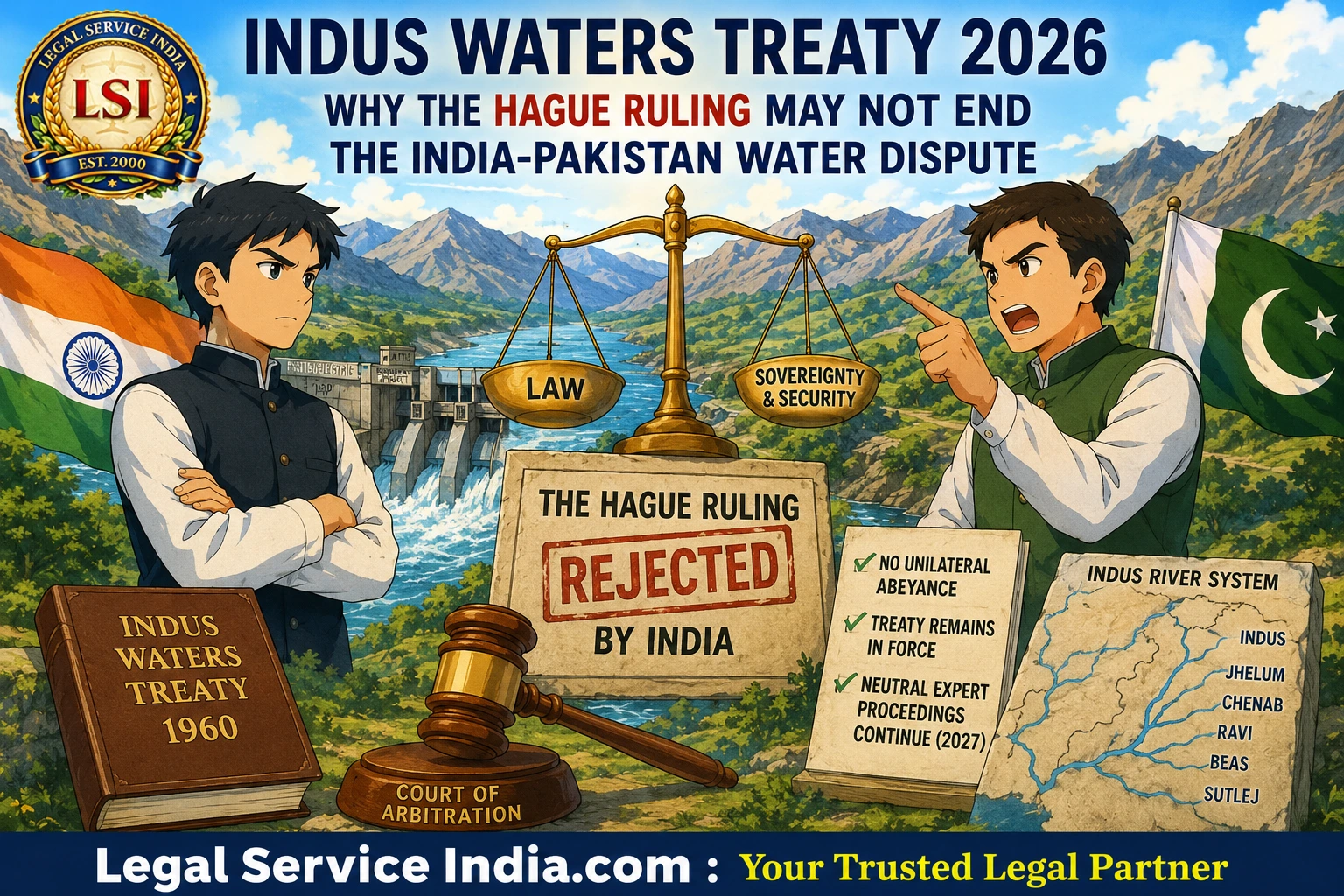
Indus Waters Treaty 2026: Why The Hague Ruling May Not End The India-Pakistan Water Dispute
“A river does not understand borders, treaties, or politics. It simply flows. But when trust between nations dries up, even water can become a weapon.” — Adv. Tarun Choudhury, Supreme Court Advocate
Introduction: A Water Dispute That Is Really About Law, Sovereignty And Security
The latest development in the Indus Waters Treaty dispute between India and Pakistan has created headlines around the world. On August 31, 2026, a Court of Arbitration sitting under the treaty framework at The Hague ruled that the 1960 treaty remains in force and that India’s decision to place it in “abeyance” was not permissible under the treaty or applicable international law.
The tribunal also imposed interim restrictions concerning certain construction activities at India’s Ratle Hydroelectric Project on the Chenab River, pending the determination of technical issues by a World Bank-appointed Neutral Expert.
But there is an extraordinary legal complication: India does not recognise the jurisdiction of this Court of Arbitration and has rejected the ruling.
That means the real story is not simply whether India has “lost” a water case. The deeper question is whether an international arbitral tribunal can produce a legally effective decision against a state that says the tribunal itself was unlawfully constituted and has never accepted its jurisdiction.
Also Read: World Inequality Report 2026: India’s Wealth Gap, Top 1%, and Economic Inequality
What Did The Court Of Arbitration Decide?
The August 31, 2026 decision addressed the status of the Indus Waters Treaty after India’s decision in April 2025 to place it in abeyance following the Pahalgam terrorist attack.
The tribunal concluded that the treaty contains no provision allowing either India or Pakistan unilaterally to suspend or terminate its operation, nor does it recognise “abeyance” as a separate legal status. It therefore held that the treaty remains fully in force and that India continues to be subject to its obligations concerning the Western Rivers and hydroelectric projects.
The tribunal also considered India’s stated reasons for its action, including national sovereignty, alleged treaty violations, terrorism, population and technological changes, climate change and armed conflict. It concluded that these grounds did not legally justify unilateral suspension or termination of the treaty.
What Did The Tribunal Actually Order?
However, this must be understood correctly.
The tribunal did not order India to physically turn on or release a particular quantity of water to Pakistan. The dispute is principally about the continuing legal operation of the treaty and India’s rights and obligations concerning projects on the Western Rivers.
Why Has India Rejected The Ruling?
India’s objection goes to the foundation of the proceedings: jurisdiction.
The Indus Waters Treaty contains a detailed dispute-resolution mechanism. Article IX provides different procedures for different categories of disagreements. Certain “questions” are handled through the Permanent Indus Commission; specified “differences” may go to a Neutral Expert; and disputes falling within the treaty’s relevant provisions may be referred to a Court of Arbitration under Annexure G.
The present controversy arose because India and Pakistan invoked different mechanisms concerning the Kishenganga and Ratle hydroelectric projects.
- Pakistan sought a Court of Arbitration.
- India sought a Neutral Expert.
- The World Bank subsequently facilitated the constitution of both processes.
India has consistently argued that this resulted in parallel proceedings over substantially connected issues and that the constitution of the Court of Arbitration breached the treaty framework.
The World Bank, however, has explained that the treaty provides separate mechanisms and that its role is essentially procedural. The Bank has also stated that both mechanisms possess authority to determine their own competence within the treaty framework.
India nevertheless refused to participate in the Court of Arbitration proceedings and has repeatedly described the tribunal as illegally constituted.
After the August 31 ruling, India’s Ministry of External Affairs again rejected the tribunal’s authority and maintained that India’s decision to hold the treaty in abeyance remains in force.
How Did The Pahalgam Attack Change The Treaty?
The present crisis cannot be understood without the events of April 2025.
Following the Pahalgam terrorist attack, India announced that the Indus Waters Treaty would be held in abeyance until Pakistan “credibly and irrevocably” ended its alleged support for cross-border terrorism.
Pakistan denied involvement in the attack and maintained that the treaty continued to bind both countries.
India’s action represented a dramatic departure from the treaty’s history. The agreement had survived wars, diplomatic crises and decades of hostility since it was signed in 1960.
The tribunal has now essentially separated the security dispute from the treaty question. Its reasoning was that the Indus Waters Treaty does not itself regulate terrorism or the use of force and that India’s stated grounds did not satisfy the legal requirements for unilateral suspension or termination.
What Is The Indus Waters Treaty?
The Indus Waters Treaty of 1960 was negotiated with World Bank involvement and allocates the waters of six rivers of the Indus system.
| Rivers | Broad Treaty Arrangement |
|---|---|
| Ravi, Beas and Sutlej | Eastern Rivers principally allocated to India’s unrestricted use, subject to treaty provisions |
| Indus, Jhelum and Chenab | Western Rivers principally allocated to Pakistan, while India retains specified rights of use |
The popular description that “India owns three rivers and Pakistan owns three” is therefore legally misleading.
India retains important rights on the Western Rivers, including the right to develop hydroelectric projects subject to detailed technical limitations. Pakistan’s concerns about projects such as Ratle and Kishenganga arise largely from disagreements over whether particular engineering features comply with those limitations.
Why The Ratle Hydroelectric Project Matters
The Ratle Hydroelectric Project is a run-of-the-river project on the Chenab River.
Pakistan has challenged aspects of the design of Ratle and Kishenganga, arguing that certain features exceed India’s permitted rights under the treaty. India maintains that its projects are permissible under the treaty.
The dispute involves highly technical questions concerning matters such as pondage, dam structures, water-intake arrangements and project design.
This is precisely why the Neutral Expert mechanism matters.
According to the latest proceedings, the Neutral Expert is expected to make a final determination concerning the technical treaty questions by July 2027. The Court of Arbitration has meanwhile imposed restrictions on certain construction activities at Ratle until 90 days after the Neutral Expert’s final decision.
The Hague Tribunal Is Not The International Court Of Justice
This distinction is extremely important for legal accuracy.
News reports sometimes use the expression “international court in The Hague”, but the body involved here is not the International Court of Justice (ICJ).
The proceedings arise from a Court of Arbitration constituted under the Indus Waters Treaty, with the Permanent Court of Arbitration providing the institutional framework.
The PCA itself describes the proceedings as the “Indus Waters Western Rivers Arbitration” instituted by Pakistan against India pursuant to Article IX and Annexure G of the treaty.
That distinction matters because the jurisdictional basis, composition, powers and legal framework are different from those of the ICJ.
Can The Hague Tribunal Force India To Comply?
This is perhaps the most misunderstood part of the controversy.
An arbitral tribunal does not possess its own police force or military authority to enter Jammu and Kashmir and physically stop construction.
But it would also be incorrect to conclude that an international arbitral decision is automatically meaningless simply because enforcement is not physical.
International adjudication operates through treaty obligations, state responsibility, diplomatic consequences and the broader legal consequences of non-compliance.
In this case, however, India has adopted a much more fundamental position: it says that the tribunal lacks jurisdiction in the first place.
Therefore, the immediate practical question is not simply “Will India obey?” It is whether the dispute over the tribunal’s authority itself can be resolved.
The Most Important Legal Problem: Two Dispute-Resolution Tracks
One of the most significant aspects of this case is the coexistence of the Court of Arbitration and Neutral Expert processes.
The World Bank has acknowledged that the treaty contains different mechanisms for different types of disputes and that both mechanisms have proceeded independently.
The Court of Arbitration has already ruled on its own competence and has continued with the case. The PCA’s case record shows earlier decisions on competence, treaty interpretation and maximum pondage, followed by the August 2026 award concerning treaty status and interim measures.
India, however, has refused to participate in that arbitration.
From an international-law perspective, this creates an unusual confrontation between jurisdiction asserted by the tribunal and jurisdiction denied by one of the parties.
That issue may ultimately prove more consequential than the immediate Ratle order.
Also Read: India GDP 7.8% vs 2.6%: Was GDP cut from ₹86 Lakh Crore to ₹80 Lakh Crore?
Can India Simply Stop Pakistan’s Water?
No—not in the simplistic sense often suggested in political debate.
The suspension of the treaty does not mean that India can instantly shut off the Indus system.
India’s existing storage and infrastructure capacity does not permit an immediate physical cessation of the vast quantities of water flowing downstream. The actual impact of any future Indian projects would depend upon infrastructure, storage, diversion capacity, seasonal river flows and the technical characteristics of individual projects.
Therefore, the statement that “India has stopped Pakistan’s water” would be legally and technically inaccurate.
The more serious issue is what India may be able to do over time if it chooses to develop its infrastructure on the Western Rivers outside the operational constraints of the treaty.
What Does Pakistan Gain From The Ruling?
Pakistan gains something extremely important even if India refuses to accept the decision: an international legal finding supporting its interpretation of the treaty.
Islamabad can use the decision diplomatically to argue that the treaty remains binding and that India’s unilateral action has been rejected by an arbitral tribunal constituted under the treaty framework.
Pakistan has already welcomed the decision as reaffirming the treaty’s continuing validity and the operation of its dispute-resolution mechanisms.
But the ruling does not automatically resolve Pakistan’s practical concerns over future water flows or India’s hydroelectric development.
What Does India Gain Or Risk?
India’s principal argument is strategic rather than merely hydraulic.
New Delhi considers the treaty framework increasingly inadequate in light of terrorism, climate change, population pressures, energy requirements and changing security conditions.
India also wants to maximise the use of the rights available to it over the Western Rivers and develop hydroelectric infrastructure in Jammu and Kashmir.
The legal risk, however, is equally clear.
If India acts outside treaty constraints while the treaty is held by the tribunal to remain in force, Pakistan is likely to continue challenging those actions through diplomatic and legal channels.
Can The Indus Waters Treaty Be Revived?
Technically, the treaty is still there.
Politically, however, the relationship that sustained it has suffered an enormous breakdown.
The tribunal has taken the position that the treaty remains legally binding and cannot be unilaterally suspended. The treaty itself provides that modification or termination requires action by both countries through a further treaty.
India has suggested renegotiation, but Pakistan has little obvious incentive to voluntarily surrender the existing arrangement, which it regards as fundamental to its water security.
Consequently, a negotiated replacement treaty appears politically difficult in the present environment.
Conclusion: The Real Battle Is Over the Rules of the River
The latest Indus Waters Treaty ruling does not bring the India-Pakistan water dispute to an end.
It does something more complicated.
It puts two fundamentally opposing legal positions on the table.
The Court of Arbitration says the treaty remains in force and that India cannot unilaterally place it in abeyance. India says the tribunal itself has no jurisdiction and that its decision cannot affect India’s sovereign actions.
Meanwhile, the Neutral Expert process concerning the technical disputes over projects such as Ratle and Kishenganga continues toward an expected decision in 2027.
Two Fundamentally Opposing Legal Positions
| Position | Legal Stand |
|---|---|
| Court of Arbitration | The Indus Waters Treaty remains in force and India cannot unilaterally place it in abeyance. |
| India | The tribunal has no jurisdiction and its decision cannot affect India’s sovereign actions. |
| Neutral Expert Process | The technical disputes involving projects such as Ratle and Kishenganga continue toward an expected decision in 2027. |
Diplomatic and Legal Impact of the Hague Ruling
For Pakistan, the Hague ruling is an important diplomatic and legal victory.
For India, the immediate priority appears to be maintaining its position on terrorism and national security while developing the infrastructure necessary to exercise its rights over the Western Rivers.
But there is a larger lesson here.
The Indus Waters Treaty Depends on Mutual Confidence
Water treaties are ultimately sustained not merely by legal language, but by mutual confidence.
The Indus Waters Treaty survived three wars because both countries continued to accept the basic framework. Today, that foundation of trust is severely damaged.
The future therefore may not be decided by the August 31 ruling alone.
It may be decided by what happens next:
- Whether India and Pakistan continue their confrontation through competing legal mechanisms.
- Whether the 2027 Neutral Expert decision changes the technical dispute.
- Whether the two countries eventually recognise that a 1960 water-sharing framework needs a modern solution for a very different geopolitical and climatic era.
The Indus will continue to flow.
The real question is whether India and Pakistan can agree on the rules governing that flow.
Need Legal Guidance on Complex International or Constitutional Issues?
When disputes involve international treaties, sovereignty, state responsibility, arbitration, or constitutional law, understanding the legal position can make all the difference.
“The Indus will keep flowing. The real question is whether trust between two nations will.” — Adv. Tarun Choudhury, Supreme Court Advocate
Adv. Tarun Choudhury
Supreme Court Advocate | 25+ Years of Legal Experience
For professional legal consultation and guidance:
- 📞 Call: 9650499965
- 💬 WhatsApp: 8851978611
Discuss your legal concerns with an experienced Supreme Court Advocate.
Frequently Asked Questions About the Indus Waters Treaty
Based on the article, here are 5 SEO-friendly Frequently Asked Questions targeting searches around the Indus Waters Treaty, India-Pakistan water dispute, the Hague ruling, Ratle project, and international arbitration.
1. What Did the Hague Court of Arbitration Decide on the Indus Waters Treaty in 2026?
The Hague Court of Arbitration ruled on August 31, 2026, that the Indus Waters Treaty remains in force and that India could not unilaterally place the treaty in “abeyance” under the treaty framework or applicable international law.
2. Can India Legally Suspend or Terminate the Indus Waters Treaty Unilaterally?
According to the Court of Arbitration’s ruling discussed in the article, the Indus Waters Treaty does not provide for unilateral suspension or termination by either India or Pakistan.
The treaty provides for modification or termination through a further agreement between both countries.
3. Can the Hague Tribunal Force India to Release Water to Pakistan?
No. The article clarifies that the ruling does not order India to release a specific quantity of water to Pakistan.
An arbitral tribunal also does not have its own police or military force to physically enforce an order.
The immediate legal dispute concerns the treaty’s continuing operation and India’s obligations regarding the Western Rivers.
4. What Is the Ratle Hydroelectric Project Dispute Between India and Pakistan?
The Ratle Hydroelectric Project, located on the Chenab River, is a run-of-the-river project.
Pakistan has challenged aspects of its design, while India maintains that the project complies with its rights under the Indus Waters Treaty.
Technical issues include questions concerning pondage, dam structures, water-intake arrangements and project design.
5. Is the Hague Court of Arbitration the Same as the International Court of Justice (ICJ)?
No. The body involved in the Indus Waters dispute is not the International Court of Justice (ICJ).
The proceedings arise under Article IX and Annexure G of the Indus Waters Treaty, with the Permanent Court of Arbitration providing the institutional framework.
Its jurisdiction and legal framework are therefore different from those of the ICJ.
SEO-Friendly Key Takeaways: Indus Waters Treaty 2026
- Indus Waters Treaty: The Indus Waters Treaty remains at the centre of the India-Pakistan water dispute, with major questions involving international law, sovereignty, national security and treaty obligations.
- Hague Court of Arbitration ruling: The Hague Court of Arbitration ruled on August 31, 2026, that the Indus Waters Treaty remains in force and that India could not unilaterally place it in “abeyance” under the treaty framework.
- India’s position: India has rejected the tribunal’s jurisdiction and ruling, arguing that the Court of Arbitration was unlawfully constituted and that India did not accept its authority.
- Water release: The Hague tribunal did not order India to release a specific quantity of water to Pakistan. The ruling primarily concerns the continuing legal operation of the treaty and India’s obligations regarding projects on the Western Rivers.
- Ratle Hydroelectric Project: The Ratle Hydroelectric Project is a key part of the dispute, with India and Pakistan disagreeing over whether aspects of the project’s design comply with India’s permitted rights under the Indus Waters Treaty.
- Parallel dispute-resolution mechanisms: The Court of Arbitration and Neutral Expert are separate dispute-resolution mechanisms under the Indus Waters Treaty, creating an unusual situation in which two related processes have proceeded in parallel.
- Court of Arbitration and ICJ: The Hague tribunal is not the International Court of Justice (ICJ). The proceedings arise under Article IX and Annexure G of the Indus Waters Treaty, with the Permanent Court of Arbitration providing the institutional framework.
- India cannot simply turn off Pakistan’s water overnight: Physical water flows depend on existing infrastructure, storage capacity, seasonal river flows, diversion capacity and future development of projects.
- Pakistan’s diplomatic and legal advantage: Pakistan gains an important diplomatic and legal advantage from the Hague ruling, because the tribunal has supported its position that the treaty continues to operate. However, the ruling does not by itself resolve the practical dispute over future water flows or hydroelectric development.
- Future of the Indus Waters Treaty: The future of the Indus Waters Treaty may depend on the 2027 Neutral Expert process, continued India-Pakistan negotiations, and the possibility of a modernised water-sharing framework.
Summary
In simple terms: The 2026 Hague ruling has not ended the India-Pakistan Indus Waters dispute.
The Court of Arbitration says the Indus Waters Treaty remains legally in force, while India rejects the tribunal’s jurisdiction and maintains its decision to hold the treaty in abeyance.
The parallel Neutral Expert process on technical disputes involving projects such as Ratle and Kishenganga remains significant.
The deeper conflict is now about treaty law, jurisdiction, sovereignty, water security and the future rules governing the Indus River system.