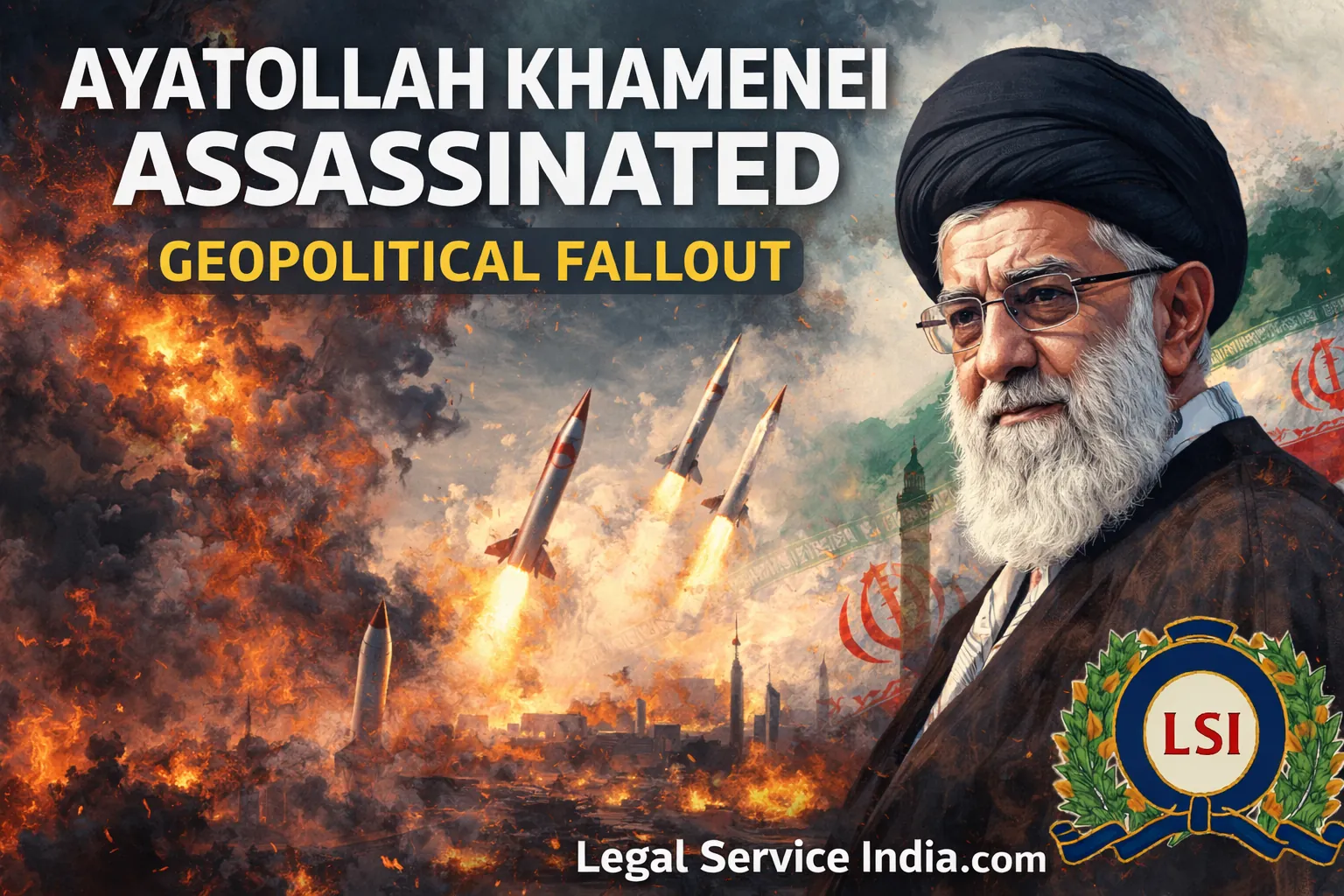
A Sudden Geopolitical Shift In The Middle East
The events that unfolded in Iran over the past 24 hours have transformed forty years of history almost overnight. The balance of power, regional influence, and even the concept of peace in the Middle East now appear fundamentally altered.
The news is that Ayatollah Khamenei has now been assassinated. This confirmation has now come to us from Iranian state media. What does this mean? What is its impact? What do we have to do with it? These are all things that are very important to discuss.
The rapid pace at which the situation in the Middle East is changing, its impact will have an impact on the entire world, including India.
Some Key Questions To Understand The Situation
The discussion revolves around these crucial questions:
- What happened in the last 24 hours?
- What impact does Khamenei’s death bring?
- How does the Iranian political system function?
- Is Iran’s chain of command still intact?
- What does this event mean for global geopolitics and international order?
What Happened In The Last 24 Hours?
First of all let us understand what happened. This attack occurs on 28 February. After months of warning, we learn that an aerial strike has been launched. Israel, on its part, America launched these attacks from its bases and aircraft carriers.
The motive, unlike previous attacks, in which the target was nuclear sites to damage their nuclear program or terminate scientists, was different this time. This time the target was top military and political leadership so that they should be eliminated and a change of guard can take place.
This has been done so that democracy can be restored and people can come out on the streets. At least this has been said publicly.
But somewhere Iran said first that our leadership is completely intact and that no harm had been done to them. But one thing was clear: Iran was furious.
The way it opened a front against seven countries and started attacking wherever there were American bases made one thing clear: Iran was agitated and there was no holding back.
There was so much retaliation that people started saying that something is wrong. The state media then gradually goes silent.
- First there was talk that Khamenei will come or the President will come and address the nation on television.
- But that did not happen.
- By nightfall, Netanyahu reports that there were indications that Khamenei had been eliminated.
- Then Donald Trump tweets about the development.
Eventually, Iranian state media also confirmed that he had been assassinated.
Role Of Mossad And Precision Intelligence
The question arises: how did America and Israel know how to perform such a precision strike?
Trump himself hinted that while America has never backed down from bombing, the ground intelligence that Israel brings has turned the whole game around.
The intelligence network of Mossad seems to have penetrated deep inside Iran.
Precision-guided missiles have existed for years, but the key question has always been:
- Where should the missile go?
- How should the exact target be identified?
It appears that Mossad infiltrated Iranian systems and extracted critical information that made the operation possible.
Satellite images suggest bunker-busting bombs were used, indicating that Khamenei was hiding inside a bunker and was targeted there.
Damage To Iran’s Top Leadership
The attack was not limited to Khamenei alone.
Reports indicate that senior commanders of the Iranian Revolutionary Guard Corps (IRGC) were also eliminated.
This indicates major damage to Iran’s top leadership and demonstrates how intelligence operations redefined modern warfare.
Who Was Ayatollah Khamenei?
To understand the magnitude of this event, one must understand who Khamenei was.
- He ruled Iran for approximately 37 years.
- He exercised absolute authority over the country.
- He was 86 years old and had declining health but maintained an iron grip on power.
He had seen several American presidents from Bush to Trump.
The revolution in Iran was initiated by Ayatollah Khomeini, but it was Khamenei who built the complete state structure afterward.
He ensured that:
- The Revolutionary Guards
- The military
- The judiciary
remained loyal to him.
This structure effectively created a theocratic state with strong centralized authority.
Public Protests And Internal Unrest
Iran has experienced repeated waves of protests.
- The Mahsa Amini protests in 2022.
- Recent protests in 2026 over economic crisis.
The regime and the IRGC suppressed these revolts harshly.
Now conflicting reports are emerging:
- Iranian state television claims people are mourning.
- International media reports suggest people are celebrating in the streets.
However, there is little doubt that the regime had become highly unpopular in certain sections of society.
Is Iran’s Chain Of Command Broken?
A major concern is whether Iran’s command structure has collapsed after Khamenei’s death.
Iran is not a weak state. It is a regional superpower with advanced military capabilities.
Khamenei had reportedly identified three potential successors.
Among the possible names:
- Mojtaba Khamenei (his son)
- Religious clerical leaders
- Members of the revolutionary establishment
However, Khamenei himself had stated that he did not want a hereditary succession.
According to the constitution, a temporary council will take charge.
| Position | Role In Transitional Leadership |
|---|---|
| President | Part of temporary governing council |
| Head Of Judiciary | Participates in leadership transition |
| Guardian Council | Helps oversee succession process |
Iran’s Military Capabilities
Even after the assassination, Iran retains significant military capabilities.
- More than 2,000 ballistic missiles
- Supersonic missile technology
- 3,000 to 6,000 naval mines
These mines could block the Strait of Hormuz, through which nearly 20% of global oil and LNG shipments pass.
This makes the situation extremely sensitive for global energy markets.
Possible Future Scenarios
1. Smooth Transition Of Power
A new leadership may take over and maintain Iran’s existing policies.
2. Hardliner Takeover
Hardline factions may escalate retaliation against the United States and Israel.
3. State Fragmentation
The worst-case scenario would resemble Syria, where different groups divide the country into separate regions.
Does Regime Change Bring Stability?
History provides several examples where removing a leader did not bring stability:
- Iraq
- Libya
- Afghanistan
In each case, leadership removal created power vacuums and prolonged instability.
Impact On Global Order
The larger question concerns the legitimacy of international power structures.
Many observers argue that such unilateral military actions weaken international institutions such as the United Nations.
Another implication concerns nuclear deterrence.
Countries may conclude that possessing nuclear weapons is the only reliable safeguard against external intervention.
Conclusion
The assassination of Ayatollah Khamenei, represents a dramatic turning point in global geopolitics. The coming days will determine whether Iran stabilizes, retaliates, or enters a phase of deeper conflict. One thing is certain: the geopolitical balance of the Middle East and possibly the global order has changed significantly within a very short time.
Also Read:
- The Iran–Israel Conflict of 2026: How the Middle East Reached the Brink of War
- How Ali Khamenei Was Killed in His Tehran Compound: Verified Facts and Global Consequences
- Iran’s Power Struggle After Khamenei: What May Happen Next in Tehran