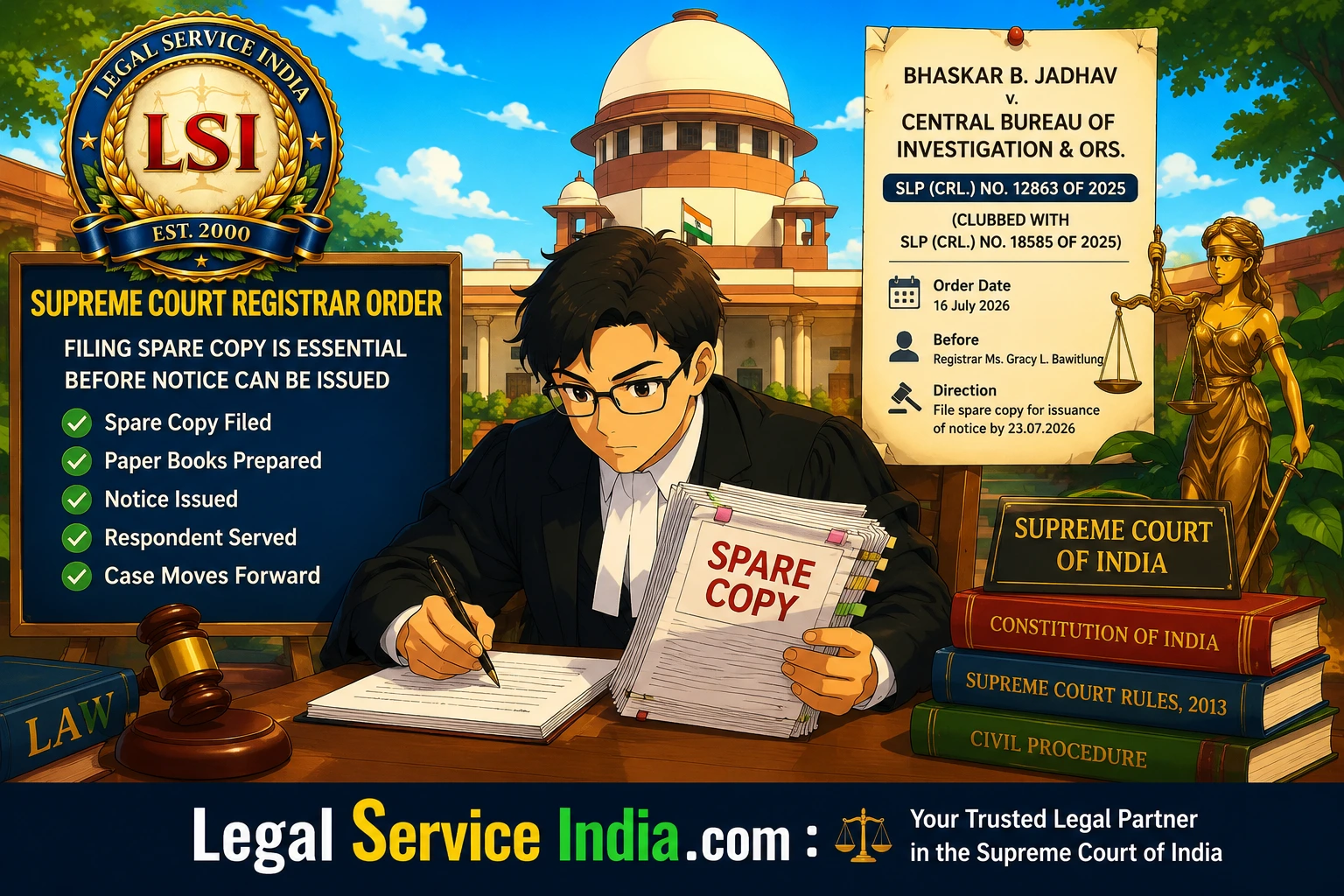
Bhaskar B. Jadhav v. Central Bureau of Investigation & Ors. (2026): Supreme Court Registrar Directs Filing of Spare Copy for Issuance of Notice
Citation: Bhaskar B. Jadhav v. The Central Bureau of Investigation & Ors., SLP (Crl.) No. 12863 of 2025 (clubbed with SLP (Crl.) No. 18585 of 2025), Record of Proceedings before the Registrar, Supreme Court of India, dated 16 July 2026.
Introduction
Not every order passed by the Supreme Court creates a new legal principle, yet many procedural orders are crucial because they determine whether a case will move forward or come to a halt. Such orders often receive little public attention despite playing a significant role in the administration of justice.
The order passed by Registrar Ms Gracy L. Bawitlung on 16 July 2026 in Bhaskar B. Jadhav v. Central Bureau of Investigation & Ors. is one such procedural order. While the Registrar did not adjudicate the merits of the criminal Special Leave Petition (SLP), the order demonstrates the Supreme Court’s insistence on procedural discipline before judicial proceedings can progress.
For lawyers practising before the Supreme Court, the order is a reminder that compliance with procedural requirements is not a mere technicality. It is an essential part of ensuring fairness, efficiency, and the orderly administration of justice.
Case Citation
| Particular | Details |
|---|---|
| Case Name | Bhaskar B. Jadhav v. The Central Bureau of Investigation & Ors. |
| Case Number | SLP (Crl.) No. 12863 of 2025 |
| Tagged Matter | SLP (Crl.) No. 18585 of 2025 |
| Court | Supreme Court of India |
| Court Number | Registrar Court No. 2 |
| Order Date | 16 July 2026 |
| Before | Registrar: Ms Gracy L. Bawitlung |
Background
The proceedings arise from criminal Special Leave Petitions filed under Article 136 of the Constitution of India.
The record indicates that:
- SLP (Crl.) No. 18585 of 2025 appears in the cause title.
- However, only SLP (Crl.) No. 12863 of 2025 was listed before the Registrar on 16 July 2026.
- The respondent includes the Central Bureau of Investigation (CBI) along with other respondents.
The order itself does not disclose:
- the underlying criminal allegations,
- the impugned judgement,
- or the substantive legal questions involved.
Its scope is confined entirely to procedural compliance.
Key Procedural Features
| Aspect | Observation |
|---|---|
| Nature of Proceedings | Criminal Special Leave Petition under Article 136 of the Constitution of India. |
| Primary Respondent | Central Bureau of Investigation (CBI). |
| Stage of Proceedings | Procedural hearing before the Registrar. |
| Issues Considered | Only procedural compliance; no adjudication on merits. |
| Merits Examined | No. |
What Happened Before the Registrar?
The matter came before the Registrar for compliance with an earlier judicial direction passed by the Supreme Court on 8 June 2026.
After hearing counsel, the Registrar recorded the following directions:
“Ld. Counsel for the petitioner is directed to file a spare copy for issuance of notice to the sole respondent on or before 23.07.2026.”
The Registrar further ordered:
“Process the matter in terms of the Hon’ble Court’s order dated 08.06.2026.”
Lastly, a copy of the Record of Proceedings was directed to be furnished to the concerned Advocate-on-Record for compliance.
Understanding the Importance of a “Spare Copy”
To non-lawyers, filing a “spare copy” may appear to be an insignificant administrative requirement.
In reality, it is an indispensable part of Supreme Court practice.
Whenever the Supreme Court directs the issuance of notice, the Registry must prepare paper books for service upon the respondents.
These paper books are prepared from the spare copies supplied by the petitioner.
Without sufficient copies:
- Notice cannot be issued.
- Service cannot be completed.
- Respondents cannot be informed of the proceedings.
- The litigation cannot progress.
Thus, filing spare copies directly affects the movement of the case.
Why Spare Copies Are Essential
| Requirement | Why It Matters |
|---|---|
| Spare copy filed | Enables preparation of paper books by the Registry. |
| Paper books prepared | Allows issuance of notice to the respondent. |
| Notice served | Ensures the respondent is informed of the proceedings. |
| Service completed | Permits the case to move to the next procedural stage. |
Why Did the Registrar Fix a Deadline?
The Registrar directed compliance by 23 July 2026.
This reflects a common practice in the Supreme Court.
Registrar Courts routinely supervise:
- Filing defects.
- Procedural compliance.
- Paper book preparation.
- Issuance of notice.
- Service of respondents.
- Completion of pleadings.
- Registry objections.
Strict timelines prevent unnecessary delays and ensure that cases proceed in accordance with judicial directions.
Purpose of Fixing Procedural Deadlines
| Registrar’s Objective | Practical Effect |
|---|---|
| Ensure timely compliance. | Prevents avoidable procedural delays. |
| Monitor Registry requirements. | Ensures all procedural formalities are completed. |
| Implement judicial directions. | Allows the matter to proceed as ordered by the Supreme Court. |
“Process the Matter in Terms of the Hon’ble Court’s Order Dated 08.06.2026”
This single sentence has considerable procedural significance.
It indicates that the judicial bench had already passed an order on 8 June 2026, and the registry is merely implementing that order.
Registrar courts do not alter judicial directions.
Their function is administrative and procedural.
Accordingly, once the petitioner files the required spare copy, the Registry will initiate the process contemplated in the Bench’s earlier order—most likely the issuance and service of notice upon the respondent.
Procedural Significance of the Direction
- The judicial bench had already issued directions on 8 June 2026.
- The Registrar is implementing, not modifying, those directions.
- Compliance by the petitioner enables the Registry to proceed further.
- The next procedural step is most likely issuance and service of notice upon the respondent.
Role of the Registrar in the Supreme Court
Many litigants mistakenly assume that every Supreme Court order is passed by judges.
That is not the case.
The Supreme Court Rules create an independent procedural framework in which registrars perform numerous judicially supervised administrative functions.
These include:
- Scrutinising filings.
- Removing office objections.
- Monitoring procedural compliance.
- Ensuring service of notices.
- Granting time for curing defects.
- Placing matters before appropriate benches.
Registrar orders facilitate the functioning of the court without deciding the substantive rights of the parties.
Key Functions of the Registrar
| Function | Purpose |
|---|---|
| Scrutinising filings | Checks whether petitions comply with procedural requirements. |
| Removing office objections | Ensures filing defects are cured before further processing. |
| Monitoring procedural compliance | Ensures parties comply with judicial and registry directions. |
| Ensuring service of notices | Facilitates communication of proceedings to respondents. |
| Granting time for curing defects | Allows parties an opportunity to rectify procedural deficiencies. |
| Placing matters before appropriate benches | Ensures cases are listed before the competent judicial bench. |
Why Procedural Compliance Matters
The Supreme Court handles thousands of matters annually. If procedural requirements were ignored, the registry would struggle to process cases efficiently.
Compliance requirements such as filing:
- Vakalatnamas
- Certified copies
- Affidavits
- Paper books
- Spare copies
- Translations
These requirements are intended to ensure that:
- Respondents receive complete records.
- Judicial time is not wasted.
- Hearings proceed smoothly.
- Natural justice is observed.
Procedural discipline ultimately supports substantive justice.
Objectives of Procedural Compliance
| Procedural Requirement | Purpose |
|---|---|
| Vakalatnamas | Authorise advocates to represent parties before the Court. |
| Certified Copies | Ensure authenticity of judicial records. |
| Affidavits | Verify the truthfulness of facts placed before the Court. |
| Paper Books | Provide judges and parties with complete case records. |
| Spare Copies | Facilitate service upon respondents and efficient registry processing. |
| Translations | Ensure documents are understandable to the court and all parties. |
Significance for Criminal Appeals
Criminal Special Leave Petitions frequently involve:
- Personal liberty
- Criminal convictions
- Investigations
- Bail
- Constitutional rights
Yet even matters concerning liberty must satisfy procedural requirements before substantive hearings can occur.
This order demonstrates that procedural safeguards apply uniformly irrespective of the seriousness of the allegations.
The Importance of Notice
One of the most fundamental principles of natural justice is:
Audi alteram partem — hear the other side.
Notice is the mechanism through which this principle is implemented.
Unless notice is properly served:
- Respondents cannot appear.
- No effective hearing can take place.
- Judicial proceedings cannot advance.
The Registrar’s direction therefore safeguards fairness by ensuring that the respondent receives proper notice in accordance with the Supreme Court’s earlier judicial order.
Counsel Appearing
For the Petitioner
- Mr Mandeep Kalra, Advocate-on-Record
- Ms Radhika Narula
- Ms Chitrangada Singh
- Mr Yashas J.
- Mr Vaibhav Yadav
- Mr Paras Mohan Sharma
For the Respondents
- Mr Rameshwar Prasad Goyal, Advocate-on-Record
- Mr Mukesh Kumar Maroria, Advocate-on-Record
Legal Analysis
Although brief, the order reinforces several important aspects of Supreme Court procedure:
1. Procedural Compliance Is Mandatory
The Court will not permit matters to progress unless registry requirements are fulfilled.
2. Registrar Orders Ensure Efficient Court Administration
The Registrar acts as the procedural gatekeeper, ensuring that judicial directions are implemented efficiently.
3. Notice Is a Cornerstone of Fair Procedure
Issuance of notice cannot occur without the necessary documents being filed.
4. Administrative Orders Have Practical Consequences
While they do not decide legal rights, procedural orders determine whether litigation moves forward or remains stalled.
Key Takeaways from the Legal Analysis
| Legal Principle | Practical Significance |
|---|---|
| Procedural Compliance | Mandatory before substantive hearings can proceed. |
| Registrar’s Role | Ensures efficient administration of Supreme Court proceedings. |
| Service of Notice | Protects the principles of natural justice. |
| Administrative Orders | Determine whether litigation progresses or remains stalled. |
Practical Lessons for Advocates
This order serves as a reminder for Supreme Court practitioners that:
- Registry directions deserve immediate attention.
- Delay in removing defects can postpone hearings.
- Filing spare copies should never be treated as a routine formality.
- Compliance with registrar orders avoids unnecessary adjournments and procedural complications.
Experienced Supreme Court practitioners recognise that meticulous procedural compliance often determines the pace at which a matter reaches substantive hearing.
Conclusion
The order dated 16 July 2026 in Bhaskar B. Jadhav v. Central Bureau of Investigation & Ors. does not decide any question of criminal law or constitutional interpretation. Instead, it highlights an often-overlooked reality of Supreme Court litigation: justice depends not only on persuasive legal arguments but also on strict adherence to procedural requirements.
By directing the petitioner to file a spare copy for issuance of notice and by instructing the Registry to process the matter in accordance with the Court’s earlier order dated 8 June 2026, the Registrar ensured that the litigation remains on course while upholding the principles of orderly judicial administration and natural justice.
For litigants and lawyers alike, the order underscores that procedural precision is not a mere technicality—it is an indispensable foundation of the Supreme Court’s ability to deliver timely and effective justice.
Key Takeaways
The following table summarises the most important procedural principles emerging from the Registrar’s order.
| Aspect | Key Takeaway |
|---|---|
| Procedural Compliance | The Supreme Court Registrar reiterates that procedural compliance is mandatory before a Special Leave Petition (SLP) can progress to the next stage. |
| Case Direction | In Bhaskar B. Jadhav v. Central Bureau of Investigation & Ors., SLP (Crl.) No. 12863/2025, the Registrar directed the petitioner to file a spare copy by 23 July 2026 for issuance of notice to the respondent. |
| Spare Copy Requirement | The order reinforces that filing spare copies is an essential procedural requirement under Supreme Court practice, enabling the Registry to prepare and serve notice on respondents. |
| Earlier Supreme Court Order | The Registrar instructed the Registry to process the matter in accordance with the Supreme Court’s earlier order dated 8 June 2026, ensuring continuity in the judicial process. |
| Role of the Registrar | The decision highlights the critical role of the Supreme Court Registrar in supervising procedural compliance, removing filing defects, and facilitating the smooth administration of justice. |
| Importance of Procedural Orders | The case underscores that procedural orders, though not deciding the merits, are vital to the progress of litigation and the efficient functioning of India’s highest court. |
| Impact on Advocates and Litigants | The order serves as an important reminder to Advocates-on-Record (AORs) and litigants that delays in complying with Registry directions can postpone hearings and issuance of notice. |
| Natural Justice | The proceedings reaffirm the principle of natural justice (audi alteram partem) by ensuring that respondents receive proper notice before the case advances. |
| Procedural Significance | Bhaskar B. Jadhav v. CBI (2026) is a significant procedural development illustrating how the Supreme Court maintains discipline and efficiency through strict adherence to the Supreme Court Rules, 2013. |
| Who Should Read This Case? | The case is particularly relevant for lawyers, law students, and litigants seeking to understand Supreme Court SLP procedure, Registrar Court functions, issuance of notice, filing requirements, and procedural compliance in criminal appeals. |
Quick Reference Points
- Procedural compliance is mandatory before an SLP progresses.
- Filing a spare copy is necessary for the issuance of notice.
- The Registry must follow earlier judicial directions.
- The Registrar plays a crucial role in ensuring procedural discipline.
- Procedural orders facilitate the smooth administration of justice.
- Delays in registry compliance can postpone hearings.
- Natural justice requires proper service of notice on respondents.
- The order demonstrates strict adherence to the Supreme Court Rules, 2013.
Summary
The Supreme Court Registrar, in Bhaskar B. Jadhav v. Central Bureau of Investigation & Ors. (SLP (Crl.) No. 12863/2025), directed the petitioner to file a spare copy by 23 July 2026 to facilitate issuance of notice to the respondent. The order, dated 16 July 2026, emphasises that strict procedural compliance is essential before a criminal Special Leave Petition can proceed.
Although it does not address the merits of the dispute, the order highlights the Registrar’s crucial role in implementing judicial directions, ensuring proper service of notice, and maintaining the efficient administration of justice under the Supreme Court Rules. This case is an important reference for understanding Supreme Court filing procedures, registry practice, and the procedural safeguards governing criminal appeals in India.
Need Expert Legal Assistance from the Supreme Court of India?
Whether you are planning to file a Special Leave Petition (SLP), Writ Petition, Civil Appeal, Criminal Appeal, Transfer Petition, Review Petition, Curative Petition, or require expert legal advice on any matter before the Supreme Court of India, experienced legal guidance can make all the difference.
Adv. Tarun Choudhury
Supreme Court Advocate | 25+ Years of Legal Experience
📞 Call: 9891244487
💬 WhatsApp: 9891244487
Get trusted legal advice, strategic case evaluation, expert drafting, and dedicated representation before the Supreme Court of India and other courts.
Contact today for a confidential consultation and protect your legal rights with experienced Supreme Court representation.