





Introduction
In the competitive world of consumer goods like packaged drinking water, brand identity and market reputation are crucial. This Delhi High Court Division Bench ruling in a passing off dispute between two companies highlights the critical “clean hands” doctrine in trademark litigation. It serves as a cautionary tale for businesses, legal practitioners, and litigants about the severe consequences of relying on fabricated documents or misleading the court. The judgement reinforces ethical standards in IP disputes, emphasising that even strong claims can fail if parties approach courts with unclean hands, while balancing interim relief to prevent market confusion.
Factual And Procedural Background
More Than Water Private Limited, engaged in selling packaged drinking water in Tetra Paks, claimed rights over marks like ‘MORE THAN WATERBOX’ and ‘WATERBOX IS THE RIGHT CHOICE’ through its predecessor since 2018. It alleged that NESCO Limited’s ‘MY WATER BOX’ mark and similar packaging design caused confusion.
The appellant filed a suit for passing off after discovering the respondent’s 2025 trademark registration. The single judge denied an absolute injunction to the appellant for lack of proven goodwill but imposed territorial restrictions limiting each party to their respective states (Gujarat for the appellant, Maharashtra for the respondent).
The appellant appealed for nationwide relief, while the respondent filed cross-objections. The division bench reviewed sales invoices, CA certificates, FSSAI licences, social media evidence, and trademark filings.
Key Facts at a Glance
| Particular | Details |
|---|---|
| Appellant | More Than Water Private Limited |
| Respondent | NESCO Limited |
| Nature of Dispute | Passing off and trademark-related dispute |
| Products | Packaged drinking water in TetraPaks |
| Disputed Marks | ‘MORE THAN WATERBOX’, ‘WATERBOX IS THE RIGHT CHOICE’, and ‘MY WATER BOX’ |
| Interim Order Challenged | Territorial restrictions imposed by the Single Judge |
Dispute Before The Court
The main issues were whether the appellant proved prior adoption, goodwill, and reputation in its marks to secure an interim injunction against the respondent nationwide and whether the single judge erred in imposing territorial limits without specific prayers.
The appellant argued:
- Continuous use since 2018.
- Deceptive similarity in marks and packaging.
- Respondent’s false user claims.
The respondent countered with:
- Challenges to the appellant’s invoices as fabricated.
- Lack of substantial sales or promotion.
- Its own later but expanding use.
- No objection to lifting the territorial restraints.
Reasoning And Analysis Of The Court
The Court applied established principles from Supreme Court judgements like Wander Ltd v. Antox India (P) Ltd, 1990 Supp SCC 727, and Pernod Ricard India (P) Ltd v. Karanveer Singh Chhabra, 2025 SCC OnLine SC 1701, limiting appellate interference in discretionary interim orders unless arbitrary.
It stressed that in passing off actions, goodwill is a prerequisite, requiring proof of reputation through consistent use and promotion, not mere adoption.
Key Findings of the Court
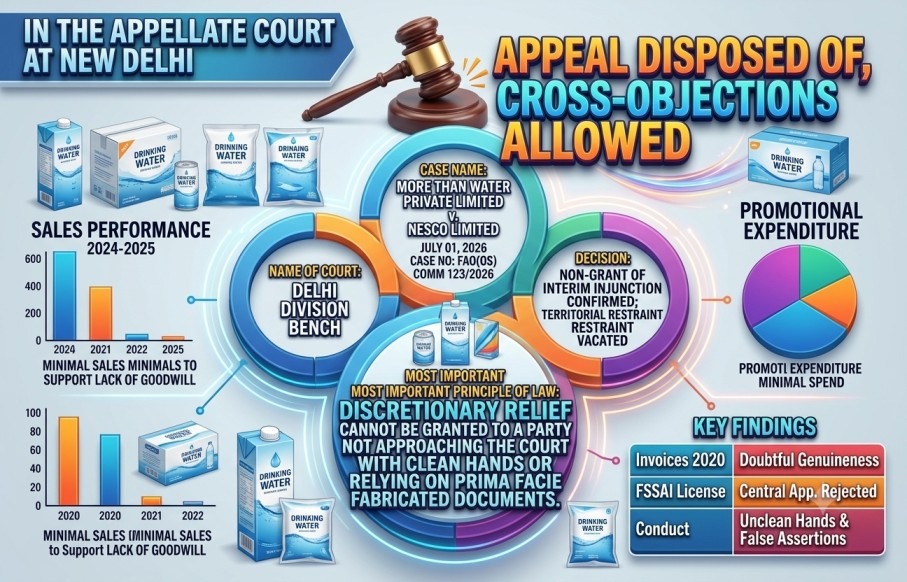
- Prima facie doubts existed over the appellant’s 2020 invoices because of wrong HSN codes and the absence of GST support.
- The appellant made misleading claims regarding a Central FSSAI licence, which had actually been rejected.
- The respondent’s trademark registration relied on fabricated photographs and unreliable invoices.
- Citing Tommorroland Limited v. Housing and Urban Development Corporation Limited (2025) 4 SCC 19, the court held that parties must approach the court with clean hands and that dishonesty disentitles a party from equitable relief such as injunctions.
- Even assuming prior use by the appellant, the sales figures were meagre and promotional expenditure was insufficient to establish goodwill.
- The descriptive nature of “WATERBOX” was noted, leaving the issue of deceptive similarity for trial.
- The territorial restraints were vacated because neither party established a strong prima facie case, and the respondent raised no objection.
Final Decision Of The Court
The Division Bench dismissed the appeal and cross-objections.
It vacated all territorial injunctions, allowing both parties to operate without geographic limits pending trial (subject to legal compliance).
The court also:
- Restrained the respondent from relying on its disputed trademark registration.
- Directed the Registrar of Trademarks to note the judgement.
- Permitted perjury proceedings for fabricated documents.
Point Of Law Settled
The judgement strongly reaffirms the “clean hands” doctrine in IP interim relief, holding that reliance on fabricated documents or false assertions disentitles a party from discretionary injunctions, even with arguable prior use.
It clarifies that goodwill in passing off requires substantial, consistent evidence beyond sporadic sales or social media.
This will:
- Deter dishonest litigation.
- Promote ethical practices before trademark registries and courts.
- Influence how businesses document use and licensing in consumer product disputes.
Case Details
| Particular | Details |
|---|---|
| Title of the Case | More Than Water Private Limited vs NESCO Limited |
| Date of Judgment/Order | 01.07.2026 |
| Case Number | FAO(OS) (COMM) 123/2026 |
| Neutral Citation | 2026:DHC:5238-DB |
| Name of Court | High Court of Delhi |
| Honourable Judges | V Kameshwar Rao and Manmeet Pritam Singh Arora |
| Written By | Advocate Ajay Amitabh Suman, IP Adjutor [Patent and Trademark Attorney], High Court of Delhi |
Key Legal Takeaways
- Goodwill is an essential ingredient in a passing-off action.
- Mere prior adoption without substantial reputation is insufficient for interim relief.
- Courts will deny equitable relief to litigants who rely on fabricated documents.
- The “clean hands” doctrine remains a fundamental principle governing discretionary injunctions.
- Descriptive marks receive limited protection unless distinctiveness and goodwill are established.
- Trademark registration obtained using unreliable material may not assist the registrant before the court.
Disclaimer
Images used herein do not reflect actual images used in Judgement, and the same are for illustrative purposes only. Readers are advised not to treat this as a substitute for legal advice, as it may contain errors in perception, interpretation, and presentation.

