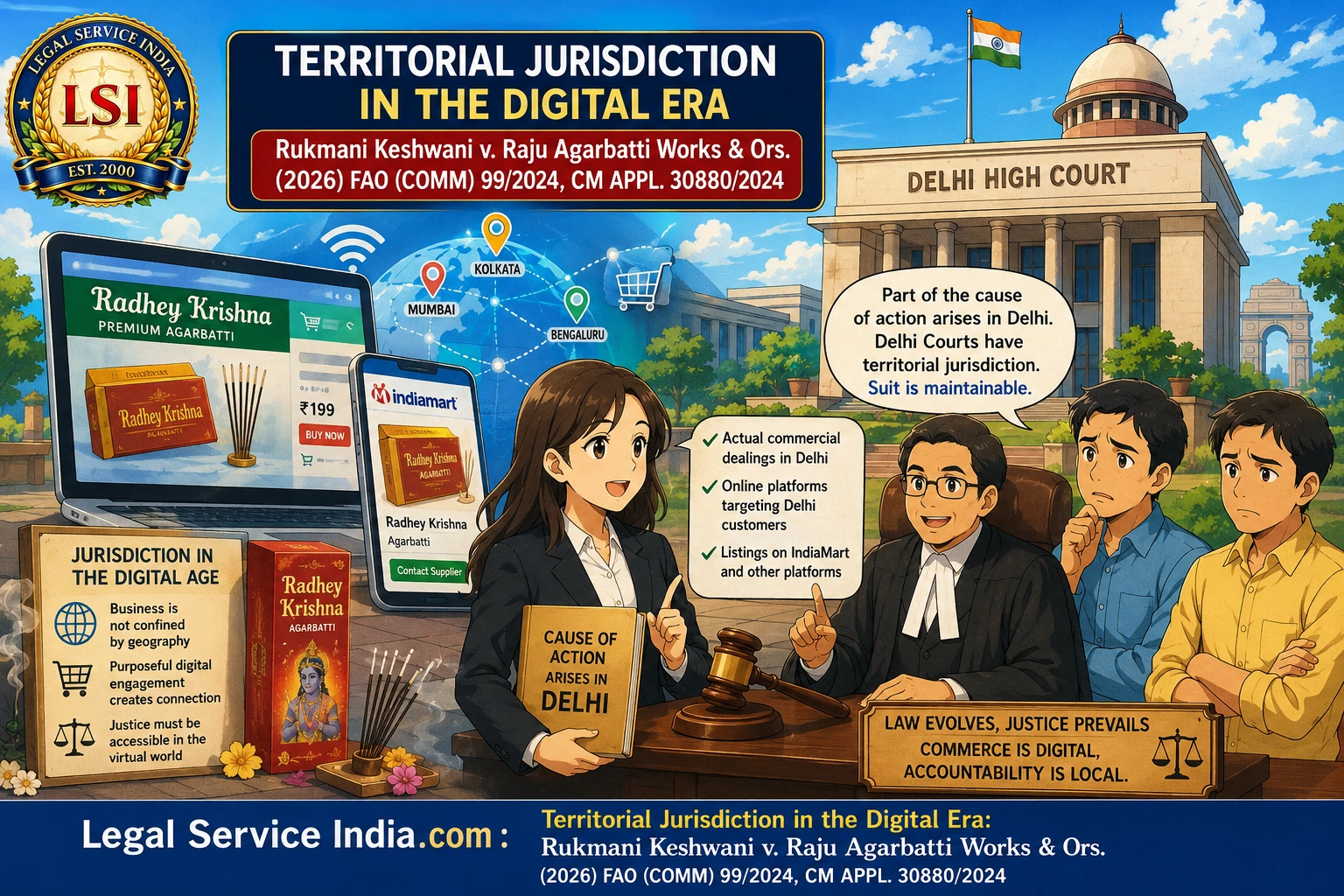
Territorial Jurisdiction in the Digital Era: Rukmani Keshwani v. Raju Agarbatti Works & Ors. (2026) FAO (COMM) 99/2024, CM APPL. 30880/2024
Introduction
Territorial jurisdiction has always been based on geography. Courts exercise power based on the residence of parties or where a cause of action arises. The decision of the Delhi High Court in Rukmani Keshwani v. Raju Agarbatti Works & Ors. (2026) represents a notable advance in the development of conventional jurisdictional principles in the arena of online business and e-commerce.
Factual Background
Two agarbatti manufacturers from Ajmer in Rajasthan had a fight. The plaintiff, Ms. Rukmani Keshwani, claimed infringement of her trademark “Radhey Krishna” under the Trade Marks Act, 1999, and Copyright Act, 1957.
She filed a suit in the Delhi Shahdara District Court alleging that the defendants were selling and promoting infringing goods, including through online platforms accessible in Delhi.
However, the trial court dismissed the plaint under Order VII Rule 10 of the Code of Civil Procedure, 1908, on the ground that there is no territorial jurisdiction of Delhi to entertain the same.
It stated that:
- Both parties belonged to Rajasthan.
- There was no real cause of action in Delhi.
- Jurisdiction was not granted by the mere availability of online platforms.
The Heart of the Legal Issue
Is it enough that online commercial activity is available in a particular territory for territorial jurisdiction to exist—even if both parties are physically outside of it?
Judgement of Delhi High Court
The High Court set aside the narrow interpretation adopted by the trial court and held that:
Jurisdiction in the digital age can no longer be limited to physical presence. Listings, marketing, and transactions conducted online could create a real connection with a region.
The plaintiff had shown:
- Actual commercial dealings in Delhi.
- The online interactive platforms, which are targeted towards the customers out of Rajasthan.
- Defendants’ listings on IndiaMart and other similar websites.
The above factors cumulatively led to the conclusion that a part of the cause of action arose in Delhi, and therefore, territorial jurisdiction was conferred under Section 20(c) of the Code of Civil Procedure, 1908, read with Section 134 of the Trademark Act, 1999, and Section 62 of the Copyright Act, 1957.
The Court Emphasised
A jurisdictional analysis must acknowledge that modern e-commerce is an intentional commercial reach beyond physical boundaries.
The suit thus was revived, and the Delhi courts were held competent to try the issue.
Statutory Provisions Involved
| Provision | Purpose |
|---|---|
| Section 20(c), Code of Civil Procedure, 1908 | Jurisdiction where the cause of action wholly or partly arises. |
| Section 134, Trade Marks Act, 1999 | Special jurisdiction for trademark infringement suits. |
| Section 62, Copyright Act, 1957 | Jurisdiction for copyright infringement actions. |
Indian Case Laws Relevant
| Case | Principle Laid Down |
|---|---|
| Indian Performing Right Society v. Sanjay Dalia (2015) | Recognized that plaintiffs can sue where they live or do business, subject to limitations against forum shopping. |
| World Wrestling Entertainment Inc. v. Reshma Collection (2014) | Held that online presence may be a factor in jurisdiction when combined with commercial intent. |
| Dabur India Ltd. v. K.R. Industries (2008) | Stressed that the cause of action should be real and substantial. |
| Banyan Tree Holdings (P) Ltd. Vs. A. Murali Krishna Reddy (2010) | It was said that interactive websites aimed at users in a jurisdiction could establish a basis for territorial jurisdiction. |
Important Measures
- Territory is no longer purely geographical in its jurisdiction.
- Courts have to apply old legal concepts to new technologies.
- Real transaction evidence supports jurisdiction claims.
- Targeting matters.
Analysis
This is a case in point of law slowly catching up with how people actually do business today.
Courts have traditionally looked to the geographic areas where the parties lived or where the issue physically occurred. However, the Delhi High Court in this regard recognized a simple truth: in the digital age, business does not remain confined to one place.
The trial court adopted a hardline approach that if the products were listed online, then the Delhi courts could not hear the case. This view saw e-commerce as passive and geographically constrained.
But the High Court looked beyond the technicalities and saw the reality. When sellers showcase their goods on interactive platforms, they are not just displaying their products; they are proactively reaching out to customers all over the place, including Delhi.
The Court’s rationale is pragmatic and fair. If a business can make profits from customers in a certain place, they should also be answerable there. Otherwise, wrongdoers could hide behind geography to make money from statewide or even global marketplaces.
The judgement is essentially a compromise. It does not say that every website creates jurisdiction everywhere, but it does make it clear that purposeful digital engagement and actual commercial activity are important.
This means that the law remains relevant, accessible, and fair in a world where trade is conducted through clicks rather than in person.
At the end of the day, this is not just a question of jurisdiction; it is a question of reconciling legal concepts with ordinary human and business reality.
Key Takeaways
- Online commercial activity can contribute to territorial jurisdiction.
- Interactive e-commerce platforms are more significant than passive websites.
- Actual commercial dealings remain an important factor.
- Purposeful targeting of customers strengthens jurisdictional claims.
- Courts are adapting traditional jurisdiction principles to the realities of digital commerce.
Conclusion
The judgement of Rukmani Keshwani v. Raju Agarbatti Works is a progressive movement in Indian jurisprudence. It connects the world of old legal principles with the realities of modern business.
The Delhi High Court has assured that access to justice is not compromised in an increasingly virtual world. The ruling reiterates that the law should evolve, not lag behind, in the face of technological transformation.
Key Takeaways
The following are the key takeaways from the Delhi High Court’s landmark judgment in Rukmani Keshwani v. Raju Agarbatti Works & Ors. (2026) on territorial jurisdiction in the digital era:
- The Delhi High Court clarified that territorial jurisdiction in the digital era is not confined to physical locations but can extend to online commercial activities.
- In Rukmani Keshwani v. Raju Agarbatti Works & Ors. (2026), the Court held that interactive e-commerce platforms and targeted online business activities may create a valid cause of action in another jurisdiction.
- The ruling reinforces that actual commercial transactions and purposeful targeting of customers are crucial factors in determining territorial jurisdiction in online trademark disputes.
- Mere accessibility of a website may not be sufficient; however, active online listings, marketing, and commercial engagement can establish a real connection with a forum.
- The judgment applies Section 20(c) of the Code of Civil Procedure, 1908, together with Section 134 of the Trade Marks Act, 1999, and Section 62 of the Copyright Act, 1957, to determine jurisdiction in digital commerce cases.
- The decision strengthens legal protection for trademark owners by allowing them to pursue infringement actions where meaningful online commercial activity gives rise to a part of the cause of action.
- The Delhi High Court reaffirmed that Indian courts must adapt traditional jurisdiction principles to modern e-commerce and digital marketplaces.
- The judgment draws support from important precedents, including Indian Performing Right Society v. Sanjay Dalia, Banyan Tree Holding (P) Ltd. v. A. Murali Krishna Reddy, World Wrestling Entertainment Inc. v. Reshma Collection, and Dabur India Ltd. v. K.R. Industries.
- The ruling discourages forum shopping while ensuring that businesses engaging in nationwide online commerce remain accountable before courts where they intentionally conduct commercial activities.
- This landmark decision is expected to influence future litigation involving online trademark infringement, copyright disputes, intellectual property enforcement, and e-commerce jurisdiction across India.
Quick Summary
| Aspect | Key Point |
|---|---|
| Core Issue | Territorial jurisdiction in online and e-commerce disputes. |
| Court | Delhi High Court. |
| Principal Finding | Purposeful online commercial activity can establish territorial jurisdiction. |
| Important Laws | Section 20(c), Code of Civil Procedure, 1908; Section 134, Trade Marks Act, 1999; Section 62, Copyright Act, 1957. |
| Impact | Strengthens jurisdictional principles for digital commerce, online trademark disputes, and intellectual property litigation. |