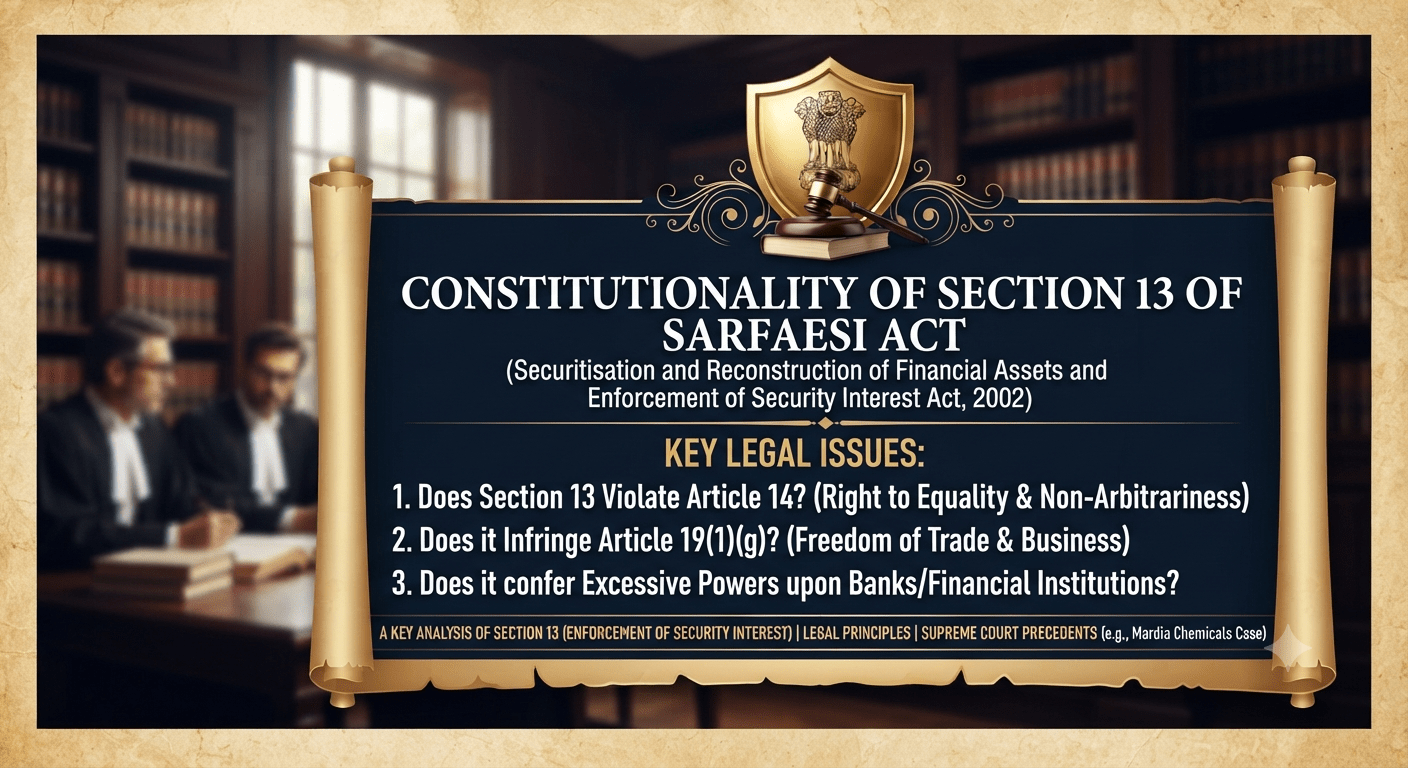
Constitutionality of Section 13 of the SARFAESI Act: Supreme Court on Borrowers’ Rights, DRT Remedies & Mardia Chemicals Explained
An in-depth analysis of Section 13 of the SARFAESI Act, 2002, covering its constitutional validity, the Mardia Chemicals judgment, borrower protections under Section 13(3A), DRT remedies, Section 14 proceedings, and the latest Supreme Court principles governing secured loan recovery.
Constitutionality of Section 13 of the SARFAESI Act, 2002
Introduction
The SARFAESI Act was introduced in the year 2002, and its objective is to provide a mechanism that helps banks when a loan amount becomes a non-performing asset. This Act gives power to banks to recover loans without the intervention of the court, so the question arises about the constitutionality of Section 13 of this Act, which gives power to banks to recover loans, and whether the bar on the right to approach the court is constitutionally valid or not.
In 2004, this section was challenged in the case of Mardina Chemicals Ltd. v. Union of India. Petitioners argued that Section 13 was unconstitutional and violated Article 14 (Equality Before the Law), and it allegedly violated Article 19(1)(g) (Right to Carry on Trade/Business), but the question arises whether this provision violated the right of the borrower. In this judgement, the court held that this provision is constitutionally valid and does not violate the right of the borrowers.
Reasoning Related to Section 13
However, in the judgment of Mardina Chemicals Ltd. v. Union of India, the court declared that this Section 13 is constitutionally valid, but there is no provision in this act related to any arbitrariness of bank action against the borrower. So, whether this hampers the right of the borrower or not, as the borrower has no right to approach the court, the only right the borrower has is to approach the Debt Recovery Tribunal after the action taken by the bank to recover the loan.
But if we talk in favor of banks, it gives banks a fast loan recovery option for loans, as there is no involvement of the court. Therefore, there is no question of pendency of court proceedings, which helps the bank to recover the loan amount in a fast manner.
Key Points on Section 13
Banks can recover secured debts without prior court intervention.
Borrowers cannot approach the court before action is taken by the bank.
The primary remedy available to borrowers is before the Debt Recovery Tribunal (DRT).
The provision aims to ensure speedy recovery of non-performing assets.
Developments: Section 13(3A)
In the year 2004, Section 13(3A) was the provision that protected the right of borrowers regarding any arbitrary action by the bank. The borrowers are liable to submit a representation or objection that challenges the notice, so banks shall consider such an objection and representation before taking any action to recover the loan amount.
But this is not a strong right for the borrower, as this section does not allow the borrower to approach the Debt Recovery Tribunal. The borrower can only approach the Debt Recovery Tribunal after some strong action is taken by the bank, such as taking possession of the secured creditors or taking over management.
The main purpose of introducing this section is to allow borrowers to point out factual or legal errors before coercive action is taken.
Purpose of Section 13(3A)
Allows borrowers to file objections or representations.
Requires banks to consider the objections before proceeding.
Provides an opportunity to correct factual or legal errors.
Acts as a procedural safeguard against arbitrary action.
Is the Creditor’s Duty Under Section 13(3A) Mandatory?
So the question arises whether it is compulsory to give a reply to the borrower regarding the objection and representation submitted by the borrower.
The answer to this is it is mandatory to reply to the objections of the borrowers. If he finds some default on the part of secured creditors, the secured creditor first corrects the default, and then only he can start the recovery process to recover the loan amount.
How Is Property Sold to Recover the Dues Without a Court Order Under Section 13?
Yes, only the person who has an absolute interest in the property can sell the property if such property is mortgaged as per the provisions of the Transfer of Property Act.
Section 69 of the Transfer of Property Act comes and provides the right to the mortgagee to sell the property without the order of the court. This mortgage is classified as an English mortgage in this situation.
Under the English mortgage, the ownership is transferred to the mortgagee, but the possession is in the hands of the mortgager (i.e., the borrower). If any default is made on the part of the borrower, the mortgagee (i.e., secured creditor) can recover the loan amount from the borrower.
Legal Basis for Sale Without Court Order
Provision
Purpose
Section 13, SARFAESI Act
Enables secured creditors to enforce security interest without court intervention.
Section 69, Transfer of Property Act
Permits the sale of mortgaged property without a court order in specified English mortgages.
When Does the Borrower’s Right to Redeem the Property End?
It is a situation where the borrower has absolutely lost his right to get his mortgaged property.
Once the auction notice to sell the property is issued, this is the time when the borrower loses his right to redeem the property and does not have any option to recover the property back.
Whether One Can Approach the High Court Under Article 226 After the Bank Has Taken Action?
So the question arises, can one directly approach the High Court if one is not satisfied with the bank’s action to recover the loan and has started the debt recovery process?
The answer to this question is “No”; one cannot approach the High Court directly. The borrower shall first approach the Debt Recovery Tribunal and then only may approach the High Court for any relief against the order of the Debt Recovery Tribunal.
This is based on a principle under which one has an alternative remedy available, so first use that remedy, then use the second remedy.
Available Legal Remedies
Bank initiates recovery proceedings.
Borrower approaches the Debt Recovery Tribunal.
Challenge the DRT order before the appropriate appellate forum or the High Court, where maintainable.
Section 14 Proceedings
Recent judgments of the High Court, citing Supreme Court judgments, have further affirmed that the District Magistrate/Chief Metropolitan Magistrate is an administrative authority when helping to take possession of property in dispute between the borrower and the bank.
Right to Redeem
In M. Rajendran, the Supreme Court held that, post-amendment of 2016, the statutory right of redemption of the borrower ceases with publication of notice of the sale in auction and not after the confirmation of the sale. This is one of the most important judgements in respect of Section 13.
Important Judicial Principles
Issue
Position
Constitutionality of Section 13
Held constitutionally valid.
Borrower’s Objections
Section 13(3A) requires consideration of objections.
Alternative Remedy
The borrower should first approach the Debt Recovery Tribunal.
Right of Redemption
Ends upon publication of the auction sale notice as held by M. Rajendran.
Section 14 Proceedings
The District Magistrate/CMM performs an administrative function.
Conclusion
Section 13 is the evolving provision that has been interpreted many times, which gives more clarity regarding the provision and provides a new interpretation of the section. Section 13 helps the banks to recover the loan in a fast manner without the intervention of the court.
However, in recent times, there is also a need to protect the rights of borrowers.
Key Takeaways
The following are the key legal principles and judicial developments relating to Section 13 of the SARFAESI Act, 2002:
Section 13 of the SARFAESI Act, 2002, empowers banks and financial institutions to recover secured loans without prior court intervention, ensuring faster recovery of non-performing assets (NPAs).
The Supreme Court upheld the constitutional validity of Section 13 in Mardia Chemicals Ltd. v. Union of India, holding that the provision does not violate Articles 14 or 19(1)(g) of the Constitution.
Borrowers cannot directly approach civil courts against measures taken under Section 13. The primary statutory remedy is before the Debt Recovery Tribunal (DRT).
Section 13(3A) provides borrowers with an opportunity to submit objections or representations against the demand notice before coercive recovery measures are initiated.
Banks are required to consider and communicate their decision on the borrower’s objections under Section 13(3A), making it an important procedural safeguard against arbitrary action.
The SARFAESI framework balances speedy loan recovery for lenders with limited procedural protections for borrowers, though debates continue over whether stronger borrower safeguards are needed.
Under Section 69 of the Transfer of Property Act, certain English mortgages permit the mortgagee to sell the secured property without obtaining a court order.
The borrower’s statutory right of redemption ceases upon the publication of the auction sale notice, as clarified by the Supreme Court in M. Rajendran following the 2016 amendment.
Before invoking the writ jurisdiction of the High Court under Article 226, borrowers are generally expected to exhaust the alternative statutory remedy before the Debt Recovery Tribunal.
Proceedings under Section 14 of the SARFAESI Act involve the District Magistrate or Chief Metropolitan Magistrate acting in an administrative capacity to assist in taking possession of secured assets.
Judicial interpretation of Section 13 has continuously shaped the scope of borrowers’ rights, creditor powers, and procedural fairness under the SARFAESI Act.
Understanding the constitutional framework and judicial precedents governing Section 13 of the SARFAESI Act is essential for borrowers, banks, legal practitioners, and businesses dealing with secured lending and loan recovery.
Summary Table
Topic
Key Principle
Recovery Mechanism
Section 13 allows secured creditors to recover dues without prior court intervention.
Constitutional Validity
Upheld by the Supreme Court in Mardia Chemicals Ltd. v. Union of India.
Borrower’s Remedy
The Debt Recovery Tribunal (DRT) is the primary statutory forum.
Borrower’s Objections
Section 13(3A) permits objections before enforcement measures.
Bank’s Duty
Banks must consider and communicate their decision on objections.
Procedural Safeguards
The Act balances speedy recovery with limited borrower protections.
English Mortgage
Section 69 of the Transfer of Property Act permits sale without court intervention in specified cases.
Right of Redemption
Ends upon publication of the auction sale notice, as clarified in M. Rajendran.
Writ Jurisdiction
Alternative remedies before the DRT should ordinarily be exhausted before approaching the High Court.
Section 14 Proceedings
The district magistrate or chief metropolitan magistrate assists in taking possession of secured assets.
Judicial Interpretation
Supreme Court decisions continue to define creditor powers and borrower rights.
Practical Importance
Essential knowledge for borrowers, banks, legal practitioners, and businesses involved in secured lending.