





Introduction
In the digital age, where businesses operate across borders through online platforms, determining the right court for intellectual property disputes has become increasingly complex. This Delhi High Court Division Bench decision in a trademark and copyright battle over agarbatti brands highlights how courts are adapting traditional jurisdiction rules to modern e-commerce realities.
Factual and Procedural Background
The plaintiff, operating Vishwas Agarbatti Store, claimed prior use since 1995 of the “RADHEY KRISHNA” trademark and trade dress for agarbattis. It filed a suit under the Trade Marks Act and Copyright Act alleging that the defendants from Ajmer, Rajasthan, were selling deceptively similar products under names like “Lucky Radha Krishna.”
The plaintiff sought injunctions and other reliefs. An ex parte interim injunction was granted in January 2022. The defendants challenged territorial jurisdiction, arguing both parties operated from Rajasthan with no cause of action in Delhi.
The trial court initially rejected the plaint, but the High Court restored the suit in 2023, directing evidence on jurisdiction. After trial, the district judge returned the plaint in March 2024, finding no territorial jurisdiction in Delhi and vacating interim orders. The plaintiff appealed.
Dispute Before the Court
The main question was whether the Shahdara District Court in Delhi had territorial jurisdiction over the IP infringement suit.
The plaintiff argued that defendants’ IndiaMart listings and her own online sales through Instamojo created a cause of action in Delhi, supported by Sections 134 of the Trade Marks Act and 62 of the Copyright Act.
The defendants contended that both parties were based in Rajasthan, no actual sales occurred in Delhi, and the suit amounted to forum shopping. They relied on the Supreme Court’s IPRS judgment to argue that jurisdiction should lie where the substantial business and cause of action existed.
Reasoning and Analysis of the Court
The Division Bench examined Section 20(c) of the CPC, which allows suits where cause of action arises in part, alongside special provisions in Section 134 of the Trade Marks Act and Section 62 of the Copyright Act that provide additional forums for IP owners.
The Court referred to the Supreme Court’s decision in Indian Performing Rights Society Ltd. v. Sanjay Dalia (2015) 10 Supreme Court Cases 161, clarifying it prevents abuse through distant subordinate offices but does not bar jurisdiction where an independent cause of action exists via online activities.
Key Precedents Relied Upon
- Indian Performing Rights Society Ltd. v. Sanjay Dalia (2015) 10 Supreme Court Cases 161
- Banyan Tree Holding v. A. Murali Krishna Reddy, 2009 SCC OnLine Del 3780
- World Wrestling Entertainment v. Reshma Collection, 2014 (60) PTC 452 (DB)
- Kohinoor Seed Fields India Pvt. Ltd. v. Veda Seed Sciences Pvt. Ltd., 2025:DHC:10789-DB
- Raju Kumar v. Vinod Sah (15 SLP(C) No. 12585/2026)
The Court adopted a purposive approach suited to digital commerce, holding that interactive websites enabling commercial transactions constitute purposeful availment.
Evidence of defendants’ IndiaMart listings with GST details and plaintiff’s deliveries in Delhi established a real nexus. Mere accessibility was not enough, but purposeful targeting through e-commerce satisfied the test. The trial court’s restrictive view ignored proven facts and evolving jurisprudence on online infringement.
Final Decision of the Court
The Division Bench allowed the appeal. It set aside the trial court’s order returning the plaint, restored the suit to its original number for adjudication on merits, directed parties to appear before the district judge, and left further proceedings to the trial court.
Point of Law Settled
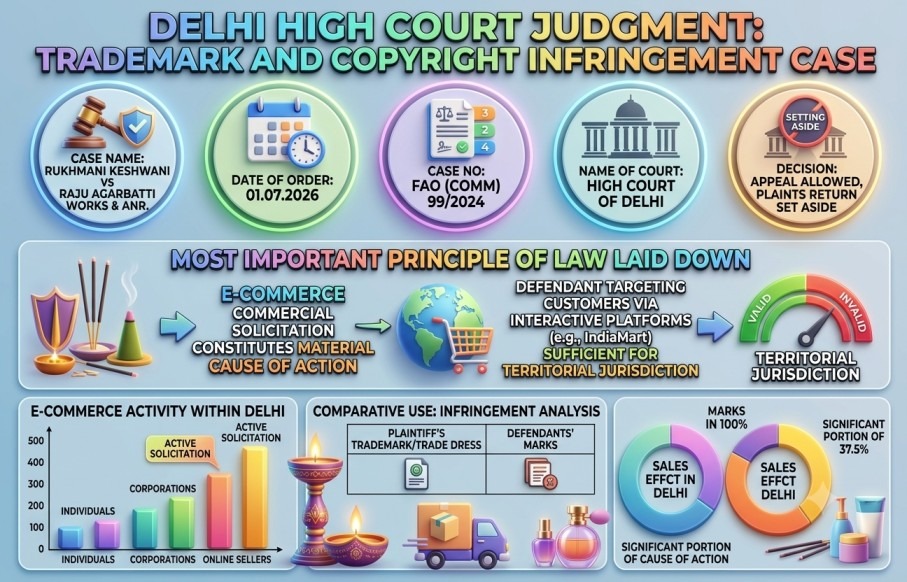
The judgment reaffirms and expands principles of territorial jurisdiction in IP disputes involving e-commerce. It clarifies that interactive online platforms and purposeful commercial targeting can create a cause of action under Section 20(c) CPC, read with special IP provisions, even if parties are based elsewhere.
Case Summary
| Title of the Case | Rukhmani Keshwani vs. Raju Agarbatti Works & Anr. |
|---|---|
| Date of Judgment/Order | 01.07.2026 |
| Case Number | FAO (COMM) 99/2024 |
| Neutral Citation | 2026:DHC:5232-DB |
| Name of Court | High Court of Delhi |
| Name of Honorable Judge | C Hai Shankar and Om Prakash Shukla |
| Written By | Advocate Ajay Amitabh Suman, IP Adjutor [Patent and Trademark Attorney], High Court of Delhi |
Key Legal Takeaways
- Interactive e-commerce platforms can establish territorial jurisdiction.
- Purposeful commercial targeting is a key factor in determining jurisdiction.
- Mere accessibility of a website is insufficient to confer jurisdiction.
- Section 20(c) CPC must be read with Section 134 of the Trade Marks Act and Section 62 of the Copyright Act.
- Digital commercial activities can create a valid cause of action for IP infringement suits.
Disclaimer
Images used herein do not reflect actual images used in Judgement, and the same are for illustrative purposes only. Readers are advised not to treat this as a substitute for legal advice, as it may contain errors in perception, interpretation, and presentation.

