





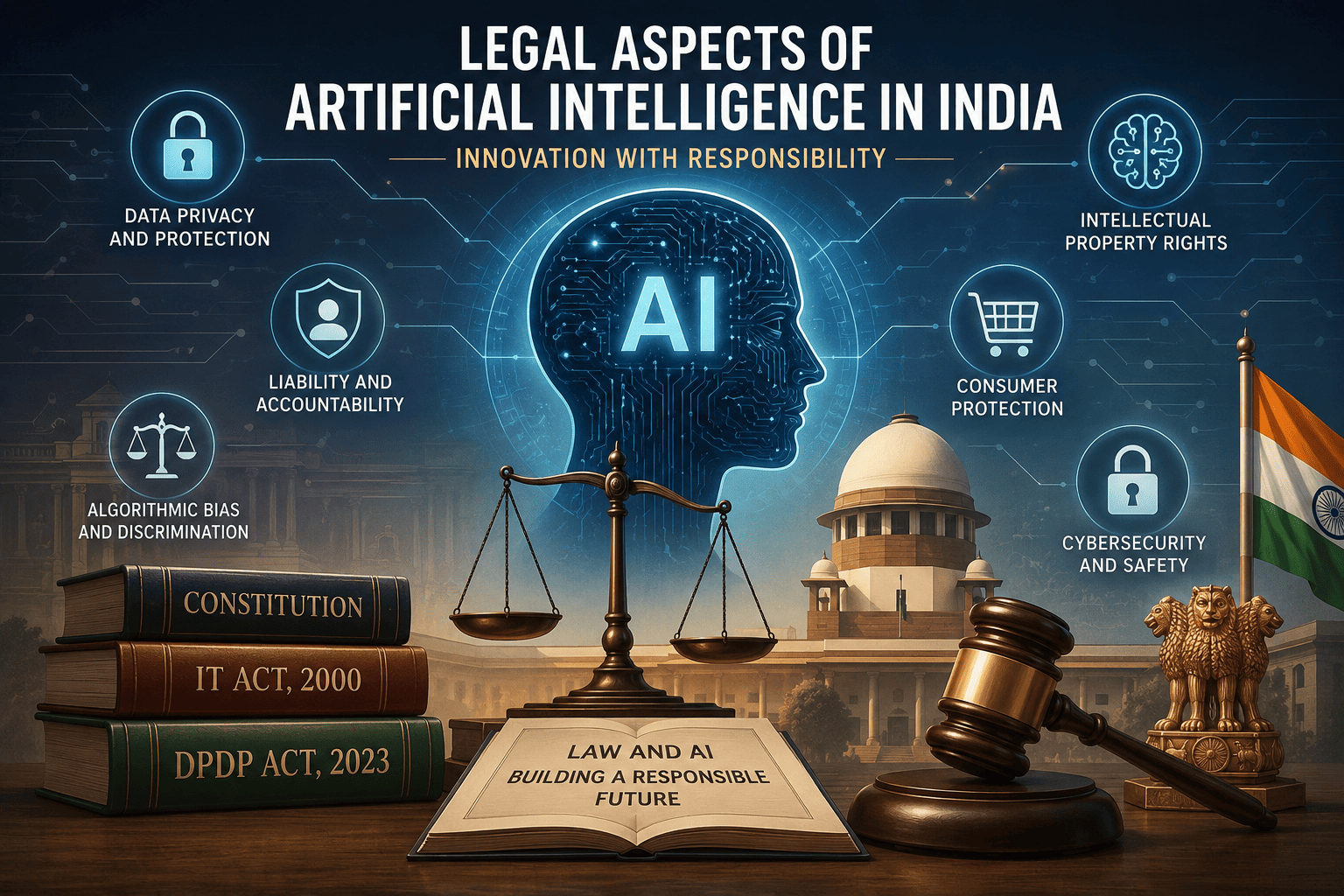
Abstract
One of the most revolutionary technologies of the twenty-first century is artificial intelligence (AI), which has an impact on a number of industries, including healthcare, banking, education, transportation, governance, and the legal profession. AI presents enormous potential for economic expansion and creativity, but it also poses serious ethical and legal issues.
One of the fastest-growing digital economies in the world, India is actively utilizing AI to progress technology and enhance the provision of public services. However, the creation of a thorough legal framework regulating its usage has lagged behind the quick incorporation of AI.
This article examines the legal issues surrounding artificial intelligence in India, along with the current regulatory framework, major obstacles, judicial developments, and the need for further reforms.
Introduction
Artificial intelligence refers to the capability of a computer or machine to do tasks that normally need human intelligence. Those tasks include learning, reasoning, decision-making, processing language, and recognizing images. AI has grown from a futuristic idea to a real-world technology that drives virtual assistants, recommendation engines, self-driving vehicles, facial recognition, predictive analytics, and generative AI tools.
India has declared AI a strategic priority for economic development and digital governance. Government programs like Digital India, India AI Mission, and the National Strategy for Artificial Intelligence are aimed at making the country a global leader in responsible AI innovation.
However, technological progress also creates legal challenges regarding privacy, intellectual property, liability, discrimination, cybersecurity, and consumer rights.
The lack of dedicated AI legislation means existing laws are being interpreted to regulate AI-related activities. Policymakers, businesses, and legal professionals therefore need to work together to ensure that innovation moves forward with adequate legal protections.
Legal Frameworks Governing AI in India
India currently regulates AI through a combination of existing statutes rather than a standalone AI law.
Digital Personal Data Protection Act, 2023 (DPDP Act)
The Digital Personal Data Protection Act, 2023 (DPDP Act) plays a significant role in regulating artificial intelligence systems processing personal data. AI applications that use users’ information must have lawful consent, be transparent, and take measures for the safe processing of personal data.
Information Technology Act, 2000
The Information Technology Act, 2000, continues to govern electronic records, cybersecurity, cyber offenses, and intermediary responsibilities. Although the legislation was enacted before the advent of modern AI technologies, many of its provisions are still relevant today for regulating digital platforms powered by artificial intelligence.
Consumer Protection Act, 2019
Similarly, the Consumer Protection Act, 2019, offers protection to consumers from unfair trade practices and misleading advertisements generated by artificial intelligence (AI) systems. Where AI-enabled services cause consumer harm because the products are defective or because the recommendations are misleading, legal remedies may be available under consumer law.
Intellectual Property Laws
Laws governing intellectual property such as the Copyright Act, 1957; the Patents Act, 1970; and the Trade Marks Act, 1999, also affect the development of AI.
Legal discussions are ongoing on topics such as the rights to content created by AI, the patentability of AI-based inventions, and the protection of works by machines.
Summary of Current AI Laws in India
| Law | Role in AI Regulation |
|---|---|
| Digital Personal Data Protection Act, 2023 | Regulates personal data processing by AI systems. |
| Information Technology Act, 2000 | Governs cybersecurity, electronic records, cyber offenses, and intermediaries. |
| Consumer Protection Act, 2019 | Protects consumers from defective AI products and misleading AI-generated services. |
| Copyright Act, 1957 | Raises issues relating to AI-generated content ownership. |
| Patents Act, 1970 | Deals with patentability of AI-assisted inventions. |
| Trade Marks Act, 1999 | Protects trademarks associated with AI technologies and businesses. |
Major Legal Challenges of Artificial Intelligence in India
Data Privacy and Data Protection
Artificial intelligence systems are dependent on big datasets. These datasets often contain sensitive personal information about a person’s health, financial status, education, or online behavior.
Uncontrolled artificial intelligence may violate the right to privacy, which the Supreme Court has recognized as a constitutional right.
Therefore, organizations must implement transparent data collection practices, minimize unnecessary data processing, and comply with the Digital Personal Data Protection Act.
Responsibility and Answerability
One of the most difficult legal questions is liability when artificial intelligence systems make wrong decisions or cause harm.
For example, when an autonomous car is involved in an accident or an AI-based medical diagnostic system makes a wrong diagnosis, it is difficult to determine who is liable.
Depending on the circumstances, liability may possibly lie with developers, software companies, manufacturers, users, or service providers.
Currently, India does not have well-defined statutory provisions for assigning liability to autonomous artificial intelligence systems.
Algorithmic Bias and Discrimination
Artificial intelligence learns from datasets of the past. If those datasets reflect existing social or economic biases, the AI may reproduce or even amplify those biases in its decisions.
Biased recruitment software, discriminatory credit scoring algorithms, and unequal facial recognition accuracy are some of the ways in which AI may undermine the constitutional guarantees of equality.
Developers must therefore regularly audit AI systems to ensure fairness, transparency, and non-discrimination.
Intellectual Property Issues
The use of AI in the creation of art, music, and software has raised questions regarding ownership of these products.
Current copyright law does not account for artificial intelligence (AI)-created works.
Whether the rights to these works should belong to the developers, the users of the software, or the organizations that create such software is uncertain under Indian law.
Also, AI-assisted inventions challenge the traditional principles of patent law.
Cybersecurity Risks
Artificial intelligence can be used to improve cybersecurity by detecting fraud and preventing cyberattacks. However, the malicious use of AI has become a threat to cybersecurity.
Strengthening cybersecurity regulations and promoting the development of responsible AI technologies are needed for national security.
Major AI Legal Challenges at a Glance
| Challenge | Key Legal Concern |
|---|---|
| Data Privacy | Protection of personal information and lawful processing. |
| Liability | Determining responsibility for AI-caused harm. |
| Algorithmic Bias | Preventing discrimination and ensuring equality. |
| Intellectual Property | Ownership of AI-generated works and AI-assisted inventions. |
| Cybersecurity | Preventing misuse of AI in cyberattacks and fraud. |
Need for India’s Own AI Law
AI is moving fast—sometimes too fast for the laws we already have. India really needs its own legal playbook for governing AI.
Here’s what future laws need to spell out:
- What developers and users can and can’t do with AI.
- Who’s responsible when autonomous systems mess up.
- Rules that make sure high-risk AI is transparent about how it works.
- Checks to keep algorithms from getting biased—plus regular audits to catch problems early.
- Tools to fight deepfakes and AI-generated misinformation.
- Tight standards for how government uses AI, so it stays ethical.
- Extra data protection for kids and people who can’t always protect themselves.
Laws should encourage innovation but draw clear lines so nobody’s rights or trust are left behind as technology moves forward.
Key Recommendations for Future AI Regulation
| Priority Area | Recommended Reform |
|---|---|
| AI Accountability | Clearly define liability for autonomous AI systems. |
| Transparency | Require explainable AI for high-risk applications. |
| Privacy | Strengthen personal data protection and consent requirements. |
| Bias Prevention | Mandate periodic algorithm audits. |
| Deepfakes | Create dedicated legal safeguards against AI-generated misinformation. |
| Government AI | Establish ethical standards and independent oversight. |
| Children’s Data | Provide enhanced legal protection for minors and vulnerable individuals. |
Conclusion
AI’s changing everything—governance, healthcare, classrooms, business, and law. It’s opening up a ton of opportunities for India’s economy and growth, but it’s also raising some big, complicated legal questions. Think about privacy, who’s at fault when things go wrong, discrimination, copyright, and cybersecurity—the list keeps growing.
Right now, India’s legal system only sort of covers AI. It just doesn’t go deep enough for all the twists and turns AI’s throwing at us.
As these technologies become part of daily life, everyone—lawmakers, judges, businesses, and regular people—needs to work together.
The goal is to build a legal system strong enough to protect our rights and values and flexible enough to grow with technology.
If India gets this right, the country can set the standard for trustworthy, people-first AI worldwide.
Key Takeaways: Legal Issues of Artificial Intelligence (AI) in India
The following key takeaways summarize the major legal issues, regulatory developments, and future challenges relating to artificial intelligence (AI) in India.
- Artificial Intelligence (AI) is transforming India across sectors such as healthcare, finance, education, transportation, governance, and the legal profession, creating both opportunities and complex legal challenges.
- India does not yet have a dedicated AI law. AI is currently regulated through existing legislation, including the Digital Personal Data Protection Act, 2023, the Information Technology Act, 2000, the Consumer Protection Act, 2019, and various intellectual property laws.
- Data privacy is one of the biggest legal concerns. AI systems rely on massive amounts of personal data, making compliance with the Digital Personal Data Protection Act (DPDP Act), 2023, essential.
- Liability for AI-generated decisions remains legally uncertain. Indian law does not clearly determine who is responsible when autonomous AI systems cause harm, whether developers, manufacturers, software providers, or users.
- Algorithmic bias can result in discrimination. AI systems trained on biased datasets may produce unfair outcomes in recruitment, lending, facial recognition, and public services, raising concerns under India’s constitutional guarantee of equality.
- AI is reshaping intellectual property law. Questions surrounding copyright ownership of AI-generated works and patentability of AI-assisted inventions remain unresolved under existing Indian legislation.
- AI presents both cybersecurity opportunities and risks. While AI improves fraud detection and cyber defense, it is also increasingly used for cyberattacks, deepfakes, identity theft, and misinformation.
- India needs a comprehensive artificial intelligence law that clearly defines AI governance, accountability, transparency, ethical standards, liability, and regulatory oversight.
- Future AI legislation should include safeguards against algorithmic bias, deepfakes, misinformation, unethical government surveillance, and misuse of personal data while promoting responsible innovation.
- Responsible AI governance requires collaboration between lawmakers, courts, regulators, technology companies, businesses, researchers, and civil society to balance innovation with constitutional rights.
- A balanced AI regulatory framework can position India as a global leader in trustworthy, ethical, and human-centric artificial intelligence while encouraging technological growth and protecting citizens’ rights.
- The future of AI regulation in India will significantly influence digital governance, economic development, consumer protection, cybersecurity, and constitutional freedoms in the coming decades.
Summary Table of Key AI Legal Issues in India
| Legal Issue | Key Takeaway |
|---|---|
| AI Adoption | Artificial intelligence is rapidly transforming multiple sectors of the Indian economy. |
| Legal Framework | India currently regulates AI through existing laws instead of a dedicated AI statute. |
| Data Privacy | Compliance with the Digital Personal Data Protection Act, 2023, is essential. |
| Liability | Responsibility for AI-caused harm remains legally uncertain. |
| Algorithmic Bias | AI systems may create discriminatory outcomes if trained on biased datasets. |
| Intellectual Property | Ownership of AI-generated works and AI-assisted inventions remains unresolved. |
| Cybersecurity | AI strengthens cyber defense but also creates new cyber threats. |
| Future AI Law | India needs comprehensive legislation governing AI accountability and ethics. |
| Governance | Collaboration among stakeholders is necessary for responsible AI development. |
| Long-Term Impact | AI regulation will shape India’s digital economy and constitutional governance. |
Written By: Ankusha

