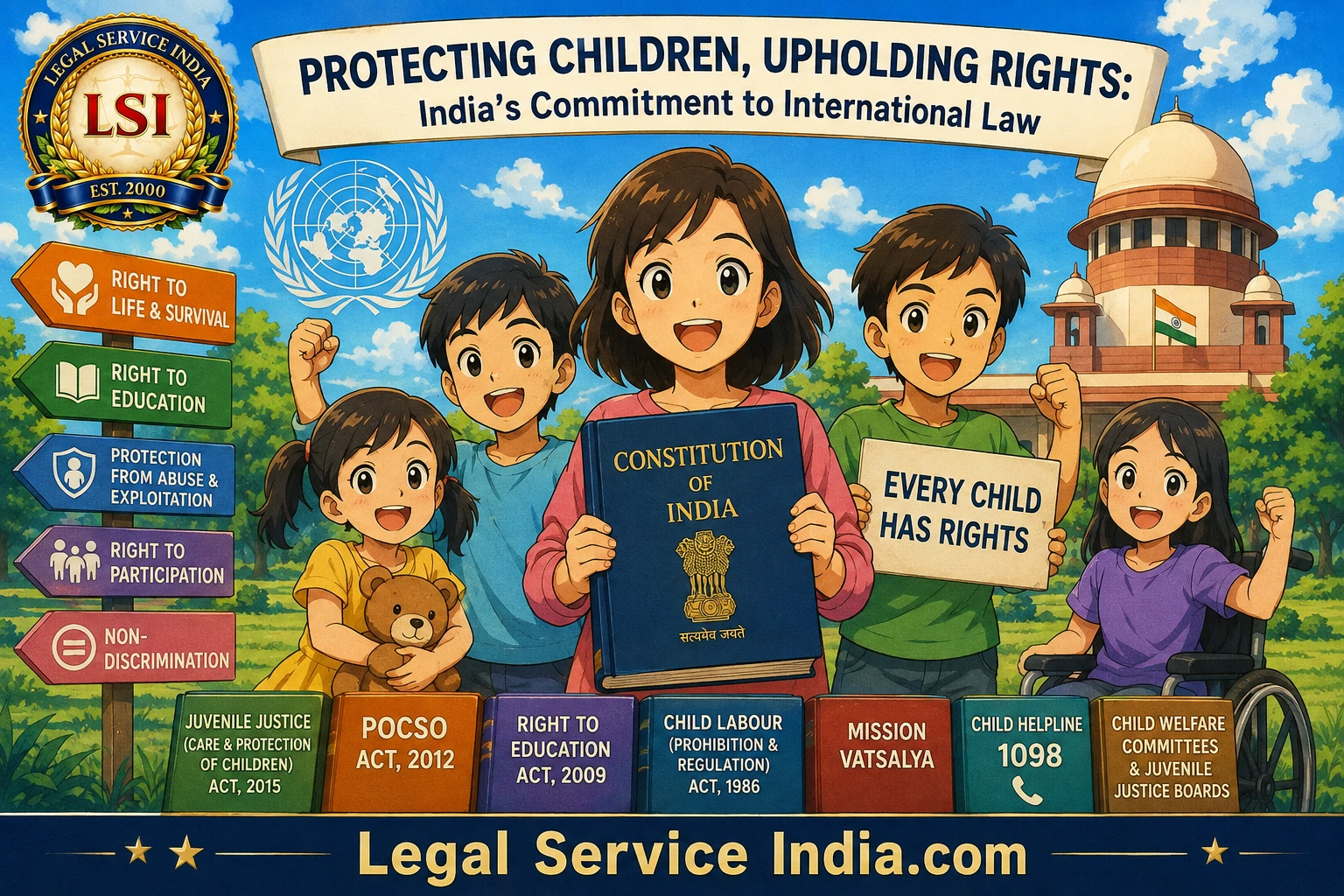
Protecting Children, Upholding Rights: India’s Commitment to International Law
The protection of children is not merely a matter of welfare; it is a constitutional, legal, and moral commitment. India’s child protection framework is grounded in the principles of dignity, equality, non-discrimination, the best interests of the child, and the right to survival, development, and participation.
Constitutional Commitment to International Child Rights
India’s commitment is also anchored in Article 51(c) of the Constitution of India, which directs the State to foster respect for international law and treaty obligations in the dealings of organized peoples with one another. In keeping with this constitutional vision, India signed the United Nations Convention on the Rights of the Child (UNCRC) in 1990 and ratified it on 11 December 1992. The ratification reaffirmed India’s commitment to protecting and promoting the civil, political, economic, social, and cultural rights of every child.
Constitutional Safeguards for Children in India
The principles of the UNCRC find strong resonance in India’s constitutional framework. Article 14 guarantees equality before law; Article 15(3) enables the State to make special provisions for children; Article 21 protects life and personal liberty; Article 21A recognises the right to education; while Articles 23 and 24 provide safeguards against trafficking, forced labour and hazardous employment. Articles 39(e) and 39(f) further require the State to protect children from abuse and exploitation and ensure that they develop in conditions of freedom, dignity, and opportunity.
Key Constitutional Provisions
| Constitutional Provision | Protection Offered |
|---|---|
| Article 14 | Equality before law |
| Article 15(3) | Special provisions for children |
| Article 21 | Protection of life and personal liberty |
| Article 21A | Right to education |
| Articles 23 & 24 | Protection against trafficking, forced labor, and hazardous employment |
| Articles 39(e) & 39(f) | Protection from abuse, exploitation, and promotion of healthy development |
| Article 51(c) | Respect for international law and treaty obligations |
Legislative Framework for Child Protection
These constitutional commitments are translated into a comprehensive legislative framework, including the Juvenile Justice (Care and Protection of Children) Act, 2015 (as amended in 2021), the Protection of Children from Sexual Offences (POCSO) Act, 2012 (as amended in 2019), the Right of Children to Free and Compulsory Education Act, 2009, Child and Adolescent Labour (Prohibition and Regulation) Act, 1986 (as amended in 2016), and legislation addressing child marriage, trafficking and adoption.
Major Child Protection Laws in India
- Juvenile Justice (Care and Protection of Children) Act, 2015 (as amended in 2021)
- Protection of Children from Sexual Offences (POCSO) Act, 2012 (as amended in 2019)
- Right of Children to Free and Compulsory Education Act, 2009
- Child and Adolescent Labour (Prohibition and Regulation) Act, 1986 (as amended in 2016)
- Legislation relating to child marriage
- Legislation relating to child trafficking
- Legislation relating to adoption
Mission Vatsalya and Child Protection Institutions
India has further strengthened this framework through policies and programmes such as Mission Vatsalya, which seeks to build a robust child protection system based on family-based care, prevention, protection, rehabilitation and social reintegration. Statutory institutions such as Child Welfare Committees, Juvenile Justice Boards and Special Juvenile Police Units, together with the Child Helpline 1098 and digital child protection systems, form important components of this architecture.
Key Child Protection Institutions
- Mission Vatsalya
- Child Welfare Committees (CWCs)
- Juvenile Justice Boards (JJBs)
- Special Juvenile Police Units (SJPUs)
- Child Helpline 1098
- Digital Child Protection Systems
Four Foundational Principles of the UNCRC
At its core, India’s child protection approach reflects the four foundational principles of the UNCRC: non-discrimination; the best interests of the child; the right to life, survival and development; and respect for the views of the child.
| UNCRC Principle | Meaning |
|---|---|
| Non-discrimination | Equal protection and opportunities for every child |
| Best interests of the child | Every decision affecting children should prioritize their welfare. |
| Right to life, survival, and development | Ensuring holistic physical, mental, and emotional development |
| Respect for the views of the child | Children should be heard in matters affecting them. |
India’s Ongoing Commitment to Child Rights
Thus, India’s commitment to international law is not confined to treaty ratification. It is reflected in the continuing endeavor to translate international child rights standards into constitutional guarantees, legislation, institutions, policies, and programs. Protecting children and upholding their rights is ultimately an expression of India’s constitutional values and its commitment to ensuring that every child grows, develops, and participates in an environment of safety, dignity, and opportunity.
References
- Constitution of India, particularly Articles 14, 15(3), 21, 21A, 23, 24, 39(e), 39(f), and 51(c). Available at:
India Code – Constitution of India, HAQ Centre for Child Rights - United Nations Convention on the Rights of the Child (UNCRC), adopted by the UN General Assembly on 20 November 1989. India acceded to/ratified the Convention on 11 December 1992. Available at:
OHCHR – India’s Pledge on CRC, OHCHR Treaty Database - The Juvenile Justice (Care and Protection of Children) Act, 2015 (as amended in 2021). Ministry of Law and Justice, Government of India. Available through the Mission Vatsalya portal:
Juvenile Justice Act, 2015 - The Protection of Children from Sexual Offences (POCSO) Act, 2012 and the Protection of Children from Sexual Offences (Amendment) Act, 2019. Government of India. Referenced under Mission Vatsalya resources:
Mission Vatsalya - The Right of Children to Free and Compulsory Education Act, 2009. Government of India. Linked to the constitutional guarantee under Article 21A:
Indian Kanoon, Mission Vatsalya - The Child and Adolescent Labour (Prohibition and Regulation) Act, 1986, as amended in 2016, Government of India.
- Ministry of Women and Child Development, Government of India. Mission Vatsalya: Guidelines and Child Protection Framework. Available at:
Mission Vatsalya Portal, Mission Vatsalya Guidelines - National Policy for Children, 2013, Ministry of Women and Child Development, Government of India.
Mission Vatsalya - National Commission for Protection of Child Rights (NCPCR). Child Rights and Constitutional Safeguards in India.
- Office of the United Nations High Commissioner for Human Rights (OHCHR). Convention on the Rights of the Child: Ratification Status and Implementation Framework.
OHCHR Treaty Database, OHCHR
Written By
Junaid ul Islam, Child Protection Systems Specialist, LLM (International & Humanitarian) Laws, PhD (P)