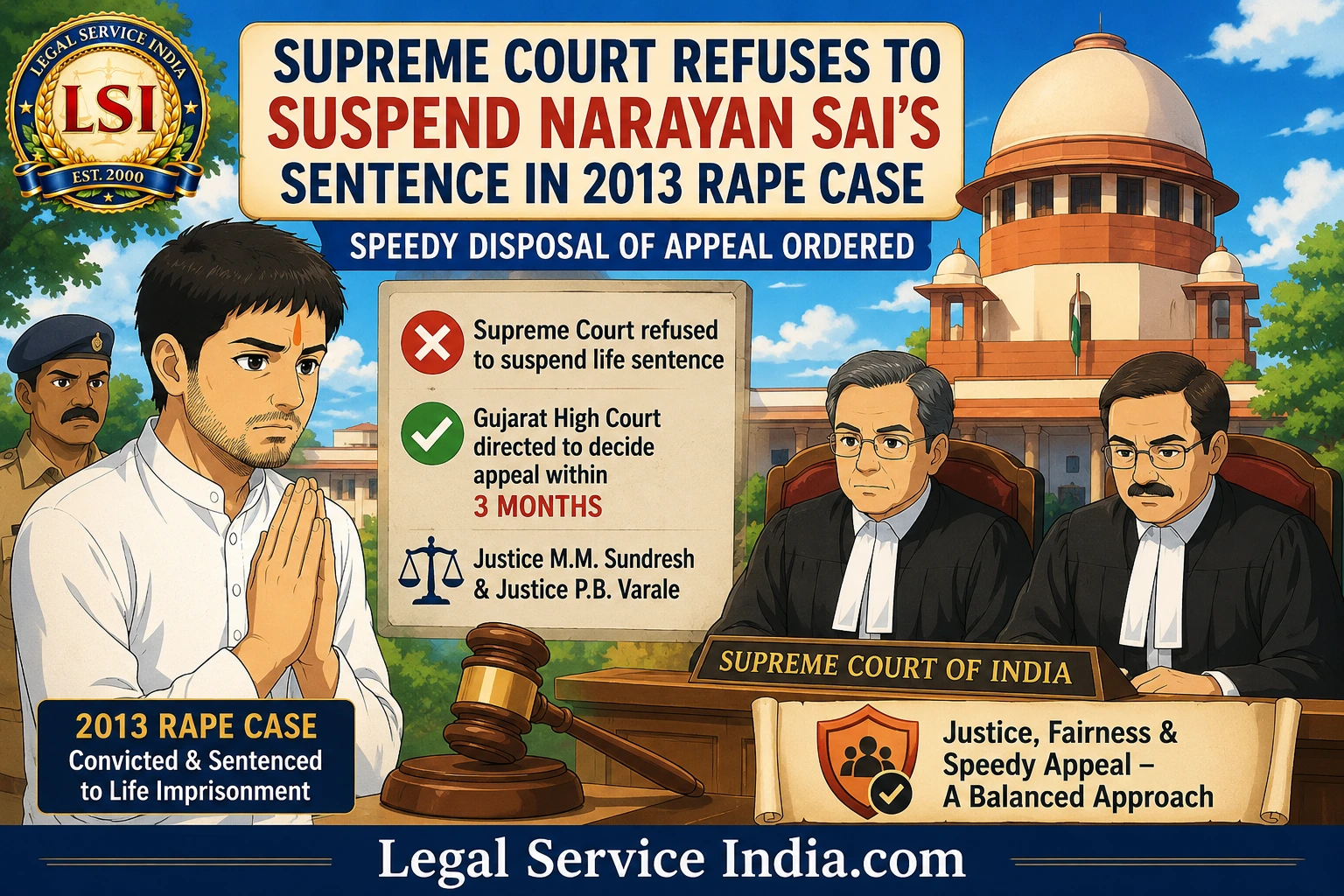
Supreme Court Refuses to Suspend Sentence of Asaram’s Son Narayan Sai in 2013 Rape Case: Speedy Disposal of Appeal Ordered
Introduction
In a significant order reinforcing judicial restraint in serious criminal offences, the Supreme Court refused to suspend the sentence of Asaram’s son Narayan Sai in the 2013 rape case, while simultaneously safeguarding his right to an expeditious appellate hearing.
Instead of granting interim liberty by suspending the sentence, the Court adopted a balanced approach. Recognizing that the appeal against conviction had remained pending, the Bench directed the Gujarat High Court to dispose of the criminal appeal within three months.
The ruling once again demonstrates that suspension of sentence after conviction in heinous offenses such as rape is an exceptional remedy and not a matter of routine.
Citation
| Particular | Details |
|---|---|
| Case | Narayan Sai v. State of Gujarat |
| Court | Supreme Court of India |
| Order Date | 7 August 2026 |
| Bench | Justice M.M. Sundresh and Justice P.B. Varale |
| Key Direction | The Supreme Court declined to suspend the life sentence imposed on Narayan Sai while directing the Gujarat High Court to decide his pending criminal appeal within three months. |
Background of the Case
The criminal proceedings originated from allegations made in 2013 by a woman devotee associated with the ashram run by Narayan Sai and his father, Asaram.
Following investigation and trial:
- Narayan Sai was convicted by the trial court.
- He was sentenced to life imprisonment for rape and other connected offenses.
- He challenged the conviction before the Gujarat High Court.
- Pending the appeal, he sought suspension of sentence and release on bail.
The Gujarat High Court rejected the request for suspension of sentence.
Aggrieved by that refusal, Narayan Sai approached the Supreme Court.
What Was Before the Supreme Court?
The principal question before the Court was not whether Narayan Sai was guilty or innocent, since that issue will ultimately be decided in the pending criminal appeal.
Instead, the Court was required to determine:
Whether the life sentence should be suspended during the pendency of the appeal and the convict released on bail.
This distinction is legally important because suspension of sentence under criminal appellate jurisdiction is discretionary and depends upon well-established judicial principles.
Supreme Court’s Decision
The Supreme Court declined to interfere with the Gujarat High Court’s order refusing suspension of sentence.
Accordingly, the Court:
- refused to suspend the life sentence;
- declined to enlarge Narayan Sai on bail; and
- directed the Gujarat High Court to decide the pending criminal appeal within three months.
Why Is This Order Legally Significant?
Although brief, the order reflects two important constitutional concerns.
1. Seriousness of the Offence
Courts consistently treat convictions for rape with exceptional seriousness.
Once a competent criminal court records a conviction after appreciation of evidence, the presumption of innocence that existed during trial no longer operates in the same manner.
Consequently, suspension of sentence becomes an exceptional relief rather than the norm.
2. Right to Speedy Justice Continues Even After Conviction
Article 21 of the Constitution protects not only the right to a fair trial but also the right to a timely adjudication.
Where criminal appeals remain pending for prolonged periods, continued incarceration without final appellate determination may raise concerns regarding fairness.
Instead of suspending the sentence, the Supreme Court addressed this concern by requiring the High Court to hear and decide the appeal expeditiously.
This approach attempts to balance:
- the interests of the victim;
- societal interest;
- the finality attached to a conviction; and
- the convict’s right to have the appeal decided within a reasonable time.
Key Highlights
| Issue | Supreme Court’s View |
|---|---|
| Suspension of Sentence | Refused |
| Bail Pending Appeal | Declined |
| Life Sentence | Continues to operate |
| Pending Criminal Appeal | To be decided by the Gujarat High Court within three months |
| Underlying Principle | Balance between the seriousness of the offense and the right to speedy justice |
Suspension of Sentence Under Indian Criminal Law
The distinction between bail before conviction and suspension of sentence after conviction is fundamental.
Before Conviction
- The accused enjoys the presumption of innocence.
After Conviction
- The conviction carries legal weight
- The trial court’s findings stand unless overturned
- The appellate court exercises greater caution while granting suspension of sentence.
Factors Considered by Courts
Courts ordinarily examine factors such as
- nature and gravity of the offense,
- strength of the conviction,
- possibility of appeal being heard soon,
- conduct of the convict,
- likelihood of misuse of liberty,
- broader interests of justice.
| Stage | Legal Position |
|---|---|
| Before Conviction | The accused enjoys the presumption of innocence. |
| After Conviction | The conviction carries legal weight, and appellate courts exercise greater caution while considering suspension of sentence. |
Where the offense involves rape or other grave crimes, appellate courts generally insist upon compelling reasons before suspending the sentence.
Balancing Liberty and Victims’ Rights
Modern criminal jurisprudence increasingly recognizes that criminal justice must protect both:
- the constitutional rights of the accused, and
- the dignity and rights of victims.
The present order reflects that balance.
Instead of releasing the convict during the pendency of the appeal, the court ensured that the appellate process itself is accelerated.
This protects public confidence in the administration of justice while ensuring that the appeal is not kept pending indefinitely.
Importance of Time-Bound Disposal
One notable aspect of the order is the direction requiring disposal of the appeal within three months.
Such directions are becoming increasingly common where:
- Appeals have remained pending for years
- Convicts continue to remain in custody
- Early adjudication can avoid repeated bail applications.
| Reason for Expedited Disposal | Purpose |
|---|---|
| Long-pending appeals | Ensures timely justice. |
| Continued custody of convicts | Avoids unnecessary delay in adjudication. |
| Repeated bail applications | Reduces repetitive litigation. |
The Supreme Court has consistently emphasized that criminal appeals involving life convicts should ordinarily receive priority.
Wider Judicial Message
The ruling sends an important institutional message.
The Supreme Court has demonstrated that:
- Extraordinary relief will not ordinarily be granted merely because an appeal is pending;
- Appellate courts should dispose of serious criminal appeals expeditiously;
- Judicial efficiency can often be a better solution than interim release.
This approach reduces prolonged uncertainty for:
- victims,
- convicts,
- investigating agencies, and
- society at large.
Impact on Future Criminal Appeals
Although the order does not lay down a new principle of law, it is likely to be cited in future cases involving:
- suspension of sentence after conviction,
- life imprisonment,
- rape convictions,
- prolonged pendency of criminal appeals.
Key Takeaway
The order illustrates that the Supreme Court may prefer a speedy hearing over interim suspension of sentence where circumstances justify such a course.
Conclusion
The Supreme Court’s refusal to suspend the sentence of Asaram’s son Narayan Sai in the 2013 rape case underscores the cautious approach adopted by appellate courts in serious criminal matters.
By declining interim relief while directing the Gujarat High Court to decide the appeal within three months, the court sought to preserve the sanctity of a judicial conviction without compromising the constitutional requirement of timely justice.
The decision reinforces two enduring principles of Indian criminal law: grave offenses demand judicial caution in granting post-conviction liberty, and justice must be delivered without avoidable delay.
Frequently Asked Questions (FAQs): Supreme Court Refuses To Suspend Sentence Of Asaram’s Son Narayan Sai In 2013 Rape Case
| Question | Short Answer |
|---|---|
| Why was Narayan Sai’s sentence not suspended? | The Supreme Court found no sufficient grounds for post-conviction interim relief. |
| What did the Supreme Court direct? | The Gujarat High Court was directed to decide the pending appeal within three months. |
| Can a life sentence be suspended during appeal? | Yes, but only in exceptional circumstances. |
| Why is this judgment important? | It reinforces judicial caution in granting post-conviction bail in serious offenses. |
| What is its future impact? | It may guide future cases involving suspension of sentence and rape convictions. |
1. Why Did the Supreme Court Refuse to Suspend the Sentence of Asaram’s Son Narayan Sai in the 2013 Rape Case?
The Supreme Court refused to suspend the sentence of Asaram’s son Narayan Sai in the 2013 rape case because it found no sufficient grounds to grant post-conviction relief.
Instead of releasing him on bail, the court directed the Gujarat High Court to dispose of his pending criminal appeal within three months. This approach balances the interests of justice with the constitutional right to a speedy hearing.
2. What Is the Significance of the Supreme Court’s Decision in Narayan Sai’s Rape Case?
The Supreme Court’s decision in Narayan Sai’s rape case reinforces the principle that suspension of sentence after conviction in serious offenses such as rape is an exceptional remedy.
The judgment also highlights the importance of expeditious disposal of criminal appeals to ensure timely justice under Article 21 of the Constitution.
3. Can a Life Sentence Be Suspended While a Criminal Appeal Is Pending Before the High Court?
Yes, a life sentence can be suspended during the pendency of a criminal appeal under the Code of Criminal Procedure (now the Bharatiya Nagarik Suraksha Sanhita, 2023), but only in exceptional circumstances.
Courts consider several factors before granting such relief, including:
- The gravity of the offense.
- The merits of the appeal.
- The convict’s conduct.
- The likelihood of an early hearing.
4. What Directions Did the Supreme Court Issue While Rejecting Narayan Sai’s Plea for Suspension of Sentence?
While rejecting Narayan Sai’s plea for suspension of sentence, the Supreme Court directed the Gujarat High Court to hear and decide his pending criminal appeal within three months.
This direction ensures that the appeal is resolved without unnecessary delay while maintaining the validity of the conviction until the appeal is decided.
5. What Does the Supreme Court’s Refusal to Suspend Narayan Sai’s Sentence Mean for Future Rape Conviction Appeals?
The Supreme Court’s refusal to suspend Narayan Sai’s sentence indicates that convicts in serious offenses, including rape, cannot expect automatic suspension of sentence merely because an appeal is pending.
The order emphasizes that appellate courts may prioritize speedy disposal of appeals over granting interim bail, thereby strengthening judicial consistency in post-conviction criminal proceedings.
Key Takeaways
- The Supreme Court refused to suspend the sentence of Asaram’s son Narayan Sai in the 2013 rape case, holding that no case was made out for post-conviction interim relief while his criminal appeal remains pending.
- Instead of granting bail, the Supreme Court directed the Gujarat High Court to dispose of Narayan Sai’s criminal appeal within three months, emphasizing the importance of speedy justice under Article 21 of the Constitution.
- The ruling reiterates that suspension of sentence after conviction in serious offenses such as rape is an exceptional remedy, and courts must exercise great caution before granting post-conviction bail.
- The judgment highlights the balance between the rights of a convicted appellant, the interests of victims, and the need to uphold public confidence in the criminal justice system.
- The decision is likely to serve as an important reference in future cases involving suspension of sentence, life imprisonment, rape convictions, and expeditious disposal of criminal appeals.
- By refusing to suspend the sentence while ensuring a time-bound hearing of the appeal, the Supreme Court reaffirmed that judicial efficiency is often a better solution than interim release in serious criminal cases.
- The order underscores that a conviction by a competent trial court carries significant legal weight, and appellate courts will generally require compelling circumstances before suspending a life sentence.
- The Supreme Court’s refusal to suspend the sentence of Asaram’s son Narayan Sai in the 2013 rape case reinforces the principle that justice must be both fair and timely, protecting constitutional rights without compromising the gravity of serious criminal offences.
Important Links
- Lawyers in India
- Copyright Registration in India
- Caveat Filing in Supreme Court of India
- Mutual Consent Divorce in Delhi NCR: WhatsApp 9650499965