





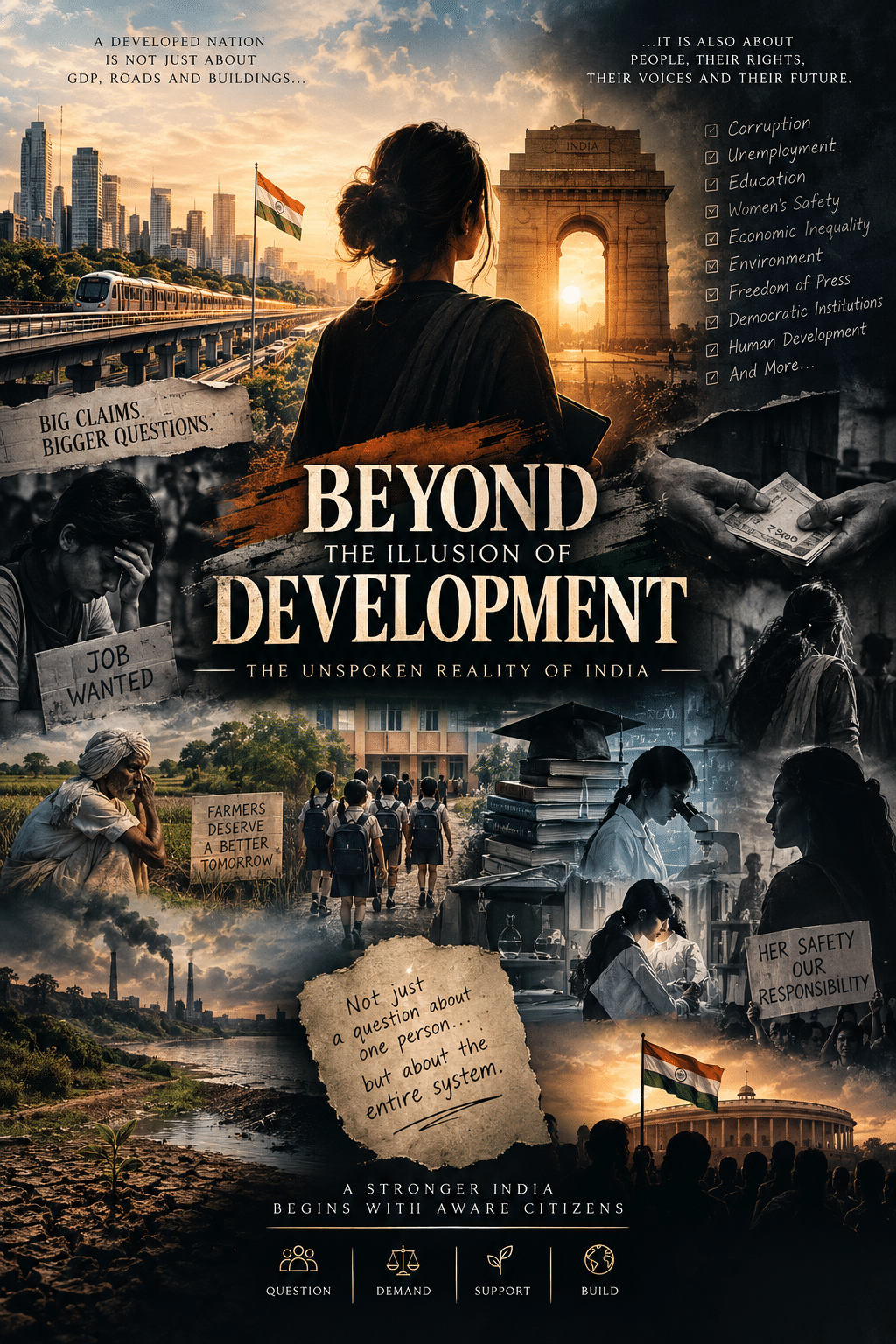
Beyond the Illusion of Development: The Unspoken Reality of India
Who Is Our Hitler? – The Reality of India Behind the Claims of Development
Are we really moving towards becoming a developed nation, or are there some important questions that we are slowly forgetting to ask because of all the big claims about development?
India’s Democracy, Constitutional Values and Accountability
India is the world’s largest democracy. People from different religions, languages, cultures and backgrounds live together here. Our Constitution gives every citizen the right to equality, freedom and justice. But the real strength of a democracy is not just its elections, Parliament or government. It also depends on how freely people can question those in power and how seriously the government responds to those questions.
Development, Nationalism and the Challenges Facing India
Today, we often talk about development, nationalism, economic growth and making India a leading nation in the world. But at the same time, we cannot ignore issues like corruption, unemployment, education, women’s safety, economic inequality, environmental problems and the freedom of democratic institutions.
- Corruption and government accountability.
- Unemployment and economic inequality.
- Access to quality education.
- Women’s safety and equal opportunities.
- Environmental problems and sustainable development.
- The independence and freedom of democratic institutions.
Lessons From Hitler’s Rule in Germany
History tells us how Hitler’s rule in Germany turned into a dictatorship. Democratic institutions became weak, voices of opposition were suppressed and power became concentrated in the hands of one leader. The purpose of remembering this history is not to call any person in today’s India Hitler. It is to understand the warning signs. When people become afraid to question those in power, when disagreement is treated as a problem and when publicity becomes more important than accountability, democracy can slowly become weak.
India’s Democratic Future: Questions Every Citizen Should Ask
So, the question is not about one person. It is about the entire system. Are our democratic institutions as strong as they should be? Are we fulfilling our responsibility as citizens by questioning those in power?
1. Corruption: One of the Biggest Challenges for Ordinary Citizens
Corruption weakens a country’s progress from within. It is not limited to big scams or transactions worth crores of rupees.
We can see its impact in everyday life when an ordinary person has to pay a bribe to get their work done or needs someone’s recommendation to access a government service.
According to Transparency International’s Corruption Perceptions Index 2025, India scored 39 out of 100 and ranked 91st among 182 countries. This index measures how corruption in the public sector is perceived. It does not show the total number of actual corruption cases.
A survey conducted by Transparency International under the Global Corruption Barometer – Asia 2020 found that 89% of surveyed Indians considered government corruption a major problem. The survey also found that 39% of people who used public services said they had paid a bribe to a public official in the previous 12 months.
Around 46% said they had used personal contacts to get public services.
These figures are from a 2020 survey, not a survey of the present year. However, they help us understand how serious the problem can be for ordinary citizens.
The risk of corruption is not limited to government offices. Areas such as infrastructure, real estate, transport, mining, power, public services, police and land registration also need transparency and accountability.
India already has laws such as the Prevention of Corruption Act, 1988; the Prevention of Money Laundering Act, 2002; the Lokpal and Lokayuktas Act, 2013; and the Companies Act, 2013.
But this raises an important question: If we already have laws to fight corruption, how effectively are they being implemented?
Are the same rules applied to an ordinary citizen and a powerful person?
2. Economic Growth: A Big GDP, But What About the Common Person?
India is among the world’s major economies. According to World Bank data for 2025, India’s GDP was around $3.96 trillion, with an economic growth rate of approximately 7.6%.
This is an important sign of economic progress. But does an increase in GDP automatically make life better for every citizen?
According to the same World Bank data, India’s GDP per capita was around $2,702.5. This shows why we need to understand the difference between the total economic output of a country and its average output per person.
A large GDP does not automatically mean that every citizen is financially secure or living a comfortable life.
On one side, we hear big claims about economic growth. On the other, people still face poverty, rising living costs, low incomes, unequal opportunities and financial insecurity.
The real success of development should be measured by how much people’s lives have improved.
Can ordinary families afford good education, healthcare, food, housing and a decent standard of living?
3. Unemployment and Agriculture: The Real Employment Challenge
The youth are one of the biggest strengths of any country. India has a large young population, but providing enough decent and stable jobs for them is equally important.
According to the World Bank’s ILO-modelled estimate for 2025, India’s unemployment rate was around 4.2%. However, the unemployment rate alone does not show the complete employment situation.
We also need to look at the quality of jobs, regular income, the condition of people working in the informal sector and the opportunities available to young people.
The agriculture sector also shows an important gap. According to PLFS 2023–24, around 46.1% of India’s workforce was employed in agriculture, while agriculture contributed approximately 14.7% to the country’s Gross Value Added.
This does not mean that agriculture is less important. It shows that a large number of people depend on this sector, and there is a need to improve their income, working conditions and productivity.
Are young people getting jobs according to their qualifications?
Are farmers and agricultural workers receiving enough financial support and security?
Will employment opportunities remain limited to big cities, or will smaller towns and villages also get better opportunities?
These are questions that deserve serious attention.
4. Education and Research: How Strong Is the Foundation of Our Future?
A developed nation is not recognised only by its buildings, roads and technology. Its education system and scientific thinking are equally important.
India ranked 38th among 139 countries in the Global Innovation Index 2025. This is a positive sign of India’s growing ability to develop new ideas and technology.
However, there are still challenges when it comes to spending on research and development. According to the Department of Science and Technology, India’s Gross Expenditure on Research and Development (GERD) was around 0.84% of GDP in 2023–24.
We also need to understand that education is not just about getting a degree. It should help people develop critical thinking, a scientific attitude, practical skills and a sense of responsibility as citizens.
Are government schools providing quality education?
Can students from every background access higher education?
Are our universities and research institutions receiving enough support?
Is our education system preparing young people not just to look for jobs but also to create new opportunities?
These questions are important for India’s future.
5. Human Development and Happiness: Are People Really Living Better Lives?
A country’s progress cannot be judged only by economic figures. The real condition of a country also depends on the health, education, living standards and happiness of its people.
According to the UNDP Human Development Report 2025, India ranked 130th among 193 countries, with an HDI score of 0.685. India remained in the medium human development category.
In the World Happiness Report 2026, India ranked 116th among 147 countries.
These rankings remind us that economic growth is not the only thing that matters. People’s living conditions, social security, physical and mental health and overall satisfaction with life are equally important.
If the country’s economy is growing, we must also ask whether the lives of ordinary people are improving along with it.
6. Women’s Equality and Safety: An Important Measure of Development
No society can truly progress unless women have equal opportunities and feel safe.
According to the World Economic Forum’s Global Gender Gap Report 2025, India ranked 131st among 148 countries. Its gender parity score was around 64.4%.
Crimes against women are also a serious concern. According to the NCRB’s Crime in India 2023 report, 448,211 cases of crimes against women were registered in 2023. These are reported cases recorded by the police, not the total number of incidents that may have taken place.
While discussing women’s safety, we also need to talk about a harmful mindset: blaming the victim instead of the person who committed the crime.
Whenever a crime takes place against a girl or a woman, people often start questioning her clothes, the time she went outside or her behaviour.
But why don’t we focus on the person who committed the crime? The responsibility for a crime always belongs to the offender, not the victim.
When we hear about crimes against little girls as well as elderly women, it becomes clear that blaming someone’s clothes is neither fair nor a solution to the problem.
Women’s safety is not just about making laws. It also means providing safe public places, a sensitive police system, fair investigations, timely justice and respect for women.
It is not enough to talk about respecting women in speeches and government schemes.
Women must also get equal opportunities in education, employment, politics and every other part of society.
7. Environment: Why Should Nature Pay the Price for Development?
Development is important, but it should not come at the cost of leaving future generations without clean air, clean water and a safe environment.
India ranked 176th among 180 countries in the Environmental Performance Index 2024. In the 2026 report, India was also ranked 176th.
This raises serious concerns about air pollution, climate change, biodiversity and environmental protection.
Along with large construction projects, industrial growth and urban development, we must also make sure that our rivers, forests, water sources and natural resources are protected.
Are we giving enough importance to the environment while focusing on development?
Is clean air and clean water becoming a reality for every citizen?
Development should improve people’s lives, not make the environment unsafe for them.
8. Freedom of the Press and the Right to Disagree in a Democracy
The role of the media in a democracy is not limited to showing the news. The media also questions the government, administration and public institutions and helps people stay informed.
According to Reporters Without Borders’ World Press Freedom Index 2025, India ranked 151st among 180 countries. In the 2026 report, India ranked 157th.
These rankings raise concerns about the political, economic, legal, social and safety-related conditions faced by journalists.
Criticising the government does not mean criticising the country. The government and the country are not the same thing.
Questioning government decisions, discussing its policies and pointing out its mistakes are democratic rights.
The strength of a democracy should not be judged by how much the government is praised. It should also be judged by how much space people have to disagree, question and criticise.
9. Military Strength and Real Development Are Two Different Things
According to the Global Firepower 2025 ranking, India was placed fourth in terms of military strength. This reflects India’s important position in defence and military capability.
But military strength and human development are two different things.
A country can be strong in defence, but it must also continue to improve in education, healthcare, employment, social equality and environmental protection.
We should be proud of India’s achievements, but that does not mean we should stop talking about the areas where improvement is still needed.
10. The Role of Citizens in a Democracy: Asking Questions Is a Right, Not a Crime
Democracy is not just about voting once every five years. It also means that citizens should keep an eye on the government’s work, understand its policies, raise their concerns and demand accountability.
When people stop asking questions, there is a risk that those in power may become less accountable.
Peaceful protests, public discussions, debates and criticism are important parts of a democratic society.
Not every protest is necessarily right, but treating every disagreement as wrong goes against the basic idea of democracy.
No matter which political party is in power, its responsibility is towards the people.
Before being supporters of any political party, we should first be aware citizens who understand their rights and responsibilities.
11. The Way Forward: Change May Take Time, But It Must Begin Somewhere
We cannot expect the entire system to change overnight. Problems like corruption, unemployment, poor educational facilities and delays in government work have existed for years. Solving them will take time, proper planning and continuous effort.
But just because change cannot happen immediately does not mean we should keep waiting for it. Change must begin somewhere, and it can begin with the steps that are already within the government’s power.
The government may not be able to solve every problem at once, but it can start by taking practical steps in areas where it has the responsibility and authority to act.
11.1. More Employment Opportunities and Timely Recruitment
The government should focus on creating more jobs, especially for educated young people. Government vacancies should be announced regularly, recruitment schedules should be followed and examinations should take place on time.
The selection process must be fair and transparent. Unnecessary delays in results and appointments should be avoided.
11.2. Security and Stability for Young People
Young people need more than promises of employment. They need financial security, stable careers and opportunities to build independent lives.
Fair salaries, safe working conditions, social security and protection from workplace exploitation should also be given importance.
11.3. Improving the Education System
The focus should not only be on getting more students into schools and colleges. The quality of education matters just as much.
Government schools and colleges need better buildings, trained teachers, modern learning facilities, research opportunities and practical skill-based education.
Students should have access to good-quality education in India. Studying abroad should be a personal choice, not something students feel forced to do because they cannot find enough opportunities at home.
11.4. Transparent Government Recruitment
Paper leaks, cancelled examinations and delays in recruitment affect the future of millions of students and job seekers.
Strict security arrangements, reliable examination systems, independent monitoring and action against those responsible are necessary.
Students should not have to lose years of their lives because of administrative failures.
11.5. Controlling Corruption and Strengthening Accountability
Every government department should have clear and transparent procedures, regular audits and easy ways for people to file complaints.
Government projects and public spending should be properly monitored. Anyone found responsible for corruption should face fair and timely legal action, regardless of their position or influence.
11.6. Strengthening Democratic Institutions
A strong democracy needs independent institutions, a free press and the freedom to question those in power.
Parliamentary discussions, opposition voices and peaceful public criticism should be respected. Transparency and accountability should be seen as basic responsibilities of democracy, not as problems for those in power.
11.7. Better Healthcare and Public Facilities
Development should reach ordinary people, not just big cities and major projects.
Government hospitals need enough doctors, medical staff, equipment and basic facilities.
Public transport, roads, sanitation, electricity and clean drinking water also need regular attention.
11.8. Supporting Small Businesses and Creating New Opportunities
Not everyone can get a government job, and people should not have to depend only on government recruitment for their future.
Small businesses, startups, local industries and skill-development programmes should receive proper support. This can create more employment opportunities and reduce the pressure on government jobs.
11.9. Listening to Citizens and Taking Responsibility
A government must stay connected to the people it represents.
Public complaints should be heard, people should receive timely responses and there should be clear ways to question administrative decisions.
Development should not be judged only by the announcements made by the government. It should also be judged by what actually reaches ordinary people.
11.10. Small Steps Today, A Stronger India Tomorrow
We may not be able to change everything immediately, but we can certainly begin with the things that are within our control and responsibility.
Every vacancy announced on time, every examination conducted fairly, every corruption complaint investigated properly and every student given access to better education is a step towards a stronger India.
The government cannot solve every problem in a single day, but it cannot keep postponing its responsibility either.
Change does not always begin with a revolution. Sometimes, it begins with one honest decision, one responsible action and one system that finally starts listening to its people.
India does not need more promises about the future. It needs practical decisions in the present.
Conclusion: Our Question Is Not About One Person, It Is About the Entire System
India is facing two different realities today. One shows economic growth, technological progress, military strength and a growing global identity. The other highlights corruption, employment challenges, unequal access to education, women’s safety, environmental problems and questions about accountability.
Both are part of India’s reality. We cannot hide the challenges by only talking about achievements. At the same time, it would also be unfair to ignore the country’s progress by focusing only on its problems.
We need to understand that loving our country does not mean supporting every decision made by the government. A responsible citizen is someone who feels proud of the country’s achievements but is also ready to question its problems and demand improvement.
The biggest lesson from Hitler’s history is that a democracy needs strong institutions, fair laws, independent journalism, citizens’ rights and accountability to protect itself from becoming a dictatorship.
So, perhaps the most important question today is not who India’s Hitler is. The real question is whether we can keep our democracy strong enough to make sure that no individual or government gets the power to become authoritarian.
Because the greatest strength of a democracy does not belong to one leader. It belongs to its aware and responsible citizens.
If we truly love our country, we must be ready to accept its reality. We should not only praise it; we should also have the courage to question it when something needs to change.
References and Further Reading
- Transparency International – Corruption Perceptions Index 2025
- Transparency International – Global Corruption Barometer – Asia
- World Bank – India Economic Data
- UNDP – Human Development Report 2025
- World Economic Forum – Global Gender Gap Report 2025
- World Happiness Report – World Happiness Report 2026
- WIPO – Global Innovation In
