





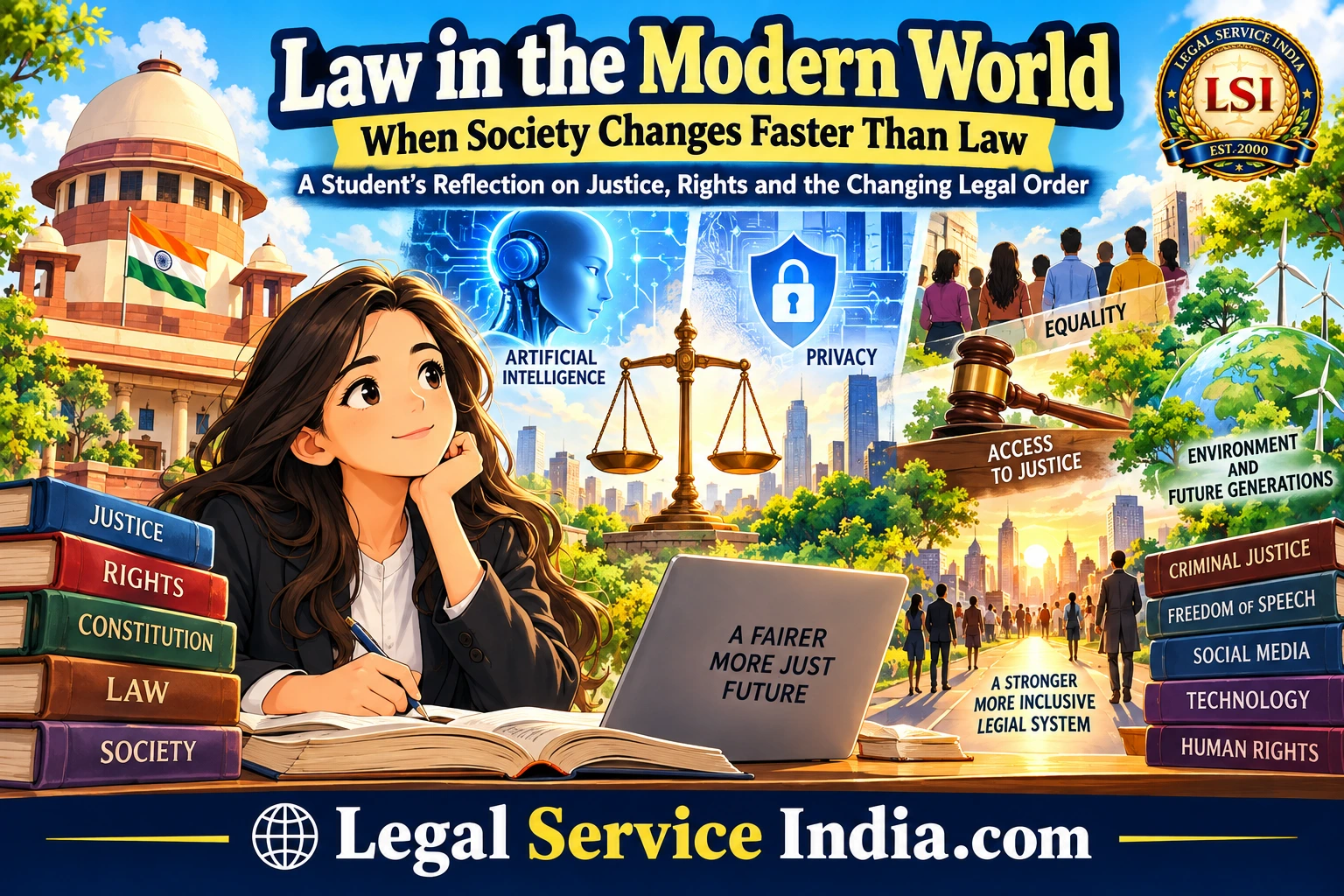
When Society Changes Faster Than Law: Rethinking Justice, Rights and the Modern Legal System
A Student’s Reflection on Justice, Rights and the Changing Legal Order
Law as a Response to Human Problems
Law is usually understood as a set of rules made to regulate society. That definition is correct, but it does not tell us everything about law.
Law is also a response to human problems.
When society changes, the problems faced by people change with it. Technology has changed the way we communicate. Social media has changed the way information travels. Artificial intelligence is changing the way decisions are made. Economic inequality continues to affect access to opportunities, while questions of privacy, liberty and human dignity have become more complicated than ever.
This leaves us with a simple but important question:
Can a legal system designed for yesterday always solve the problems of tomorrow?
I do not think the answer can be a simple yes.
The challenge before modern law is not merely to create new legislation. It is to make sure that law continues to serve its fundamental purpose — justice.
The Difference Between Having a Right and Using a Right
One of the concerns that deserves much greater attention is the gap between law in theory and law in practice.
Our Constitution provides fundamental rights. Statutes create remedies. Courts exist to protect legal rights. Yet, for many ordinary people, approaching the legal system remains difficult.
The problem may be money. It may be lack of legal awareness. It may be distance from a court. Sometimes it may simply be the fear of entering a system that appears complicated to someone unfamiliar with legal procedure.
This raises an uncomfortable question:
What is the practical value of a right if the person who possesses it cannot effectively enforce it?
This is why access to justice should be understood as more than access to a courtroom. It includes:
- legal awareness
- affordable representation
- legal aid
- understandable procedures
- an effective remedy
A right written in a statute is important.
A right that a common person can actually exercise is even more important.
Delay Is Not a Small Defect in the Justice System
The expression “justice delayed is justice denied” has been repeated so often that its seriousness can sometimes be forgotten.
A case is not merely a file in a court.
Behind that file may be a person’s property, employment, family, reputation, liberty or future. When litigation continues for years, the delay itself can become a burden.
But there is another side to the issue.
The answer cannot simply be to dispose of cases as quickly as possible.
Justice must be timely, but it must also be fair.
A hurried hearing that ignores natural justice is not an achievement.
The real objective should be a system where cases are decided without unnecessary delay while preserving due process, fair hearing and judicial independence.
Technology, alternative dispute resolution, better case management and adequate judicial infrastructure can contribute to this goal. But technology alone cannot solve a problem that is also institutional and procedural.
Privacy in a World Where Everything Leaves a Digital Trace
Privacy has acquired a completely different meaning in the digital age.
A person’s phone may contain private conversations, photographs, financial information, documents, contacts and details about their personal life. Online platforms may collect information about what people search, watch, purchase or communicate.
The Supreme Court’s decision in Justice K.S. Puttaswamy (Retd.) v. Union of India recognised privacy as a fundamental right.
That principle becomes increasingly significant as technology becomes more deeply connected with everyday life.
The modern privacy question is no longer limited to whether someone enters your physical home without permission.
It also concerns something less visible:
Who has access to your data?
And once that data is collected, who controls it?
The law has to find a careful balance. Individuals require protection against unlawful intrusion, while legitimate requirements of law enforcement and public interest also have to be recognised.
The important point is that privacy should not be treated as an obstacle to technological progress.
It is connected with dignity, autonomy and liberty.
Artificial Intelligence and the Question of Responsibility
Artificial intelligence has already entered the legal profession.
It can help with research, organisation of information, document analysis and many routine tasks. Used properly, it can make legal work more efficient.
But efficiency should not make us careless about responsibility.
Suppose an AI system produces an incorrect result that causes serious harm. Who is accountable?
- The machine?
- The developer?
- The organisation using it?
- The person who relied upon its output?
These questions cannot be ignored simply because the technology is new.
The law will have to develop principles relating to liability, transparency, data protection, intellectual property and accountability.
There is one principle that should remain clear:
Technology may assist human decision-making, but responsibility cannot disappear behind technology.
An algorithm cannot appear before a court and accept legal responsibility.
A human institution ultimately has to answer for the decision.
Criminal Law: Protecting Society Without Weakening Liberty
Criminal law presents one of the clearest examples of the balance that law must maintain.
The State needs effective powers to investigate offences, protect public order and prosecute criminals. Without such powers, the administration of criminal justice would become ineffective.
But those powers have limits.
Arrest, search, seizure, investigation and prosecution directly affect individual liberty. They must therefore operate within the framework of constitutional safeguards, due process, fair trial and the presumption of innocence.
This is not about choosing between security and liberty.
A constitutional legal system has to protect both.
The strength of criminal law should therefore not be measured only by how severely it punishes.
It should also be measured by how fairly it reaches the person it seeks to punish.
Equality Cannot Remain Only a Constitutional Promise
The principle of equality occupies a central position in Indian constitutional law.
But equality in real life is more complicated than equality in words.
Two people may possess exactly the same legal rights while having completely different economic and social circumstances.
This is why modern law has to think not only about formal equality but also about the practical conditions in which people exercise their rights.
At the same time, every social problem cannot be solved by creating another offence or another restriction.
Sometimes the better legal response may involve:
- education
- institutional reform
- economic opportunity
- proper implementation of existing laws
There is a tendency to believe that whenever a problem appears, a new law must be created.
That is not always true.
A poorly implemented good law can be more ineffective than a carefully implemented existing law.
The quality of justice depends not only upon legislation but also upon implementation.
The Environment and the Rights of Future Generations
Environmental protection is no longer simply an issue concerning forests and wildlife.
It concerns human life itself.
Pollution, climate change, water scarcity and destruction of natural resources raise questions of public interest and constitutional responsibility.
The idea of sustainable development becomes important here.
Development is necessary. Economic growth matters. Employment matters.
But development cannot be measured only by what is gained today.
We must also consider what is left for tomorrow.
This is where the idea of intergenerational justice becomes significant. Future generations cannot participate in today’s decisions, yet they will live with their consequences.
Modern environmental law therefore has to maintain a difficult balance between development and environmental protection.
Social Media Has Changed the Meaning of Legal Harm
The internet has made communication easier, but it has also made certain forms of harm much faster.
Defamation, cyber fraud, identity theft, harassment and privacy violations can reach thousands of people within minutes.
At the same time, freedom of speech and expression remains a fundamental constitutional value.
This creates a difficult legal balance.
The answer cannot be to restrict every controversial statement.
But freedom cannot become a justification for unlawful conduct either.
The legal system must distinguish between legitimate expression and conduct that violates the rights of others.
That requires careful application of constitutional freedoms, reasonable restrictions, civil remedies and criminal law.
Perhaps Law Has Become Too Difficult for the People It Governs
There is another issue that is rarely discussed enough.
Law can become so technical that ordinary people find it difficult to understand.
Legal precision is necessary. Lawyers cannot simply replace technical legal concepts with casual language. But there is still room for greater clarity.
A person should be able to understand the basic nature of their legal rights without feeling completely lost before they even reach a lawyer.
This is particularly important in a country where legal awareness remains uneven.
Legal awareness is not merely knowledge of law. It is a means of empowerment.
The more people understand their rights and duties, the less dependent they become upon misinformation and informal sources of legal advice.
What Does the Modern Lawyer Need to Become?
These changes also raise a question about legal education.
The lawyer of the future cannot be someone who merely remembers sections and case names.
Knowing the law remains essential. But it is no longer enough.
A modern lawyer must also understand technology, privacy, constitutional values, social realities and the practical difficulties faced by ordinary people.
More importantly, a lawyer should learn to ask questions.
- Why does this law exist?
- Does it achieve its purpose?
- Who benefits from it?
- Who may be left outside its protection?
- What happens when the law is poorly implemented?
These questions encourage critical legal thinking.
And critical thinking does not mean criticising everything.
It means identifying weaknesses honestly while looking for lawful and constructive ways to improve them.
Conclusion: Law Must Move With Society, Not Behind It
The modern world does not need a legal system that changes every time society changes.
But neither can law remain permanently attached to conditions that no longer exist.
The challenge is to find the balance.
| Modern Legal Challenge | Principle That Must Be Protected |
|---|---|
| Technology | Privacy |
| Criminal justice | Liberty |
| Economic development | Environmental responsibility |
| Equality | Practical experience of citizens |
| Legal rights | Effective access to justice |
Technology should develop without destroying privacy.
Criminal justice should protect society without sacrificing liberty.
Economic development should continue without ignoring environmental responsibility.
Equality should exist not merely in constitutional language but in the practical experience of citizens.
And legal rights should not remain rights only on paper.
For me, the most important question for modern law is therefore not how many laws we have, but how effectively those laws protect the person for whom they were created.
A legal system becomes meaningful when an ordinary person can understand their rights, approach the system without unreasonable barriers and receive a fair remedy.
Law must be strong enough to maintain order.
It must be flexible enough to respond to change.
But above everything else, it must remain human.
Because behind every petition, every FIR, every contract, every constitutional challenge and every courtroom argument, there is ultimately a person seeking something that no legal system should lose sight of—justice.
