Introduction
India stands at a defining moment in its democratic journey. The world’s largest democracy has witnessed extraordinary political evolution over the past seven decades. Yet, as society changes rapidly through technology, urbanisation, artificial intelligence, social media, and an increasingly aspirational youth population, a fundamental question emerges:
Are political parties evolving as fast as the citizens they seek to represent?
The challenges facing modern India are unlike those of previous generations. Citizens today are better informed, more connected, more vocal, and more demanding of accountability than ever before. They no longer seek leaders only during elections; they seek institutions that listen, respond, and remain present throughout the year.
The future of Indian democracy may therefore depend not on who wins the next election, but on who succeeds in building the next generation’s political organisation—one that combines technology, transparency, internal democracy, social service, and citizen participation.
This article explores what an ideal political party for modern India could look like.
Why Traditional Political Models Are Becoming Obsolete
For decades, political parties across the world have operated on a familiar model:
- Centralised leadership.
- Closed-door decision-making.
- Candidate selection controlled by a few individuals.
- Election-focused activity.
- Limited citizen engagement between elections.
While such systems may have been effective in the past, modern India demands something different.
Today’s citizens expect the following:
- Transparency.
- Accountability.
- Participation.
- Faster responses.
- Evidence-based governance.
- Accessible leadership.
The political party of the future must therefore transform itself from an election machine into a permanent democratic institution.
Traditional vs Modern Political Expectations
| Traditional Political Model | Modern Citizen Expectations |
|---|---|
| Centralized leadership | Participatory decision-making |
| Limited transparency | Open and transparent governance |
| Election-focused engagement | Year-round engagement |
| Top-down communication | Two-way communication |
| Restricted access to leadership | Accessible and responsive leadership |
From Political Party to Public Service Ecosystem
The most successful political organisation of the future will not disappear after elections.
Instead, it will function throughout the year as a public service ecosystem.
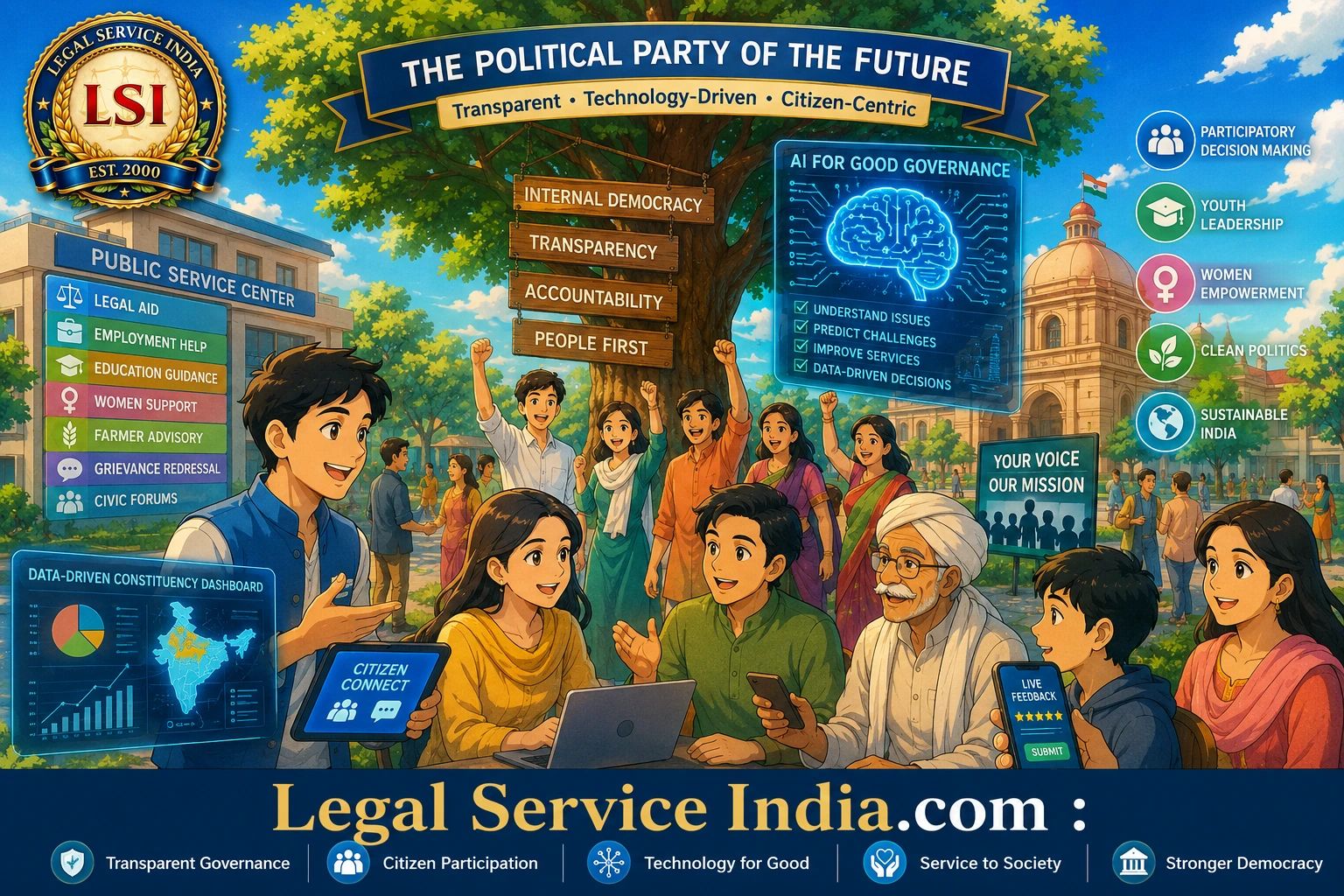
Every constituency should have permanent mechanisms to assist citizens through:
- Legal aid centres.
- Employment assistance desks.
- Educational guidance programmes.
- Women’s support networks.
- Farmer advisory services.
- Governance grievance platforms.
- Civic participation forums.
Such a model would fundamentally change the relationship between citizens and politics.
Politics would no longer be something people experience once every five years.
It would become part of everyday democratic life.
Key Components of a Public Service Ecosystem
| Service Area | Purpose |
|---|---|
| Legal Aid Centres | Provide legal awareness and assistance |
| Employment Assistance Desks | Support job seekers and skill development |
| Educational Guidance Programmes | Assist students and young professionals |
| Women’s Support Networks | Promote safety, empowerment, and inclusion |
| Farmer Advisory Services | Offer agricultural guidance and support |
| Governance Grievance Platforms | Address citizen concerns efficiently |
| Civic Participation Forums | Encourage democratic engagement |
Internal Democracy: The Missing Revolution
One of the biggest criticisms of political parties worldwide is the concentration of power.
Many ordinary workers feel disconnected from decision-making processes. Candidate selection often appears opaque, leading to perceptions of favouritism, influence, or privilege.
The political party of the future must embrace genuine internal democracy.
This could include:
- Internal primaries.
- Worker participation in candidate selection.
- Transparent evaluation systems.
- Public performance scorecards.
- Periodic organisational elections.
Candidates should earn opportunities through merit, public service, organisational commitment, and community trust—not merely through influence or connections.
A democratic society deserves democratic political institutions.
Benefits of Internal Democracy
- Greater transparency in leadership selection.
- Enhanced trust among party workers.
- Improved candidate quality.
- Reduced perceptions of favouritism.
- Stronger public credibility.
- Increased grassroots participation.
The Role of Artificial Intelligence in Democracy
Artificial intelligence is transforming every sector of society.
Politics cannot remain an exception.
Used responsibly, AI can strengthen democracy rather than weaken it.
An innovative political organisation can use AI to:
- Understand public concerns.
- Track emerging issues.
- Improve policy design.
- Monitor service delivery.
- Enhance citizen engagement.
- Predict administrative challenges.
For example, if unemployment concerns rise sharply in a particular district, AI systems can identify the trend early, enabling policymakers to respond before frustrations escalate.
Technology should not replace human judgement.
It should enhance it.
How AI Can Support Democratic Governance
| AI Application | Potential Democratic Benefit |
|---|---|
| Public Sentiment Analysis | Early identification of citizen concerns |
| Policy Impact Assessment | Better-informed decision-making |
| Service Delivery Monitoring | Improved accountability and efficiency |
| Citizen Feedback Systems | Enhanced public participation |
| Issue Prediction Models | Proactive governance responses |
| Data-Driven Planning | Evidence-based policymaking |
Data-Driven Governance Rather Than Assumption-Driven Politics
One of the greatest weaknesses of traditional politics is decision-making based on assumptions.
The future belongs to evidence-based governance.
A modern political organisation should maintain the following:
- Constituency dashboards.
- Citizen feedback systems.
- Performance monitoring tools.
- Development tracking platforms.
Why Accurate Data Matters for Governance
Public representatives should know:
- Which villages lack healthcare.
- Which schools need attention.
- Where unemployment is rising.
- Which infrastructure projects are delayed.
| Governance Area | Information Required |
|---|---|
| Healthcare | Which villages lack healthcare. |
| Education | Which schools need attention? |
| Employment | Where unemployment is rising. |
| Infrastructure | Which infrastructure projects are delayed? |
Good governance begins with accurate information.
Building a Youth-Centric Political Culture
India is one of the youngest countries in the world.
Yet many young citizens feel disconnected from politics.
The ideal political party should actively recruit:
- Students.
- Entrepreneurs.
- Professionals.
- Lawyers.
- Engineers.
- Researchers.
- Social workers.
- Technology experts.
Empowering Young Leaders and Policy Contributors
Politics should become an attractive avenue for talented individuals who wish to serve society.
Young people should not merely be campaign volunteers.
They should become policy contributors, organisational leaders, and future decision-makers.
| Traditional Role | Future-Oriented Role |
|---|---|
| Campaign volunteers | Policy contributors |
| Event participants | Organizational leaders |
| Support workers | Future decision-makers |
Women’s Leadership Must Become Central
No modern political organisation can succeed without meaningful participation of women.
Women’s involvement should not be symbolic.
It should be structural.
Creating Structural Opportunities for Women
This includes:
- Leadership training programmes.
- Policy development roles.
- Candidate opportunities.
- Community outreach networks.
- Economic empowerment initiatives.
| Area of Participation | Key Initiative |
|---|---|
| Leadership | Leadership training programmes. |
| Policy | Policy development roles. |
| Representation | Candidate opportunities. |
| Community Engagement | Community outreach networks. |
| Economic Growth | Economic empowerment initiatives. |
A society progresses most effectively when women participate fully in public life.
Hyperlocal Democracy
National issues are important.
However, citizens often experience governance through local realities.
A blocked drain, a dysfunctional school, poor healthcare facilities, or inadequate public transportation can have a greater impact on daily life than national political debates.
The ideal political party should therefore focus on hyperlocal governance.
Strengthening Local Governance and Community Participation
Every constituency should maintain:
- Issue databases.
- Community consultations.
- Local development plans.
- Citizen advisory councils.
| Hyperlocal Governance Tool | Purpose |
|---|---|
| Issue databases | Track local concerns and priorities. |
| Community consultations | Gather citizen feedback. |
| Local development plans | Guide area-specific progress. |
| Citizen advisory councils | Promote participatory governance. |
The future of democracy lies in solving real problems close to where people live.
Transparency as a Political Asset
Transparency should no longer be viewed as a risk. It should become a competitive advantage.
Modern political organisations should voluntarily disclose the following:
- Candidate evaluations.
- Funding mechanisms.
- Organisational processes.
- Performance reports.
- Policy outcomes.
Citizens are more likely to trust institutions that openly explain how decisions are made. Trust is the most valuable political capital of the modern age.
Benefits of Transparency in Political Organizations
| Transparency Area | Potential Public Benefit |
|---|---|
| Candidate Evaluations | Improves confidence in leadership selection. |
| Funding Mechanisms | Enhances financial accountability. |
| Organizational Processes | Strengthens institutional credibility. |
| Performance Reports | Enables informed public assessment. |
| Policy Outcomes | Promotes evidence-based governance. |
Digital Communities Instead of Digital Propaganda
Social media has transformed political communication. However, many organisations use digital platforms primarily for propaganda. The future requires something different.
Political organisations should build digital communities around the following:
- Employment opportunities.
- Education.
- Entrepreneurship.
- Civic awareness.
- Skill development.
- Public policy discussions.
The objective should be engagement, not merely messaging. A connected citizen is a stronger citizen.
Focus Areas for Digital Citizen Engagement
| Community Focus | Expected Outcome |
|---|---|
| Employment Opportunities | Supports economic empowerment. |
| Education | Encourages informed citizenship. |
| Entrepreneurship | Promotes innovation and self-reliance. |
| Civic Awareness | Strengthens democratic participation. |
| Skill Development | Improves workforce readiness. |
| Public Policy Discussions | Encourages constructive dialogue. |
Leadership Through Service
The most effective political leaders of the future may not be those who speak the loudest. They may be those who listen the best.
Leadership should increasingly be measured by:
- Accessibility.
- Problem-solving ability.
- Integrity.
- Community engagement.
- Policy competence.
Citizens are seeking service-orientated leadership rather than personality-driven politics.
Key Pillars of Service-Oriented Leadership
| Leadership Quality | Public Value |
|---|---|
| Accessibility | Creates stronger citizen connections. |
| Problem-Solving Ability | Delivers practical governance outcomes. |
| Integrity | Builds long-term trust. |
| Community Engagement | Encourages participation and collaboration. |
| Policy Competence | Improves decision-making quality. |
A New Democratic Social Contract
The political party of the future should offer citizens a new social contract:
“We will not appear only during elections.
We will remain present throughout the year.
We will listen before we speak.
We will measure before we promise.
We will serve before we seek power.”
Such a philosophy can fundamentally redefine public trust.
Core Principles of the New Social Contract
- Continuous public engagement.
- Year-round accountability.
- Listening-driven governance.
- Evidence-based commitments.
- Service-first leadership.
Conclusion
India’s democratic future will not be shaped solely by elections. It will be shaped by the institutions that connect citizens, technology, governance, and public service into a single democratic ecosystem.
The ideal political party for modern India is not merely an organisation seeking votes.
- It is a platform for citizen participation.
- It is a centre for innovation.
- It is a school for leadership.
- It is a mechanism for accountability.
- It is a bridge between government and society.
Most importantly, it is a living democratic institution that evolves with the aspirations of the people.
As India moves deeper into the twenty-first century, the political organisations that embrace transparency, technology, merit, participation, and service will not only win elections—they will shape the future of democracy itself.