




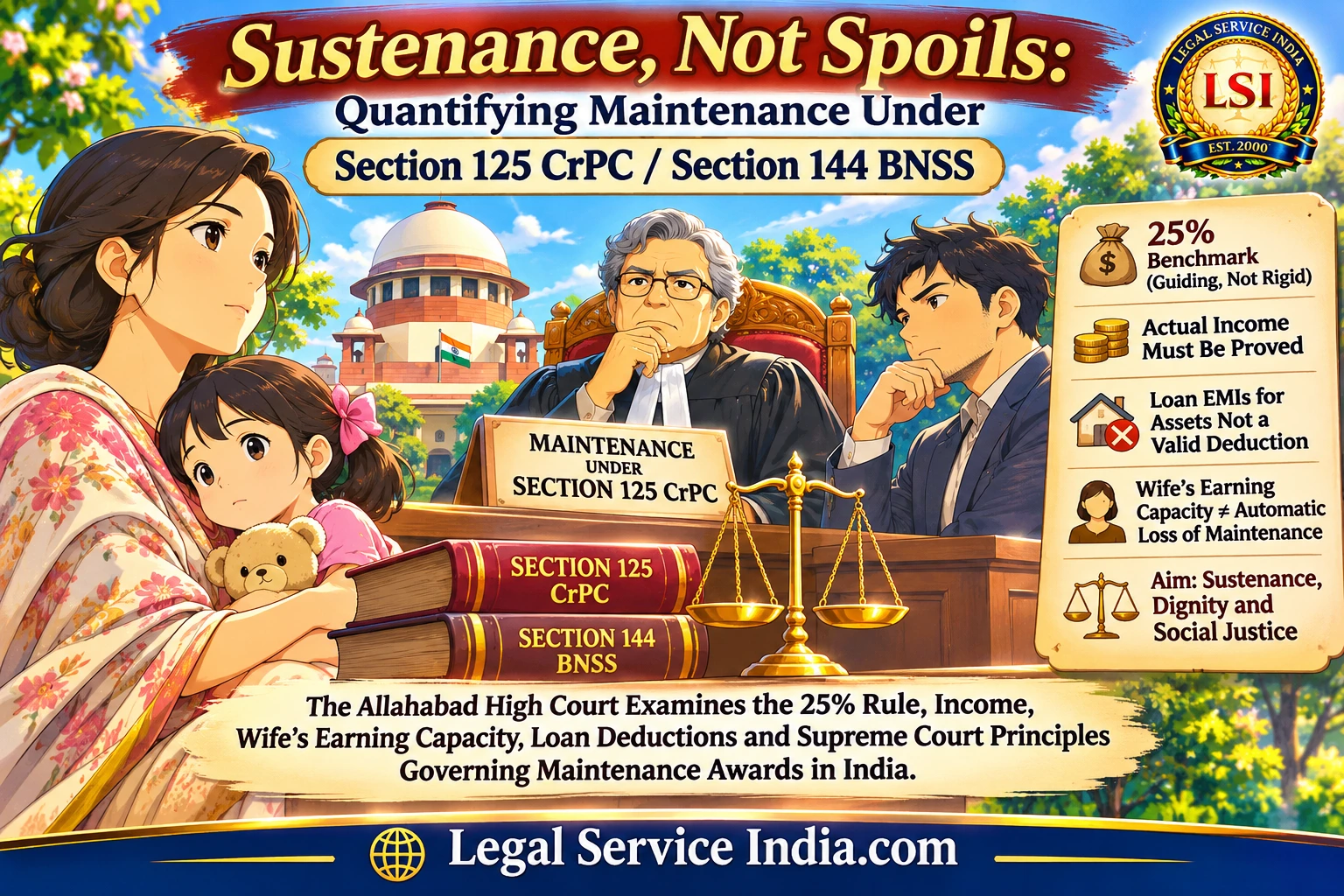
Sustenance, Not Spoils: Quantifying Maintenance Under Section 125 CrPC / Section 144 BNSS
I. The Question
Maintenance litigation is fought on two fronts: entitlement (is the claimant unable to maintain herself?) and quantum (how much, and measured against what income?). A recent single-judge ruling of the Allahabad High Court addresses the second front squarely. It holds that the object of Section 125 CrPC (now Section 144 BNSS, 2023) is a measure for securing sustenance and dignity and not a means of creating a “bonanza or windfall” for the claimant. This article places that ruling within the Supreme Court’s settled jurisprudence.
II. The Decision
Ankit Singh v. State of U.P. and Another
Ankit Singh v. State of U.P. and Another (with a connected revision), 2026 LiveLaw (AB) 811—Allahabad High Court, Lakshmi Kant Shukla J., reported 8 October 2026. Cross-revisions arose from the order of 4 November 2024 of the Principal Judge, Family Court, Jaunpur, awarding the wife ₹15,000 per month under Section 125 CrPC.
The Wife’s Case
The husband, a co-founder and CEO of a private company (director since 14 July 2016), earned about ₹4 lakh per month. Reliance was placed on the company’s authorised share capital (₹50 lakh) and paid-up capital (₹20 lakh).
The Husband’s Case
His salary record showed ₹50,000 per month. The wife, a B.Ed. and former private-school teacher, had salary slips (Aug–Oct 2021) showing ₹45,000 per month; he argued she could maintain herself.
Key Holdings
| Legal Issue | Finding of the Court |
|---|---|
| Company Share Capital | Authorised or paid-up share capital raises no presumption that the company generates enough income to pay a director a ₹4 lakh salary. Income must be shown by cogent material. |
| 25% Maintenance Benchmark | The 25% of net income benchmark (Kalyan Dey Chowdhury) is a guiding factor, not an inflexible rule. Even on ₹50,000, ₹15,000 already exceeded 25%, so there was no case for enhancement. |
| Determination of Maintenance | Quantum must balance the claimant’s needs, the payer’s income and capacity, the parties’ standard of living and other circumstances. |
| Final Outcome | Both revisions were dismissed. The wife’s 2021 slips covered only a short period and did not establish earnings when proceedings began in 2022. |
Important Observations in Paragraph 18 of the Judgement
It is pertinent to reproduce para. 18 of the said judgement, which reads thus:
“18. The object of Section 125 Cr.P.C. is to prevent destitution and vagrancy and to ensure that a wife, child or parent who is unable to maintain himself or herself is not left without the basic means of subsistence. The provision is essentially a measure of social justice intended to provide a reasonable and dignified means of support to the person entitled to maintenance. At the same time, the provision is not intended to confer an unmerited financial advantage or to serve as a source of enrichment for the person claiming maintenance. The amount of maintenance must, therefore, be determined having regard to the needs of the claimant, the income and financial capacity of the person liable to pay, the standard of living of the parties and the other relevant circumstances of the case, so as to strike a fair balance between the legitimate needs of the claimant and the corresponding financial capacity of the person liable to maintain. Section 125 Cr.P.C. is a measure for securing sustenance and dignity and not a means of creating a bonanza or windfall in favour of the claimant.”
III. The Settled Foundation
Object of the Provision
Section 125 is a measure of social justice for women, children and parents: Vimala (K.) v. Veeraswamy (K.), (1991) 2 SCC 375 (three-judge bench); Chaturbhuj v. Sita Bai, (2008) 2 SCC 316, where the court held that the test is whether the wife can maintain herself in the way she was used to in her husband’s home, drawing on Bhagwan Dutt v. Kamla Devi, (1975) 2 SCC 386.
Sustenance Is Not Survival
Shamima Farooqui v. Shahid Khan, (2015) 5 SCC 705, and Bhuwan Mohan Singh v. Meena, (2015) 6 SCC 353, stress that an able-bodied husband cannot plead financial incapacity. Maintenance must not be illusory.
No Fixed Formula
Jasbir Kaur Sehgal v. District Judge, Dehradun, (1997) 7 SCC 7, held that no rigid formula exists and that the award must give the wife reasonable comfort. Rajnesh v. Neha, (2021) 2 SCC 324 (decided 4 November 2020), laid down the quantum criteria and the mandatory Affidavit of Disclosure of Assets and Liabilities.
Balancing the Interests of Both Parties
The two themes combine as follows. The payer cannot minimise income, and the claimant cannot inflate it.
IV. Proving the Payer’s Income
Corporate Filings Are Not Personal Income
A director’s drawings, remuneration and dividends are what count, and the burden of proof lies on whoever alleges the higher figure. Two safeguards operate here.
Rajnesh Affidavits
Both parties must disclose assets and liabilities, and a false affidavit invites action under Section 340 CrPC. In Pinki @ Preeti v. State of U.P., 2026 LiveLaw (AB) 404 (Achal Sachdev J., 13 July 2026), the Family Court’s award was corrected partly because the husband had not filed the affidavit and admitted salary records had been ignored.
Adverse Inference
Where a husband withholds his true income, the court may draw an adverse inference. A claimant who relies on indirect markers must still show a link to actual earnings, as Ankit Singh illustrates.
V. The 25% Benchmark: Yardstick, Not Rule
The benchmark originates in Dr Kulbhushan Kumar v. Raj Kumari (1970) 3 SCC 129 and was followed in Kalyan Dey Chowdhury v. Rita Dey Chowdhury Nee Nandy (2017) 14 SCC 200 (R. Banumathi J., 19 April 2017), where 25% of the husband’s net salary was held “just and proper”.
Three Cautions for Practitioners
- Kalyan Dey arose in a Hindu Marriage Act matrimonial dispute, not a Section 125 proceeding. It is persuasive, not controlling, in Section 125 of the quantum.
- Rajnesh sets out criteria but prescribes no percentage. Some High Courts have noted this expressly.
- Both Ankit Singh and Pinki treat 25% as a broad guideline. Pinki enhanced her salary from ₹12,000 to ₹20,000 on a gross salary of ₹86,674, while Ankit Singh refused an enhancement of ₹15,000.
The benchmark therefore cuts both ways. It is a sanity check on the quantum and never a substitute for evidence.
VI. What Is Deducted from Income
Income Tax and Provident Fund Contributions
Kulbhushan Kumar, as applied by the High Courts, allows income tax and compulsory provident fund contributions to be deducted when arriving at disposable income, while household overheads such as rent and electricity are not.
Supreme Court’s Position on Loan Repayments
The Supreme Court has now spoken on loan repayments. In Deepa Joshi v. Gaurav Joshi, 2026 INSC 370 (Sanjay Karol and Augustine George Masih JJ., 16 April 2026; non-reportable), the Court enhanced maintenance from ₹15,000 to ₹25,000. It held that loan repayments that build assets are capital investment, are voluntary in nature, and cannot rank above the legal obligation to maintain a spouse. The husband’s liability is a primary duty. The Court also referred to Chaturbhuj, Shamima Farooqui and Rajnesh in reaching that conclusion.
Unavoidable Liabilities and Asset-Creating EMIs
Summaries that say “valid secured loan repayments must be factored in” overstate the position. After Deepa Joshi, only unavoidable liabilities (statutory deductions, dependants, genuine medical expense) carry weight. Asset-creating EMIs do not.
VII. The Claimant’s Earning Capacity
Actual Inability Versus Potential Earning Capacity
The expression “unable to maintain herself” means actual, not potential, inability:
- Bhagwan Dutt (1975): the wife’s independent income does not bar her claim but is weighed in fixing the quantum.
- Chaturbhuj (2008): the test is whether she can live in the manner to which she was accustomed.
- Sunita Kachwaha v. Anil Kachwaha, (2014) 16 SCC 715 = AIR 2015 SC 554 (R. Banumathi J., 28 October 2014): merely because the wife was earning something, her claim cannot be rejected.
- Shailja v. Khobbanna, (2018) 12 SCC 199: capacity to earn is distinct from actual earning.
Earning Capacity Arguments in Ankit Singh
In Ankit Singh, the husband’s earning-capacity argument failed on evidence, since three slips from 2021 could not show earnings at the time of the proceedings. A line of High Court authority, such as the Delhi High Court in Damanpreet Kaur v. Indermeet Juneja (14 May 2012, Pratibha Rani J.), has denied relief to well-qualified wives who voluntarily stay idle. A Kerala High Court bench has recently declined to follow a similar Delhi view (Megha Khetrapal v. Rajat Kapoor, 2025 SCC OnLine Del 1688) in light of Shailja and Rajnesh. The safer submission is that qualification alone proves nothing, and evidence of actual earnings or deliberate idleness is what matters.
VIII. A Note on Revisional Jurisdiction
Pinki records that a revisional court ordinarily cannot increase or reduce the quantum, since its power is supervisory. It may do so where the findings are perverse, material evidence is ignored or settled principles are misapplied. Ankit Singh shows the other face: where the trial court’s finding rests on evidence, the High Court will not tinker with it.
IX. Practitioner’s Checklist
- File the Rajnesh affidavit early, and insist on the other side’s.
- Prove income through salary slips, ITRs, bank statements and Form 16. Corporate filings alone are weak.
- Quantify net income: statutory deductions only, and no asset-creating EMIs (Deepa Joshi).
- Use 25% as a cross-check and argue the facts that move the figure.
- Meet an earning-capacity plea with evidence of actual employment, or its absence, at the date of the proceedings.
- For revisions, frame the challenge as perversity or ignored material, and not as a re-weighing of quantum.
X. Citation Table
| Sl. No. | Case Name | Citation / Details |
|---|---|---|
| 1 | Ankit Singh v. State of U.P. | 2026 LiveLaw (AB) 811; Neutral Citation 2026:AHC:198622; Order dated 22/09/2026 |
| 2 | Rajnesh v. Neha | (2021) 2 SCC 324 |
| 3 | Kalyan Dey Chowdhury | (2017) 14 SCC 200. Decided 19.04.2017. |
| 4 | Kulbhushan Kumar v. Raj Kumari | (1970) 3 SCC 129 |
| 5 | Chaturbhuj v. Sita Bai | (2008) 2 SCC 316 |
| 6 | Bhagwan Dutt v. Kamla Devi | (1975) 2 SCC 386 |
| 7 | Shamima Farooqui | (2015) 5 SCC 705 |
| 8 | Bhuwan Mohan Singh v. Meena | (2015) 6 SCC 353 |
| 9 | Vimala (K.) v. Veeraswamy | (1991) 2 SCC 375. Three-Judge Bench. |
| 10 | Jasbir Kaur Sehgal | (1997) 7 SCC 7 |
| 11 | Sunita Kachwaha | (2014) 16 SCC 715 / AIR 2015 SC 554 |
| 12 | Shailja v. Khobbanna | (2018) 12 SCC 199 |
| 13 | Deepa Joshi v. Gaurav Joshi | 2026 INSC 370 |
| 14 | Pinki @ Preeti v. State of U.P. | 2026 LiveLaw (AB) 404 |
| 15 | Damanpreet Kaur v. Indermeet Juneja | (Del HC) (2013) 1 JCC 306 |
Written By: Inder Chand Jain
Ph no: 8279945021, Email: [email protected]