





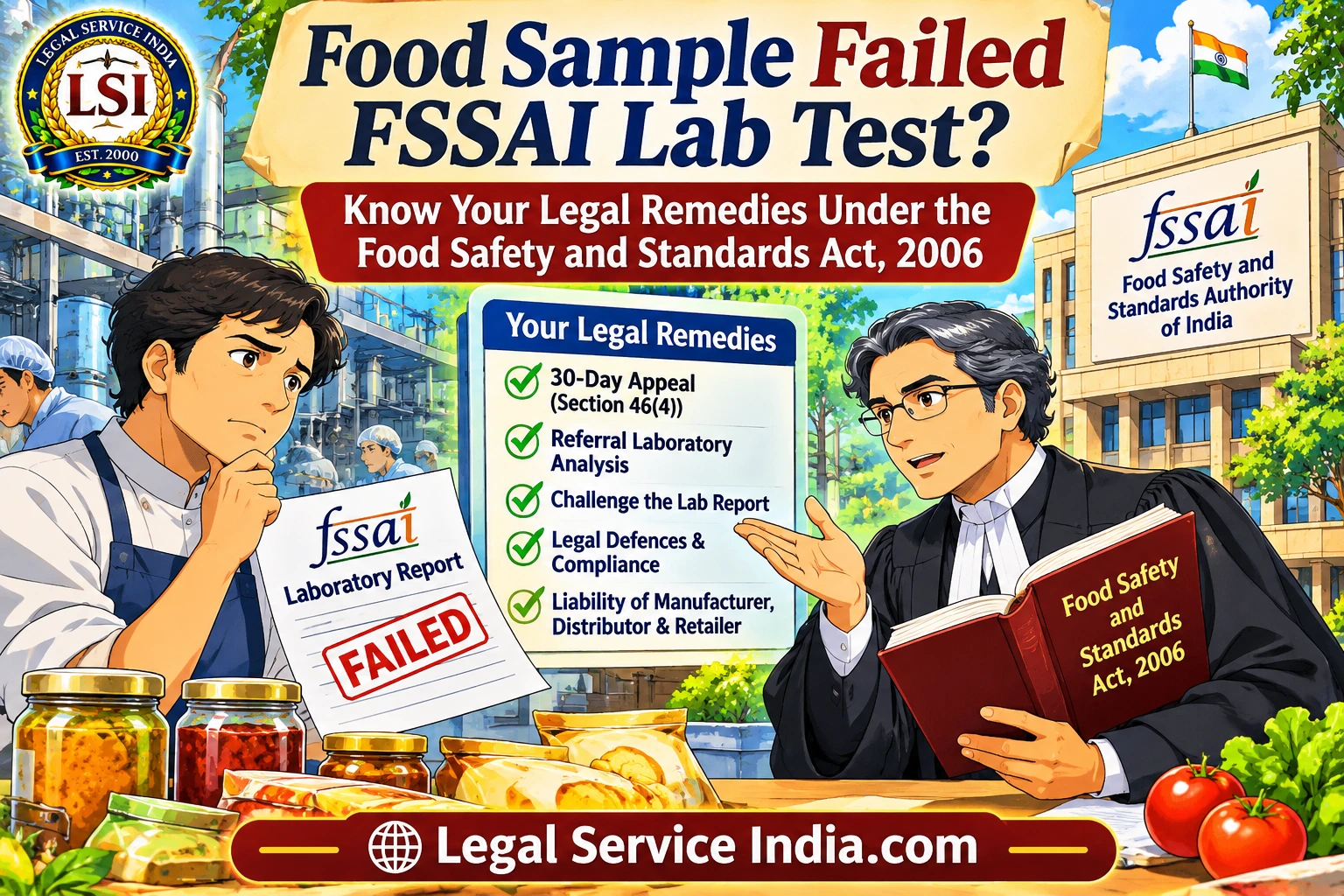
Food Sample Failed FSSAI Lab Test? Know Your Legal Remedies Under the Food Safety and Standards Act, 2006
An adverse food laboratory report can be a serious matter for a food business. A manufacturer may face questions about the quality of an entire production batch. A distributor may receive a notice alleging that unsafe food entered the supply chain. A retailer may suddenly find itself named in proceedings over a product it purchased from an established supplier.
But there is an important legal distinction that every food business operator should understand: a failed food sample report does not, by itself, automatically establish criminal liability.
The Food Safety and Standards Act, 2006 (FSS Act) provides a structured procedure for sampling, laboratory analysis, challenging an adverse report and determining liability. The manner in which a sample was collected, preserved, tested and reported can be just as important as the result itself.
For a business that has received an adverse FSSAI report, the immediate priority should be to understand the nature of the alleged violation, examine the laboratory findings and protect the statutory right to seek further analysis.
This article explains the legal remedies available when a food sample fails an FSSAI laboratory test, including the right to referral laboratory analysis, the distinction between Sections 46(4) and 47, the liability of different participants in the food supply chain, and the defences that may be available under the Act.
1. What Does It Mean When a Food Sample Fails an FSSAI Laboratory Test?
The expression “failed FSSAI lab test” is commonly used to describe a food sample that has been reported as not conforming to the standards prescribed under the FSS Act and the regulations made under it.
However, not all adverse reports mean the same thing.
Depending on the laboratory findings, a sample may be classified as:
- Sub-standard: The food does not meet the prescribed standards, although it may not necessarily be unsafe.
- Unsafe: The food is likely to cause injury to health because of its composition, substance or other characteristics.
- Misbranded: The product or its label, packaging or presentation does not comply with the applicable legal requirements.
- Food containing extraneous matter: The food contains an undesirable foreign substance or material.
These classifications have different legal consequences. The nature of the finding determines the relevant statutory provision and the possible penalty or prosecution.
For clarity, Section 53 of the FSS Act deals with misleading advertisements, whereas Section 54 specifically addresses food containing extraneous matter. These are separate legal categories and should not be confused.
A finding that a product is sub-standard should not automatically be treated as a finding that it is unsafe. Similarly, a labelling defect does not necessarily establish that the food itself is hazardous.
The precise wording of the Food Analyst’s report is therefore the starting point of any legal assessment.
2. The Legal Framework Governing FSSAI Sampling and Testing
The Food Safety and Standards Act, 2006 establishes the responsibilities of food business operators and gives food safety authorities powers to inspect premises, collect samples and initiate enforcement proceedings.
Several provisions are particularly important when a sample fails laboratory testing.
Important Legal Provisions Under the FSS Act
| Legal Provision | What It Deals With |
|---|---|
| Section 26 | Responsibilities of Food Business Operators |
| Section 27 | Liability of manufacturers, packers, wholesalers, distributors and sellers |
| Section 38 | Powers of the Food Safety Officer |
| Section 42 | Procedure for launching prosecution |
| Section 43 | Recognition and accreditation of food laboratories |
| Section 45 | Appointment of Food Analysts |
| Section 46 | Functions of Food Analysts and referral laboratory appeal |
| Section 47 | Sampling and analysis procedure |
| Section 51 | Penalty for sub-standard food |
| Section 52 | Penalty for misbranded food |
| Section 53 | Penalty for misleading advertisements |
| Section 54 | Penalty for food containing extraneous matter |
| Section 55 | Penalty for failure to comply with directions of Food Safety Officer |
| Section 56 | Penalty for unhygienic or unsanitary processing or manufacturing |
| Section 57 | Penalty for possessing adulterants |
| Section 58 | Penalty where no specific penalty is provided |
| Section 59 | Punishment for unsafe food |
| Section 68 | Adjudication |
| Section 69 | Power to compound offences |
| Section 70 | Food Safety Appellate Tribunal |
| Section 80 | Defences which may be allowed under the Act |
The provisions must be read together with the Food Safety and Standards Rules, 2011 and the applicable regulations. An adverse laboratory report is only one part of the enforcement process; the authorities must still follow the statutory procedure before liability can be established.
3. What Happens After a Food Sample Fails the Laboratory Test?
When a Food Analyst finds that a sample does not conform to the applicable standards, the report is sent through the prescribed official channel to the Designated Officer.
The authorities then consider the nature of the violation and the legal provisions that may apply.
The consequences can vary considerably.
A case involving a minor labelling defect may be dealt with differently from one involving a product alleged to be unsafe. A sub-standard product may attract a monetary penalty, while an unsafe food allegation may lead to more serious proceedings depending on the circumstances.
Factors Examined by Food Safety Authorities
The authorities may examine:
- The category of non-compliance identified by the laboratory.
- The applicable food standard or regulation.
- The identity of the manufacturer, distributor, wholesaler or seller.
- The circumstances in which the sample was collected.
- The available laboratory reports and supporting documents.
- Whether the matter attracts adjudication or criminal prosecution.
The Food Business Operator should not assume that the matter is over simply because the first laboratory report is adverse. Equally, it would be unwise to ignore the report or wait for the authorities to take further action.
The statutory opportunity to challenge the report may be time-sensitive.
4. Section 46(4): The Right to Challenge an Adverse Food Analyst Report
One of the most important remedies available after an adverse FSSAI laboratory report is the appeal mechanism under Section 46(4) of the Food Safety and Standards Act, 2006.
This provision enables a Food Business Operator to challenge the Food Analyst’s report before the Designated Officer and seek referral laboratory analysis.
The procedure is prescribed under Rule 2.4.6 of the Food Safety and Standards Rules, 2011.
The 30-Day Limitation Period
Under Rule 2.4.6, the appeal must be filed in Form VIII within 30 days from the date of receipt of the copy of the analysis report from the Designated Officer.
This is a particularly important deadline.
A business should not assume that informal correspondence with the Food Safety Officer, a request for clarification or an internal representation automatically preserves the right of appeal.
If the report is disputed, the appropriate statutory remedy should be considered promptly.
What Happens After Filing Form VIII?
The Designated Officer considers the appeal and the material placed before him. The Food Business Operator must be given an opportunity of being heard.
If the Designated Officer decides to refer the matter, one part of the sample is forwarded to the notified Referral Food Laboratory under appropriate conditions.
The cost of the analysis is borne by the Food Business Operator.
Rule 2.4.6 also requires the sample to be transported and preserved in conditions appropriate to the product so that its integrity is maintained.
The report of the Referral Food Laboratory is treated as final under the rule.
This procedure is important because it gives the business an opportunity to question the scientific basis of the original report rather than simply accepting the first laboratory conclusion.
5. Section 47 and Section 46(4): Two Different Safeguards
A frequent source of confusion in FSSAI proceedings is the relationship between Section 47 and Section 46(4).
Although both provisions concern sampling and laboratory analysis, they operate at different stages.
Section 47: The Sampling-Stage Safeguard
Section 47 prescribes the procedure for taking and dealing with food samples.
The statutory framework provides for division of the sample into prescribed parts, sealing, marking, documentation and delivery to the relevant authorities and laboratory.
The purpose is to preserve the integrity of the sample and ensure that the testing process can be properly examined if the result is disputed.
The prescribed procedure also provides for the handling and retention of sample portions, including the opportunity for further analysis through an accredited laboratory in the circumstances contemplated by the Act.
Section 46(4): The Post-Report Appeal
Section 46(4), on the other hand, becomes relevant after the Food Analyst has issued an adverse report.
It allows the Food Business Operator to challenge that report before the Designated Officer and seek referral laboratory analysis in accordance with Rule 2.4.6.
The distinction is straightforward:
| Legal Provision | Primary Purpose |
|---|---|
| Section 47 | Deals primarily with how the sample is collected, divided, handled and sent for analysis. |
| Section 46(4) | Provides a statutory route to challenge the Food Analyst’s report after it has been received. |
Both provisions are important. A business should examine not only whether the laboratory result is scientifically correct, but also whether the sample was collected, sealed, transported and preserved in accordance with the law.
6. What If the Food Analyst and referral laboratory give different reports?
A particularly important legal issue arises when the original Food Analyst and the Referral Food Laboratory reach different conclusions.
For example, the first laboratory may report that a product is unsafe because of a particular ingredient, while the Referral Food Laboratory may identify a different issue or classify the product differently.
Such a situation raises questions about the evidentiary value of the reports and the effect of the referral analysis on subsequent proceedings.
Kerala High Court Decision: Pepsico India Holdings Pvt. Ltd. v. State of Kerala
The Kerala High Court examined this issue in Pepsico India Holdings Pvt. Ltd. v. State of Kerala, Crl. M.C. No. 8950 of 2016, decided on 4 September 2024 (2024:KER:67629).
In that case, the Food Analyst reported the presence of sodium saccharin, whereas the Referral Food Laboratory identified undeclared caffeine. The findings were materially different.
The Court examined the statutory scheme and observed that Rule 2.4.6 describes the Referral Food Laboratory’s report as final. However, the rule does not expressly use the word “supersede”, which would clearly indicate that the later report replaces the earlier one.
The Court identified a lacuna in the statutory framework. It reasoned that where the Food Business Operator challenges the Food Analyst’s report and the Referral Food Laboratory gives a divergent opinion rather than confirming the original finding, prosecution cannot simply proceed as though the original report had been confirmed.
The Court quashed the proceedings against the petitioner in that case.
Why This Judgment Is Significant
This decision is significant because it highlights a practical difficulty in the FSS Act’s laboratory appeal mechanism. A referral report that differs materially from the original report cannot simply be ignored without examining the legal consequences of that difference.
The judgment does not mean that every difference between two laboratory reports automatically ends a case. The nature of the findings, the statutory procedure followed and the facts of the particular matter remain important.
Nevertheless, where the two reports reach materially different conclusions, the issue deserves careful legal examination.
7. Adjudication or Criminal Prosecution: Why the Difference Matters
Not every violation under the FSS Act results in a criminal prosecution.
The Act provides different enforcement mechanisms depending on the nature and seriousness of the alleged contravention.
Adjudication Under Section 68
Section 68 provides for adjudication of specified contraventions that attract monetary penalties.
The Adjudicating Officer considers the available material, gives the concerned party an opportunity to present its case and determines whether a penalty is justified.
The proceedings are not the same as a criminal trial.
A business facing adjudication should nevertheless take the notice seriously. It should examine the laboratory report, the applicable standard, the sampling documents and the material relied upon by the authority.
An adverse order may also be challenged through the appellate mechanism provided under the Act.
Criminal Prosecution Under Section 42
Where the alleged offence is punishable with imprisonment, the prosecution procedure under Section 42 becomes relevant.
The Designated Officer examines the report and the material placed before the authority. The statutory process includes consideration of the nature of the offence and the appropriate enforcement route.
Depending on the facts and the applicable provision, the matter may proceed to a criminal court.
Compounding Under Section 69
Section 69 provides a mechanism for compounding certain offences in accordance with the conditions prescribed under the Act.
However, the availability of compounding depends on the nature of the offence and the statutory restrictions. It should not be assumed that every FSS Act violation can be compounded.
What About Unsafe Food Under Section 59?
Section 59 deals with punishment for unsafe food. The consequences depend on the seriousness of the violation and whether injury or death results.
Following the Jan Vishwas (Amendment of Provisions) Act, 2023, the amended framework provides for imprisonment up to three months and a fine up to ₹3 lakh where unsafe food does not result in injury.
More serious consequences apply where injury or death results. In cases involving death, the provision retains particularly severe punishment, including a minimum imprisonment term of seven years, which may extend to imprisonment for life, along with a minimum fine of ₹10 lakh.
The applicable statutory version and commencement provisions should always be checked for the relevant date and nature of the alleged offence.
The distinction between adjudication and prosecution is therefore not merely procedural. It affects the nature of the proceedings, the possible consequences and the manner in which the defence should be prepared.
8. Who Is Responsible: Manufacturer, Distributor or Retailer?
A common mistake in food safety proceedings is to assume that every participant in the supply chain is automatically responsible for an adverse sample.
Section 27 recognises different categories of responsibility.
The liability of a manufacturer is not necessarily identical to that of a wholesaler, distributor or retailer.
Manufacturer or Packer
A manufacturer may be held responsible where the evidence establishes that the relevant contravention arose from manufacturing, processing, packing or other activities within its control.
Important records may include:
- Production and batch records.
- Raw material purchase documents.
- Quality-control reports.
- Laboratory test certificates.
- Manufacturing and packing dates.
- Product formulation and ingredient records.
- Storage and dispatch records.
A manufacturer should be able to demonstrate how the product was produced, tested and released into the market.
Wholesaler or Distributor
A wholesaler or distributor may face liability in relation to the food supplied or distributed by them.
However, Section 27 distinguishes between different stages of the supply chain. The nature of the transaction, the source of the product, the condition in which it was received and whether it was supplied after its expiry date may all become relevant.
Invoices, delivery challans, batch identification records and storage documentation can help establish the distributor’s role and the condition of the product during its custody.
Retailer or Seller
A retailer may have a different defence from that available to a manufacturer.
A shopkeeper who purchases sealed food products from a legitimate supplier may be able to rely on the statutory conditions relating to properly purchased and stored food, provided the requirements of the relevant defence are satisfied.
The seller should be able to establish:
- The product was purchased from a duly licensed manufacturer or distributor.
- The product was properly stored.
- It was sold in the same condition in which it was purchased.
- The product was sold within its applicable shelf life.
- The seller had no reason to believe that the product was unsafe or otherwise non-compliant.
A retailer should preserve supplier invoices, purchase records, stock registers and relevant storage information.
The important point is that liability must be examined in the context of the particular person’s role and conduct. Merely being named in the supply chain does not answer every question about statutory responsibility.
9. Section 80: The Importance of the Due-Diligence Defence
Section 80 of the FSS Act recognises certain defences that may be available to a person charged with an offence under the Act.
One important aspect is the defence based on reasonable precautions and due diligence.
A Food Business Operator may seek to establish that all reasonable precautions were taken and that proper care was exercised to avoid the alleged contravention.
This is not an automatic exemption. The person raising the defence must support it with relevant evidence.
Examples of Due-Diligence Evidence
For example, a retailer may seek to establish that the product was purchased from a licensed supplier, remained sealed, was stored under appropriate conditions and was sold within its shelf life.
A manufacturer may rely on quality-control systems, raw material testing, production records, inspection reports and batch-release procedures.
The strength of a due-diligence defence often depends on the quality of the records maintained before the dispute arose.
A general statement that the business followed proper practices is unlikely to be as persuasive as contemporaneous documents showing what precautions were actually taken.
10. Can Procedural Defects Invalidate an FSSAI Case?
Food safety enforcement depends on scientific analysis, but the scientific result must be obtained through a legally compliant procedure.
A laboratory report should not be examined in isolation from the circumstances in which the sample was collected and tested.
Depending on the facts, the following issues may require scrutiny:
A. Defects in Sampling
Was the sample collected in accordance with the statutory procedure? Were the prescribed notices and documents prepared? Was the sample divided, sealed and marked correctly?
B. Chain of Custody
Can the authorities establish how the sample moved from the place of collection to the laboratory?
Any unexplained gap in custody may become relevant where the integrity or identity of the sample is disputed.
C. Preservation and Transportation
Was the sample stored and transported under conditions appropriate for the particular food product?
Some products are sensitive to temperature, light, moisture or other environmental conditions. Improper handling may affect the reliability of the analysis.
D. Laboratory Recognition and Competence
Was the analysis conducted by a laboratory recognised or notified for the relevant purpose under Section 43?
Was the laboratory competent to carry out the particular test?
E. Analytical Method
Was the prescribed or scientifically appropriate method used?
The report should identify the method of analysis as required by the applicable rules and regulations.
F. Delay in Analysis
Was the sample analysed within the applicable period? If there was a delay, was it explained in the manner required by the rules?
A delay may be particularly important where the food is perishable or its composition can change during storage.
It is important to remember that not every procedural irregularity automatically invalidates a prosecution or adjudication. The legal significance of a defect depends on the statutory requirement involved, the facts of the case and whether the defect affected the fairness or reliability of the proceedings.
11. What Happens When a Sample Is Tested After Its Shelf Life?
Shelf-life disputes can be particularly important in food safety litigation.
A product may undergo changes after its declared shelf life. Microbial growth, loss of nutrients, changes in composition or deterioration caused by storage conditions may affect the laboratory findings.
The central question is whether the adverse condition existed when the product was manufactured, supplied or sold, or whether it developed after the product’s shelf life had expired.
The answer may differ depending on the nature of the food and the evidence available.
Bombay High Court: Tata Chemicals Ltd. v. State of Maharashtra
In Tata Chemicals Ltd. v. State of Maharashtra, 2024 SCC OnLine Bom 1342, the Bombay High Court considered a dispute involving iodised salt.
The Referral Food Laboratory had taken more than the prescribed period to complete the analysis. The Court noted that exposure to heat, light and moisture could affect the iodine content of salt.
The Court found that the delay and failure to comply with the prescribed procedure affected the significance of the referral report. It set aside the penalty orders against the appellants.
The decision is important because it demonstrates that laboratory delay is not always a harmless procedural issue. Where the nature of the food makes it vulnerable to deterioration, delay may affect the reliability of the test result itself.
Kerala High Court: Pepsico India Holdings Pvt. Ltd. v. State of Kerala
The shelf-life issue also arose in Pepsico India Holdings Pvt. Ltd. v. State of Kerala, Crl. M.C. No. 8192 of 2024, decided on 17 February 2025 (2025:KER:18041).
The sample in that case was collected after the product’s declared shelf life had expired. The Court considered the presence of yeast, mould and coliforms and examined whether those findings could fairly be used to proceed against the manufacturer.
The Court held that the manufacturer could not be proceeded against on the facts before it, particularly in view of the statutory allocation of responsibility under Section 27.
Madhya Pradesh High Court: A Different Approach
The position is not entirely uniform.
In Ashok Bhaves v. State of Madhya Pradesh, W.P. No. 1951 of 2017, decided on 9 September 2019, the Madhya Pradesh High Court declined to quash the proceedings merely because the product’s shelf life had expired by the time the Food Business Operators received the report.
The Court considered, among other things, that the original analysis had been completed before expiry and that the petitioners had not exercised the available appeal remedy. It also observed that the question of whether the sample could still be referred for further analysis depended on its preservation and condition.
These decisions illustrate why shelf-life arguments must be assessed carefully. The date of sampling, date of analysis, date of communication of the report, condition of the retained sample and the nature of the alleged defect may all influence the outcome.
A business should not assume that expiry of shelf life automatically defeats the proceedings. Equally, the authorities should not treat a post-expiry laboratory result as conclusive without examining whether the product could have deteriorated after its shelf life.
12. What Should a Food Business Operator Do After Receiving an Adverse FSSAI Report?
The first few days after receiving an adverse report can be important. A business should take a structured approach rather than responding informally or waiting for a prosecution notice.
Step 1: Obtain and Examine the Complete Report
Read the laboratory report carefully. Identify the exact parameter that failed, the applicable standard, the method of analysis and the classification of the alleged violation.
Do not rely only on a brief notice or verbal explanation.
Step 2: Check the Date of Receipt
Record the date on which the copy of the Food Analyst’s report was received from the Designated Officer.
This date is important for calculating the 30-day period under Rule 2.4.6.
Step 3: Preserve the Relevant Records
Collect the documents relating to the product and the batch in question, including:
- Purchase and sales invoices.
- Manufacturing and batch records.
- Raw material records.
- Quality-control certificates.
- Supplier and distributor details.
- Storage and transportation records.
- Temperature-monitoring records, where applicable.
- Product labels and packaging details.
- Licences and relevant compliance documents.
Step 4: Examine the Sampling Procedure
Review the sampling documents, notices, sealing details, sample division, transportation records and other available material.
Any irregularity should be identified with reference to the applicable statutory requirement.
Step 5: Consider Filing Form VIII
If the Food Analyst’s report is disputed, obtain legal advice promptly on filing the appeal under Section 46(4), read with Rule 2.4.6.
Do not allow the 30-day period to lapse while waiting for informal correspondence or explanations.
Step 6: Identify the Correct Legal Defence
The defence available to a manufacturer may be different from the defence available to a retailer or distributor.
The facts should be examined in the context of Section 27, Section 80 and the specific provision under which the notice or proceedings have been initiated.
Step 7: Respond to the Notice With Supporting Material
A reply should address the actual allegations and the evidence relied upon by the authority.
A general denial is rarely sufficient. The response should identify the relevant legal provisions, factual discrepancies, scientific issues and supporting documents.
13. Important Regulatory Development: Laboratory and Sample Analysis Amendment Regulations, 2026
The Food Safety and Standards Authority of India has notified the Food Safety and Standards (Laboratory and Sample Analysis) Amendment Regulations, 2026.
The notification is dated 14 September 2026 and was published in the Gazette in September 2026. The amendments are scheduled to come into force on 1 April 2027.
This distinction is important: as of November 2026, the new provisions have been notified but have not yet commenced.
The amendments introduce changes concerning laboratory reporting, methods of analysis and timelines for testing.
Among the important changes are:
Fourteen-Day Timeline for Regulatory Samples
The amended framework provides that a Food Analyst should issue the signed report within 14 days of receiving a regulatory sample.
If the sample cannot be analysed within that period, the Food Analyst must inform the Designated Officer and the Commissioner of Food Safety, provide reasons for the delay and specify the additional time required.
Fourteen-Day Timeline for Appeal Samples
The amendments also prescribe a 14-day period for the Referral Food Laboratory to issue its report after receiving a sample in an appeal matter.
If the laboratory cannot complete the analysis within that period, it must communicate the reasons for the delay and the expected time required.
Five-Day Timeline for Import Samples
For import samples, the amended framework provides a five-day reporting period from receipt of the sample, subject to the applicable provisions governing import testing.
If the laboratory cannot complete the test within the prescribed period, it must communicate the reasons in writing to the Authorised Officer.
Methods of Analysis
The amendments also establish a hierarchy for methods of analysis.
The manuals adopted or amended by FSSAI are to be used. Where a method for a particular parameter is not available in those manuals, the regulations permit the use of validated methods from recognised scientific and regulatory sources, subject to the prescribed framework.
These changes are intended to improve consistency, transparency and timeliness in laboratory analysis.
For Food Business Operators, the amendments are particularly relevant because they reinforce the importance of proper sample handling, timely reporting and documented reasons for delays.
Businesses and legal practitioners should keep the commencement date in mind when examining a particular case. The amended timelines should not be treated as operative before 1 April 2027.
14. Why Legal Advice Should Be Taken Before Responding to an FSSAI Notice
An adverse laboratory report may appear straightforward, but the legal issues behind it are often more complicated.
The same laboratory finding may have different consequences depending on whether the allegation concerns sub-standard food, unsafe food, misbranding or extraneous matter.
The business’s role in the supply chain also matters. A manufacturer, distributor and retailer may not have identical responsibilities or defences.
In some cases, the central issue may be the scientific accuracy of the report. In others, it may concern the sampling procedure, the preservation of the sample, the expiry date, the delay in analysis or the legal effect of a divergent referral report.
A proper response should therefore examine the complete record before deciding whether to challenge the report, contest the notice, seek adjudication remedies or defend a prosecution.
Most importantly, the statutory deadline for challenging the Food Analyst’s report should not be overlooked.
Conclusion: Food Sample Failed FSSAI Lab Test – Legal Remedies and Defences
A failed FSSAI laboratory report should never be ignored, but neither should it be treated as an automatic finding of criminal liability.
The Food Safety and Standards Act, 2006 provides a framework for challenging adverse reports, seeking referral laboratory analysis and examining the responsibility of different participants in the food supply chain.
Sections 46(4), 47, 27 and 80 are particularly important when assessing the available remedies and defences. The decisions of the High Courts in Tata Chemicals, Pepsico India Holdings and other food safety matters also demonstrate that the integrity of the sample, the reliability of laboratory analysis and compliance with statutory procedure can have a significant bearing on the outcome.
For manufacturers, distributors and retailers, the practical lesson is clear: act within the prescribed time, preserve the relevant records and examine the scientific and legal basis of the allegation before responding.
An adverse report deserves careful scrutiny. The final legal outcome must depend on the evidence, the applicable law and the procedure followed by the authorities.
Received an Adverse FSSAI Report or Food Safety Notice?
A failed food sample report can expose a business to financial penalties, prosecution and reputational damage. The available remedies depend on the nature of the alleged violation, the laboratory findings and compliance with the statutory procedure.
If your business has received an FSSAI notice, an adverse Food Analyst report or a referral laboratory report, obtain a legal assessment promptly, particularly where the 30-day appeal period under Rule 2.4.6 may be running.
Legal Assistance for Food Safety and FSSAI Matters
Adv. Tarun Choudhury
Supreme Court Advocate | 25+ Years of Legal Experience
- Call: 9650499965
- WhatsApp: 8851978611
- Email: [email protected]
- Website: LegalServiceIndia.com
Contact us for an assessment of FSSAI notices, food sample reports, referral laboratory appeals, adjudication proceedings and food safety prosecutions.
Frequently Asked Questions (FAQs)
Here are five SEO-focused FAQs designed to target relevant Google searches and naturally reinforce the article’s focus keyword, “Food Sample Failed FSSAI Lab Test.”
1. What Should I Do If My Food Sample Fails the FSSAI Laboratory Test?
If your food sample fails the FSSAI laboratory test, carefully examine the Food Analyst’s report to identify the exact violation. Under Section 46(4) of the Food Safety and Standards Act, 2006, read with Rule 2.4.6 of the FSS Rules, you can appeal to the Designated Officer in Form VIII within 30 days of receiving the report. You may request referral laboratory analysis to challenge the original findings. Preserve all relevant manufacturing, purchase, storage and quality-control records.
2. Can I Challenge an Adverse FSSAI Food Analyst Report?
Yes. A Food Business Operator can challenge an adverse Food Analyst report under Section 46(4) of the FSS Act. The appeal must be submitted in Form VIII within 30 days of receiving the report from the Designated Officer. The Designated Officer may refer the sample to a notified Referral Food Laboratory after considering the appeal. The Referral Food Laboratory’s report is treated as final under Rule 2.4.6.
3. What Is the Difference Between Section 46(4) and Section 47 of the FSS Act?
Section 47 deals with the procedure for collecting, dividing, sealing and handling food samples for analysis. It also provides safeguards concerning further testing. Section 46(4), on the other hand, provides a post-analysis appeal mechanism through which a Food Business Operator can challenge an adverse Food Analyst report and seek referral laboratory analysis. In simple terms, Section 47 concerns the sampling procedure, while Section 46(4) concerns challenging the laboratory report.
| Legal Provision | Subject | Purpose |
|---|---|---|
| Section 46(4) | Appeal against adverse Food Analyst report | Provides a mechanism to challenge laboratory findings. |
| Section 47 | Food sample collection and handling | Governs sampling procedures and related safeguards. |
4. Can a Retailer or Distributor Be Prosecuted If a Food Sample Fails the FSSAI Test?
A retailer or distributor is not automatically liable merely because a food sample fails an FSSAI test. Section 27 of the FSS Act distinguishes the responsibilities of manufacturers, wholesalers, distributors and sellers. Depending on the circumstances, a retailer may rely on statutory defences where the food was purchased from a duly licensed supplier, properly stored and sold in the same condition in which it was purchased. Section 80 also recognises certain due-diligence defences based on reasonable precautions and proper care.
5. Can an FSSAI Case Be Challenged If the Food Sample Was Tested After Its Expiry Date?
Yes, the timing of sampling and laboratory analysis may be relevant when challenging FSSAI proceedings. Certain food products can deteriorate or undergo chemical and microbiological changes after their declared shelf life. Courts have examined whether delayed testing or post-expiry analysis affects the reliability of laboratory findings. However, expiry of shelf life does not automatically invalidate a case. The sampling date, analysis date, preservation conditions, nature of the food and applicable statutory procedure must all be considered.
Key Takeaways: Food Sample Failed FSSAI Lab Test – Your Legal Rights and Remedies
- An adverse FSSAI lab report does not automatically establish criminal liability. The nature of the violation, laboratory findings and statutory procedure must be examined before liability can be determined.
- You have 30 days to challenge an adverse Food Analyst report. Under Section 46(4) of the Food Safety and Standards Act, 2006, read with Rule 2.4.6, a Food Business Operator can appeal in Form VIII before the Designated Officer and seek referral laboratory analysis.
- Section 46(4) and Section 47 provide different legal safeguards. Section 47 governs food sampling and sample handling, while Section 46(4) provides the post-analysis appeal mechanism against an adverse laboratory report.
- A referral laboratory report can significantly affect FSSAI proceedings. Where the original Food Analyst and Referral Food Laboratory reach materially different conclusions, the legal effect of the divergent findings must be carefully examined.
- Manufacturers, distributors and retailers have different legal responsibilities. Section 27 distinguishes liability across the food supply chain. A retailer or distributor may have relevant statutory defences depending on the circumstances of purchase, storage, handling and sale.
- Section 80 recognises the importance of due diligence. Businesses should maintain purchase invoices, batch records, quality-control reports, supplier details, storage records and other evidence demonstrating reasonable precautions.
- Procedural defects can be important in challenging FSSAI cases. Improper sampling, defective sealing, broken chain of custody, unsuitable preservation conditions, laboratory recognition issues and unexplained testing delays may affect the reliability of the proceedings.
- Testing after expiry of shelf life requires careful legal examination. Food deterioration, sample preservation, sampling dates and laboratory analysis dates may influence the evidentiary value of an adverse report.
- FSSAI adjudication and criminal prosecution are different proceedings. Section 68 deals with adjudication of monetary penalties, while Section 42 governs the procedure for launching prosecution in appropriate cases.
- The 2026 Laboratory and Sample Analysis Amendment Regulations take effect on 1 April 2027. Food Business Operators should understand the forthcoming changes to laboratory reporting timelines and methods of analysis.
Important: If your food sample has failed an FSSAI laboratory test, do not ignore the notice or allow the 30-day appeal period to expire. Obtain a legal assessment, examine the laboratory findings and preserve all relevant business records.
Authoritative Legal References
The following legislation, regulations and judicial decisions are relevant to understanding the legal remedies and defences discussed in this article:
- Food Safety and Standards Act, 2006 – India Code.
- Food Safety and Standards Rules, 2011 – particularly Rule 2.4.6 and Form VIII.
- Food Safety and Standards (Laboratory and Sample Analysis) Regulations, 2011.
- Food Safety and Standards (Laboratory and Sample Analysis) Amendment Regulations, 2026 – notified in September 2026, effective from 1 April 2027.
- Tata Chemicals Ltd. v. State of Maharashtra, 2024 SCC OnLine Bom 1342.
- Pepsico India Holdings Pvt. Ltd. v. State of Kerala, 2024:KER:67629.
- Pepsico India Holdings Pvt. Ltd. v. State of Kerala, 2025:KER:18041.
- Ashok Bhaves v. State of Madhya Pradesh, W.P. No. 1951 of 2017, decided on 9 September 2019.
Disclaimer
This article is intended for general legal information and does not constitute legal advice. The appropriate remedy depends on the facts, documents, applicable statutory provisions and procedural stage of each case.
