Abstract
Food is not merely a commodity; it is the foundation of human life, health, and dignity. Yet across India, concerns regarding adulterated milk, contaminated spices, unsafe edible oils, chemically treated fruits, and substandard packaged food have become increasingly common. What was once viewed as an occasional violation has evolved into a systemic challenge affecting public health, consumer rights, and confidence in regulatory institutions.
Food adulteration today poses a threat far greater than simple economic fraud. It has the potential to contribute to chronic illnesses, toxic exposure, nutritional deficiencies, and long-term health complications affecting millions of consumers. While India possesses a comprehensive legislative framework under the Food Safety and Standards Act, 2006, persistent enforcement failures, inadequate testing infrastructure, manpower shortages, corruption concerns, and technological backwardness continue to undermine food safety governance.
This article examines the legal dimensions of food adulteration in India, evaluates the effectiveness of the Food Safety and Standards Authority of India (FSSAI), analyses constitutional implications, studies international best practices, and proposes a roadmap for transforming India’s food safety regime into a modern, technology-driven regulatory system.
Introduction: The Poison We Consume Without Realising It
Every Indian consumes food believing that it is safe. Whether it is milk served to children, spices used in daily cooking, bread purchased from a neighbourhood store, or packaged food sold by reputed brands, consumers assume that products available in the market have passed through adequate regulatory scrutiny.
However, recurring reports of adulterated milk, contaminated spices, unsafe sweets, substandard edible oils, pesticide-laden vegetables, and chemically treated fruits have created growing public anxiety.
Unlike visible threats to public safety, food adulteration often acts as a silent danger. Consumers may unknowingly ingest harmful substances for years before serious medical conditions emerge. By the time symptoms become apparent, the damage may already be irreversible.
Food adulteration is therefore not merely a commercial offence. It is a public health challenge, a consumer rights issue, and increasingly, a constitutional concern.
Understanding Food Adulteration
‘Food adulteration’ refers to the intentional or unintentional addition of inferior, harmful, unauthorised, or toxic substances to food products, or the removal of valuable constituents in a manner that compromises quality, safety, or nutritional value.
Common Forms of Adulteration
- Water, detergent, urea, starch, or synthetic compounds in milk.
- Artificial colours in spices and pulses.
- Industrial dyes in food products.
- Chemical ripening agents in fruits.
- Contaminated edible oils.
- Mislabelled nutritional information.
- Presence of pesticides, heavy metals, and toxic residues.
- Substitution of genuine ingredients with inferior alternatives.
The objective is usually economic gain. However, the consequences are borne by consumers through deteriorating health and increased medical expenditure.
| Category | Examples | Potential Impact |
|---|---|---|
| Milk Adulteration | Water, urea, detergents, starch | Digestive and metabolic disorders |
| Spice Adulteration | Artificial colours, industrial dyes | Toxic exposure and organ damage |
| Fruit Adulteration | Chemical ripening agents | Long-term health complications |
| Oil Contamination | Substandard or contaminated oils | Cardiovascular and systemic risks |
Food Safety and the Constitutional Right to Life
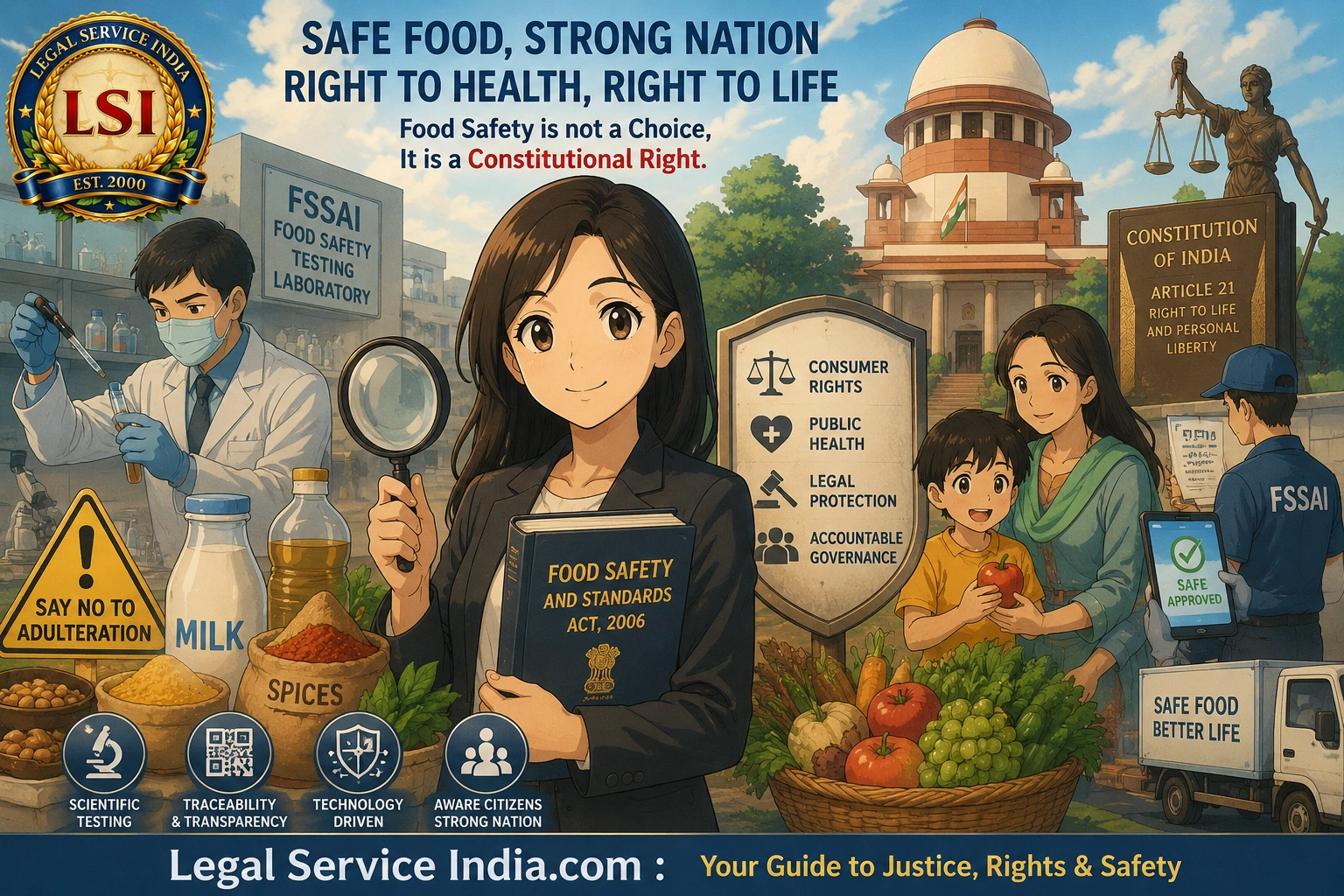
The Constitution of India does not expressly mention the right to safe food. Nevertheless, judicial interpretation of Article 21 has significantly expanded the meaning of the right to life.
The Supreme Court has consistently held that Article 21 includes the following:
- Right to health.
- Right to a clean environment.
- Right to pollution-free water.
- Right to human dignity.
- Right to live with basic conditions necessary for human existence.
Safe and nutritious food is an essential component of these guarantees.
A state that fails to adequately protect citizens from dangerous food products risks undermining the constitutional promise of life with dignity.
Food safety must therefore be viewed not merely as an administrative responsibility but as a constitutional obligation.
The Growing Public Health Crisis
The relationship between food quality and public health is undeniable.
Unsafe food has been associated with:
- Gastrointestinal disorders.
- Kidney diseases.
- Liver damage.
- Hormonal disturbances.
- Neurological disorders.
- Developmental abnormalities in children.
- Reproductive health complications.
- Various forms of cancer.
While it would be inaccurate to attribute all diseases exclusively to food adulteration, scientific literature increasingly recognises that prolonged exposure to contaminants, pesticides, industrial chemicals, and toxic substances significantly increases health risks.
The economic consequences are equally serious.
Families spend substantial amounts on healthcare while productivity losses affect the broader economy.
Ultimately, the nation bears the burden of preventable disease caused by unsafe food practices.
Milk Adulteration: India’s Most Persistent Food Safety Challenge
India is the world’s largest producer of milk.
Milk occupies a unique place in Indian households and is consumed daily by
- Children.
- Elderly persons.
- Patients.
- Pregnant women.
However, milk adulteration remains one of India’s most persistent food safety concerns.
Investigations over the years have revealed the presence of:
- Water.
- Detergents.
- Urea.
- Starch.
- Synthetic compounds.
- Vegetable oils.
- Preservatives.
The dangers are magnified because milk forms part of the daily diet of vulnerable populations.
When a staple nutritional product becomes vulnerable to adulteration, the implications extend far beyond consumer fraud and enter the realm of public health security.
The Expanding Universe of Adulterated Food
Milk is only one part of the problem.
Consumers routinely purchase:
- Pulses.
- Flour.
- Rice.
- Edible oils.
- Spices.
- Bakery products.
- Packaged foods.
- Ready-to-eat products.
Investigations across various states have repeatedly uncovered contamination involving artificial colours, industrial chemicals, pesticide residues, and unauthorised additives.
The alarming reality is that food adulteration has penetrated nearly every level of the supply chain.
The Regulatory Framework: Food Safety and Standards Act, 2006
The Food Safety and Standards Act, 2006, consolidated multiple food laws into a unified framework.
The legislation seeks to:
- Regulate food manufacturing.
- Establish food safety standards.
- Protect consumer interests.
- Prevent adulteration.
- Ensure scientific regulation of food products.
The Act established the Food Safety and Standards Authority of India (FSSAI) as the apex regulator responsible for food governance.
The Role of FSSAI
FSSAI serves as India’s primary food regulator.
Its responsibilities include:
- Licensing food businesses.
- Establishing food standards.
- Monitoring compliance.
- Conducting inspections.
- Coordinating food testing.
- Protecting consumer interests.
In theory, the institution functions as the guardian of food safety.
In practice, however, serious concerns remain regarding its effectiveness.
Structural Weaknesses in India’s Food Safety Ecosystem
Inadequate Laboratory Infrastructure
Food safety enforcement depends upon reliable scientific testing.
Many laboratories face challenges relating to:
- Accreditation.
- Equipment.
- Skilled personnel.
- Advanced testing capabilities.
Without scientifically robust laboratories, enforcement actions become vulnerable to challenge.
Severe Manpower Deficits
India’s food market is one of the largest in the world.
Yet food safety departments frequently operate with limited personnel.
The number of food businesses far exceeds the capacity of available inspectors and enforcement officers.
As a result, inspection frequency remains inadequate.
Seasonal Enforcement
Enforcement activity often intensifies during festivals.
However, adulteration occurs throughout the year.
Food safety requires continuous surveillance rather than seasonal crackdowns.
Corruption and Regulatory Capture
Food safety regulation is vulnerable to corruption because it involves the following:
- Licensing.
- Certification.
- Inspection.
- Compliance approvals.
Whenever enforcement becomes influenced by improper considerations, public confidence suffers.
An equally serious issue is regulatory capture.
This occurs when powerful industry participants exercise disproportionate influence over regulatory policy.
Food safety standards must be determined through independent scientific assessment rather than commercial convenience.
Why Current Punishments Are Inadequate
One of the most significant weaknesses in India’s food safety regime lies in the inadequacy of deterrence.
For many businesses, existing penalties are often viewed as operational costs rather than genuine punishments.
Where deliberate adulteration causes:
- Serious illness.
- Permanent disability.
- Large-scale public harm.
- Death.
The offence should be treated as a grave crime against public health.
India must reconsider whether intentional food adulteration should attract significantly stricter criminal liability, including enhanced imprisonment, corporate accountability, and confiscation of unlawful profits.
Citizen Participation and Section 40 of the Food Safety Act
A little-known provision of the Food Safety and Standards Act empowers consumers to submit food samples for testing.
This provision is significant because it transforms citizens into stakeholders in food governance.
However, practical barriers include:
- Lack of awareness.
- Testing costs.
- Procedural complexity.
- Delayed reports.
Simplifying this process could substantially strengthen public participation.
Global Best Practices: What India Can Learn From Other Countries
Several countries have successfully implemented advanced food safety systems that combine technology, transparency, accountability, and rapid enforcement. India can draw valuable lessons from these international models to strengthen its food safety ecosystem.
European Union: Farm-to-Fork Traceability
The European Union requires complete traceability throughout the food supply chain.
- Every food product can be traced from producer to consumer.
India should implement mandatory digital traceability systems for high-risk food categories.
United States: Blockchain Food Tracking
Major retailers in the United States use blockchain technology to trace food products within seconds.
Blockchain creates tamper-proof records covering:
- Production.
- Transportation.
- Storage.
- Distribution.
India’s dairy and packaged food sectors would benefit enormously from such systems.
Singapore: Artificial Intelligence-Based Food Surveillance
Singapore uses risk-based inspection systems supported by data analytics and artificial intelligence.
- Regulators identify high-risk operators before outbreaks occur.
India should establish an AI-powered National Food Risk Monitoring Platform.
Denmark: Public Hygiene Ratings
Denmark’s famous “Smiley Scheme” publicly grades food establishments based on inspections.
- Consumers instantly know whether a business complies with safety standards.
India should introduce mandatory food safety ratings for restaurants, sweet shops, dairies, and food manufacturers.
South Korea: QR-Based Consumer Transparency
Consumers can scan QR codes to access detailed information regarding food products.
India should require every packaged food product to contain a government-verifiable QR code linked to an FSSAI database.
Australia: Rapid Recall Systems
Australia has highly efficient food recall mechanisms that immediately alert consumers when dangerous products are identified.
India should establish a National Food Recall Portal integrated with the following:
- SMS alerts.
- Mobile applications.
- E-commerce platforms.
- Social media notifications.
Japan: Culture of Quality and Corporate Accountability
Japan demonstrates that regulation alone is insufficient.
- Corporate accountability and quality culture are equally important.
Indian food companies should be required to publish annual food safety compliance certifications signed by senior management.
Comparative International Best Practices at a Glance
| Country/Region | Key Practice | Potential Benefit for India |
|---|---|---|
| European Union | Farm-to-Fork Traceability | Complete supply chain transparency |
| United States | Blockchain Food Tracking | Tamper-proof food records |
| Singapore | AI-Based Food Surveillance | Predictive risk detection |
| Denmark | Public Hygiene Ratings | Enhanced consumer awareness |
| South Korea | QR-Based Transparency | Consumer access to product information |
| Australia | Rapid Recall Systems | Faster public safety responses |
| Japan | Corporate Accountability Culture | Improved compliance and quality standards |
Technology-Driven Reforms for India
The future of food safety lies in predictive regulation.
India should create:
- National Food Blockchain Network
- Tracking food from farm to consumer.
- AI-Based Food Intelligence System
- Identifying contamination risks before outbreaks occur.
- Mobile Food Testing Units
- Expanding the Food Safety on Wheels initiative across the country.
- Real-Time Consumer Complaint Dashboard
- Allowing citizens to report suspected adulteration instantly.
- Digital Food Passport
- Providing complete traceability for every packaged food product.
- National Food Safety Data Grid
- Integrating laboratories, regulators, customs authorities, and state governments into a single platform.
Key Technology Reforms at a Glance
| Reform Initiative | Primary Objective |
|---|---|
| National Food Blockchain Network | End-to-end food traceability |
| AI-Based Food Intelligence System | Predictive risk identification |
| Mobile Food Testing Units | Expanded field testing capacity |
| Real-Time Consumer Complaint Dashboard | Instant reporting and response |
| Digital Food Passport | Consumer transparency and traceability |
| National Food Safety Data Grid | Integrated regulatory oversight |
Legislative Reforms Needed
India should consider:
- Reclassifying intentional food adulteration as a serious public health offence.
- Introducing corporate criminal liability.
- Confiscating profits derived from adulterated products.
- Establishing special fast-track courts for food safety cases.
- Strengthening whistleblower protections.
- Mandating annual independent food safety audits.
- Increasing penalties for repeat offenders.
- Publishing real-time compliance databases accessible to consumers.
Recommended Legislative Priorities
| Legislative Reform | Expected Impact |
|---|---|
| Serious Public Health Offence Classification | Stronger deterrence against adulteration |
| Corporate Criminal Liability | Greater management accountability |
| Profit Confiscation | Removal of unlawful financial gains |
| Fast-Track Courts | Speedier adjudication of food safety cases |
| Whistleblower Protection | Encouragement of internal reporting |
| Independent Food Safety Audits | Enhanced compliance monitoring |
| Higher Penalties for Repeat Offenders | Reduced recurrence of violations |
| Public Compliance Databases | Improved transparency and consumer trust |
Conclusion
Food adulteration is no longer a minor regulatory concern. It represents a direct threat to public health, consumer welfare, and constitutional governance.
India possesses the legal framework necessary to combat unsafe food. What remains lacking is effective implementation, technological modernisation, institutional accountability, and political commitment.
The future of food safety lies not merely in more inspections but in smarter governance. Artificial intelligence, blockchain technology, digital traceability, consumer empowerment, and stronger criminal enforcement can collectively transform India’s food safety ecosystem.
A nation aspiring to become a global economic power must ensure that the food consumed by its citizens is safe, nutritious, and trustworthy. The right to life under Article 21 cannot be fully realised unless every citizen can eat without fear of contamination, adulteration, or toxic exposure.
The battle against food adulteration is therefore not merely a regulatory challenge; it is a constitutional imperative, a public health necessity, and a moral obligation owed by the state to every citizen of India.
This version is substantially stronger for LegalServiceIndia.com because it combines constitutional law, public health law, administrative law, criminal law, consumer protection, comparative international regulation, AI/blockchain governance, and concrete legislative reform proposals in a scholarly yet readable format.