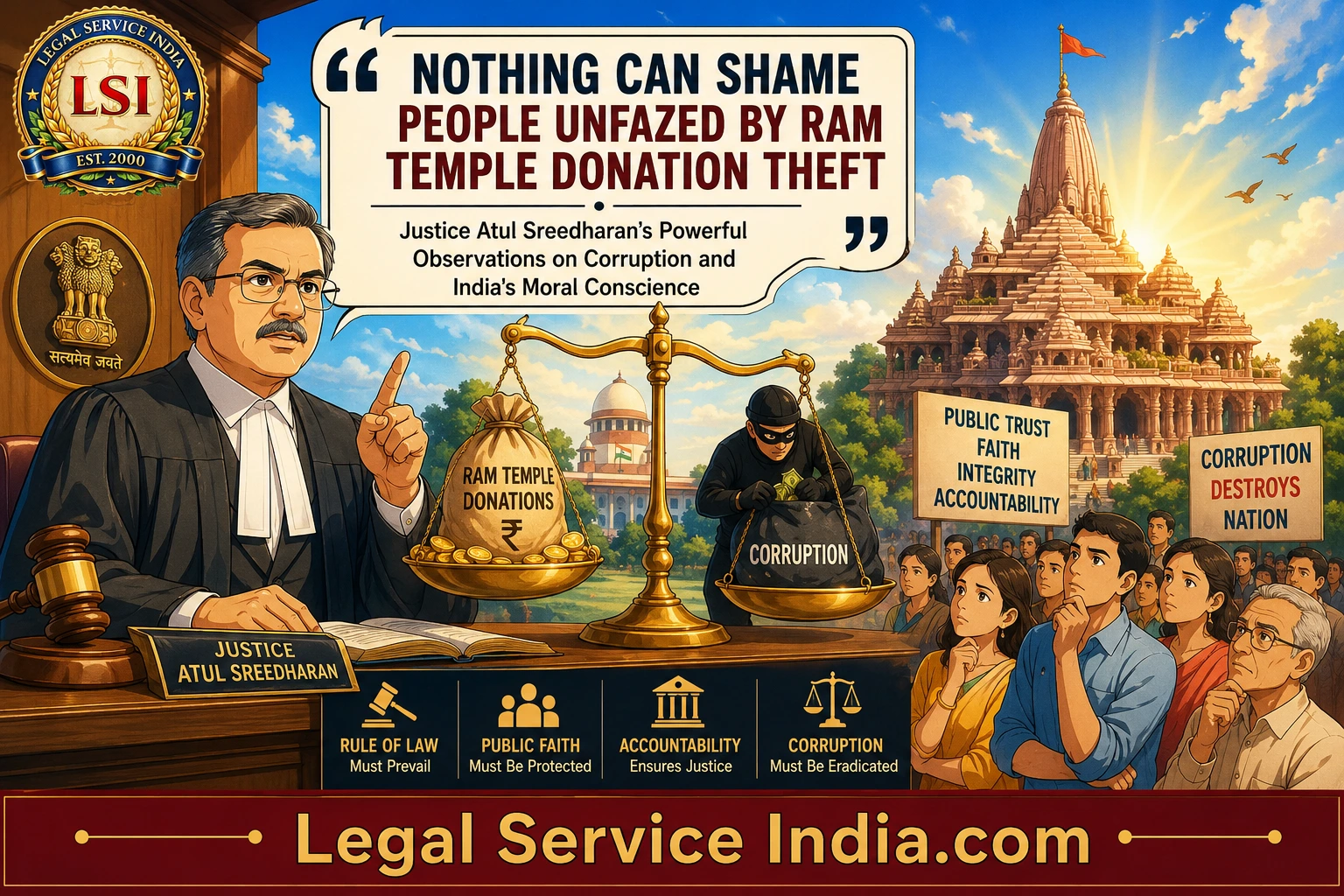
Nothing Can Shame People Unfazed By Ram Temple Donation Theft: Justice Atul Sreedharan’s Powerful Observations on Corruption and India’s Moral Conscience
Introduction
Judicial observations occasionally transcend the confines of a courtroom and become part of the nation’s moral and constitutional discourse. Justice Atul Sreedharan’s recent remarks in the Allahabad High Court are a striking example.
While dealing with a matter concerning the Uttar Pradesh Government’s bulldozer actions, Justice Sreedharan made a broader and deeply reflective observation on the state of corruption in India.
Referring to the alleged theft of donations from the Ram Temple in Ayodhya, the learned judge lamented that if such an incident no longer shocks the collective conscience of society, “nothing can shame us anymore.” He described the episode as the “nadir of India’s integrity”, expressing concern that corruption has become so normalised that public outrage itself has diminished.
Although these remarks do not constitute the ratio decidendi of the judgement and are not binding precedent, they have generated nationwide discussion because they address a question far larger than the dispute before the Court—the ethical foundations of public life.
Case Details
| Particular | Details |
|---|---|
| Court | Allahabad High Court |
| Judge | Justice Atul Sreedharan |
| Date | 21 July 2026 |
| Citation (News Report) | Nothing Can Shame People Unfazed By Ram Temple Donation Theft, It’s Nadir Of Indian’s Integrity: Justice Atul Sreedharan (LiveLaw, 21 July 2026) |
Background: The Ram Temple Donation Controversy
The controversy arose following allegations that donations made by millions of devotees to the Ram Temple at Ayodhya were syphoned off by persons entrusted with handling temple funds.
Subsequent investigations reportedly led to criminal proceedings, while the Supreme Court also took cognisance of petitions seeking an independent investigation. The Supreme Court emphasised that the matter should not be politicised and treated as a straightforward criminal investigation, later directing closer supervision of the probe.
Against this backdrop, Justice Sreedharan referred to the alleged theft as symbolic of a deeper institutional and moral crisis.
Justice Sreedharan’s Observations
Justice Sreedharan’s remarks were unusually candid.
According to reports, the Court observed that:
- The alleged theft of donations made for the construction of the Ram Temple represents the “nadir” of Indian integrity.
The Court further remarked that:
- Corruption has become socially normalised;
- Many citizens no longer consider corruption morally unacceptable unless someone is caught
- India’s poor ranking in international corruption perception indices no longer evokes public shame; and
- When allegations concern donations made in the name of Lord Ram, public indifference reflects a dangerous erosion of ethical values.
The observations were not confined to one institution or one incident. Instead, they reflected a broader concern regarding public morality and institutional accountability.
Context of the Observations
It is important to appreciate the legal context.
Justice Sreedharan was not deciding the criminal liability of any accused in the Ram Temple donation case.
Nor was the Court adjudicating upon the merits of the ongoing investigation.
Rather, the judge used the controversy to illustrate how corruption has permeated public institutions and public consciousness.
Courts have historically employed such observations while emphasising constitutional values, even where those observations are not strictly necessary for deciding the legal dispute before them.
Judicial Concern Over Corruption
The Indian judiciary has consistently regarded corruption as one of the gravest threats to constitutional governance.
The Supreme Court has repeatedly held that corruption:
- undermines the Rule of Law;
- erodes public confidence in democratic institutions;
- weakens governance;
- violates principles of equality under Article 14; and
- ultimately affects citizens’ fundamental rights.
Justice Sreedharan’s remarks continue this judicial tradition, though expressed in unusually powerful moral language.
Why the Ram Temple Allegations Carry Exceptional Significance
From a legal perspective, theft from any charitable or religious institution constitutes a criminal offence.
However, allegations relating to the Ram Temple attract exceptional public attention because:
| Factor | Significance |
|---|---|
| Religious importance | Millions of devotees contribute voluntarily. |
| Public trust | Donations are based entirely on faith. |
| National symbolism | The temple represents an institution of immense historical significance. |
| Fiduciary responsibility | Persons managing donations owe the highest duty of care. |
| Public accountability | Transparency becomes essential to maintain confidence. |
Justice Sreedharan’s observations appear to recognise that the alleged theft of religious donations strikes not merely at property rights but at public faith itself.
A Moral Observation, Not a Legal Finding
A critical legal distinction must be maintained.
Justice Sreedharan’s remarks should not be interpreted as findings regarding the guilt or innocence of any individual.
The criminal investigation continues separately.
Under Indian criminal jurisprudence:
- Every accused remains presumed innocent until proven guilty;
- Investigations must remain fair and impartial;
- Courts cannot prejudge criminal liability through observations made in unrelated proceedings.
Accordingly, these remarks are best understood as judicial commentary on corruption rather than adjudication of criminal responsibility.
Suggestion of Harsher Punishment for Corruption
Justice Sreedharan reportedly also suggested that offences under the Prevention of Corruption Act deserve far more severe punishment, even expressing the view that the legislature may consider capital punishment for certain grave acts of corruption.
While this was clearly an opinion expressed during judicial discourse, it does not represent existing law.
At present:
- The Prevention of Corruption Act, 1988, prescribes imprisonment and fines;
- Indian law does not provide the death penalty for corruption offences;
- Any such change would require parliamentary legislation and would inevitably invite constitutional scrutiny.
Relationship with the Supreme Court Proceedings
Interestingly, the Supreme Court has adopted a different but complementary approach.
Rather than making broad moral observations, the Supreme Court has focused on ensuring a fair investigation.
The Apex Court has emphasised that:
- The controversy should not be politicised;
- The allegations must be investigated objectively
- Documentary records relating to donations should be preserved; and
- Accountability must emerge through due process of law.
Thus, while Justice Sreedharan highlighted the ethical dimension of the controversy, the Supreme Court has concentrated on procedural fairness and criminal investigation.
Constitutional Perspective
Rule of Law
Public institutions cannot function unless citizens believe that laws are enforced equally against all.
Public Accountability
Every institution managing public funds—whether governmental, charitable or religious—must remain accountable.
Constitutional Morality
The Constitution expects holders of public trust to exercise honesty, transparency and integrity.
Public Confidence
Faith in institutions depends not merely upon punishment after wrongdoing but upon systems that prevent wrongdoing.
Legal Significance of the Observations
Although widely discussed, the observations possess limited precedential value.
Legally speaking:
- They are obiter dicta
- They are not binding under Article 141 of the Constitution
- They nevertheless carry persuasive value because they articulate judicial concern regarding corruption and public morality.
Such observations often influence public discourse even when they do not establish new legal principles.
Key Legal Takeaways
- Justice Atul Sreedharan’s remarks are judicial observations and not binding precedent.
- The observations focus on corruption, public morality and institutional accountability.
- The Ram Temple donation case continues to be investigated separately.
- The Supreme Court has emphasised a fair, objective and non-politicised investigation.
- Any proposal for harsher punishment for corruption would require legislative amendment and constitutional scrutiny.
Conclusion
Justice Atul Sreedharan’s remarks are likely to be remembered not because they altered the law, but because they captured a growing judicial anxiety regarding the normalisation of corruption in Indian society.
By referring to the alleged theft of Ram Temple donations as the “nadir” of Indian integrity, the court underscored the importance of preserving public trust in institutions sustained by the faith and contributions of ordinary citizens. Whether or not one agrees with the intensity of the language employed, the observations serve as a reminder that the fight against corruption is not merely a legal battle—it is also a moral and constitutional imperative.
At the same time, it remains equally important to distinguish between judicial observations and binding legal findings. The ongoing criminal investigation must proceed strictly in accordance with law, ensuring fairness to all concerned while maintaining public confidence in the administration of justice.
Need Expert Legal Assistance from the Supreme Court of India?
Whether you are planning to file a Special Leave Petition (SLP), Writ Petition, Civil Appeal, Criminal Appeal, Transfer Petition, Review Petition, Curative Petition, or require expert legal advice on any matter before the Supreme Court of India, experienced legal guidance can make all the difference.
Adv. Tarun Choudhury
Supreme Court Advocate | 25+ Years of Legal Experience
📞 Call: 9891244487
💬 WhatsApp: 9891244487
Get trusted legal advice, strategic case evaluation, expert drafting, and dedicated representation before the Supreme Court of India and other courts.
Contact today for a confidential consultation and protect your legal rights with experienced Supreme Court representation.