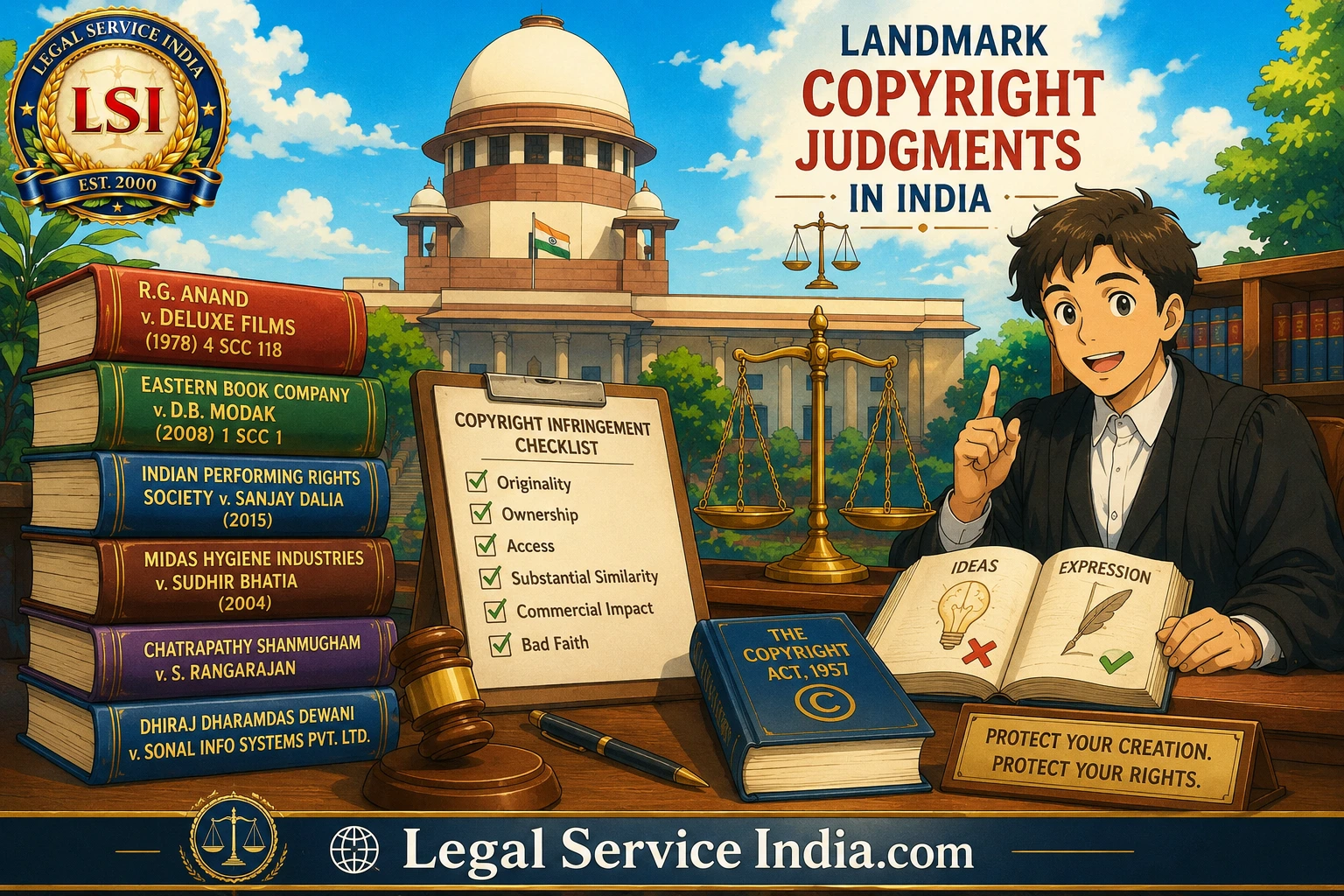
Important Supreme Court & High Court Judgements Every Copyright Owner Should Know
Understanding the leading judicial decisions on copyright law is essential for anyone considering litigation. Over the years, the Supreme Court of India and various High Courts have developed important principles governing originality, infringement, jurisdiction, interim injunctions, and remedies.
Below are some of the landmark judgements that continue to shape copyright litigation in India.
Landmark Copyright Judgements in India
| Case | Key Legal Principle |
|---|---|
| R.G. Anand v. Deluxe Films (1978) 4 SCC 118 | Copyright protects expression, not ideas. |
| Eastern Book Company v. D.B. Modak (2008) 1 SCC 1 | Originality requires a minimum degree of creativity. |
| Indian Performing Rights Society Ltd. v. Sanjay Dalia (2015) | Clarified territorial jurisdiction under Section 62. |
| Midas Hygiene Industries Pvt. Ltd. v. Sudhir Bhatia (2004) | Courts ordinarily grant injunctions where infringement is apparent. |
| Chatrapathy Shanmugham v. S. Rangarajan | Ideas and public domain material are not protected. |
| Dhiraj Dharamdas Dewani v. Sonal Info Systems Pvt. Ltd. | Registration strengthens evidentiary value in litigation. |
1. R.G. Anand v. Deluxe Films (1978) 4 SCC 118
Why This Case Is Important
This is perhaps the most cited copyright judgement in India.
The dispute arose when playwright R.G. Anand alleged that the Hindi film New Delhi had copied his play Hum Hindustani.
Supreme Court Held
The Court ruled that:
- Copyright protects expression, not ideas.
- Similar themes alone do not constitute infringement.
- A substantial and material copy of the original expression must be shown.
- Minor similarities or coincidences are insufficient.
- The overall impression on an ordinary viewer is an important consideration.
Practical Takeaway
Merely claiming that someone “copied my idea” is not enough.
The plaintiff must establish copying of the original expression.
2. Eastern Book Company v. D.B. Modak (2008) 1 SCC 1
Why This Case Matters
This landmark judgement clarified what amounts to originality under Indian copyright law.
Supreme Court Held
The Court rejected the traditional “sweat of the brow” doctrine and held that copyright requires a minimum degree of creativity.
Merely investing labour or money is insufficient.
The work must demonstrate:
- Intellectual effort
- Skill
- Judgement
- Originality
Practical Significance
This judgement is extremely important for:
- Publishers
- Legal databases
- Educational material
- Compilations
- AI-generated works
3. Indian Performing Rights Society Ltd. v. Sanjay Dalia (2015)
Why It Matters
This judgement clarified territorial jurisdiction under Section 62 of the Copyright Act.
Supreme Court Held
Although the Copyright Act gives the copyright owner an additional forum for filing a suit, the plaintiff cannot misuse that provision merely for convenience.
Where both the plaintiff and the cause of action exist at the same place, the suit should ordinarily be instituted there.
Practical Importance
Jurisdiction objections frequently arise in copyright litigation.
This judgement remains the leading authority on territorial jurisdiction.
4. Midas Hygiene Industries Pvt. Ltd. v. Sudhir Bhatia (2004)
Although primarily a trademark case, this judgement is repeatedly relied upon in intellectual property litigation.
Supreme Court Principle
- Where infringement is apparent, courts should ordinarily grant injunctions.
- Delay alone does not necessarily defeat the plaintiff’s right to interim relief.
- This principle is frequently applied in copyright matters.
5. Chatrapathy Shanmugham v. S. Rangarajan
The Madras High Court observed that copyright law does not protect:
- Ideas
- Systems
- Methods
- Public domain material
- General information
Only the original expression enjoys protection.
This decision reinforces the distinction between ideas and expression.
6. Dhiraj Dharamdas Dewani v. Sonal Info Systems Pvt. Ltd.
This judgement discussed the evidentiary importance of copyright registration.
Although copyright arises automatically upon creation of an original work, registration often provides stronger documentary evidence during litigation.
Modern judicial practice generally recognises that registration is not mandatory before instituting an infringement action, but registration substantially strengthens the plaintiff’s evidentiary position.
How Courts Decide Whether Copyright Has Been Infringed
Every copyright case depends upon its own facts.
However, courts generally examine several important factors before granting relief.
These include:
| Factor | Question Considered by the Court |
|---|---|
| Originality | Is the plaintiff’s work original? |
| Ownership | Does the plaintiff actually own the copyright? |
| Access | Did the defendant have access to the plaintiff’s work? |
| Substantial Similarity | Has a substantial part of the protected work been copied? |
| Commercial Impact | Has the infringement caused financial loss? |
| Bad Faith | Was the copying deliberate? |
Substantial Similarity
The court looks beyond isolated words or sentences and examines the work as a whole.
Bad Faith
Intentional commercial piracy is viewed much more seriously than accidental similarity.
Copyright Infringement Checklist
Before filing a lawsuit, ask yourself the following questions.
| Question | Yes. | No |
|---|---|---|
| Is my work original? | □ | □ |
| Can I prove ownership? | □ | □ |
| Do I possess original files? | □ | □ |
| Have I preserved screenshots? | □ | □ |
| Can I prove copying? | □ | □ |
| Is the copied portion substantial? | □ | □ |
| Have I calculated my losses? | □ | □ |
| Have I identified all infringers? | □ | □ |
| Should I send a legal notice first? | □ | □ |
| Do I require an urgent injunction? | □ | □ |
Completing this checklist before approaching a lawyer can save valuable time and strengthen your case.
Practical Tips for Businesses
Businesses frequently own far more copyrighted material than they realise.
Examples Include
- Brochures
- Advertisements
- Training manuals
- Product catalogues
- Websites
- Mobile applications
- Software
- Presentations
- Employee manuals
- Instructional videos
- Architectural drawings
Every business should adopt a copyright protection strategy.
Recommended Measures Include
- Register valuable works.
- Execute assignment agreements with employees.
- Obtain written licences from freelancers.
- Watermark photographs.
- Monitor competitors.
- Preserve original source files.
- Maintain version history.
- Use copyright notices.
- Regularly monitor online marketplaces.
- Conduct periodic intellectual property audits.
Copyright Protection for Website Owners
Website owners frequently become victims of plagiarism.
Typical Infringement Includes
- Copying blogs
- Copying FAQs
- Copying legal pages
- Copying product descriptions
- Copying images
- Copying graphics
- Copying downloadable PDFs
- Copying infographics
Whenever Infringement Is Discovered
- Capture screenshots.
- Preserve URLs.
- Download copies.
- Record dates.
- Issue a legal notice.
- Send platform take-down requests.
- Initiate court proceedings if necessary.
Copyright Protection for YouTubers and Content Creators
Digital creators should:
- Maintain original recordings.
- Preserve editing files.
- Keep invoices.
- Retain project files.
- Maintain upload history.
- Register valuable works.
Platform-specific copyright complaint mechanisms should usually be exhausted before initiating litigation.
Copyright Protection for Software Developers
Software companies should preserve:
- Source code
- Git repositories
- Version history
- Development logs
- Licences
- Contributor agreements
In software disputes, courts often rely heavily upon technical expert evidence.
How Long Does Copyright Last in India?
The duration depends upon the nature of the work.
Generally:
| Work | Duration |
|---|---|
| Literary, dramatic, musical and artistic works | Lifetime of the author + 60 years |
| Cinematograph films | 60 years from publication |
| Sound recordings | 60 years from publication |
| Government works | 60 years |
| Anonymous and pseudonymous works | As provided under the Copyright Act |
Once copyright expires, the work ordinarily enters the public domain.
Frequently Asked Litigation Questions
How Much Compensation Can I Recover?
There is no fixed amount.
Courts assess damages depending upon:
- Loss suffered
- Profits earned by the infringer
- Market value
- Licence fees
- Reputation damage
- Deliberate conduct
Can I Recover Legal Costs?
Yes.
Successful litigants may also recover costs where the court considers it appropriate.
Can Multiple Defendants Be Sued?
Yes.
Publishers, distributors, website owners, intermediaries and commercial users may all be joined where justified by the facts.
Can I Seek an Injunction Before Trial?
Yes.
Urgent interim injunctions are frequently granted in copyright disputes where the plaintiff establishes:
- A strong prima facie case
- Balance of convenience
- Irreparable injury
Should I First Register My Copyright?
Although registration is not compulsory, experienced intellectual property practitioners almost always recommend registration for commercially valuable works.
It substantially strengthens future litigation.
Common Myths About Copyright
| Myth | Reality |
|---|---|
| “I emailed the work to myself, so it is copyrighted.” | Copyright arises upon creation, not because of emailing the work. |
| “I changed 20% of the article.” | Changing words does not automatically avoid infringement if substantial protected expression has been copied. |
| “I gave credit to the author.” | Giving credit does not substitute for obtaining permission where permission is legally required. |
| “It was available on Google.” | Availability on the internet does not place a work in the public domain. |
| “I am not making money.” | Commercial profit is not always necessary for copyright infringement. |
Final Thoughts
Copyright law plays a crucial role in protecting creativity, innovation, and investment. In today’s digital environment, where content can be copied and distributed globally within seconds, creators and businesses must act promptly to safeguard their rights.
A successful copyright infringement case depends upon careful preparation, preservation of evidence, timely legal advice, and a well-planned litigation strategy. Whether the dispute involves books, software, films, photographs, website content, music, educational material, or AI-related issues, the law provides robust remedies to stop infringement and compensate the rightful owner.
If you discover that your work has been copied, do not ignore the infringement. Early legal intervention can often prevent wider misuse, preserve valuable evidence, and significantly improve the chances of obtaining effective relief from the court.
Why Choose Professional Legal Representation?
Copyright disputes often involve complex questions of originality, ownership, technology, jurisdiction, and valuation of damages. An experienced intellectual property lawyer can help you:
- Assess whether infringement has actually occurred.
- Preserve and present evidence effectively.
- Draft legally sound cease and desist notices.
- Initiate take-down procedures.
- Obtain urgent interim injunctions.
- Claim damages or an account of profits.
- Conduct civil and criminal proceedings where appropriate.
- Protect your creative assets across India.
Contact for Copyright Litigation & Intellectual Property Matters
If your copyright has been infringed or you wish to proactively protect your creative work, professional legal guidance can help you enforce your rights effectively.
Adv. Tarun Choudhury
- Supreme Court Advocate | 25+ Years of Legal Experience
- Call: 9891244487
- WhatsApp: 9891244487
Practice Areas
- Copyright Registration
- Copyright Infringement Litigation
- Civil & Criminal Copyright Actions
- Website & Digital Content Protection
- Software Copyright Disputes
- YouTube & Social Media Copyright Issues
- Copyright Licensing & Assignment
- Intellectual Property Advisory
- Injunctions & Emergency Relief
- Intellectual Property Portfolio Management
Protect Your Intellectual Property
Your creativity is your intellectual property. Protect it with timely legal action and experienced representation. Contact Adv. Tarun Choudhury today for comprehensive copyright law assistance across India.
Important Links
Important Links:
- Lawyers in India
- Copyright Registration in India
- Caveat Filing in Supreme Court of India
- Mutual Consent Divorce in Delhi NCR: WhatsApp 9650499965