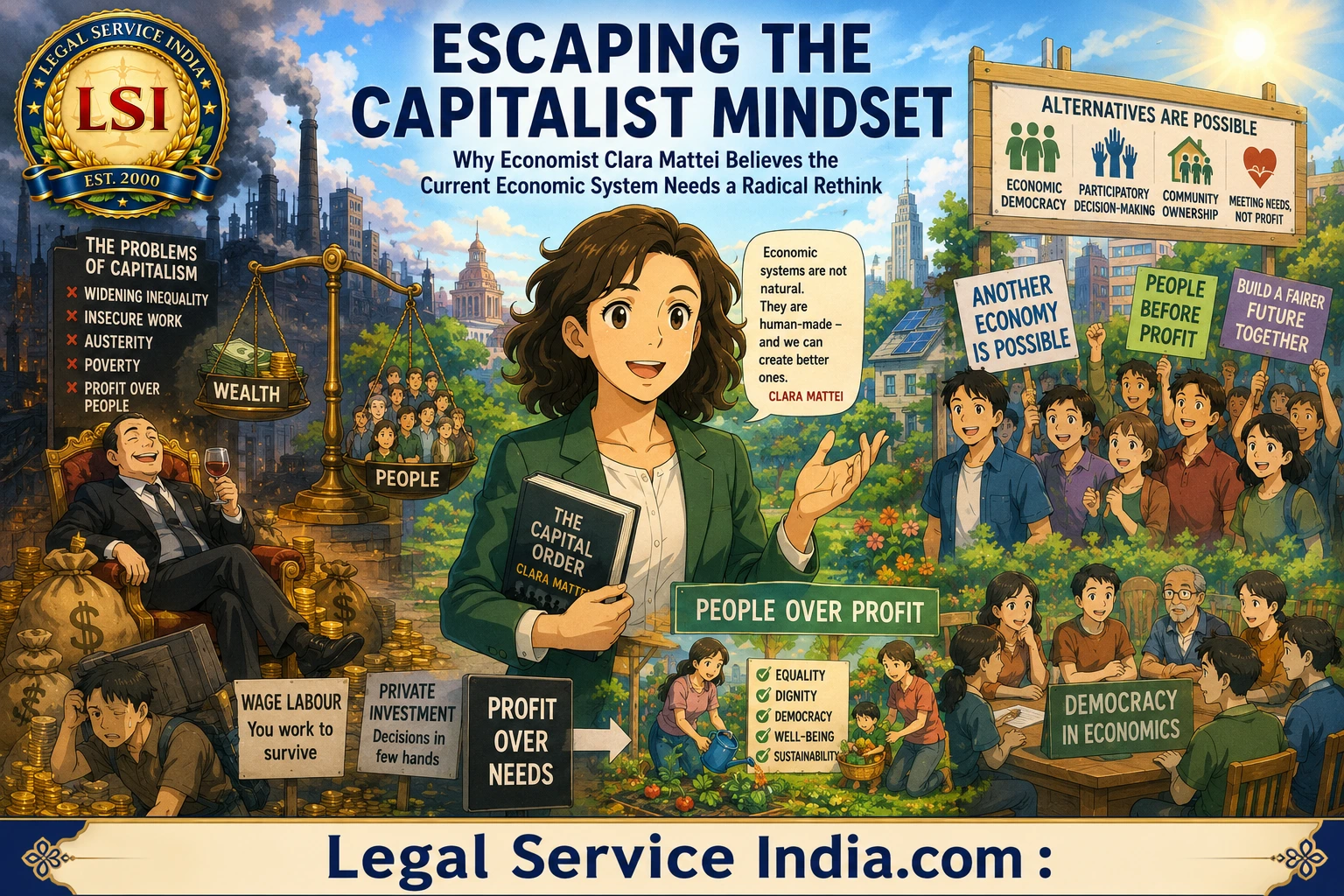
Escaping the Capitalist Mindset: Why Economist Clara Mattei Believes the Current Economic System Needs a Radical Rethink
Quick Summary: This article examines economist Clara Mattei’s critique of capitalism, including her views on wage labour, private investment, profit-driven economies, inequality, austerity, and why she believes alternative economic systems deserve serious consideration.
Introduction
Capitalism has long been presented as the natural foundation of modern society. From classrooms to political debates, people are often told that markets, competition, and private enterprise are simply extensions of human nature. Wealth creation, individual ambition, and consumer choice are frequently portrayed as universal instincts rather than products of a particular economic system.
Economist and author Clara Mattei challenges this assumption. She argues that capitalism is not an inevitable outcome of human progress but a historically constructed system maintained through political decisions, institutional power, and economic policies. In her view, many of today’s most pressing problems—including widening inequality, insecure employment, recurring austerity measures, and even persistent poverty—are not accidental failures of capitalism. Instead, they are outcomes that emerge from the way the system is designed to function.
According to Mattei, genuine change begins by questioning the belief that there is no alternative. Only after society recognises that economic systems are created by people, she argues, can people begin imagining and building different ones.
Key Takeaways
- Capitalism is presented by Clara Mattei as a historically constructed system rather than a natural human condition.
- She identifies wage labour and private investment as the two core pillars of capitalism.
- Profit, according to Mattei, determines production priorities instead of social needs.
- Growing inequality is viewed as a structural outcome rather than an accidental failure.
- Austerity is described as a recurring feature that reinforces market dependence.
- Mattei argues that societies can redesign economic systems because they are human-made institutions.
The First Step: Escaping the Mental Trap
One of Mattei’s central arguments is that the greatest obstacle to economic change is not political power but public perception.
Many people assume that capitalism reflects basic human instincts. The desire to accumulate wealth, own property, compete with others, and maximise personal gain is often treated as evidence that capitalism simply mirrors human nature.
Mattei disagrees.
She argues that these beliefs overlook the extensive political and institutional effort required to sustain capitalist economies. Rather than emerging spontaneously, capitalism depends upon laws, policies, and government intervention that continually reinforce market dependence.
From this perspective, governments do not merely regulate markets—they actively protect and preserve them. Economic policies are designed to ensure that most people remain dependent on paid employment for survival, leaving them with little practical alternative but to sell their labour in exchange for wages.
This dependence, Mattei argues, is one of the defining characteristics of the modern economic system.
How Clara Mattei Defines Capitalism
Rather than viewing capitalism simply as a market economy, Mattei describes it as a system resting upon two fundamental pillars.
| Pillar | Description |
|---|---|
| Wage Labour | People primarily survive by selling their labour in exchange for wages. |
| Private Investment | Investment decisions are concentrated among owners of capital who allocate resources based on expected returns. |
1. Wage Labour
The first pillar is wage labour.
Most individuals do not own sufficient productive resources to support themselves independently. Consequently, they must sell their ability to work in exchange for wages.
According to Mattei, this relationship creates an imbalance. Workers often generate economic value far exceeding the wages they receive while having limited influence over what is produced, how production is organised, or who ultimately benefits from it.
Employment therefore becomes not merely a means of earning income but the mechanism through which the broader economic system operates.
2. Private Investment
The second pillar is private investment.
Mattei argues that decisions regarding production are concentrated in relatively few hands. Investors, corporations, and owners of capital largely determine which industries expand, which products are developed, and where resources are allocated.
As a result, society delegates significant economic decision-making to private actors whose primary objective is financial return.
Profit as the Driving Force
Above these two pillars sits what Mattei considers the defining objective of capitalism: profit.
She argues that under capitalism, production is generally undertaken only when investors expect financial gain. Goods and services are produced because they promise returns on investment rather than because they directly satisfy social needs.
This distinction, she believes, explains why societies can simultaneously experience enormous wealth alongside widespread deprivation.
Essential services such as housing, healthcare, education, and food may remain inaccessible to millions despite sufficient resources existing to provide them. In her analysis, profitability—not human necessity—determines economic priorities.
A Different Critique of Capitalism
Criticism of capitalism is hardly new. For decades, activists, scholars, and political movements have questioned its consequences.
Mattei believes, however, that much public criticism still misses the central issue.
Rather than attributing inequality to excessive greed, corporate misconduct, or isolated cases of corruption, she argues that these outcomes are built into the structure of capitalism itself.
In her view, the system is functioning largely as intended.
The concentration of wealth among a relatively small number of individuals is not an unintended side effect but a predictable consequence of economic arrangements that prioritise capital accumulation above all else.
This perspective shifts the conversation away from blaming individual actors toward examining the institutional rules that shape economic outcomes.
Rising Inequality as Evidence of Structural Problems
Mattei points to growing wealth disparities as evidence that capitalism increasingly benefits a narrow segment of society.
She notes that an extraordinarily small number of individuals now control wealth exceeding that owned by billions of people combined. Meanwhile, many countries continue to experience rising poverty, food insecurity, precarious employment, and increasing housing costs.
For Mattei, these developments are not temporary disruptions caused by poor policy choices or economic mismanagement.
Instead, they reflect a system designed primarily to generate returns on capital rather than ensure universal well-being.
Even in advanced economies, she argues, wealth continues to concentrate despite substantial increases in overall economic productivity.
While billionaires accumulate unprecedented fortunes, many households struggle with stagnant wages, insecure employment, and declining purchasing power.
This growing divide, Mattei suggests, demonstrates that economic growth alone does not guarantee broadly shared prosperity.
Structural Inequality Overview
| Observation | Mattei’s Interpretation |
|---|---|
| Growing wealth concentration | Structural outcome of capitalism |
| Persistent poverty | Result of profit-centered priorities |
| Stagnant wages | Reflects imbalance between labour and capital |
| Economic growth | Does not necessarily produce shared prosperity |
The Global Dimension of Wealth
Mattei also extends her analysis beyond national economies.
She argues that the prosperity enjoyed by many developed countries cannot be understood without examining their historical and ongoing relationships with developing nations.
According to her perspective, economic development in wealthier regions has often depended upon extracting resources, labour, and financial value from poorer countries.
Although formal colonial rule has largely ended, she believes that unequal financial arrangements continue through mechanisms such as international debt, resource extraction, multinational investment structures, and unequal trade relationships.
These processes, she argues, allow wealth to flow from developing economies toward richer nations on a continuing basis.
Consequently, global inequality cannot be explained solely by differences in domestic policy or productivity. Instead, Mattei believes it reflects structural relationships embedded within the international economic system itself.
Why Austerity Plays Such a Central Role
Among Mattei’s most controversial arguments is her interpretation of austerity.
Public debate often portrays austerity measures as painful but unavoidable responses to economic crises. Governments reduce spending, limit social programmes, and cut public services in order to restore fiscal stability.
Mattei offers a different interpretation.
She argues that austerity should not be viewed simply as an emergency economic tool. Instead, she sees it as an essential feature of capitalism.
By reducing social protections while maintaining market dependence, austerity encourages workers to accept lower wages, more precarious employment, and weaker bargaining power.
In her analysis, austerity is therefore politically and economically functional because it reinforces the dependence of labour upon the market.
What appears to be a temporary financial necessity is, from her perspective, part of a broader strategy that preserves the existing economic order.
Capitalism and Austerity at a Glance
- Austerity reduces public spending.
- Social protections become weaker.
- Market dependence increases.
- Workers may accept lower wages and less secure employment.
- The existing economic structure is reinforced.
Looking Beyond the Existing System
Despite her sharp criticism of capitalism, Mattei insists that alternatives remain possible.
Her central message is not that change will occur automatically but that societies must first recognise that economic systems are human creations rather than immutable laws of nature.
If people built existing institutions, she argues, they also possess the capacity to redesign them.
That process begins by questioning assumptions that have long been accepted as self-evident.
Rather than asking how to improve capitalism at its margins, Mattei invites readers to consider whether entirely different economic arrangements might better prioritise human needs, democratic participation, and collective well-being.
This challenge forms the foundation of her broader argument that another economic future is possible—provided societies are willing to rethink the principles on which their current system is built.
Clara Mattei’s analysis challenges widely held assumptions about capitalism by arguing that economic systems are shaped by political choices rather than fixed laws of nature. Her critique focuses on wage labour, private investment, profit-driven priorities, inequality, and austerity as structural features rather than isolated problems. Whether readers agree or disagree with her conclusions, her work encourages a broader discussion about how societies organise economic life and whether alternative models could better balance prosperity, democratic participation, and collective well-being.
Democracy, Economic Education, and the Search for Alternatives
Economic systems are often discussed in terms of markets, policies, and government decisions. However, Clara Mattei argues that understanding economics also requires examining democracy, education, political power, and historical narratives.
The following sections explore her views on economic democracy, the role of governments, historical lessons, economic education, and the search for alternative economic models.
Is Democracy Truly Shaping Economic Decisions?
One of Clara Mattei’s most thought-provoking arguments concerns the relationship between democracy and economic power. While many people believe that elected governments determine national economic priorities through democratic processes, Mattei contends that the reality is more complicated.
According to her, citizens often have the opportunity to vote in elections, but they exercise far less influence over the economic decisions that shape their daily lives. Choices involving investment, production, employment, taxation, and financial markets are frequently made by governments, central banks, multinational corporations, and major investors rather than by ordinary citizens.
In this sense, Mattei argues that political democracy does not necessarily translate into economic democracy.
She believes that although democratic institutions remain important, they often operate within economic frameworks that citizens have little power to change.
| Political Democracy | Economic Decision-Making |
|---|---|
| Citizens elect representatives. | Major economic decisions are often made by governments, central banks, corporations, and investors. |
| Voting influences political leadership. | Investment, taxation, employment, and production decisions remain largely outside direct public control. |
| Democratic participation through elections. | Limited participation in everyday economic governance. |
Liberal Democracy and Economic Power
Mattei distinguishes between political democracy and what she calls economic democracy.
Political democracy allows citizens to elect representatives, participate in elections, and influence public policy through voting. However, she argues that many crucial economic decisions remain concentrated in the hands of those who control capital.
According to this perspective, governments may change through elections, yet the broader economic system continues to function according to the same principles.
- Investment decisions remain largely private.
- Corporate ownership remains concentrated.
- Financial markets continue influencing national policies.
As a result, Mattei believes that elections alone cannot fundamentally alter the distribution of economic power.
This does not mean she rejects democracy. Rather, she argues that democratic participation should extend beyond elections into the everyday decisions that affect work, production, and public resources.
Why Economic Choices Often Feel Inevitable
Modern governments frequently justify economic decisions by describing them as unavoidable.
Budget cuts, higher interest rates, reductions in public spending, or labour market reforms are often presented as technical necessities dictated by economic conditions rather than political choices.
Mattei challenges this narrative.
She argues that many policies described as economically inevitable actually reflect particular ideological preferences.
For example, governments may claim that reducing welfare spending is necessary to maintain fiscal discipline while simultaneously providing financial support to large corporations or expanding military expenditure.
According to Mattei, these contrasting priorities demonstrate that governments continue making political choices even when they present those choices as objective economic requirements.
| Common Government Narrative | Mattei’s Perspective |
|---|---|
| Budget cuts are unavoidable. | They may reflect ideological priorities. |
| Higher interest rates are purely technical decisions. | Economic policies also involve political choices. |
| Fiscal discipline requires welfare reductions. | Governments may simultaneously increase spending elsewhere. |
Historical Lessons About Power
Drawing upon her historical research, Mattei argues that economic systems have often been protected by powerful political institutions.
Throughout history, governments have introduced laws, regulations, and policies designed to preserve existing economic arrangements.
When significant social movements have challenged prevailing economic structures, political institutions have frequently responded by defending established interests.
Mattei examines historical episodes in which governments prioritised financial stability and investor confidence over broader social demands.
Her broader argument is that economic systems should be understood not only through financial indicators but also through the political forces that sustain them.
Why Have Alternative Economic Models Struggled?
A common question arises whenever capitalism is criticised.
If alternative systems are superior, why have so many countries ultimately embraced market-based economies?
Mattei offers several explanations.
She argues that global capitalism did not spread solely because it consistently outperformed competing systems.
Instead, she points to historical factors such as geopolitical competition, international financial institutions, military influence, trade relationships, and political alliances that encouraged—or in some cases pressured—countries to adopt capitalist economic models.
According to her, the expansion of global capitalism resulted from both economic incentives and political power.
Whether readers agree or disagree, Mattei encourages examining this history rather than assuming capitalism became dominant simply because it was the only viable option.
| Factors Influencing the Spread of Capitalism |
|---|
| Geopolitical competition |
| International financial institutions |
| Military influence |
| Trade relationships |
| Political alliances |
| Economic incentives |
The Influence of Economic Narratives
One of Mattei’s recurring themes is the power of ideas.
She believes that economic systems survive not only because of laws and institutions but also because of the stories societies tell about them.
Many people grow up believing that:
- Success is entirely the result of personal effort.
- Poverty reflects individual failure.
- Wealth automatically benefits society.
- Markets naturally reward merit.
- Economic inequality is unavoidable.
Mattei argues that these beliefs shape public attitudes long before people begin studying economics.
When inequality is interpreted primarily as a consequence of personal choices, broader structural questions receive far less attention.
As a result, citizens may blame themselves—or other disadvantaged groups—for economic hardships rather than examining the institutions that influence economic outcomes.
| Common Economic Narrative | Mattei’s Perspective |
|---|---|
| Success depends entirely on personal effort. | Structural institutions also shape opportunities. |
| Poverty reflects individual failure. | Economic systems and institutions influence outcomes. |
| Markets always reward merit. | Power structures also affect wealth distribution. |
| Inequality is unavoidable. | Different economic arrangements may produce different outcomes. |
The Role of Mainstream Economics
As a professor of economics, Mattei is particularly critical of how the subject is commonly taught.
She argues that many introductory economics courses emphasise concepts such as
- Market efficiency
- Consumer choice
- Profit maximization
- Supply and demand
- Individual rationality
While these ideas form important components of economic theory, Mattei believes they often receive far greater attention than competing schools of thought.
According to her, students rarely encounter serious discussions of economic history, political economy, institutional analysis, or alternative models of economic organisation.
Consequently, many graduates leave university assuming that existing market structures represent objective reality rather than one possible economic framework among many.
| Mainstream Topics Commonly Taught | Areas Mattei Believes Deserve More Attention |
|---|---|
| Market efficiency | Economic history |
| Consumer choice | Political economy |
| Profit maximization | Institutional analysis |
| Supply and demand | Alternative economic models |
| Individual rationality | Competing schools of economic thought |
Why Economic Education Matters
Mattei believes education plays a decisive role in shaping public understanding of capitalism.
If students are introduced only to one dominant theoretical framework, they may conclude that alternative approaches lack credibility or simply do not exist.
She argues that economics should expose students to a wider range of intellectual traditions, allowing them to compare different explanations of how economies function.
This broader approach would encourage critical thinking rather than presenting any single model as universally accepted.
According to Mattei, expanding economic education is essential for strengthening democratic debate about public policy.
Key Takeaways
- Economic education shapes public understanding.
- Students should study multiple schools of economic thought.
- Critical thinking strengthens democratic debate.
- No single economic model should be treated as universally accepted.
Revisiting Karl Marx
Few thinkers generate as much debate in economic discussions as Karl Marx.
For many people, Marx is associated primarily with twentieth-century communist governments or centrally planned economies.
Mattei believes this association often obscures Marx’s broader contributions to economic thought.
Rather than treating capitalism as a natural expression of human behaviour, Marx examined it as a historical system with specific social relationships, institutions, and power structures.
He asked questions that continue influencing political economy today:
- Who controls production?
- How is wealth distributed?
- Why does inequality persist?
- What role does labour play in creating value?
- How do economic systems evolve over time?
Mattei argues that these questions remain relevant regardless of one’s political beliefs.
| Questions Raised by Karl Marx |
|---|
| Who controls production? |
| How is wealth distributed? |
| Why does inequality persist? |
| What role does labour play in creating value? |
| How do economic systems evolve over time? |
Marx Beyond the Stereotypes
According to Mattei, Marx is frequently presented in simplified or ideological terms rather than studied as an economist whose work challenged dominant assumptions.
She believes his writings encourage readers to examine structural forces instead of focusing exclusively on individual behaviour.
Rather than viewing wealth simply as accumulated money, Marx emphasised the social relationships underlying production.
- Who owns factories?
- Who performs the work?
- Who receives the profits?
- Who makes economic decisions?
These questions remain central to Mattei’s own analysis of capitalism.
She stresses that engaging with Marx’s ideas does not require accepting every conclusion he reached. Instead, she encourages readers to treat his work as an important contribution to understanding economic systems.
Capitalism as a Human Creation
One of the themes Mattei draws from Marx is the idea that capitalism is historically constructed.
If institutions are created by human beings, they can also be changed by human beings.
This perspective contrasts sharply with the belief that markets function according to fixed natural laws beyond democratic influence.
For Mattei, recognising the historical origins of capitalism opens space for public debate about its future.
Economic systems are neither permanent nor inevitable.
They evolve as societies change.
| Mattei’s Perspective | Implication |
|---|---|
| Capitalism is historically constructed. | Economic institutions are created by human societies. |
| Institutions can change. | Alternative economic arrangements remain possible. |
| Markets are not immutable natural laws. | Public debate can influence future economic systems. |
| Economic systems evolve over time. | Change is a recurring feature of history. |
Why People Continue Supporting the Existing System
Despite rising inequality, many citizens continue supporting political leaders and economic policies that critics argue reinforce existing power structures.
Mattei believes narratives play a significant role in explaining this phenomenon.
When people are repeatedly told that success depends entirely upon individual effort, they may conclude that financial struggles reflect personal shortcomings rather than structural conditions.
At the same time, political leaders often direct public frustration toward immigration, cultural conflicts, or other social issues instead of addressing deeper economic questions.
According to Mattei, these narratives divert attention from the concentration of wealth and power within modern economies.
Key Factors Influencing Public Support
- Belief that success depends entirely upon individual effort.
- Financial struggles are viewed as personal shortcomings.
- Attention shifts toward immigration and cultural conflicts.
- Structural economic issues receive less public scrutiny.
- Narratives reduce focus on wealth and power concentration.
| Common Narrative | Mattei’s Interpretation |
|---|---|
| Success depends solely on individual effort. | Structural economic conditions also influence outcomes. |
| Economic hardship reflects personal failure. | Institutional factors contribute significantly. |
| Public debate focuses on cultural issues. | Economic inequality receives less attention. |
Fear of Change
Economic reform can also generate understandable anxiety.
Many people fear that significant changes to existing institutions could threaten their jobs, savings, homes, or retirement security.
Mattei acknowledges these concerns but argues that large segments of society already experience considerable insecurity.
- Millions of workers live from one pay cheque to the next despite full-time employment.
- Housing affordability continues to decline in many regions.
- Healthcare and education costs place increasing pressure on household finances.
In this context, Mattei believes that preserving the status quo does not necessarily guarantee long-term security.
Instead, she argues that societies should evaluate whether alternative arrangements might provide greater economic stability.
| Current Challenges | Concerns Raised by Mattei |
|---|---|
| Job insecurity | The status quo may not provide lasting stability. |
| Declining housing affordability | Alternative arrangements deserve consideration. |
| Rising healthcare costs | Economic reform should address long-term security. |
| Increasing education expenses | Public debate should examine different policy options. |
Changing Minds Before Changing Institutions
Throughout her work, Mattei emphasises that lasting economic reform begins with ideas.
Political systems rarely change unless public understanding changes first.
For this reason, she places enormous importance on education, public discussion, and historical awareness.
Rather than asking citizens to accept predetermined solutions, she encourages them to question assumptions that have long been treated as unquestionable truths.
Only after people recognise that economic institutions are shaped by human decisions, she argues, can meaningful democratic debate about alternatives truly begin.
This intellectual transformation, in Mattei’s view, is the foundation upon which broader economic and political change can eventually be built.
Key Takeaways
- Economic reform begins with changing ideas.
- Public understanding influences political change.
- Education strengthens democratic participation.
- Historical awareness encourages critical thinking.
- Economic institutions are shaped by human decisions.
- Democratic debate can explore alternative economic systems.
| Core Theme | Mattei’s View |
|---|---|
| Education | Essential for informed democratic participation. |
| Public Discussion | Encourages questioning long-held assumptions. |
| Historical Awareness | Helps explain how institutions evolve. |
| Democratic Debate | Creates space to consider alternative economic systems. |
| Institutional Change | Follows changes in public understanding. |
Building Alternatives: Participatory Democracy, Community Action, and Grassroots Economic Change
From Criticism to Action
Throughout her critique of capitalism, Clara Mattei emphasises that identifying the shortcomings of the current economic system is only the beginning. In her view, criticism has limited value unless it is accompanied by practical alternatives that ordinary people can experience in their everyday lives.
Rather than waiting for sweeping national reforms or revolutionary political shifts, Mattei argues that meaningful change can begin within local communities. She believes citizens should actively participate in designing new economic institutions that prioritise cooperation, shared responsibility, and democratic decision-making.
For Mattei, transformation is not simply about replacing one economic model with another. It is about creating new ways for people to organise their communities, manage resources, and influence the decisions that directly affect their lives.
Why Local Communities Matter
One of Mattei’s recurring themes is that large-scale change often begins at the local level.
National governments, international organisations, and financial institutions may appear distant and difficult to influence. By contrast, local communities offer opportunities for direct participation and collective problem-solving.
According to Mattei, neighbourhoods, municipalities, and local organisations can become testing grounds for alternative economic practices.
These community-level initiatives allow people to:
- Develop cooperative solutions to shared problems.
- Strengthen social relationships.
- Increase local participation in decision-making.
- Reduce dependence on purely market-driven solutions.
- Build trust through collective action.
She believes that successful local experiments can eventually inspire broader institutional reforms.
Benefits of Community-Based Economic Models
| Community Initiative | Primary Benefit |
|---|---|
| Cooperative problem-solving | Addresses shared local challenges collectively. |
| Democratic participation | Increases citizen involvement in decision-making. |
| Collective action | Builds trust and strengthens communities. |
| Local innovation | Creates models that may inspire broader reforms. |
Public Participation Beyond Elections
Mattei argues that democracy should not be limited to casting a ballot every few years.
While elections remain important, she believes democratic participation should extend into the management of public resources, local services, and economic planning.
Citizens, in her view, should have meaningful opportunities to influence decisions regarding:
- Public spending.
- Infrastructure projects.
- Housing priorities.
- Community development.
- Education initiatives.
- Social welfare programmes.
This broader understanding of democracy shifts public participation from occasional voting toward continuous civic engagement.
Participatory Democracy in Practice
A central concept in Mattei’s work is participatory democracy.
Unlike representative democracy, where elected officials make most policy decisions, participatory democracy encourages citizens to become directly involved in shaping public policies.
According to Mattei, people are often better positioned to identify their communities’ most pressing needs than distant policymakers.
Through public meetings, neighbourhood assemblies, and collaborative decision-making processes, communities can determine which projects deserve priority.
This approach seeks to strengthen public ownership of democratic institutions by giving citizens greater influence over practical economic decisions.
Representative vs. Participatory Democracy
| Representative Democracy | Participatory Democracy |
|---|---|
| Elected officials make most policy decisions. | Citizens directly participate in policy formation. |
| Periodic elections. | Continuous civic engagement. |
| Limited public involvement after voting. | Ongoing community participation. |
| Top-down decision-making. | Collaborative decision-making. |
Participatory Budgeting: Giving Citizens a Voice
One of the most practical examples Mattei discusses is participatory budgeting.
Originally developed in Brazil during the late twentieth century, participatory budgeting allows residents to help determine how portions of public budgets are allocated.
Instead of leaving every spending decision to elected officials, citizens participate directly in identifying priorities and voting on proposed projects.
Under such systems, communities may decide to allocate funding toward the following:
- Schools.
- Public healthcare.
- Parks and recreational facilities.
- Affordable housing.
- Road improvements.
- Community centres.
- Environmental protection.
- Public transportation.
Mattei sees this process as an important example of economic democracy because it gives ordinary people a direct role in determining how public resources are used.
Key Features of Participatory Budgeting
| Feature | Description |
|---|---|
| Citizen involvement | Residents participate directly in budgeting decisions. |
| Transparent spending | Communities understand how public funds are allocated. |
| Community priorities | Projects reflect local needs instead of only political decisions. |
| Economic democracy | Public resources are managed with citizen participation. |
Rebuilding Public Trust
Many democracies today face declining public confidence in political institutions.
Citizens often feel disconnected from government decision-making and sceptical about whether their voices truly matter.
Mattei believes participatory institutions can help rebuild trust by making government more transparent and responsive.
When individuals witness their ideas influencing public policy, they become more invested in democratic processes.
Greater participation may also improve accountability, as citizens gain a clearer understanding of how budgets are prepared and how public money is spent.
Beyond Protest: Creating Institutions
Mattei argues that social movements should focus not only on protesting existing institutions but also on creating new ones.
Public demonstrations can raise awareness, but long-term change requires durable organisations capable of addressing everyday economic challenges.
These institutions might include:
- Community assemblies.
- Worker cooperatives.
- Mutual aid networks.
- Local food initiatives.
- Cooperative housing projects.
- Community investment funds.
- Public education forums.
Rather than waiting for governments to initiate reform, Mattei encourages citizens to begin building practical alternatives themselves.
Examples of Community-Driven Institutions
| Institution | Purpose |
|---|---|
| Community assemblies | Encourage local democratic decision-making. |
| Worker cooperatives | Promote shared ownership and workplace democracy. |
| Mutual aid networks | Provide community-based support during everyday challenges. |
| Local food initiatives | Improve food security through local participation. |
| Cooperative housing projects | Expand affordable and community-managed housing. |
| Community investment funds | Support local economic development. |
| Public education forums | Increase civic awareness and economic literacy. |
Food Sovereignty as Economic Independence
Food plays a particularly important role in Mattei’s vision of local empowerment.
She argues that access to nutritious food should never depend entirely upon market forces.
Many communities experience “food deserts” where affordable and healthy food is difficult to obtain despite living in economically advanced countries.
Mattei believes local food systems can reduce this dependence by encouraging the following:
- Community gardens.
- Urban agriculture.
- Cooperative farming.
- Local food distribution.
- Shared agricultural resources.
These initiatives strengthen food security while also fostering community cooperation.
Rather than treating food solely as a commercial product, Mattei argues it should be viewed as a fundamental social necessity.
How Local Food Systems Strengthen Communities
| Local Initiative | Community Benefit |
|---|---|
| Community gardens | Increase access to fresh food. |
| Urban agriculture | Improve local food production. |
| Cooperative farming | Encourage shared agricultural responsibility. |
| Local food distribution | Reduce dependence on external supply chains. |
| Shared agricultural resources | Lower costs and promote collaboration. |
Reducing Dependence on Markets
A recurring goal in Mattei’s proposals is reducing excessive dependence on market transactions.
Modern life often requires people to purchase nearly every essential service—from housing and healthcare to childcare and education.
Mattei believes communities can reclaim greater control by organising certain services cooperatively.
Examples include:
- Shared childcare arrangements.
- Cooperative housing associations.
- Community health initiatives.
- Collective purchasing groups.
- Local energy cooperatives.
- Tool-sharing programmes.
These efforts do not necessarily eliminate markets but reduce the extent to which every aspect of daily life depends upon them.
Community Solutions That Reduce Market Dependence
| Community Solution | Primary Objective |
|---|---|
| Shared childcare arrangements | Lower childcare costs through cooperation. |
| Cooperative housing associations | Provide community-managed housing options. |
| Community health initiatives | Expand access to local healthcare support. |
| Collective purchasing groups | Reduce costs through bulk purchasing. |
| Local energy cooperatives | Increase community control over energy resources. |
| Tool-sharing programmes | Promote resource sharing and reduce unnecessary consumption. |
The Importance of Public Education
Education occupies a central place in Mattei’s strategy for social change.
She believes knowledge should not remain confined to universities or academic journals.
Instead, economic education should become a public resource accessible to everyone.
Community workshops, public discussions, reading groups, and civic forums can help citizens better understand:
- Public finance.
- Economic history.
- Labour markets.
- Government budgeting.
- Taxation.
- Wealth inequality.
- Democratic participation.
According to Mattei, informed citizens are better equipped to challenge existing assumptions and participate meaningfully in economic decision-making.
Benefits of Public Economic Education
| Educational Focus | Benefit |
|---|---|
| Public finance | Improves understanding of government spending. |
| Economic history | Provides historical perspective on economic systems. |
| Labour markets | Enhances awareness of employment dynamics. |
| Government budgeting | Supports informed civic participation. |
| Taxation | Builds understanding of public revenue systems. |
| Wealth inequality | Encourages informed discussion on economic fairness. |
| Democratic participation | Strengthens active citizenship. |
Knowledge Through Participation
Mattei argues that learning does not occur only in classrooms.
People also develop knowledge through collective action.
When communities work together to solve practical problems, participants gain firsthand experience in cooperation, negotiation, budgeting, and governance.
This practical learning strengthens civic engagement while demonstrating that alternative forms of economic organisation are possible.
Rather than viewing citizens as passive recipients of policy, Mattei sees them as active contributors to democratic life.
How Participation Builds Civic Knowledge
| Form of Participation | Knowledge and Skills Developed |
|---|---|
| Collective action | Practical experience in solving community problems. |
| Cooperation | Strengthens teamwork and shared responsibility. |
| Negotiation | Improves consensus-building and conflict resolution. |
| Budgeting | Enhances understanding of public resource management. |
| Governance | Develops civic leadership and democratic participation. |
Why Traditional Political Parties May Not Be Enough
Although political parties remain important institutions, Mattei questions whether they alone can deliver meaningful economic transformation.
She argues that party politics often focuses on elections, leadership contests, and short-term policy debates rather than long-term institutional change.
Moreover, electoral competition sometimes encourages politicians to prioritise immediate political gains over deeper structural reforms.
Mattei, therefore, places greater emphasis on grassroots organisations capable of operating independently of election cycles.
Community assemblies, local associations, and civic initiatives can continue building democratic participation regardless of which political party holds office.
Grassroots Organizations Versus Traditional Party Politics
| Traditional Political Parties | Grassroots Organizations |
|---|---|
| Focus on elections. | Focus on continuous community engagement. |
| Leadership-driven decision-making. | Citizen-led participation. |
| Short-term political priorities. | Long-term institutional development. |
| Dependent on election cycles. | Operate regardless of electoral outcomes. |
Challenging Economic Hegemony
Mattei draws inspiration from the Italian political thinker Antonio Gramsci, who argued that power is maintained not only through laws and institutions but also through ideas and cultural influence.
According to Gramsci’s concept of cultural hegemony, societies often accept existing power structures because they come to view them as natural or inevitable.
Mattei believes changing economic institutions therefore requires changing public understanding.
Citizens must begin questioning long-held assumptions about markets, competition, inequality, and economic success.
Only then can alternative ideas gain broader public acceptance.
Understanding Cultural Hegemony
| Concept | Explanation |
|---|---|
| Cultural hegemony | Dominant ideas become accepted as natural or inevitable. |
| Public understanding | Changing beliefs can support institutional reform. |
| Questioning assumptions | Encourages critical thinking about economic systems. |
| Alternative ideas | Create opportunities for broader democratic acceptance. |
Building a New Economic Imagination
For Mattei, perhaps the greatest obstacle to reform is the widespread belief that there is no realistic alternative to capitalism.
She argues that this belief discourages experimentation and limits public imagination.
Yet history shows that economic systems have changed repeatedly over time.
- Feudalism gave way to industrial capitalism.
- Economic institutions have evolved alongside technological, political, and social transformations.
Mattei believes today’s challenges—including inequality, climate change, housing shortages, and financial insecurity—require societies to imagine new institutional arrangements rather than assuming existing models are permanent.
Historical Evolution of Economic Systems
| Historical Development | Significance |
|---|---|
| Feudalism | An earlier economic system that eventually changed. |
| Industrial capitalism | Replaced previous economic structures through historical change. |
| Technological transformation | Helped reshape economic institutions. |
| Political and social transformation | Contributed to the evolution of economic systems. |
Key Takeaways
- Meaningful economic change can begin within local communities.
- Participatory democracy encourages continuous civic engagement.
- Community institutions strengthen democratic participation.
- Local food systems improve resilience and food security.
- Public education empowers informed economic decision-making.
- Grassroots organisations can complement traditional political institutions.
- Challenging cultural assumptions creates opportunities for institutional reform.
- Economic systems evolve over time through social, political, and technological change.
Small Experiments, Larger Possibilities
Rather than proposing a single universal blueprint, Mattei encourages communities to experiment with different approaches suited to their own circumstances.
Some communities may prioritise affordable housing.
Others may focus on food security, cooperative businesses, environmental sustainability, or public budgeting.
The objective is not to replicate identical models everywhere but to encourage local innovation grounded in democratic participation.
Over time, successful initiatives could inspire broader reforms at regional and national levels.
Examples of Local Priorities for Community Innovation
| Community Priority | Potential Focus |
|---|---|
| Affordable housing | Expanding access to secure and sustainable housing. |
| Food security | Developing resilient local food systems. |
| Cooperative businesses | Promoting shared ownership and democratic workplaces. |
| Environmental sustainability | Supporting community-led environmental initiatives. |
| Public budgeting | Encouraging citizen participation in financial decision-making. |
Grassroots Change as the Foundation for Broader Reform
Mattei ultimately argues that durable economic transformation is unlikely to emerge solely from legislation passed by national governments.
Instead, she believes lasting change will develop through millions of citizens participating in local institutions, strengthening democratic engagement, and demonstrating that alternative economic arrangements can function effectively.
By combining public education, community organisation, participatory democracy, and practical experimentation, Mattei envisions a gradual process of institutional renewal.
Whether one agrees with her conclusions or not, her proposals invite readers to consider an important question: can societies build more democratic economic systems from the ground up rather than waiting for change to arrive from above?
Pillars of Mattei’s Grassroots Approach
| Pillar | Role in Institutional Renewal |
|---|---|
| Public education | Builds informed and engaged citizens. |
| Community organization | Strengthens local cooperation and collective action. |
| Participatory democracy | Expands public involvement in economic decision-making. |
| Practical experimentation | Tests innovative community-based economic models. |
| Grassroots participation | Supports long-term democratic and institutional change. |
Revolution, Reform, and the Future of Capitalism
Can Capitalism Be Reformed?
After examining inequality, austerity, democracy, and grassroots participation, Clara Mattei arrives at perhaps the most important question: can capitalism simply be improved, or does it require a more fundamental transformation?
Unlike many reformers who advocate limited adjustments to existing institutions, Mattei argues that the structural problems she identifies cannot be solved through minor policy changes alone.
In her view, measures such as modest tax reforms, temporary welfare programmes, or stricter financial regulations may reduce some immediate hardships, but they leave the underlying economic framework largely intact.
According to Mattei, meaningful change requires questioning the basic assumptions that shape the relationship between markets, labour, private investment, and democratic decision-making.
The Meaning of Revolution
The word “revolution” often evokes images of political upheaval, conflict, and violence.
Mattei believes this association obscures the broader meaning of the term.
She argues that revolution fundamentally refers to profound social transformation rather than violence itself.
Throughout history, societies have experienced revolutionary changes that reshaped political institutions, economic systems, technological development, and civil rights.
From this perspective, revolution represents a process through which societies rethink established institutions and replace outdated structures with new ones.
Mattei suggests that significant social change should not automatically be viewed as destructive simply because it challenges existing arrangements.
Why Change Often Faces Resistance
Major institutional reforms rarely occur without opposition.
Those who benefit most from existing systems frequently possess the political influence, financial resources, and institutional authority needed to resist change.
Mattei argues that history repeatedly demonstrates this pattern.
When demands emerge for greater economic equality, expanded public services, stronger labour protections, or broader democratic participation, powerful interests often mobilise to preserve the status quo.
For this reason, she believes meaningful reform requires not only new ideas but also sustained public participation capable of generating political momentum.
The Importance of Public Participation
Although Mattei is highly critical of existing political institutions, she does not advocate withdrawing from public life.
Instead, she argues for expanding democratic participation far beyond elections.
Citizens, in her view, should actively engage in:
- Community organisations.
- Local assemblies.
- Public budgeting.
- Cooperative enterprises.
- Educational initiatives.
- Civic campaigns.
- Democratic oversight of public institutions.
These activities strengthen democratic culture while gradually increasing citizens’ influence over economic decision-making.
Rather than waiting for governments to solve every problem, Mattei encourages communities to become active participants in shaping economic priorities.
Food Security as a Universal Priority
Among all social issues, Mattei places particular emphasis on food security.
She argues that no society should consider itself successful if large numbers of people struggle to obtain adequate nutrition.
According to her, ensuring access to food should rank among every government’s highest responsibilities.
She questions an economic system in which food production primarily follows market profitability while millions remain food insecure.
Instead, Mattei advocates organising food systems around human need.
This may include:
- Strengthening local agriculture.
- Supporting community food initiatives.
- Expanding public nutrition programmes.
- Protecting access to affordable food.
- Encouraging sustainable farming practices.
For Mattei, food is not simply another commodity—it is a basic human necessity that should receive priority over commercial considerations.
Ending Violence and Human Suffering
Mattei also argues that economic priorities cannot be separated from humanitarian concerns.
She maintains that excessive military spending, prolonged conflicts, and large-scale humanitarian crises divert resources away from essential social needs.
In discussing contemporary global conflicts—including the humanitarian situation in Palestine, as referenced in the interview—she argues that economic systems should be evaluated not only by financial performance but also by their ability to reduce human suffering.
More broadly, Mattei calls for greater international attention to regions experiencing war, famine, displacement, and chronic poverty.
Whether one agrees with her political analysis or not, her broader principle remains consistent: societies should prioritise protecting human life above maximising economic returns.
The Global South and Unequal Development
Another important theme in Mattei’s work concerns global inequality.
She challenges the idea that every country follows the same path toward economic development.
According to conventional modernisation theories, developing countries simply need time, investment, and market reforms before achieving the prosperity enjoyed by wealthier nations.
Mattei disputes this assumption.
Drawing upon dependency theory and related schools of political economy, she argues that international economic relationships often reinforce unequal patterns of development.
Resource extraction, debt obligations, unequal trade arrangements, and financial dependence may limit opportunities for many developing countries.
As a result, economic growth in wealthier nations can occur alongside persistent underdevelopment elsewhere.
This perspective encourages readers to examine global inequality as a structural issue rather than solely a consequence of domestic policy choices.
Rethinking Development
Mattei believes that many developing countries continue receiving similar policy advice from international financial institutions:
- Liberalise markets.
- Privatise public assets.
- Reduce government spending.
- Deregulate labour markets.
- Encourage foreign investment.
While supporters argue these policies improve efficiency and attract investment, Mattei contends they may also increase dependence on external capital while weakening domestic social protections.
She therefore encourages developing countries to critically evaluate economic prescriptions rather than assuming they represent universally applicable solutions.
Freedom Beyond Consumer Choice
Throughout the interview, Mattei repeatedly returns to the concept of freedom.
She argues that modern societies often define freedom primarily in economic terms—freedom to purchase goods, choose between products, or participate in markets.
While these freedoms have value, Mattei believes they represent only one dimension of human liberty.
She proposes a broader understanding of freedom that includes the following:
- Economic security.
- Democratic participation.
- Access to education.
- Healthcare.
- Housing.
- Meaningful work.
- Collective decision-making.
- Social cooperation.
According to Mattei, genuine freedom requires enabling people to participate fully in society rather than simply allowing them to function as consumers.
Can Economic Systems Change?
History suggests that economic institutions are far from permanent.
- Feudal economies gradually evolved into commercial societies.
- Industrial capitalism transformed agricultural economies.
- Labour movements secured protections that once seemed politically impossible.
- Public education, universal voting rights, social insurance, and labour regulations all emerged through long periods of political debate and social activism.
Mattei views these historical examples as evidence that institutions evolve in response to changing public priorities.
If previous generations reshaped economic systems, she argues, future generations possess the same capacity.
The Power of Collective Imagination
One of Mattei’s most optimistic arguments concerns human creativity.
She rejects the notion that societies have exhausted their capacity to develop new economic ideas.
Instead, she believes communities can continue experimenting with different models that better reflect democratic values and social priorities.
These experiments may involve:
- Cooperative ownership.
- Community finance.
- Participatory budgeting.
- Worker participation.
- Local food systems.
- Mutual aid networks.
- Public-interest institutions.
Mattei does not present these initiatives as complete replacements for existing economies.
Rather, she views them as opportunities to expand democratic participation and reduce excessive dependence on market mechanisms.
A Debate That Continues
Whether readers agree with Clara Mattei’s analysis or strongly disagree, her work raises fundamental questions that extend beyond conventional economic debates.
Among them are:
- Who should control economic decision-making?
- What responsibilities should governments have toward citizens?
- How should wealth be distributed?
- Can economic growth coexist with greater equality?
- Should markets determine access to essential services?
- What role should democracy play in shaping economic priorities?
These questions remain central to contemporary discussions about the future of capitalism, public policy, and social justice.
Conclusion
Clara Mattei offers a provocative critique of modern capitalism by arguing that many of its most persistent problems are structural rather than accidental. In her view, inequality, austerity, unemployment, and economic insecurity should not be understood merely as policy failures but as outcomes that emerge from the system’s underlying priorities.
Her proposed alternatives emphasise participatory democracy, stronger community institutions, expanded public engagement, and economic arrangements that place human needs alongside financial considerations.
Supporters may view her work as a compelling call for rethinking the foundations of modern economic life, while critics may question her interpretation of history, capitalism, and alternative economic models. Regardless of one’s perspective, her arguments contribute to an ongoing global conversation about how societies should organise production, distribute resources, and balance economic efficiency with social well-being.
Ultimately, Mattei invites readers to reconsider a fundamental assumption: if economic systems are created by people, then people also possess the capacity to reshape them.
Key Takeaways
| Topic | Key Point |
|---|---|
| Capitalism | Clara Mattei argues that capitalism is a historically constructed system rather than a natural expression of human behaviour. |
| Structural Issues | She believes inequality, austerity, and labour insecurity are structural features of the current economic model. |
| Economic Education | Economic education, in her view, should expose students to a wider range of theories and historical perspectives. |
| Participatory Democracy | Participatory democracy and community-led initiatives can strengthen citizens’ influence over economic decisions. |
| Public Priorities | Food security, public services, and democratic participation should receive greater priority in economic policymaking. |
| Alternative Institutions | She encourages societies to imagine alternative institutions instead of assuming capitalism represents the only viable economic system. |
| Overall Impact | Whether accepted or challenged, her ideas contribute to an important debate about the future of economic organisation and democratic governance. |