Introduction
Democracy is often judged by what happens on election day. Citizens cast their votes, governments are formed, and political leaders claim a mandate from the people. Yet one fundamental question is rarely asked: How democratic are the political parties themselves?
A political party serves as the gateway to public office. It selects candidates, formulates policies, chooses leaders, and ultimately shapes the future direction of a nation. If power within a party is concentrated in the hands of a few individuals, families, financiers, or unelected committees, can the larger democratic system truly flourish?
History demonstrates that many democratic nations have struggled not because elections failed, but because political organisations gradually became centralised, opaque, and disconnected from ordinary members. Internal democracy weakened, accountability declined, and leadership became increasingly insulated from grassroots voices.
The future of democratic governance therefore requires a simple but transformative principle: democracy must begin inside political parties before it can succeed in government.
This article explores what a truly democratic political party would look like if it combined the best practices from successful democratic systems around the world while addressing the weaknesses that plague many contemporary political organisations.
The Forgotten Foundation of Democracy
Political scientists often use the term ‘intra-party democracy’ to describe the degree to which ordinary party members can influence leadership decisions, policy formation, and candidate selection.
A party cannot claim to represent democratic values if the following are true:
- Leaders remain in office indefinitely.
- Candidates are chosen by a handful of powerful individuals.
- Internal elections are absent or symbolic.
- Financial operations remain secret.
- Dissent is punished.
- Membership participation is discouraged.
In contrast, genuinely democratic parties distribute authority broadly, encourage debate, and maintain structures that ensure leaders remain accountable to members rather than the other way around.
The most successful examples can be found in various forms across Germany, Switzerland, Scandinavia, the United Kingdom, and the United States. While none are perfect, each offers valuable lessons about how political power can be decentralised and democratised.
A New Vision: Members Govern, Leaders Serve
The central philosophy of an ideal democratic party can be summarised in a single sentence:
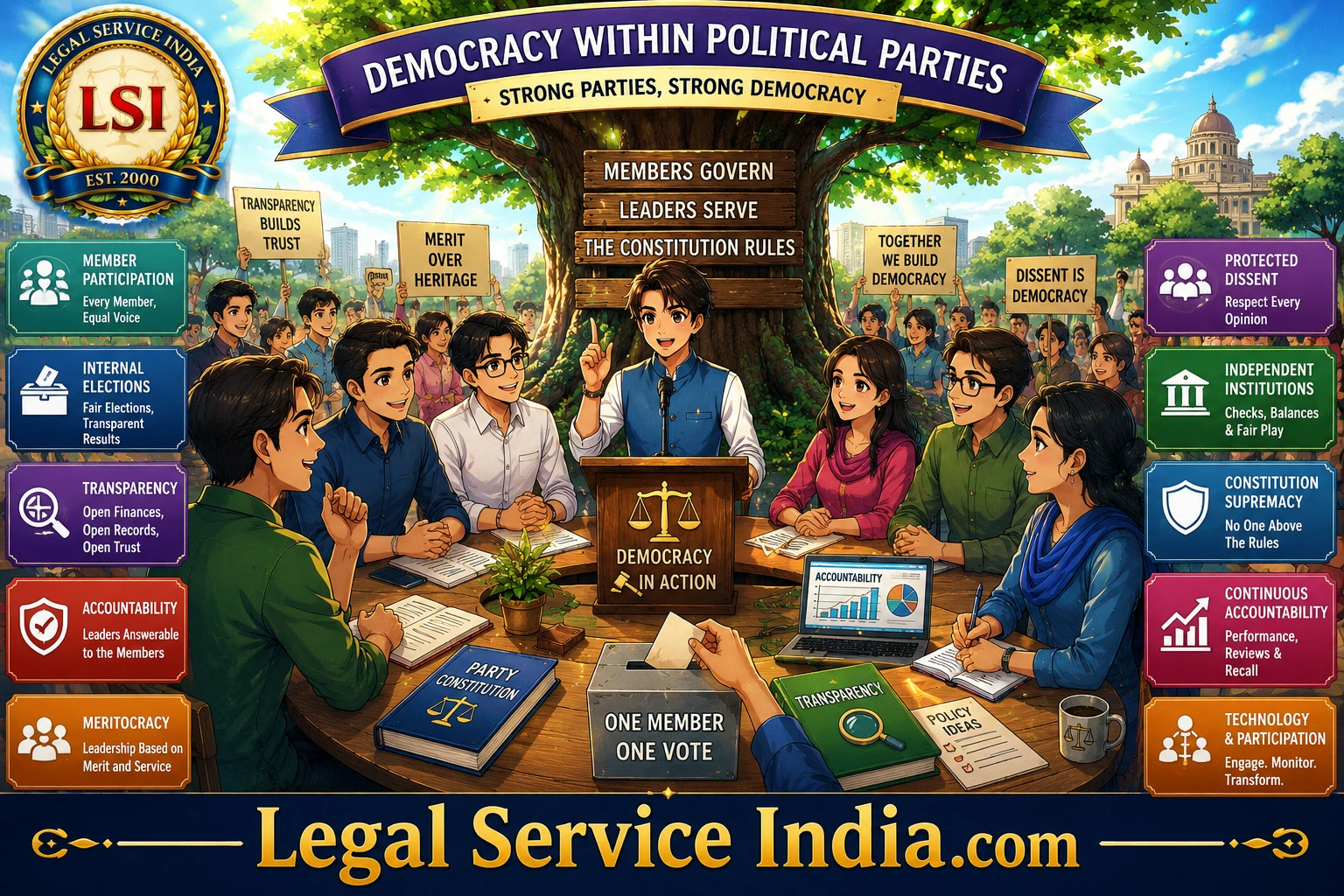
Members govern. Leaders serve. The constitution rules.
This principle reverses the traditional top-down model that dominates many political organisations.
Instead of power flowing from a supreme leader downward through the hierarchy, authority should originate from members and move upward through democratic institutions.
In such a system, leaders become trustees rather than rulers, accountable to those who elected them.
One Member, One Vote
At the heart of any democratic organisation lies political equality.
Every member should possess:
- Equal voting rights.
- Equal opportunities to contest elections.
- Equal access to party information.
- Equal participation in policy formation.
Wealth, family background, social status, seniority, or personal connections should never determine the value of a member’s voice.
The concept is simple but revolutionary in practice: one member must mean one vote.
Leadership Must Be Earned, Not Inherited
One of the greatest threats to internal democracy is the emergence of permanent leadership structures.
Political organisations often begin as movements but gradually evolve into institutions dominated by a few individuals or families.
An ideal democratic party would therefore impose the following:
- Fixed leadership terms.
- Strict term limits.
- Cooling-off periods.
- Mandatory re-election requirements.
No office should belong permanently to any person.
Leadership should be viewed as temporary public service rather than a lifelong entitlement.
Such safeguards ensure regular renewal, encourage fresh ideas, and prevent excessive concentration of power.
Candidate Selection Must Belong to Members
Perhaps no aspect of party democracy is more important than candidate selection.
In many political systems, candidates are effectively appointed by party leadership. This creates loyalty to the leadership rather than accountability to members and voters.
A more democratic approach is the use of open internal primaries.
Under such a system:
- Applications remain open.
- Candidates participate in debates.
- Members evaluate competing visions.
- Voting determines the nominee.
The process transforms candidate selection from an exercise in patronage into a genuine democratic contest.
The ultimate decision belongs to members rather than a “high command.”
Democracy Requires Transparency
Political trust cannot exist without transparency.
Citizens increasingly demand accountability from governments. The same standard must apply to political parties.
A democratic party should publicly disclose the following:
- Donations received.
- Expenditure records.
- Audit reports.
- Campaign finances.
- Assets and liabilities.
| Area | Information to Be Disclosed |
|---|---|
| Funding | Donations received |
| Spending | Expenditure records |
| Compliance | Audit reports |
| Campaigns | Campaign finances |
| Assets | Assets and liabilities |
Anonymous donations should be prohibited.
Every rupee collected and spent should be traceable and verifiable.
Transparency not only discourages corruption but also strengthens public confidence in democratic institutions.
The Importance of Internal Checks and Balances
Many political organisations concentrate all authority within a single leadership structure.
The result is predictable: conflicts of interest, weak accountability, and institutional stagnation.
An ideal democratic party should embrace the constitutional principle of separation of powers.
Independent Institutions Within the Party
| Institution | Primary Responsibilities |
|---|---|
| Party Election Commission | Conducting elections, verifying memberships, auditing voting processes, publishing results |
| Ethics Commission | Investigating corruption, reviewing conflicts of interest, enforcing ethical standards |
| Constitutional Tribunal | Resolving disputes, protecting member rights, interpreting party rules |
| Ombudsman | Handling complaints against leaders, investigating administrative misconduct, publishing independent reports |
Party Election Commission
Responsible for:
- Conducting elections.
- Verifying memberships.
- Auditing voting processes.
- Publishing results.
Ethics Commission
Responsible for:
- Investigating corruption.
- Reviewing conflicts of interest.
- Enforcing ethical standards.
Constitutional Tribunal
Responsible for:
- Resolving disputes.
- Protecting member rights.
- Interpreting party rules.
Ombudsman
Responsible for:
- Handling complaints against leaders.
- Investigating administrative misconduct.
- Publishing independent reports.
By separating authority, no single individual or faction can dominate the organisation.
Protecting the Right to Disagree
Democracy is not measured by how it treats supporters. It is measured by how it treats critics.
Healthy organizations encourage debate rather than suppress it.
Members should have the right to:
- Question leadership decisions.
- Present alternative policies.
- Form internal groups.
- Contest leadership elections.
- Advocate reforms.
Disagreement should never be confused with disloyalty.
In fact, dissent often serves as democracy’s early warning system, identifying problems before they become crises.
Building a Culture of Meritocracy
Democracy must be balanced with competence.
Popularity alone cannot be the sole qualification for leadership.
Candidates seeking higher office should demonstrate:
- Integrity.
- Public service.
- Administrative competence.
- Ethical conduct.
- Knowledge of governance.
| Leadership Quality | Why It Matters |
|---|---|
| Integrity | Builds trust and credibility |
| Public Service | Ensures commitment to citizens |
| Administrative Competence | Improves governance and decision-making |
| Ethical Conduct | Prevents misuse of authority |
| Knowledge of Governance | Enhances policy effectiveness |
Leadership academies, policy training, and mandatory grassroots experience can help cultivate capable future leaders.
The goal is to create a system where merit and service matter more than influence and connections.
Technology and the Future of Participation
Modern technology offers unprecedented opportunities to deepen democratic participation.
Secure digital platforms can allow members to:
- Vote electronically.
- Participate in policy discussions.
- Monitor finances.
- Propose reforms.
- Track leadership performance.
Technology should not replace democratic engagement.
It should expand it.
When properly designed, digital participation can bring millions of members directly into decision-making processes.
Ending the Culture of Political Dynasties
One of the most persistent criticisms of political organisations worldwide is the influence of dynastic politics.
Democracy requires equal opportunity.
Family members of leaders should neither be favoured nor excluded.
They should simply compete under the same rules as every other member.
Political inheritance should never substitute merit.
Open competition remains the best safeguard against hereditary control.
Accountability Between Elections
Democracy cannot function only once every few years.
Leaders must remain accountable continuously.
Innovative mechanisms include:
- Annual confidence votes.
- Performance scorecards.
- Recall procedures.
- Member referendums.
- Periodic reviews of office bearers.
Such measures ensure that leadership remains responsive long after election victories have faded.
Key Accountability Mechanisms
| Mechanism | Purpose |
|---|---|
| Annual Confidence Votes | Evaluate leadership support regularly. |
| Performance Scorecards | Measure effectiveness and delivery. |
| Recall Procedures | Remove ineffective leaders when necessary. |
| Member Referendums | Enable direct member participation. |
| Periodic Reviews of Office Bearers | Promote continuous accountability. |
A Party Constitution Above All Individuals
The strongest democratic safeguard is constitutional supremacy.
- No founder.
- No president.
- No executive committee.
- No influential faction.
- No powerful donor.
No leader, regardless of popularity, should stand above the party constitution.
Rules should govern individuals—not the other way around.
This principle distinguishes institutions from personality-driven organisations.
The Platinum Standard of Political Democracy
Imagine a political party where:
- Every member has an equal voice.
- Leaders are elected and removable.
- Finances are transparent.
- Policies are member-driven.
- Candidates emerge through open competition.
- Dissent is protected.
- Institutions are stronger than individuals.
- Public service outweighs political ambition.
Such a party would not merely compete in democratic elections.
It would embody democracy itself.
By combining German organisational discipline, Swiss direct democracy, Scandinavian decentralisation, British member participation, and American-style primaries, the world could witness the emergence of a new political model—one designed not around power, but around accountability.
Core Pillars of the Model
| Democratic Feature | Expected Outcome |
|---|---|
| Equal Member Participation | Greater legitimacy and trust. |
| Transparent Finances | Reduced corruption risks. |
| Open Candidate Selection | Merit-based leadership. |
| Protected Dissent | Healthier internal debate. |
| Constitutional Supremacy | Stronger institutions. |
| Continuous Accountability | Responsive leadership. |
Conclusion
The health of any democracy ultimately depends upon the health of its political parties.
When parties become centralised, opaque, and leader-centric, democratic institutions inevitably weaken. Conversely, when parties are transparent, participatory, accountable, and member-driven, democracy becomes stronger from the ground up.
The future of democratic politics does not lie merely in changing governments. It lies in transforming the organisations that produce those governments.
Real democracy begins long before citizens enter a polling booth.
It begins within political parties.
And perhaps the most important political reform of the twenty-first century is not electoral reform alone but the creation of parties where power truly belongs to the people.
Party Motto
“Members Govern. Leaders Serve. The Constitution Rules.”