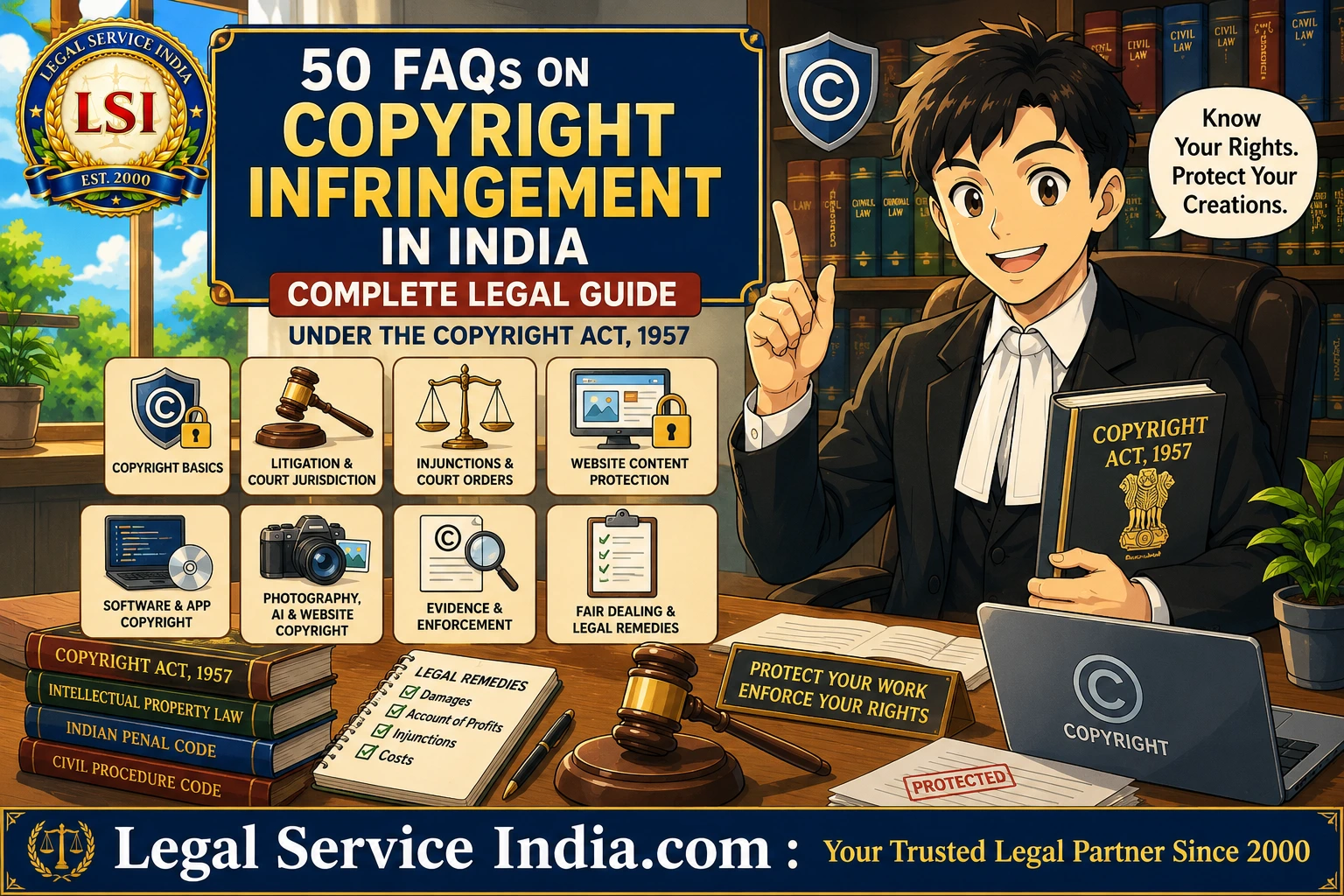
50 Frequently Asked Questions (FAQs) on Copyright Infringement in India
This comprehensive guide answers the most frequently asked questions about copyright infringement in India, including copyright registration, litigation, civil and criminal remedies, injunctions, damages, website content protection, software copyright, AI-generated content, and legal enforcement under the Copyright Act, 1957.
Copyright Basics
1. What is copyright infringement?
Copyright infringement occurs when a person uses, reproduces, publishes, distributes, communicates, adapts, or commercially exploits a copyrighted work without the permission of the copyright owner, unless the use is permitted by law.
2. Which law governs copyright in India?
Copyright in India is governed by the Copyright Act, 1957, together with the Copyright Rules, 2013, as amended from time to time.
3. Is copyright registration compulsory?
No.
Copyright arises automatically when an original work is created and expressed in a tangible form.
Registration is optional but highly recommended because it strengthens evidence of ownership.
4. Can I file a copyright infringement case without registration?
Yes.
Registration is generally not mandatory for filing a civil suit, although a registration certificate often makes litigation much easier.
Copyright Litigation and Court Jurisdiction
| Question | Answer |
|---|---|
| 5. Which court hears copyright infringement cases? | Depending upon the nature and valuation of the dispute, proceedings may be instituted before the competent District Court or Commercial Court having jurisdiction under the Copyright Act and other applicable laws. |
| 6. Can I file both civil and criminal proceedings? | Yes. Civil and criminal remedies may be pursued independently where the facts justify both courses of action. |
| 7. Can the police register an FIR? | Yes. In appropriate cases involving criminal copyright infringement, an FIR may be registered and the police may investigate in accordance with law. |
| 8. What punishment can a copyright infringer face? | Depending upon the facts and the applicable provisions of the Copyright Act, a person found guilty of criminal copyright infringement may face imprisonment, fines, or both. |
| 9. Can I claim damages? | Yes. The court may award damages, an account of profits, costs, or other appropriate relief depending upon the circumstances. |
| 10. What is an injunction? | An injunction is a court order restraining a person from continuing copyright infringement. |
Injunctions and Special Court Orders
11. What is an Anton Piller Order?
It is an extraordinary court order permitting inspection and preservation of evidence at the defendant’s premises to prevent destruction of infringing material.
12. What is a Mareva Injunction?
A Mareva Injunction prevents the defendant from disposing of assets that may be required to satisfy a future decree.
Website Content and Copyright Protection
| Question | Answer |
|---|---|
| 13. Can website content be copyrighted? | Yes. Original articles, blogs, graphics, source code, videos, images and downloadable material may all enjoy copyright protection. |
| 14. Can someone copy my legal articles? | No. Original legal articles enjoy copyright protection even though the law itself remains in the public domain. |
| 15. Does giving credit avoid infringement? | No. Acknowledging the original author does not eliminate the requirement of obtaining permission where permission is legally necessary. |
| 16. Can I copyright an idea? | No. Copyright protects the expression of an idea—not the idea itself. |
Fair Dealing and Educational Use
17. What is Fair Dealing?
Fair Dealing refers to limited uses permitted under Section 52 of the Copyright Act, such as research, criticism, review, reporting of current events, and certain educational purposes.
18. Can educational institutions use copyrighted material?
Only to the extent permitted by law.
Educational use does not automatically exempt a person from copyright infringement.
Software and Mobile Application Copyright
| Question | Answer |
|---|---|
| 19. Can I copyright software? | Yes. Computer software is treated as a literary work under the Copyright Act. |
| 20. Can mobile applications be protected? | Yes. The source code, graphics, user interface, documentation and other original elements may be protected. |
Photography, AI, and Website Copyright
| Question | Answer |
|---|---|
| 21. Can photographs be copyrighted? | Yes. Original photographs receive copyright protection automatically. |
| 22. Can AI-generated images infringe copyright? | Potentially yes. If AI-generated content substantially reproduces protected expression from an existing copyrighted work, infringement issues may arise. |
| 23. Can AI-generated content itself receive copyright? | The legal position continues to evolve and depends on the extent of human authorship and the applicable legal framework. |
| 24. Can I copyright my website? | The website as a whole may contain multiple copyright-protected elements such as text, graphics, code, databases and images. |
Preserving Evidence in Copyright Cases
25. What evidence should I preserve?
Preserve:
- Original files
- Screenshots
- URLs
- Emails
- Metadata
- Publication records
- Sales invoices
- Licence agreements
- Financial records
Pre-Litigation and Dispute Resolution
| Question | Answer |
|---|---|
| 26. Is a legal notice compulsory? | No. However, issuing a well-drafted cease and desist notice is generally advisable. |
| 27. How long does a copyright case take? | The duration depends on several factors, including the complexity of the dispute, interim applications, evidence, and the court’s docket. |
| 28. Can copyright disputes be settled? | Yes. Many disputes are resolved through negotiation, mediation or licensing arrangements. |
| 29. Can I sue multiple defendants? | Yes. Where justified by the facts, proceedings may be instituted against all persons involved in the infringement. |
| 30. What if the infringer removes the content? | Removing the content may reduce continuing damage but does not automatically extinguish liability for past infringement. |
Ownership, Assignment and Licensing
| Question | Answer |
|---|---|
| 31. Can I stop imported pirated goods? | Yes. The Copyright Act provides mechanisms that may assist in preventing the importation of infringing copies into India. |
| 32. Can freelancers retain copyright? | Yes. Unless copyright has been assigned by agreement or the law provides otherwise, freelancers may continue to own copyright in their original work. |
| 33. Who owns employee-created work? | Ownership depends upon the applicable law, the employment relationship, and the terms of the employment contract. |
| 34. Can copyright be sold? | Yes. Copyright may be assigned wholly or partly by written agreement. |
| 35. Can copyright be licensed? | Yes. Licensing permits another person to use the work subject to agreed terms and conditions. |
Protecting Creative and Educational Works
| Question | Answer |
|---|---|
| 36. Can I copyright my logo? | A logo may receive copyright protection as an artistic work, while it may also qualify for trademark protection depending on the circumstances. |
| 37. Can I protect my course material? | Yes. Original educational content, presentations, notes, videos and manuals are generally capable of copyright protection. |
Court Proceedings and Interim Relief
| Question | Answer |
|---|---|
| 38. What happens after filing the suit? | The court generally issues summons, receives pleadings, records evidence, hears arguments and finally delivers judgment. |
| 39. Can I seek urgent relief? | Yes. Courts may grant interim injunctions where the legal requirements are satisfied. |
| 40. Can the court appoint a Local Commissioner? | Yes. In appropriate cases, courts frequently appoint Local Commissioners to preserve evidence and inspect infringing material. |
Social Media, International and General Copyright Issues
| Question | Answer |
|---|---|
| 41. Can social media posts be copyrighted? | Yes. Original text, photographs, graphics and videos posted on social media continue to enjoy copyright protection. |
| 42. Does watermarking create copyright? | No. Watermarking merely helps identify ownership. Copyright exists independently. |
| 43. Can I sue someone abroad? | Cross-border copyright disputes involve complex jurisdictional questions and depend upon the applicable laws and treaties. Professional legal advice is recommended. |
| 44. What if someone copies only a small portion? | The answer depends upon whether the copied portion constitutes a substantial part of the protected expression. Quality is often more important than quantity. |
| 45. What is “substantial similarity”? | Courts compare the overall expression of the two works rather than merely counting identical words or pages. |
| 46. Can I recover legal costs? | Yes. Courts may award litigation costs where appropriate. |
| 47. Can copyright expire? | Yes. Copyright protection lasts only for the statutory period prescribed under the Copyright Act. After expiry, the work generally enters the public domain. |
| 48. Is copyright the same as a trademark? | No. Copyright protects creative expression, whereas trademarks protect brands, logos, names and source identifiers. |
| 49. When should I consult a copyright lawyer? | Immediately after discovering infringement or before initiating any legal proceedings. Early legal advice often prevents costly mistakes. |
| 50. Why should I choose an experienced copyright lawyer? | Copyright litigation frequently involves complex legal and technical issues concerning originality, ownership, electronic evidence, jurisdiction, interim injunctions, valuation of damages, licensing, software, AI-generated content and digital platforms. Experienced legal representation can significantly improve the chances of protecting your intellectual property effectively. |
Quick Copyright Litigation Checklist
Before filing a copyright infringement case, ensure that you have:
- ✔ Identified the original work.
- ✔ Collected ownership documents.
- ✔ Preserved digital evidence.
- ✔ Taken screenshots of the infringement.
- ✔ Recorded relevant URLs.
- ✔ Calculated financial losses.
- ✔ Considered issuing a legal notice.
- ✔ Identified all responsible parties.
- ✔ Evaluated interim reliefs required.
- ✔ Consulted an experienced intellectual property lawyer.
Why Timely Action Matters
Many copyright owners postpone legal action, believing that the infringement will stop on its own. Unfortunately, delay often allows infringing content to spread further, resulting in greater financial loss and making evidence harder to preserve.
Acting promptly can help you:
- Stop continuing infringement.
- Preserve valuable evidence.
- Secure urgent interim relief.
- Minimise commercial losses.
- Protect your reputation and goodwill.
- Strengthen your position during settlement negotiations.
Get Professional Legal Assistance for Copyright Infringement
Whether you are an author, publisher, software developer, filmmaker, photographer, artist, educator, entrepreneur, YouTuber, startup, or business owner, protecting your original work is essential.
If your copyright has been infringed—or if you need guidance on copyright registration, licensing, enforcement, or litigation—experienced legal advice can help you take the right course of action.
Adv. Tarun Choudhury
Supreme Court Advocate | 25+ Years of Legal Experience
Expert Legal Services
- Copyright Registration
- Copyright Infringement Litigation
- Civil & Criminal Copyright Cases
- Cease & Desist Notices
- Digital Content Protection
- Website Content Theft Disputes
- Software Copyright Matters
- YouTube & Social Media Copyright Issues
- Copyright Licensing & Assignment
- Intellectual Property Advisory
- Representation Before Courts Across India
Contact
- 📞 Call: 9891244487
- 💬 WhatsApp: 9891244487
Protect your original work before it is copied, exploited, or commercially misused. Contact Adv. Tarun Choudhury today for trusted legal guidance and effective representation in copyright registration and infringement matters throughout India.
Important Links
Important Links:
- Lawyers in India
- Copyright Registration in India
- Caveat Filing in Supreme Court of India
- Mutual Consent Divorce in Delhi/NCR : WhatsApp 9650499965