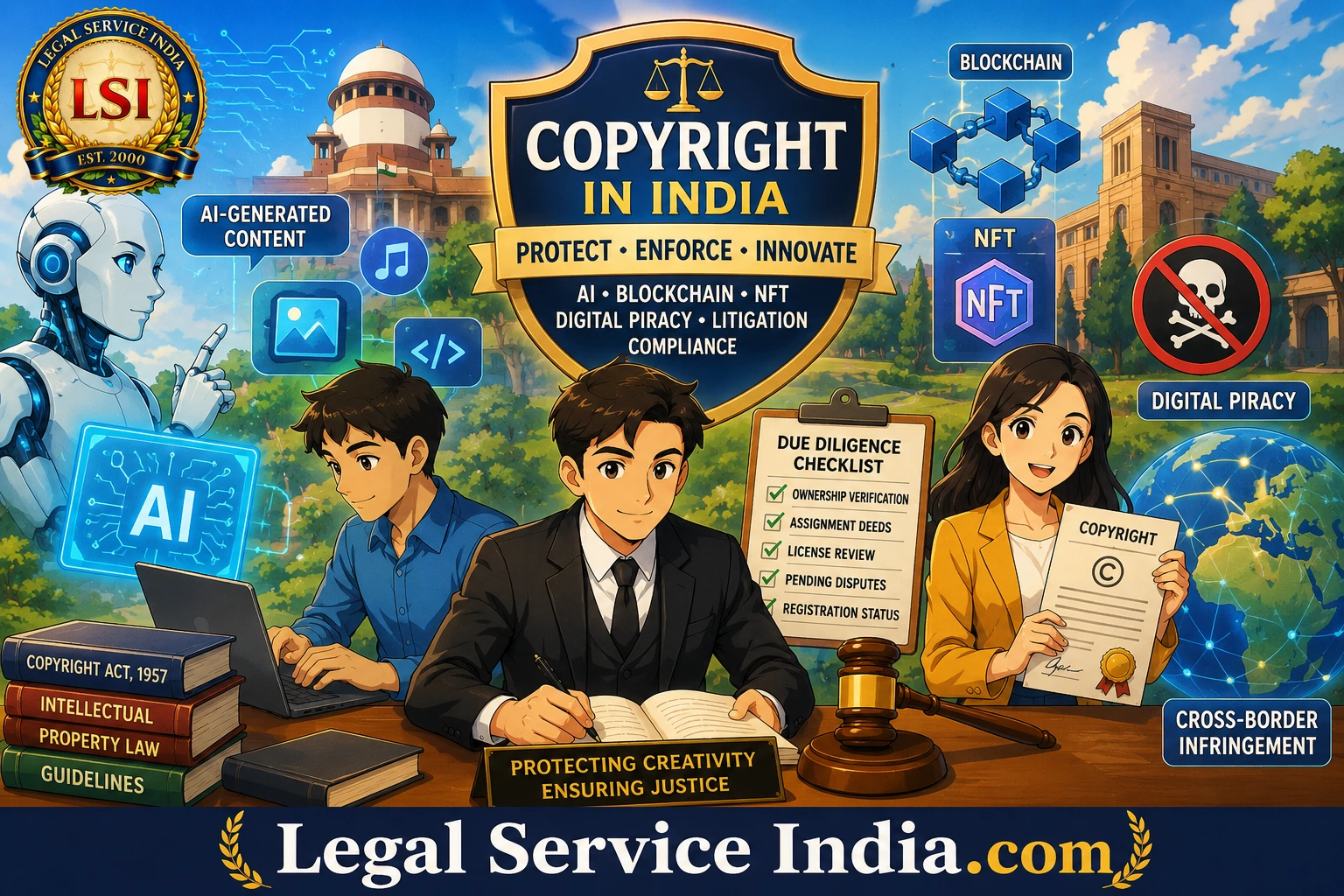
Advanced Litigation Issues, Emerging Technologies & Future of Copyright Enforcement in India
As technology evolves, copyright law continues to adapt to new forms of creativity and infringement. Courts today are increasingly called upon to decide disputes involving artificial intelligence, digital platforms, blockchain technology, online marketplaces, and cross-border infringement. This final supplementary part discusses advanced legal issues that are becoming increasingly relevant for creators, businesses, software companies, publishers, and content creators.
Copyright in the Age of Artificial Intelligence
Artificial Intelligence (AI) has fundamentally changed how creative content is produced.
Today, AI tools can generate:
- Articles
- Books
- Computer code
- Paintings
- Music
- Videos
- Voice recordings
- Animations
- Marketing material
This raises several legal questions.
Can AI Be an Author?
Under the Copyright Act, copyright traditionally protects works created through human intellectual effort. Indian law does not yet expressly recognise an AI system as an author. Consequently, issues relating to authorship and ownership of AI-generated works continue to evolve and may ultimately require legislative clarification or authoritative judicial interpretation.
Can AI Infringe Copyright?
Yes.
If an AI-generated output reproduces a substantial part of a copyrighted work without authorisation, questions of copyright infringement may arise. Whether infringement has occurred will depend on the facts of each case, including the degree of similarity, the originality of the protected work, and any applicable statutory exceptions.
Businesses using AI-generated content should therefore conduct legal due diligence before commercial publication.
Copyright Issues in Generative AI
Organisations using generative AI should consider:
- Ownership of AI-assisted output.
- Terms of service of AI platforms.
- Use of third-party copyrighted material.
- Confidential information entered into AI tools.
- Employee policies on AI usage.
- Licensing obligations.
- Risk of unintentional plagiarism.
Developing an internal AI governance policy can significantly reduce future legal disputes.
| Key AI Copyright Issue | Practical Consideration |
|---|---|
| Authorship | Indian law presently recognises human intellectual effort. |
| Ownership | Clarify ownership of AI-assisted output. |
| Infringement | Assess similarity with existing copyrighted works. |
| Compliance | Adopt internal AI governance policies. |
Copyright and Blockchain Technology
Blockchain technology offers creators new methods of recording ownership and tracking digital assets.
Possible applications include:
- Timestamping original works.
- Recording licensing transactions.
- Managing royalty payments.
- Authenticating digital artwork.
- Protecting NFTs and digital collectibles.
Although blockchain records may assist in establishing chronology or authenticity, they do not replace statutory copyright rights or eliminate the need for legal enforcement where infringement occurs.
Copyright and Non-Fungible Tokens (NFTs)
The sale of an NFT does not automatically transfer copyright in the underlying work.
Unless expressly agreed:
- The purchaser generally acquires ownership of the NFT.
- The creator usually retains copyright.
- Commercial exploitation may still require a licence.
Clear contractual terms are therefore essential when dealing with NFTs or other digital assets.
Cross-Border Copyright Infringement
Online infringement frequently extends beyond national boundaries.
Common examples include:
- Foreign websites copying Indian content.
- Overseas piracy of Indian films.
- International software piracy.
- Unauthorised distribution of e-books.
- Global streaming of infringing content.
In such cases, enforcement may involve:
- International treaties.
- Local laws of the relevant jurisdiction.
- Platform-specific complaint mechanisms.
- Cross-border legal proceedings.
Early legal advice is particularly important where infringement spans multiple countries.
Copyright Compliance During Mergers and Acquisitions
Businesses involved in mergers, acquisitions, or investment transactions should conduct intellectual property due diligence.
Important questions include:
- Who owns the copyright?
- Are assignment deeds available?
- Have employees assigned rights?
- Are software licences valid?
- Are third-party assets properly licensed?
- Are there pending infringement disputes?
- Are copyright registrations up to date?
Failure to verify ownership can significantly affect the value of a business transaction.
| Due Diligence Checklist | Importance |
|---|---|
| Ownership verification | Confirms legal rights. |
| Assignment deeds | Establishes valid transfer. |
| Licence review | Ensures lawful use. |
| Pending disputes | Assesses litigation risk. |
| Registration status | Supports enforcement. |
Copyright Audits
A copyright audit helps organisations identify and manage intellectual property assets.
Typical objectives include:
- Identifying copyrighted works.
- Verifying ownership.
- Reviewing licences.
- Detecting unauthorised use.
- Assessing compliance.
- Reducing litigation risk.
- Strengthening intellectual property portfolios.
Businesses that regularly create valuable content should consider conducting periodic copyright audits.
Copyright Insurance
Some businesses choose to obtain intellectual property insurance to manage risks associated with infringement claims.
Such policies may provide assistance with:
- Defence costs.
- Settlement expenses.
- Damages awarded by courts (subject to policy terms).
- Legal representation.
Coverage varies considerably, and businesses should carefully review policy conditions before relying on insurance.
Best Practices for Content Creators
Whether you are a writer, photographer, musician, filmmaker, educator, or social media influencer, the following practices can help safeguard your rights:
- Keep original source files.
- Maintain dated drafts.
- Register commercially valuable works.
- Use written agreements with collaborators.
- Preserve publication records.
- Monitor unauthorised use online.
- Respond promptly to infringement.
- Maintain organised records of licences and assignments.
Copyright and Employment Relationships
Ownership of works created during employment often depends upon:
- The nature of employment.
- The applicable statutory provisions.
- The terms of the employment contract.
- Whether the work was created in the course of employment.
Employers should ensure that employment agreements clearly address ownership of intellectual property to avoid future disputes.
Alternative Dispute Resolution
Not every copyright dispute requires a full trial.
Depending on the facts, parties may consider:
- Negotiation.
- Mediation.
- Arbitration (where contractually agreed).
- Commercial settlement.
Alternative dispute resolution may reduce costs and preserve commercial relationships while providing a quicker resolution.
Building a Long-Term Copyright Strategy
Effective copyright protection is not limited to litigation.
A comprehensive strategy should include:
- Registration of valuable works.
- Internal compliance policies.
- Employee training.
- Licensing management.
- Periodic intellectual property audits.
- Monitoring online infringement.
- Timely enforcement.
- Professional legal advice.
Organisations that proactively manage their intellectual property are generally better positioned to protect their commercial interests.
Final Key Takeaways
- Copyright protects original expression, not ideas.
- Registration is highly advisable, though copyright generally arises upon creation.
- Preserve evidence before contacting the infringer.
- Assess whether the use is genuinely infringing or protected by statutory exceptions.
- Consider cease and desist notices and online take-down mechanisms.
- Seek interim relief where urgent protection is required.
- Maintain comprehensive documentation throughout the life cycle of the work.
- Review contracts to ensure ownership and licensing issues are clearly addressed.
- Keep pace with emerging technologies such as AI, blockchain, and digital marketplaces.
- Obtain professional legal advice before commencing litigation.
| Area | Recommended Action |
|---|---|
| Registration | Register commercially valuable works. |
| Evidence | Maintain complete documentation. |
| Technology | Monitor developments in AI and blockchain. |
| Enforcement | Act promptly against infringement. |
| Legal Strategy | Seek professional legal advice before litigation. |
Draft Formats, Legal Checklists, Practical Templates & Professional Tips
One of the biggest challenges faced by copyright owners is knowing what to do immediately after discovering infringement. While every case requires legal advice tailored to its facts, understanding the practical workflow can save valuable time, preserve evidence, and strengthen your position before approaching a lawyer.
This part provides practical guidance, specimen formats, and checklists commonly used in copyright enforcement.
Copyright Infringement Action Plan
The moment you discover that your copyright has been infringed, avoid acting impulsively. Instead, follow a systematic approach.
Step 1: Preserve Evidence
Immediately secure evidence of the infringement.
Collect:
- Screenshots
- Website URLs
- Source code (if applicable)
- Videos
- Audio recordings
- Printed copies
- Purchase receipts
- Product catalogues
- Social media posts
- Publication dates
- Archive links
- Emails
- Metadata
Do not alert the infringer before preserving evidence, as the material may be deleted or altered.
Step 2: Verify Ownership
Ensure that you possess documents proving ownership, such as:
- Original manuscript
- Source files
- Copyright registration certificate (if available)
- Assignment deeds
- Licence agreements
- Author agreements
- Employment contracts
- Publication agreements
Step 3: Identify Every Infringing Party
The actual wrongdoer may not be the only person liable.
Potential parties include:
- Publisher
- Printer
- Distributor
- Retailer
- Website owner
- Hosting provider
- Marketplace operator
- Advertising agency
- Software reseller
- Corporate entity
- Individual uploader
Proper identification of all responsible parties helps avoid unnecessary procedural delays.
Sample Copyright Infringement Timeline
| Day | Action |
|---|---|
| Day 1 | Discover infringement. |
| Day 1 | Preserve evidence. |
| Day 2 | Consult a copyright lawyer. |
| Day 3 | Send legal notice. |
| Day 7–15 | Awaiting response |
| Day 15–20 | Prepare litigation documents. |
| Day 20+ | File a suit if necessary. |
| Immediately | Seek an interim injunction where urgent. urgent. |
Every case is unique. Urgent cases involving piracy or continuing commercial exploitation may require immediate court intervention without waiting for a reply to a legal notice.
Specimen Checklist Before Sending a Legal Notice
Before issuing a cease and desist notice, confirm the following:
- ✔ You own the copyright.
- ✔ The work is original.
- ✔ The infringing material has been preserved.
- ✔ The infringer has been correctly identified.
- ✔ The infringement is continuing.
- ✔ Your claims are factually accurate.
- ✔ Supporting documents are available.
- ✔ You are prepared to initiate legal proceedings if necessary.
A well-prepared notice often results in voluntary compliance and may avoid litigation.
Typical Contents of a Copyright Legal Notice
Although the wording varies from case to case, a professional copyright notice generally contains:
- Details of the copyright owner.
- Description of the protected work.
- Date of creation.
- Copyright registration particulars (if available).
- Description of infringement.
- Legal provisions relied upon.
- Demand to cease infringement immediately.
- Demand to remove infringing material.
- Demand for damages or compensation.
- Time limit for compliance.
- Reservation of civil and criminal remedies.
Every notice should be drafted carefully to avoid inaccurate allegations or unnecessary admissions.
What Happens After Sending the Notice?
The recipient may:
Accept the Notice
The infringing material is removed, and the dispute may conclude without litigation.
Seek a Licence
The parties may negotiate a commercial licence permitting future use of the work.
Deny Infringement
The recipient may dispute ownership, originality, or the allegation of copying.
Ignore the Notice
If no satisfactory response is received, the copyright owner may consider initiating appropriate legal proceedings.
Common Defences Raised by Defendants
During litigation, defendants frequently raise one or more of the following defences:
- Independent creation.
- Lack of originality.
- Fair dealing under Section 52.
- Public domain material.
- Prior ownership.
- Implied licence.
- Consent.
- De minimis use.
- No substantial similarity.
- No access to the original work.
The plaintiff should be prepared to rebut these defences with documentary and electronic evidence.
Electronic Evidence in Copyright Cases
Since most copyright disputes now involve digital content, electronic evidence has become critical.
Examples include:
- Emails.
- Cloud storage records.
- Website archives.
- Domain registration details.
- Git repositories.
- Social media history.
- Server logs.
- Mobile device records.
- Digital photographs.
- Metadata.
- Version history.
Maintaining an organised electronic record often strengthens the plaintiff’s case.
Copyright Due Diligence Before Filing a Suit
Experienced intellectual property lawyers generally verify the following:
| Question | Importance |
|---|---|
| Who owns the copyright? | Fundamental issue |
| Is the work original? | Essential requirement |
| Can originality be proved? | Evidence |
| Is infringement substantial? | Core legal test |
| Is there financial loss? | Damages |
| Is urgent relief required? | Interim injunction |
| Is jurisdiction correct? | Maintainability |
| Is limitation an issue? | Procedural compliance |
A thorough review before filing helps minimise avoidable procedural objections.
Mistakes That Frequently Weaken Copyright Cases
Even genuine copyright owners sometimes make errors that adversely affect their claims.
Common mistakes include:
Delaying Legal Action
Unnecessary delay may make evidence harder to obtain and allow the infringement to spread.
Poor Record-Keeping
Failure to retain original files or publication records often creates avoidable evidentiary disputes.
Public Allegations Without Proof
Accusing another person publicly before verifying the facts may expose the copyright owner to separate legal risks, including defamation claims.
Ignoring Digital Evidence
Screenshots without dates, missing URLs, or incomplete electronic records may weaken the case.
Using Inconsistent Ownership Documents
Different agreements identifying different owners may create unnecessary complications.
Copyright Compliance Checklist for Businesses
Businesses should establish internal policies to reduce the risk of infringement and ownership disputes.
Recommended practices include:
- Maintain a copyright register.
- Record creation dates.
- Preserve source files.
- Execute employee assignment agreements.
- Use written freelancer contracts.
- Review third-party licences.
- Conduct periodic IP audits.
- Train employees on copyright compliance.
- Maintain digital backups.
- Monitor online misuse of company content.
Frequently Used Copyright Documents
Depending on the nature of the dispute, a copyright lawyer may prepare:
- Cease and desist notice.
- Copyright licence agreement.
- Assignment deed.
- Non-disclosure agreement (NDA).
- Software licence agreement.
- Publishing agreement.
- Settlement agreement.
- Plaint.
- Interim injunction application.
- Affidavits.
- Written statements.
- Evidence affidavits.
- Appeal documents.
Proper drafting of these documents often has a significant impact on the outcome of the dispute.
Copyright Risk Assessment for Start-ups
Start-ups frequently overlook copyright issues during their early stages.
Every start-up should ask:
- Have we copied website content?
- Do we own our software?
- Are freelancer agreements in place?
- Are marketing images licensed?
- Is our logo original?
- Are training materials protected?
- Have employees assigned copyright?
- Are AI-generated assets legally reviewed?
Addressing these questions early can prevent expensive litigation later.
Practical Advice for Authors and Publishers
Authors Should:
- Keep dated drafts of manuscripts.
- Preserve correspondence with editors.
- Maintain publication records.
- Register commercially valuable works.
- Execute publishing agreements carefully.
- Monitor online piracy.
- Preserve evidence immediately upon discovering infringement.
Publishers should maintain robust copyright clearance procedures before publication.
Practical Advice for Software Developers
Software developers should:
- Maintain version history.
- Use source control repositories.
- Execute contributor agreements.
- Preserve development logs.
- Document software architecture.
- Secure source code access.
- Conduct periodic copyright audits.
These practices make ownership easier to establish if disputes arise.
Final Professional Advice
Copyright litigation is rarely won by legal arguments alone. Success depends upon preparation, evidence, documentation, and strategy.
Creators who preserve records from the very beginning are generally in a much stronger position than those attempting to reconstruct evidence after infringement has already occurred.
Whether you are protecting a book, website, software application, photograph, video, architectural design, educational material, musical composition, or digital content, early legal advice can help avoid costly mistakes and improve the likelihood of obtaining effective relief.
Closing Remarks
Copyright law remains one of the most dynamic areas of intellectual property. As technology continues to transform the creation, distribution, and use of creative works, both creators and businesses must remain vigilant in protecting their rights.
Timely legal advice, proper documentation, and a well-planned enforcement strategy can often prevent prolonged disputes and preserve the commercial value of intellectual property.
Whether your work involves books, software, films, music, educational content, websites, digital media, or AI-assisted creations, a proactive approach to copyright protection is the best investment in safeguarding your creative efforts.
Contact for Copyright Registration & Infringement Litigation
Adv. Tarun Choudhury
Supreme Court Advocate | 25+ Years of Legal Experience
Practice Areas
- Copyright Registration
- Copyright Infringement Litigation
- Civil & Criminal Copyright Proceedings
- Digital Content Protection
- Software & Source Code Disputes
- Copyright Licensing & Assignment
- Intellectual Property Advisory
- Emergency Injunctions
- Website Content Theft Cases
- AI & Technology-Related Copyright Advice
Contact
| Mode | Details |
|---|---|
| Call | 9891244487 |
| 9891244487 |
If your original work has been copied or commercially exploited without permission, seek experienced legal advice at the earliest opportunity. Prompt action can help preserve evidence, prevent further infringement, and protect the long-term value of your intellectual property.
Important Links
Important Links:
- Lawyers in India
- Copyright Registration in India
- Caveat Filing in Supreme Court of India
- Mutual Consent Divorce in Delhi/NCR : WhatsApp 9650499965