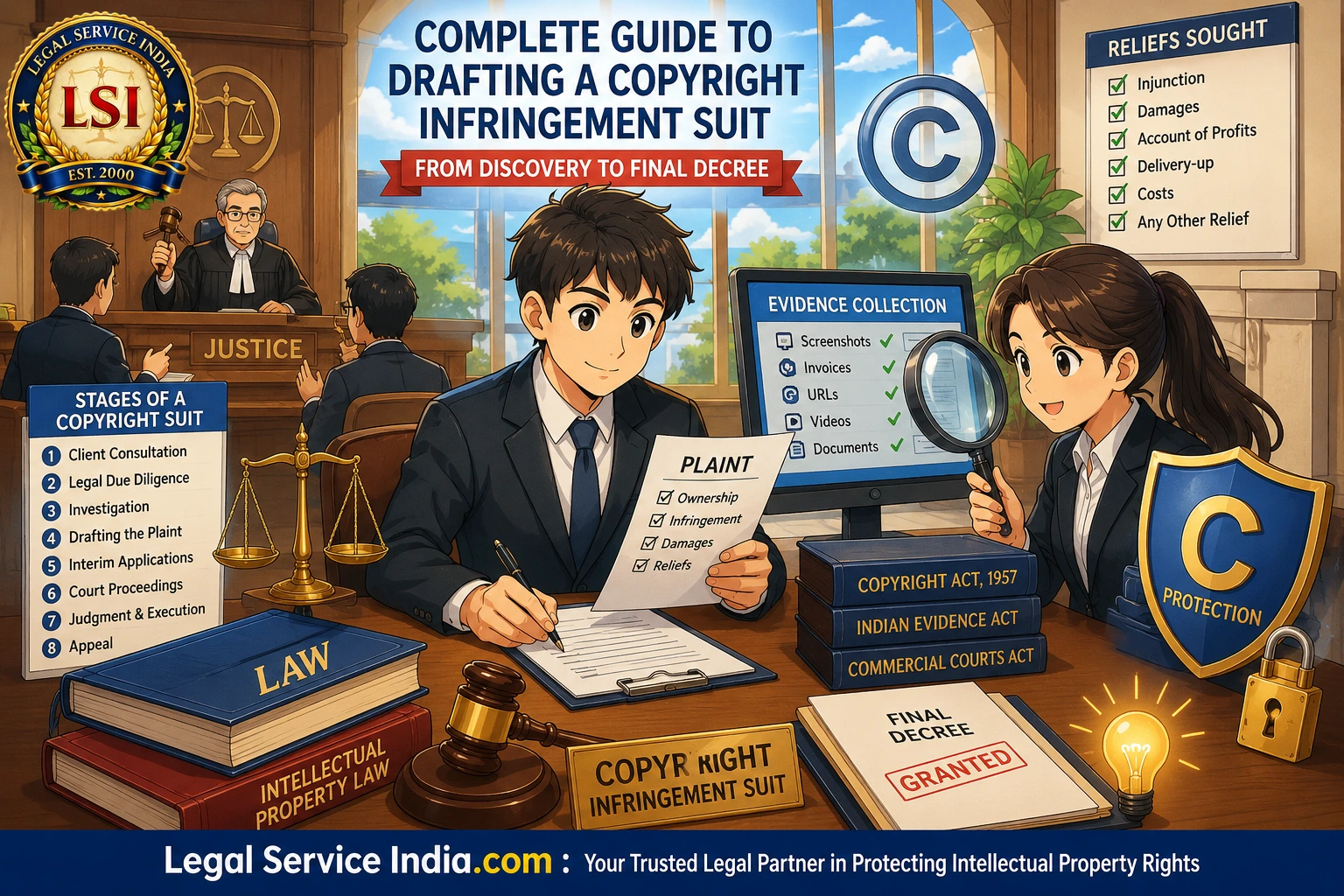
Complete Guide to Drafting a Copyright Infringement Suit: From Discovery to Final Decree
Winning a copyright infringement case is not merely about proving that someone copied your work. Success depends upon presenting a legally sustainable case, preserving evidence, choosing the correct forum, and seeking appropriate interim and final reliefs. This part explains how experienced intellectual property lawyers strategically prepare a copyright infringement suit from the initial consultation through execution of the decree.
Stages of a Copyright Infringement Suit
| Stage | Purpose |
|---|---|
| Stage 1 | Client Consultation |
| Stage 2 | Legal Due Diligence |
| Stage 3 | Investigation |
| Stage 4 | Drafting the Plaint |
| Stage 5 | Interim Applications |
| Stage 6 | Court Proceedings |
| Stage 7 | Judgement and Execution |
| Stage 8 | Appeal |
Stage 1: Client Consultation
The litigation process begins with a detailed consultation between the copyright owner and the advocate.
During this stage, the lawyer generally examines:
- Nature of the copyrighted work.
- Date of creation.
- Date of first publication.
- Ownership documents.
- Copyright registration status.
- Details of infringement.
- Commercial impact.
- Financial losses.
- Urgency of relief required.
- Previous communications with the infringer.
A careful factual assessment helps determine whether litigation is the most appropriate course of action.
Stage 2: Legal Due Diligence
Before drafting the plaint, an experienced copyright lawyer will typically verify:
Ownership
- Who owns the copyright?
- Has the work been assigned?
- Was it created by an employee?
- Was it commissioned?
Originality
Does the work satisfy the originality requirement recognised by Indian law?
Limitation
Although every case depends on its facts, unnecessary delay in enforcing rights may complicate litigation. Prompt action is therefore advisable once infringement is discovered.
Jurisdiction
- Which court has territorial and pecuniary jurisdiction?
- Does the Commercial Courts Act apply?
Stage 3: Investigation
A thorough investigation may involve:
- Purchasing infringing products.
- Downloading infringing software.
- Preserving websites.
- Recording URLs.
- Capturing videos.
- Obtaining invoices.
- Identifying distributors.
- Identifying manufacturers.
- Tracing online sellers.
The investigation often determines the strength of the plaintiff’s case.
Drafting the Plaint
The plaint should clearly and logically present every material fact.
Parties
Complete description of:
- Plaintiff.
- Defendant.
- Corporate entities.
- Proprietorship concerns.
- Online intermediaries where necessary.
Jurisdiction
The plaint should explain:
- Territorial jurisdiction.
- Pecuniary jurisdiction.
- Statutory jurisdiction under the Copyright Act.
- Applicability of commercial court legislation where relevant.
Facts
The factual narration should ordinarily include:
- Creation of the work.
- Ownership.
- Publication.
- Commercial use.
- Discovery of infringement.
- Correspondence.
- Continuing infringement.
- Financial loss.
Chronological presentation greatly improves readability.
Cause of Action
The plaint must clearly explain:
- when the infringement began;
- how it occurred;
- why the defendant is liable;
- how the plaintiff suffered loss.
Relief Clause
The plaintiff may seek one or more of the following reliefs:
- Permanent injunction.
- Interim injunction.
- Damages.
- Account of profits.
- Delivery-up of infringing copies.
- Appointment of Local Commissioner.
- Costs.
- Any other relief considered appropriate by the court.
Drafting Interim Applications
In urgent cases, several interlocutory applications may accompany the plaint.
These may include applications seeking:
- Temporary injunction.
- Ex parte injunction.
- Appointment of Local Commissioner.
- Preservation of evidence.
- Appointment of a Receiver (where justified).
- Discovery and inspection.
- Production of documents.
The facts and urgency of the case determine the appropriate relief.
Court Fees
Court fees depend upon:
- the valuation adopted by the plaintiff;
- the relief claimed;
- the applicable State legislation;
- whether the suit is before a commercial court.
Professional legal advice should be obtained regarding valuation and court fees.
What Happens on the First Date?
On the first hearing, the court may:
- examine the plaint;
- hear submissions on interim relief;
- issue summons;
- grant notice;
- pass urgent interim orders where justified;
- appoint a local commissioner;
- direct preservation of evidence.
Where a strong prima facie case is established, urgent protection may be granted even before the defendant appears.
Defendant’s Written Statement
The defendant generally responds by filing a written statement.
Common defences include:
- No originality.
- Independent creation.
- Fair dealing.
- Prior publication.
- Consent.
- Licence.
- Public domain.
- No substantial similarity.
- Lack of ownership.
- Jurisdictional objections.
The plaintiff should anticipate these issues while preparing the case.
Discovery and Inspection
The discovery stage enables parties to obtain relevant documents.
Courts may direct production of:
- contracts;
- invoices;
- sales records;
- accounting statements;
- source code;
- publication records;
- licensing agreements;
- financial statements.
Discovery often reveals the true commercial scale of the infringement.
Recording of Evidence
Oral Evidence
Witnesses may include:
- Authors.
- Publishers.
- Software developers.
- Photographers.
- Technical experts.
- Investigators.
- Customers.
Documentary Evidence
Examples include:
- Registration certificates.
- Original manuscripts.
- Emails.
- Screenshots.
- Metadata.
- Sales records.
- Agreements.
- Source code.
- Digital archives.
Expert Evidence
Complex disputes involving:
- software,
- AI,
- databases,
- music,
- films,
may require expert testimony explaining technical issues.
Cross-Examination
Cross-examination frequently focuses on:
- originality;
- ownership;
- similarity;
- financial loss;
- credibility of witnesses;
- authenticity of electronic evidence.
Thorough preparation is essential.
Final Arguments
During final arguments, counsel generally addresses:
- statutory provisions;
- judicial precedents;
- originality;
- infringement;
- damages;
- interim findings;
- evidence;
- legal principles.
The objective is to persuade the court that infringement has been established and the claimed reliefs should be granted.
Judgement
If the plaintiff succeeds, the court may grant:
- Permanent injunction.
- Damages.
- Account of profits.
- Delivery-up of infringing copies.
- Costs.
- Other consequential relief.
The precise relief depends upon the facts proved during trial.
Execution of the Decree
Obtaining a decree is not always the final step.
If the defendant fails to comply voluntarily, execution proceedings may become necessary.
Execution may involve:
- attachment of property;
- recovery of money awarded;
- enforcement of injunctions;
- delivery of infringing goods;
- other execution measures available under law.
Appeals
A party aggrieved by the judgement may have a statutory right of appeal, subject to the applicable legal framework and procedural requirements.
Appellate courts may:
- affirm the judgement;
- modify the decree;
- remand the matter;
- set aside the judgement;
- Grant interim protection pending appeal.
Professional Litigation Tips
Experienced copyright litigators generally recommend:
- ✔ Preserve evidence before contacting the infringer.
- ✔ Register valuable works whenever possible.
- ✔ Avoid making public allegations without legal advice.
- ✔ Keep all agreements in writing.
- ✔ Maintain accurate financial records.
- ✔ Respond promptly to infringement.
- ✔ Consider settlement where commercially appropriate.
- ✔ Monitor compliance even after obtaining an injunction.
Copyright Litigation Flow Chart
| Step | Process |
|---|---|
| 1 | Original Work Created |
| 2 | Copyright Arises Automatically |
| 3 | Infringement Discovered |
| 4 | Evidence Preserved |
| 5 | Legal Consultation |
| 6 | Cease & Desist Notice (where appropriate) |
| 7 | Take-down / Settlement Attempt |
| 8 | Civil Suit Filed |
| 9 | Interim Relief |
| 10 | Written Statement |
| 11 | Evidence |
| 12 | Arguments |
| 13 | Judgement |
| 14 | Execution / Appeal |
Key Takeaways
- Proper client consultation forms the foundation of a successful copyright infringement suit.
- Legal due diligence helps identify ownership, originality, limitation, and jurisdiction issues.
- Timely preservation of evidence significantly strengthens the plaintiff’s case.
- A well-drafted plaint should clearly explain facts, cause of action, jurisdiction, and reliefs.
- Interim relief may provide immediate protection against continuing infringement.
- Documentary, oral, and expert evidence are often decisive during trial.
- Successful litigation requires careful preparation from investigation through execution of the decree.
Final Words
Copyright litigation is a specialised area of intellectual property law that combines statutory interpretation, civil procedure, commercial strategy, and digital evidence. Whether the dispute concerns books, software, films, music, photographs, educational content, website articles, AI-generated material, or online piracy, careful preparation and prompt legal action are often the keys to success.
Protecting copyright is not merely about safeguarding creative expression—it is about preserving the economic value, reputation, and commercial potential of intellectual property. By understanding the litigation process and seeking timely legal advice, creators and businesses can enforce their rights effectively and minimise the impact of infringement.
Contact for Copyright Registration & Infringement Litigation
Adv. Tarun Choudhury
Supreme Court Advocate | 25+ Years of Legal Experience
Practice Areas
- Copyright Registration
- Copyright Infringement Litigation
- Civil & Criminal Copyright Proceedings
- Digital Content Protection
- Software & Source Code Disputes
- Copyright Licensing & Assignment
- Intellectual Property Advisory
- Emergency Injunctions
- Website Content Theft Cases
- AI & Technology-Related Copyright Advice
Contact
| Mode | Details |
|---|---|
| Call | 9891244487 |
| 9891244487 |
If your original work has been copied or commercially exploited without permission, seek experienced legal advice at the earliest opportunity. Prompt action can help preserve evidence, prevent further infringement, and protect the long-term value of your intellectual property.
Important Links
Important Links:
- Lawyers in India
- Copyright Registration in India
- Caveat Filing in Supreme Court of India
- Mutual Consent Divorce in Delhi/NCR : WhatsApp 9650499965