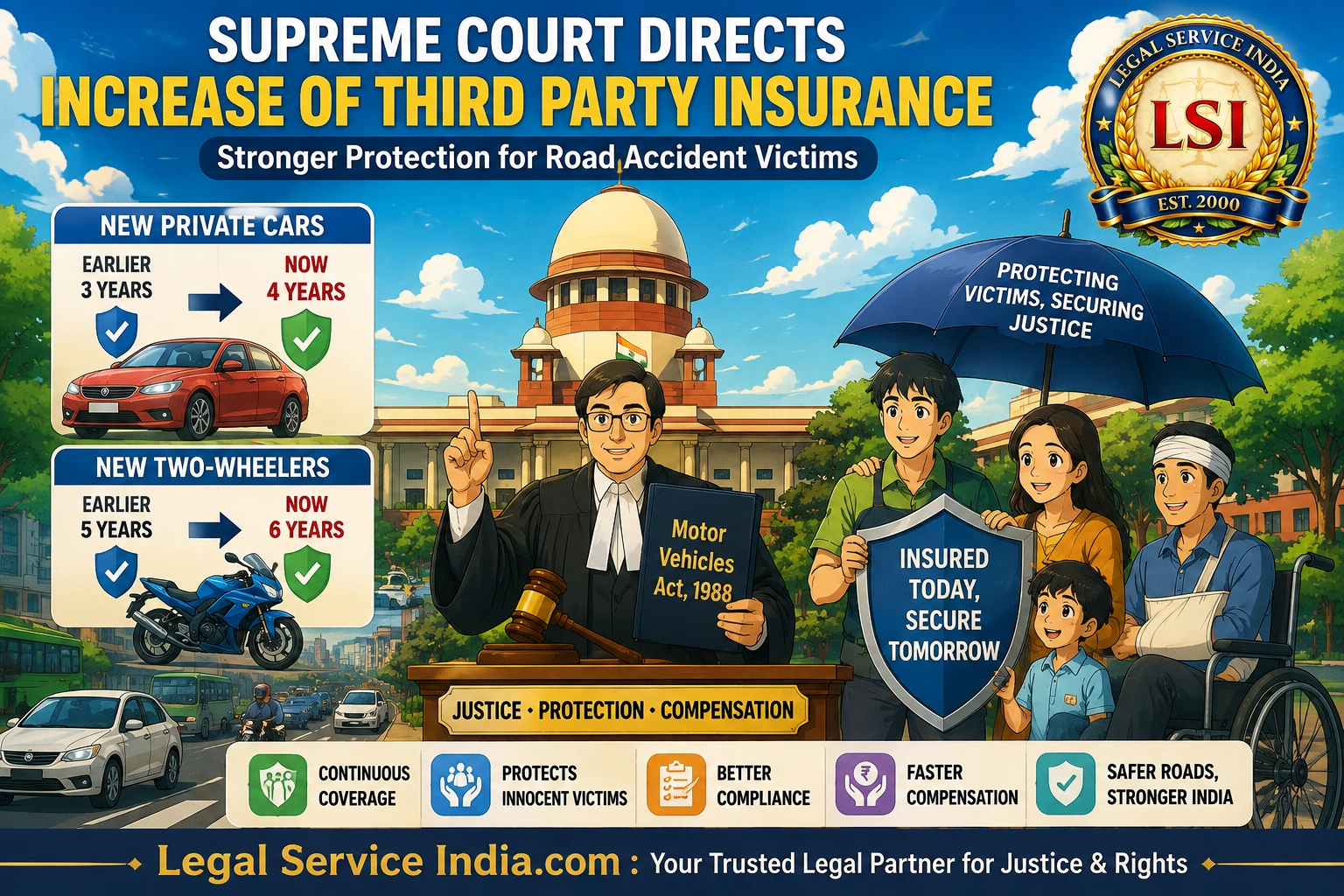
Supreme Court Directs Increase of Third-Party Insurance of Cars to 4 Years and Two-Wheelers to 6 Years: A Landmark Step Towards Stronger Road Accident Victim Protection
Introduction
In a significant move aimed at strengthening the protection available to victims of road accidents, the Supreme Court of India has directed that the mandatory third-party insurance period for newly purchased private cars be increased from three years to four years and for new two-wheelers from five years to six years.
The direction comes in the continuing proceedings concerning road safety reforms initiated by the Supreme Court in S. Rajaseekaran v. Union of India & Ors., Writ Petition (Civil) No. 295 of 2012, a matter that has fundamentally transformed India’s road safety framework.
This latest direction represents another milestone in the court’s continuing efforts to reduce uninsured vehicles on Indian roads and ensure that innocent victims of motor accidents are not deprived of compensation because vehicle owners fail to renew their insurance policies.
From the perspective of a lawyer practising before the Supreme Court for over two decades, this decision is not merely an administrative alteration in insurance tenure. It reflects the Court’s broader constitutional commitment towards social justice, victim compensation, and effective enforcement of welfare legislation under the Motor Vehicles Act, 1988.
Citation
| Particulars | Details |
|---|---|
| Case | S. Rajaseekaran v. Union of India & Others |
| Case Number | Writ Petition (Civil) No. 295 of 2012 |
| Court | Supreme Court of India |
| Latest Order | 2026 (Road Safety Committee Proceedings) |
Background of the Litigation
The present order cannot be understood without appreciating the extraordinary history of this public interest litigation.
The writ petition was originally filed seeking effective implementation of road safety measures throughout India.
Over the years, the Supreme Court constituted the Supreme Court Committee on Road Safety, which has worked closely with:
- Ministry of Road Transport and Highways
- Insurance Regulatory and Development Authority of India (IRDAI)
- General Insurance Council
- State Governments
- Transport Authorities
The Court has continuously monitored the implementation of road safety measures, including:
- Road engineering
- Speed regulation
- Helmet enforcement
- Seat belt compliance
- Licensing reforms
- Emergency trauma care
- Motor vehicle insurance
This continuing mandamus has resulted in numerous nationwide reforms over the last decade.
Earlier Supreme Court Direction on Third-Party Insurance
In July 2018, the Supreme Court had issued a landmark direction requiring:
- Three-year compulsory third-party insurance for all new private cars
- Five-year compulsory third-party insurance for all new two-wheelers
The Court accepted recommendations made by the Road Safety Committee after consultations with insurance companies and regulators.
The objective was straightforward:
Many vehicle owners renewed their registration but failed to renew their insurance after the first year. Consequently, thousands of vehicles travelled uninsured, leaving accident victims without effective compensation.
To remedy this, the Court mandated long-term third-party insurance at the time of purchase itself.
What Has Changed Now?
The latest direction extends the mandatory period even further.
The Supreme Court has now directed:
| Vehicle Type | Earlier Mandatory Third-Party Insurance | New Mandatory Period |
|---|---|---|
| Private Cars | 3 Years | 4 Years |
| Two-Wheelers | 5 Years | 6 Years |
The increase is intended to provide uninterrupted insurance protection for a longer duration after purchase and reduce the number of uninsured vehicles on Indian roads.
Why Did the Supreme Court Extend the Insurance Period?
The Court has consistently treated third-party insurance not as a commercial product but as a statutory social welfare obligation.
Several practical realities influenced this decision.
Key Reasons for Extending the Insurance Period
| Reason | Objective |
|---|---|
| Large Number of Uninsured Vehicles | Reduce uninsured vehicles and protect accident victims. |
| Protection of Innocent Victims | Ensure continuous availability of compensation. |
| Improving Compliance | Increase insurance renewal compliance and reduce litigation. |
| Supporting the Objectives of the Motor Vehicles Act | Strengthen the statutory mandate of compulsory third-party insurance. |
1. Large Number of Uninsured Vehicles
Many owners forget or deliberately avoid renewing insurance after the initial period.
This leaves victims exposed to lengthy litigation against individual vehicle owners who may not possess sufficient financial resources.
2. Protection of Innocent Victims
Third-party insurance exists primarily for accident victims—not for vehicle owners.
When insurance lapses:
- injured persons suffer;
- Families of deceased victims suffer;
- Compensation becomes uncertain;
- Execution of awards becomes difficult.
The Court therefore seeks continuous insurance coverage.
3. Improving Compliance
A longer compulsory insurance period means:
- fewer renewal defaults,
- higher compliance,
- better accident compensation,
- reduced litigation.
4. Supporting the Objectives of the Motor Vehicles Act
Chapter XI of the Motor Vehicles Act, 1988, makes third-party insurance compulsory because Parliament recognised that motor accidents are inevitable and innocent victims deserve guaranteed compensation.
The Supreme Court’s direction strengthens this legislative objective.
Legal Basis Under the Motor Vehicles Act
The decision rests primarily upon:
- Section 146
- Section 147
- Chapter XI of the Motor Vehicles Act, 1988
| Provision | Purpose |
|---|---|
| Section 146 | Prohibits use of a motor vehicle in a public place without insurance against third-party risks. |
| Section 147 | Prescribes the statutory requirements for such insurance. |
| Chapter XI | Provides the legal framework for compulsory third-party insurance. |
Section 146 prohibits use of a motor vehicle in a public place without insurance against third-party risks.
Section 147 prescribes the statutory requirements for such insurance.
The Supreme Court has repeatedly described these provisions as beneficial social welfare legislation deserving liberal interpretation in favour of accident victims.
Why Third-Party Insurance Is Different from Comprehensive Insurance
Many vehicle owners confuse these two policies.
| Third-Party Insurance | Comprehensive Insurance |
|---|---|
| It covers the death of third parties, bodily injury, and property damage caused to others. It is compulsory under law. | It additionally covers damage to one’s own vehicle, theft, fire, flood, natural disasters, and accidental damage. This remains optional. |
The Supreme Court’s latest direction concerns only the mandatory third-party insurance component.
Impact on Car Buyers
For purchasers of new cars:
- Insurance validity automatically increases;
- fewer renewal formalities;
- uninterrupted legal compliance;
- enhanced protection for accident victims.
Although the upfront purchase cost may marginally increase due to the longer mandatory insurance period, owners benefit from avoiding annual renewal hassles during the initial years.
Impact on Two-Wheeler Owners
India has one of the world’s largest populations of motorcycles and scooters.
Unfortunately, two-wheelers are also disproportionately involved in fatal road accidents.
Extending compulsory third-party insurance to six years ensures that millions of motorcycles remain insured during their highest accident-risk period.
Impact on Insurance Companies
Insurance companies will need to:
- redesign products;
- recalculate premium structures;
- modify underwriting systems;
- Issue revised bundled policies.
The Insurance Regulatory and Development Authority of India (IRDAI) is expected to operationalise the Court’s directions through appropriate regulatory circulars, as it did following the 2018 order.
Constitutional Dimension
The judgement also advances constitutional values.
Road accident compensation directly implicates:
- Article 21 (Right to Life),
- social justice principles,
- access to effective legal remedies.
A compensation regime becomes meaningful only when recoverable.
By ensuring longer insurance coverage, the Court reduces situations where victims obtain awards that cannot realistically be enforced.
Practical Advantages of the New Direction
The latest decision is likely to produce several long-term benefits:
- Better compliance with mandatory insurance laws.
- Reduced number of uninsured vehicles.
- Faster compensation for accident victims.
- Lower enforcement burden on transport authorities.
- Greater certainty before Motor Accident Claims Tribunals.
- Enhanced financial protection for families affected by road accidents.
- Stronger implementation of the Motor Vehicles Act.
Benefits at a Glance
| Key Benefit | Expected Impact |
|---|---|
| Mandatory Insurance Compliance | Better compliance with mandatory insurance laws. |
| Insurance Coverage | Reduced number of uninsured vehicles. |
| Compensation Process | Faster compensation for accident victims. |
| Administrative Efficiency | Lower enforcement burden on transport authorities. |
| MACT Proceedings | Greater certainty before Motor Accident Claims Tribunals. |
| Victim Protection | Enhanced financial protection for families affected by road accidents. |
| Legal Framework | Stronger implementation of the Motor Vehicles Act. |
Will Existing Vehicles Also Get Extended Coverage?
No.
The direction principally applies to policies issued for newly sold vehicles in accordance with the implementation mechanism prescribed by the court and the insurance regulator. Existing policies will continue according to their contractual terms unless modified through future regulatory directions.
A Lawyer’s Perspective
Having appeared in numerous motor accident compensation matters, I have often witnessed situations where deserving claimants struggle to realise compensation because the offending vehicle had no valid insurance.
The Motor Vehicles Act was enacted to provide prompt relief to victims, yet lapses in insurance renewal frequently frustrate this objective.
The Supreme Court’s latest direction is therefore a practical reform rather than merely a procedural one. By extending compulsory third-party insurance to four years for cars and six years for two-wheelers, the Court has attempted to bridge the gap between statutory rights and their effective enforcement. While the immediate financial burden on new purchasers may marginally increase, the broader public interest served by ensuring continuous insurance protection far outweighs the additional cost.
Conclusion
The Supreme Court Directs Increase Of Third-Party Insurance Of Cars To 4 & Two-Wheelers To 6 Years, Marking Another Significant Milestone In India’s Evolving Road Safety Jurisprudence. Continuing its proactive supervision in S. Rajaseekaran v. Union of India, the Court has reinforced the principle that compulsory third-party insurance is a social welfare mechanism intended to safeguard innocent victims of motor vehicle accidents rather than merely regulate contractual relations between insurers and vehicle owners.
If implemented effectively through IRDAI and insurance companies, this reform is likely to reduce the number of uninsured vehicles, improve compliance with the Motor Vehicles Act, and strengthen the ability of Motor Accident Claims Tribunals to ensure timely compensation. In the long run, the decision has the potential to save countless victims and their families from the uncertainty and hardship that often follow serious road accidents.
Need Legal Assistance in a Motor Accident or Insurance Claim?
Have you been injured in a road accident, denied insurance compensation, or need expert legal advice on motor accident claims?
Adv. Tarun Choudhury
Supreme Court Advocate | 25+ Years of Legal Experience
With over 25 years of experience in the Supreme Court of India, Adv. Tarun Choudhury provides professional legal assistance in:
- Motor Accident Claims (MACT)
- Insurance Claim Disputes
- Supreme Court & High Court Litigation
- Appeals Against MACT Awards
- Compensation for Road Accident Victims
- Legal Advice on Motor Vehicles Act Matters
Legal Services at a Glance
| Practice Area | Legal Assistance |
|---|---|
| Motor Accident Claims (MACT) | Representation before motor accident claims tribunals and appellate courts. |
| Insurance Claim Disputes | Legal assistance in disputed or rejected insurance claims. |
| Supreme Court & High Court Litigation | Professional representation in constitutional, civil, and appellate matters. |
| Appeals Against MACT Awards | Filing and defending appeals relating to motor accident compensation. |
| Compensation for Road Accident Victims | Assistance in securing fair and lawful compensation. |
| Motor Vehicles Act Matters | Comprehensive legal advice and litigation support. |
Contact Adv. Tarun Choudhury.
📞 Call: 9891244487
💬 WhatsApp: 9650499965
Get experienced legal guidance to protect your rights and secure the compensation you deserve. Contact today for a confidential consultation.