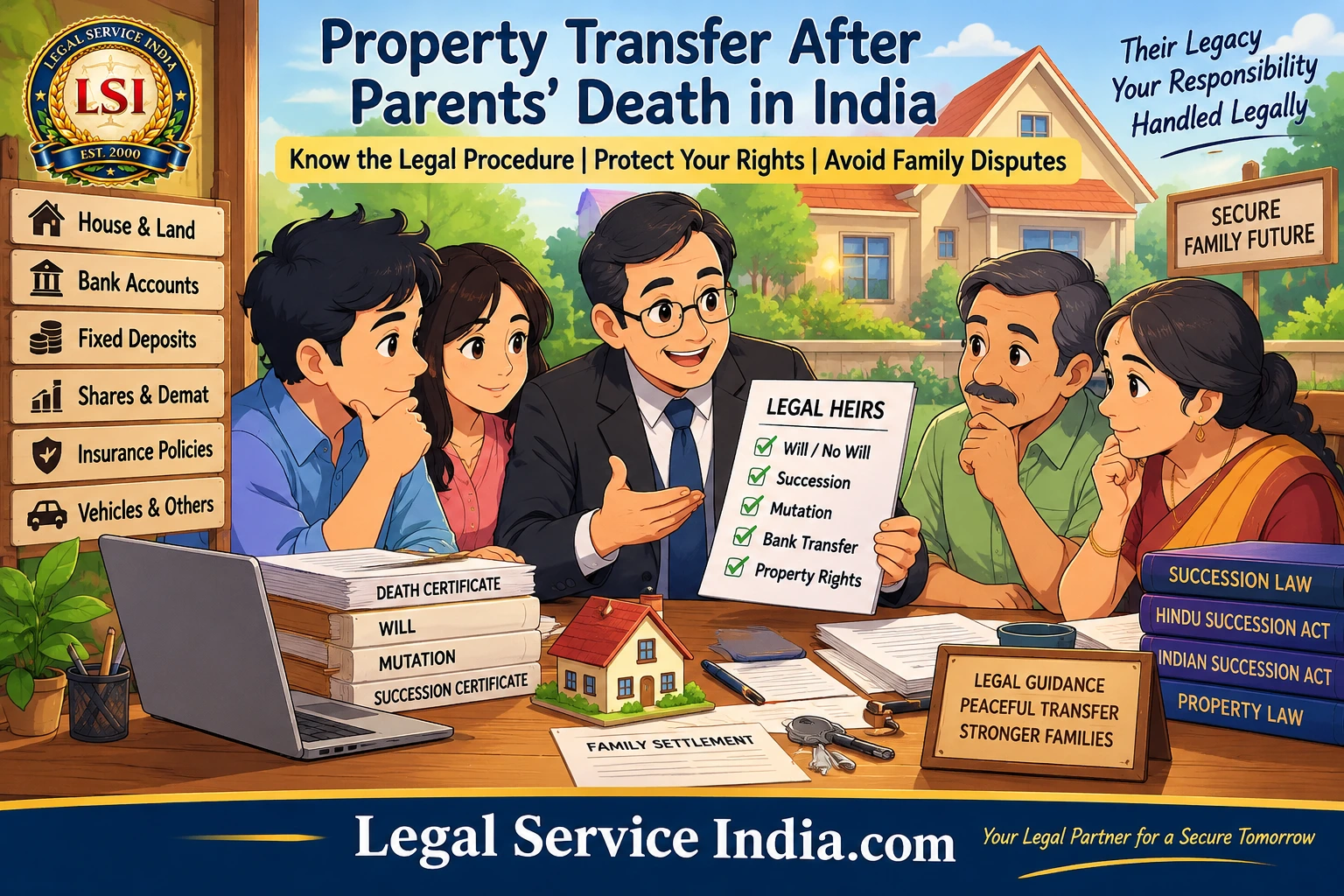
Property Transfer After Parents’ Death in India: Complete Legal Procedure for Legal Heirs
When parents die, their house, land, bank accounts, fixed deposits, shares and other assets do not simply become the property of whichever child is living in the house or happens to be named as nominee.
For most families, this is where confusion begins.
Who inherits the house? Does the nominee get the bank balance? Does a daughter have an equal share? Is mutation enough to establish ownership? Is a succession certificate necessary? What happens if there is a will? And what can be done if one brother or sister refuses to cooperate?
The legal procedure for property transfer after parents’ death depends on several factors: whether the deceased left a valid will, the applicable succession law, the nature of the property, the identity of the legal heirs, the manner in which the asset was held and whether any dispute exists among family members.
In my experience, many inheritance disputes do not begin because the law is particularly complicated. They begin because families act on assumptions before determining their legal rights.
This guide explains, step by step, how legal heirs can deal with both movable and immovable property after the death of parents in India.
The First Question: Did Your Parent Leave a Will?
Before approaching the bank, municipal authority, revenue office or housing society, find out whether the deceased parent left a will.
This is the legal starting point.
If there is a valid will, the estate will ordinarily be dealt with according to the testamentary disposition, subject to the applicable succession law and any legal challenge to the will.
If there is no will, the parent is said to have died intestate, and the property devolves according to the applicable law of intestate succession.
| Situation | What Generally Happens |
|---|---|
| The parent left a valid will. | Property is dealt with according to the Will, subject to applicable succession law and legal requirements. |
| Parent died without a will. | Property devolves upon the legal heirs according to the applicable intestate succession law. |
| Will is disputed. | The validity and effect of the will may require adjudication by the competent court. |
| Several heirs claim the same property. | Their respective rights must first be determined; partition or other proceedings may become necessary. |
| A nominee exists. | Nomination may facilitate transmission or receipt of an asset but should not automatically be equated with beneficial inheritance rights. |
What Should You Do Immediately After a Parent Dies?
Do not begin by asking, “How do I get the property transferred into my name?”
The better question is:
“What property did my parent own, and who is legally entitled to inherit it?”
Once that question is answered, the transfer procedure becomes much clearer.
Step 1: Obtain the Death Certificate
Obtain the official death certificate and keep several copies available.
It will normally be required while dealing with banks, financial institutions, insurance companies, revenue or municipal authorities, housing societies and other organisations holding assets or records in the deceased person’s name.
Step 2: Search Carefully for a Will
Look for the original Will and any later Will or codicil.
Check the deceased parent’s personal papers, locker, important document files and records maintained by his or her lawyer or other trusted person.
Finding a document headed “Will” does not necessarily end the inquiry. Where substantial property is involved, its execution, authenticity and legal effect should be examined.
Step 3: Prepare a Complete Family Tree
Identify every person who could potentially be a legal heir.
Do not assume that a married daughter has lost her rights, that an heir living abroad has no claim, or that a child who was not caring for the parents automatically loses his or her inheritance.
Succession is determined by law and legally effective dispositions—not by family assumptions.
Step 4: Prepare an Inventory of Every Asset
This is one of the most important practical steps.
Make a list of:
- House, flat and apartment
- Residential and commercial land
- Agricultural property
- Bank accounts
- Fixed and recurring deposits
- Post Office investments
- Shares and demat holdings
- Mutual funds
- Bonds and securities
- Insurance policies
- Vehicles
- Bank lockers
- Business interests
- Loans receivable
- Digital or other valuable assets, where applicable
Against every asset, record its approximate value, ownership pattern, nominee, joint holder and available documents.
Step 5: Identify Liabilities as Well
An estate does not consist only of assets.
Check whether the deceased had outstanding home loans, secured loans, tax liabilities, litigation or other legally enforceable obligations.
Property Transfer After Parents’ Death When There Is a Will
Where a valid Will exists; carefully read what it actually says.
Identify:
- The beneficiaries
- The property given to each beneficiary
- The executor, if one has been appointed
- Any conditions attached to a bequest
- The residuary clause
- Any subsequent codicil or later will
One common mistake is to assume that every will must necessarily be probated everywhere in India before anything can be done.
That is too broad a proposition.
Whether probate or other testamentary proceedings are legally necessary depends upon the applicable provisions of the Indian Succession Act, the category of will, territorial and other statutory considerations, and the particular circumstances.
Therefore, the will should be legally examined before the family either ignores probate altogether or unnecessarily starts probate proceedings.
What Happens When a Parent Dies Without a Will?
If there is no valid will, the property devolves through intestate succession.
At this point, the applicable personal/succession law becomes crucial.
For example, where the Hindu Succession Act, 1956, applies, the Act contains separate rules governing intestate succession to the property of Hindu males and Hindu females.
This distinction matters.
It is legally unsafe to write a family tree on a piece of paper and simply divide everything equally without first determining:
- Who died first
- Who was alive on the relevant date of succession
- Whether the property was solely owned or jointly held
- Whether it was self-acquired, inherited or coparcenary property
- Whether an earlier succession had already taken place
- Whether any valid transfer occurred during the parent’s lifetime
If Both Parents Have Died, Analyse the Two Deaths Separately
This point is frequently overlooked.
Suppose the father dies first. His property devolves according to his will or the applicable law of intestate succession.
If the mother inherits a share in his property and subsequently dies, that share has become part of the property whose succession must then be examined on her death.
Therefore, where both parents have died at different times, lawyers should normally reconstruct the chain of succession death by death.
Trying to jump directly from the father’s original ownership to the surviving children can produce an incorrect calculation of shares.
Self-Acquired Property and Ancestral or Coparcenary Property Are Not the Same
Before calculating anybody’s share, determine the character of the property.
A house purchased by a parent from his or her own funds cannot automatically be analysed in exactly the same manner as Hindu coparcenary property.
Similarly, merely describing an old family property as “ancestral” in everyday conversation does not necessarily establish its legal character as ancestral or coparcenary property.
The title history must be examined.
Do Daughters Have Rights in Parents’ Property?
Yes, daughters can have substantial inheritance rights, but the precise legal basis and share must be determined from the applicable succession law and nature of the property.
Under Section 6 of the Hindu Succession Act as amended, a daughter of a coparcener is a coparcener by birth in her own right in the circumstances governed by that provision, with rights and liabilities prescribed by law.
Therefore, statements such as “the daughter is married, so she has no right in the property” should never be accepted without examining the law.
How to Transfer House, Flat or Land After Parents’ Death
For property transfer after parents’ death, immovable property requires particularly careful treatment because mutation, possession and title are often confused.
1. Verify the Parent’s Title
Examine the original sale deed, conveyance deed, gift deed, partition document, allotment document or other instrument through which the parent acquired the property.
Also check whether there is a mortgage, charge, litigation or prior agreement affecting the property.
2. Determine Who Has Succeeded to the Property
This may be determined through a valid will or applicable intestate succession law.
Depending upon the circumstances, relevant documents may include a legal heir/family member certificate, probate, letters of administration, registered documents, court orders or other succession documentation.
3. Apply for Mutation or Substitution
After the succession basis has been established, the legal heirs can approach the appropriate revenue authority, municipal body, development authority, housing authority or other competent institution for mutation/substitution according to the procedure applicable to that property.
But remember one crucial principle:
Mutation is not the source of your title.
Mutation generally changes the name appearing in revenue or municipal records. It does not, by itself, decide a serious dispute concerning ownership.
4. Update Housing Society or Apartment Records
Where the deceased owned a flat, the housing society, association or other competent body may also require transmission/substitution documentation.
5. What If Several Children Inherit the Same House?
Where several heirs succeed to one property, putting the property into the name of all eligible successors does not magically divide the physical house into separate portions.
Depending upon the circumstances, the heirs may:
- Continue as co-owners;
- Enter into an appropriate family settlement;
- Partition the property;
- Release or relinquish rights through an appropriate instrument; or
- Seek partition or other relief from the competent court where agreement is impossible.
How to Claim a Parent’s Bank Account and Fixed Deposits After Death
Bank accounts should be treated separately from immovable property.
First determine whether the account was:
- A sole account with nomination;
- A sole account without nomination;
- A joint account with a survivorship mandate;
- A joint account without an applicable survivorship arrangement; or
- An account affected by a court order or succession dispute.
The claimant should ordinarily approach the bank with the death certificate, identification and the documents required under the bank’s deceased-depositor claim procedure.
Where a valid nomination or survivorship arrangement exists, the bank’s procedure can be significantly simpler.
Nominee vs Legal Heir: One of the Most Important Distinctions
This is where families frequently make mistakes.
Receiving an asset as nominee and being ultimately entitled to retain that asset beneficially are not necessarily the same legal question.
For bank deposits, nomination provides the bank with a mechanism for settling the deceased depositor’s account. But payment by the bank to a nominee does not necessarily extinguish the rights that another person may establish against that nominee under succession law.
Therefore, never advise a client:
“Your name is the nominee; therefore, the entire money automatically belongs to you.”
First examine the will, succession law and nature of the particular asset.
Shares, Demat Accounts and Mutual Funds
Financial investments have their own transmission procedures.
For dematerialised securities, the claimant normally deals with the Depository Participant. Mutual funds have prescribed transmission processes through the relevant asset management company/registrar.
The documents required can depend on factors including nomination, joint holding, value and the claimant’s legal status.
The practical lesson is simple: do not use the mutation procedure for land as a template for financial assets.
Transfer of a Vehicle After a Parent’s Death
A car, motorcycle or other registered vehicle should be transferred through the procedure prescribed under the motor vehicle law and the relevant registering authority.
The family should also deal with the vehicle’s insurance and any outstanding hypothecation or loan.
Insurance Policies
Notify the insurer and submit the prescribed death-claim documents.
However, where competing succession claims exist, the legal effect of nomination and the applicable statutory framework should be separately examined rather than assuming that nomination conclusively determines every beneficial inheritance issue.
What Happens to a Bank Locker After the Parent Dies?
A bank locker should not be forgotten while preparing the estate inventory.
The procedure will depend on whether the locker was held singly or jointly and whether a nomination or survivorship arrangement exists.
The bank’s prescribed deceased-locker procedure should be followed for access, inventory and delivery of the contents.
Also Read: SGB Tax Crisis 2026: Can Sovereign Gold Bond Investors Demand Grandfathering and Legal Protection?
Legal Heir Certificate, Succession Certificate and Probate: What Is the Difference?
These terms are often used interchangeably by families. Legally, they perform different functions.
| Document | Broad Function |
|---|---|
| Legal Heir/Family Member Certificate | Identifies family members/legal heirs for purposes recognised by the relevant issuing authority. |
| Succession Certificate | A judicial certificate under Part X of the Indian Succession Act relating to debts and securities covered by that Part. |
| Probate | Judicial process concerning a will and the representative title of the executor in circumstances governed by the Indian Succession Act. |
| Letters of Administration | Authority granted by a competent court to administer an estate in circumstances recognised by law. |
| Mutation | Updating relevant revenue/municipal records; it is not by itself adjudication of ownership. |
A succession certificate is particularly misunderstood. It is not a universal “ownership certificate” for every house, plot and asset left by a deceased person.
When Is a Succession Certificate Required?
Part X of the Indian Succession Act, 1925, deals with succession certificates concerning debts and securities.
An application under Section 372 is made by petition to the competent District Judge and contains prescribed particulars relating to the deceased, relatives, rights claimed and the debts and securities for which the certificate is sought.
Whether it is actually necessary for a particular asset must be determined from the facts and the requirements of the institution concerned.
What If One Child Wants to Give His or Her Share to Another?
This is an area where I would advise extreme caution.
Suppose two brothers and a sister inherit valuable property. One sibling is told:
“Just sign this paper. It is only an NOC.”
That person should understand exactly what is being signed.
An NOC, affidavit, release deed, relinquishment deed, gift, family settlement and partition document are not interchangeable merely because the family wants the same practical result.
The legal instrument must match the transaction.
Never surrender an inheritance right without first knowing what you own, what it is worth and what legal rights the document will extinguish.
Can Legal Heirs Make a Family Settlement?
Yes, an appropriately structured family settlement can often prevent years of litigation.
But a settlement should be drafted with clarity.
It should address:
- Who the parties are;
- What properties and rights are involved;
- What rights each party asserts or acknowledges;
- Who receives which asset;
- Who remains in possession;
- Whether money or other consideration is involved;
- Which documents must subsequently be executed; and
- Applicable stamp duty and registration consequences.
A vague family settlement can become the beginning of litigation instead of the end of it.
What If One Legal Heir Refuses to Cooperate?
No heir should assume that another co-heir’s refusal to sign an NOC destroys his or her inheritance rights.
Depending upon the facts, possible remedies can include negotiation, mediation, legal notice, partition, declaration, injunction, possession proceedings or other appropriate civil remedies.
The correct remedy depends upon what is actually disputed.
If the disagreement concerns title itself, merely fighting over mutation entries may not resolve the underlying ownership dispute.
Also Read: AI-Generated Fake Nude Images: Minnesota vs. xAI and the Future of Deepfake Law
What If Someone Challenges the Will?
A will dispute requires careful handling because the person who allegedly made the will is no longer alive to explain it.
Challenges may involve allegations concerning:
- Forgery;
- Fraud;
- Undue influence or coercion;
- Lack of testamentary capacity;
- Improper execution or attestation;
- Suspicious circumstances; or
- A subsequent will or codicil.
Preserve the original will and relevant surrounding evidence. Do not write on the original document, alter it or casually hand it from person to person.
10 Common Mistakes Families Make After a Parent Dies
- Assuming the eldest son automatically owns the property.
- Assuming a married daughter has no inheritance rights.
- Assuming the nominee necessarily becomes the beneficial owner.
- Treating mutation as conclusive proof of title.
- Signing an NOC or relinquishment document without legal advice.
- Ignoring a second marriage or children from another relationship where legally relevant.
- Ignoring the succession that occurred when the first parent died.
- Selling inherited property before establishing a clear chain of title.
- Searching only for land and bank accounts while overlooking investments, lockers and other assets.
- Waiting until relationships deteriorate before documenting an agreed family settlement.
Documents You Should Collect
- Death certificate of each deceased parent
- Original will and codicils, if any
- Sale deed/conveyance/title documents
- Previous chain of title
- Property tax records
- Revenue/municipal records
- Family tree and legal-heir documentation
- Aadhaar/PAN and other identification documents, as applicable
- Bank statements and FD details
- Demat and investment statements
- Insurance policies
- Vehicle registration certificate
- Loan and mortgage documents
- Previous family settlements, partition deeds, gift deeds or release deeds
- Relevant court orders, if litigation has already taken place
Property Transfer After Parents’ Death: Step-by-Step Checklist
- Register the death and obtain the death certificate.
- Find the original will and any codicil.
- Prepare the complete family tree.
- Identify the applicable succession law.
- Determine the legal character and ownership of each property.
- Prepare an inventory of assets and liabilities.
- Identify nominees, joint holders and survivorship mandates.
- Determine whether probate, letters of administration, a succession certificate or other legal representation is required.
- Complete the deceased-claim procedure for bank accounts and deposits.
- Complete transmission formalities for securities and investments.
- Complete the relevant procedure for vehicles and insurance.
- Apply for mutation/substitution of immovable-property records.
- Update society, development authority or apartment records where applicable.
- Determine the share of each heir before executing any transfer or relinquishment.
- Document any agreed partition or family settlement properly.
- Do not sell the inherited property until the chain of title has been legally examined.
A Practical Example
Consider a family where the father owned a house and investments and died first. The mother survives him along with their son and daughter.
The family should not immediately assume that the son now owns the house.
First ask whether the father left a will. If he did not, determine the applicable intestate succession law and identify all persons entitled to succeed to him.
Suppose the mother acquires an interest in the father’s estate through that succession and dies several years later.
Her death creates a further succession question concerning the property that belonged to her at the time of her death.
This illustrates an important principle:
Inheritance should be reconstructed legally, one succession at a time.
Frequently Asked Questions About Property Transfer After Parents’ Death
1. Does a parent’s property automatically transfer to the children after death?
The beneficial rights in the estate devolve according to a valid will or the applicable law of intestate succession. Administrative records and individual assets may then require separate transmission, mutation or claim procedures.
2. Does the eldest son automatically inherit the parents’ house?
No general rule gives the eldest son automatic exclusive ownership merely because he is the eldest male child. The will, applicable succession law, nature of the property and identity of all legal heirs must be examined.
3. Is a nominee the legal owner of a deceased parent’s bank account?
A bank nomination facilitates settlement of the bank’s liability. It should not automatically be treated as a conclusive determination of beneficial inheritance rights against all other claimants.
4. Can a married daughter claim a share in her parents’ property?
Marriage by itself should not be treated as extinguishing a daughter’s statutory inheritance or coparcenary rights where the applicable law grants those rights. Her precise entitlement depends upon the facts and applicable succession law.
5. Does mutation make a legal heir the owner?
Mutation updates revenue or other governmental records. It does not by itself create or conclusively establish title where substantive ownership is disputed.
6. Do I need a succession certificate to transfer my parents’ house?
A succession certificate under Part X of the Indian Succession Act principally concerns debts and securities. It should not automatically be treated as the document required to establish title to every immovable property.
7. What happens if my brother or sister refuses to sign the property papers?
The legal consequences depend on the nature of the property and each person’s rights. A co-heir’s refusal to cooperate does not automatically extinguish another heir’s rights. Partition or other appropriate proceedings may be available.
8. What happens if both parents die without making a will?
The estate of each deceased parent must ordinarily be examined according to the applicable intestate succession law. If the parents died at different times, the succession following each death may need to be reconstructed separately.
A Lawyer’s Perspective: Do Not Begin With Transfer—Begin With Title
After more than two decades of dealing with legal disputes, one principle deserves emphasis:
Before asking how property can be transferred, first establish who legally owns what.
A mutation application cannot cure defective title. A nominee cannot necessarily eliminate succession rights. An NOC cannot safely be signed without understanding its consequences. And a family understanding that everybody remembers differently five years later is fertile ground for litigation.
Property disputes between siblings are particularly unfortunate because they combine money, memories and family relationships.
The best time to establish everyone’s legal rights is before the dispute begins.
Key Takeaways: Property Transfer After Parents’ Death
- First determine whether the deceased parent left a valid will.
- If there is no will, identify the applicable intestate succession law.
- Analyse the deaths of the father and mother separately, where they died at different times.
- Determine whether the property is self-acquired, inherited, jointly owned or coparcenary property.
- Identify every legal heir before calculating shares.
- Nomination and beneficial inheritance are not necessarily the same thing.
- Mutation does not itself confer title.
- A succession certificate is not a universal certificate for transferring every kind of property.
- Do not sign an NOC, release, relinquishment or family settlement without understanding its legal consequences.
- Where substantial assets or competing claims exist, obtain legal advice before selling or transferring inherited property.
Need Legal Help With Property Transfer After Parents’ Death?
Losing a parent is difficult enough. Discovering afterwards that the family cannot agree about a house, land, bank account or inheritance can make that period even more painful.
If you are dealing with property transfer after parents’ death, the most important step is not to rush into signing papers. First establish the will, legal heirs, chain of title and the share to which each person is legally entitled.
This becomes particularly important where there are multiple legal heirs, a disputed will, ancestral or coparcenary property, a nominee claiming the entire asset, missing title documents, an uncooperative sibling, or a proposed relinquishment of inheritance rights.
Adv. Tarun Choudhury
Supreme Court Advocate | 25+ Years of Legal Experience
Legal assistance is available in matters involving inheritance and succession, property transfer after death, wills, probate, succession certificates, mutation, partition, family settlements, relinquishment/release deeds, legal-heir disputes and inherited property litigation.
Before you sign away an inheritance, sell inherited property or accept someone’s statement that “you have no share”, find out what the law actually gives you.
One timely legal opinion can prevent a property issue from becoming years of family litigation.
Contact Adv. Tarun Choudhury for professional legal advice concerning succession, inheritance and transfer of movable and immovable property after the death of parents.
Legal Disclaimer
This article provides general legal information and should not be treated as legal advice for a particular case. Succession rights and transfer procedures depend upon the applicable personal law, nature and location of property, will, family circumstances, title documents and other facts. State-specific stamp duty, registration, revenue and administrative procedures may also differ. Obtain professional legal advice before acting upon a specific inheritance or property matter.