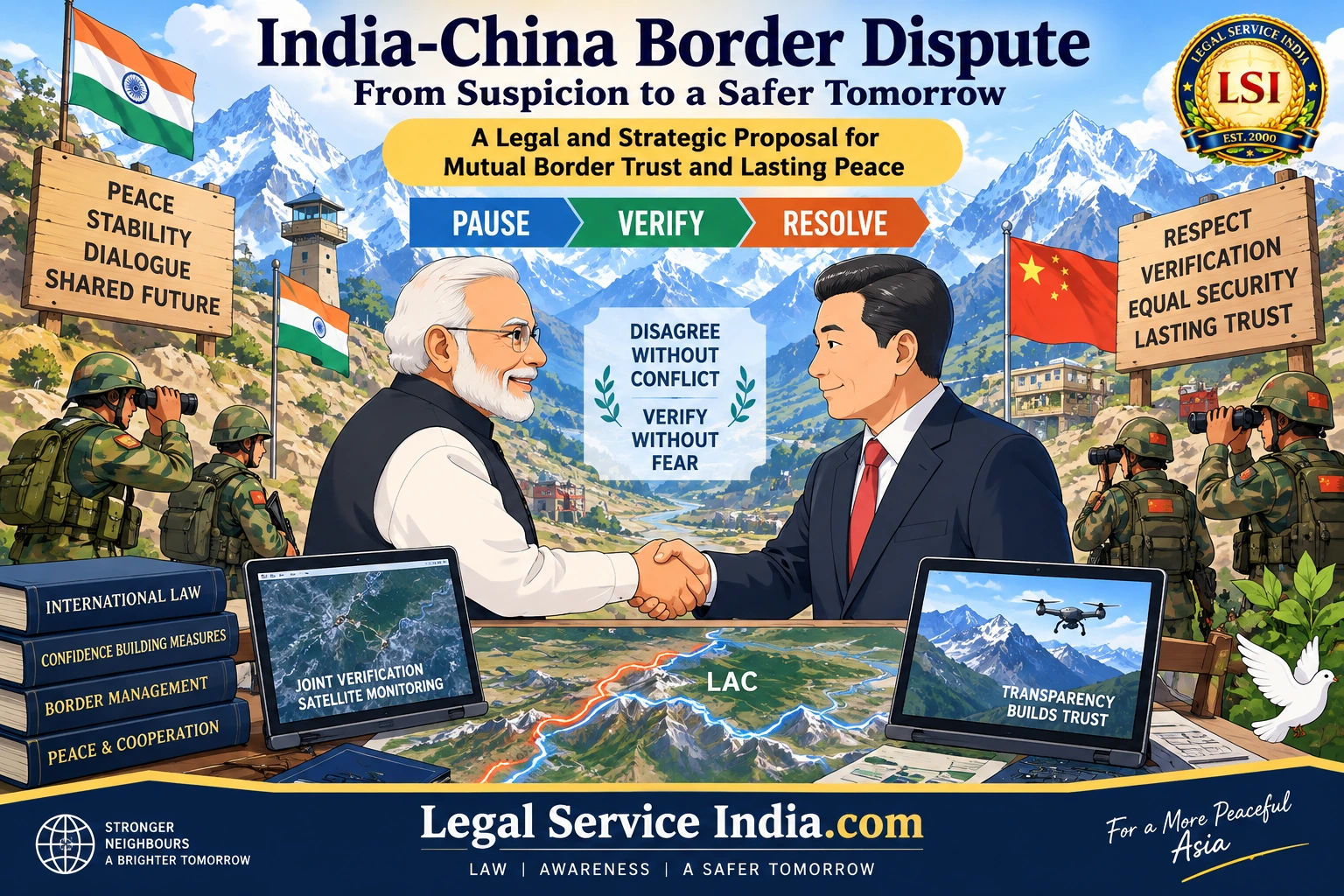
India-China Border Dispute: Can India and China Build a System Where Neither Side Ever Needs to Fear a Surprise?
A New Legal and Strategic Proposal for Permanent, Equal and Verifiable Border Trust
“Wars do not always begin with hatred; sometimes they begin with a misunderstanding that nobody stopped in time. Before nations choose to fight, they should first choose to verify.”
— By Adv. Tarun Choudhury, Supreme Court Advocate | 25+ Years of Legal Experience
There is one question that has troubled me for a long time as a lawyer watching the India-China border dispute evolve:
Can two powerful nations disagree over territory and still build a relationship in which neither side has to fear the other?
I believe the answer is yes.
But there is a condition.
India and China cannot build lasting peace merely by asking each other to trust.
They must build a system in which trust can be verified.
That distinction may appear small.
It is not.
It could be the difference between another temporary understanding and a genuinely historic transformation of the India-China border.
The Line of Actual Control has remained one of the most sensitive strategic frontiers in the world. India and China have already created a substantial framework of agreements and communication mechanisms over the years. The 1993 Agreement, for example, requires both sides to respect and observe the LAC pending a final settlement and provides mechanisms for consultation and addressing differing perceptions. The two countries have subsequently added further confidence-building and border-management arrangements.
Yet experience has taught us something important.
A treaty can tell countries what they should do. It cannot, by itself, guarantee that both countries will always agree about what actually happened on the ground.
And that is where the real problem begins.
Also Read: AI-Generated Fake Nude Images: Minnesota vs. xAI and the Future of Deepfake Law
The Real Danger May Not Be the Border Itself
When we talk about the India-China border dispute, our attention naturally goes towards territory.
- Maps.
- Mountains.
- Patrolling.
- Roads.
- Posts.
- Troops.
- Infrastructure.
But I believe there is another problem underneath all of these.
It is uncertainty.
Imagine a patrol encounters another patrol.
One side says:
“We did not cross the LAC.”
The other side says:
“You crossed it.”
Imagine a new road appears near a sensitive area.
One side says:
“It is ordinary infrastructure.”
The other says:
“It changes the security situation.”
Imagine troops move in an area.
One side calls it routine.
The other sees preparation for escalation.
Who is immediately right?
And more importantly:
Who decides what actually happened?
If the answer is that each government independently decides, the dispute can become almost impossible to contain.
The factual disagreement becomes a political disagreement.
The political disagreement becomes a national-security issue.
The national-security issue becomes a military confrontation.
And once soldiers face each other, the space for calm legal reasoning becomes dangerously small.
This is why I believe that the next generation of India-China border agreements should concentrate on something that has not received enough attention:
A Permanent System for Establishing Facts.
India and China Do Not Have to Agree on Everything
This is perhaps the most important starting point of my proposal.
India should not be required to abandon its territorial position.
China should not be required to abandon its territorial position.
India should not be asked to accept China’s maps.
China should not be asked to accept India’s maps.
Neither country should be required to concede sovereignty merely to create a mechanism for peace.
That would make the proposal politically impossible before it even began.
Instead, I propose something much more practical.
India and China should agree:
We may disagree about sovereignty, but we should not allow our disagreement about sovereignty to prevent us from establishing what happened physically on the ground.
That is the foundation of what I call the:
India-China Mutual Border Trust Compact
It is not designed to give India an advantage over China.
It is not designed to give China an advantage over India.
It is designed around one principle:
Everything that protects India must equally protect China. Everything that constrains China must equally constrain India.
This is a framework between equals.
The Question I Would Put Before Both Governments
If I were sitting across the negotiating table from representatives of both countries, I would not begin by asking:
“Who is right about the entire boundary?”
That question may take years, perhaps decades, to resolve.
I would ask something much simpler:
“Can we agree that neither country should be surprised by a significant development along the border?”
If the answer is yes, we have the beginning of a solution.
Because preventing surprise does not require either country to surrender sovereignty.
It requires transparency.
And transparency can be reciprocal.
My Proposal: From Border Suspicion to Border Trust
I propose that India and China establish permanent Border Trust Zones in carefully identified sensitive areas.
These would not be sovereignty zones.
They would not determine who owns the territory.
They would simply identify areas where unusual military, infrastructure or other activity could create a serious risk of confrontation.
Inside these zones, a new rule would apply:
No significant physical change should occur without notification or immediate reporting under an emergency procedure.
There is an important difference here.
Notification would not mean permission.
India would not need China’s permission to build legitimate infrastructure on its side.
China would not need India’s permission to undertake legitimate activities on its side.
But both countries would have a right to know about defined activities that could materially affect border stability.
This is transparency without surrendering sovereignty.
Also Read: Can America Reform the Supreme Court? Latest 5–4 Ruling Reignites Term Limits Debate
The First Thing We Need: A Common Starting Point
Here is where I would introduce one of the most important features of the proposal.
India and China should jointly create a:
Joint Border Status Quo Record
Think of it as a legally authenticated photograph of the border situation at an agreed starting date.
It would record, sector by sector:
- existing military positions;
- established patrolling arrangements;
- recognised infrastructure;
- border meeting points;
- civilian movement arrangements;
- significant roads and bridges;
- environmentally sensitive areas;
- existing communication arrangements;
- areas where the two countries have different perceptions of the LAC.
This record would not decide sovereignty.
It would answer a different question:
What existed when both countries agreed to begin the new system?
That distinction is crucial.
Because without a baseline, every future disagreement becomes:
“You changed it.”
“No, you changed it.”
“We were already there.”
“No, you were not.”
A common factual baseline begins to break that cycle.
The Border Change Register
The next step would be a permanent:
Mutual Border Change Register
Every significant new development would be recorded.
For example:
- A major road.
- A large bridge.
- A new permanent facility.
- A substantial military deployment.
- A significant engineering project.
The Register would record:
- What happened?
- Where?
- When?
- What category of activity was it?
- Was notification required?
- Was notification given?
- Was the activity verified?
- What did both sides ultimately agree about the facts?
This creates something that the India-China border dispute has desperately needed:
Institutional memory.
Future governments should not have to reconstruct a disputed incident from competing statements made years earlier.
There should be a permanent factual record.
The 72-Hour Rule
Now comes one of the most important elements of my proposal.
Suppose a serious incident takes place.
What happens?
Today, there can be considerable scope for competing narratives, military communication and political interpretation.
I propose a predefined:
72-Hour Mutual Verification Rule
| Time | Proposed Action |
|---|---|
| Within 6 hours | Local commanders or designated authorities communicate. |
| Within 24 hours | Both sides provide their preliminary factual account. |
| Within 48 hours | The Joint Verification mechanism examines available evidence. |
| Within 72 hours | The parties attempt to establish the agreed facts, disputed facts, or facts that cannot yet be established. |
Within 72 hours, the parties attempt to establish:
- A. Agreed facts;
- B. Facts that remain disputed; or
- C. Facts that cannot yet be established.
Notice what this proposal deliberately does not say.
It does not require India to accept China’s interpretation.
It does not require China to accept India’s interpretation.
It does something more modest.
It asks:
Can we first agree on what the evidence shows?
Facts First. Legal Conclusions Later.
As a lawyer, I consider this distinction fundamental.
Suppose both sides agree that:
- A patrol was present;
- a structure was constructed;
- a vehicle crossed a particular location;
- an engineering activity occurred at a particular time.
But they disagree about whether that conduct violated the LAC.
Fine.
Record the facts.
Then take the legal disagreement to the appropriate diplomatic or boundary mechanism.
We should not allow a disagreement over legal interpretation to contaminate the underlying factual record.
This is the principle I would call:
“Facts Before Conclusions.”
It could transform the way future India-China border conflicts are handled.
The Two-Key Principle
I would go one step further.
For significant incidents, neither country should become the sole judge of its own evidence.
I propose a:
Two-Key Evidence Principle
Significant factual findings should, wherever practicable, be authenticated through:
- one Indian verification component
- and
- one Chinese verification component.
Where physical access is impossible, mutually agreed technical evidence could be used.
This might include:
- authenticated photographs;
- satellite-derived information;
- geospatial records;
- timestamped imagery;
- technical measurements;
- other mutually accepted evidence.
Important Safeguard: Protecting Sensitive Intelligence
But there must be an important safeguard.
This system must never become a back door for intelligence collection.
India should not have to reveal sensitive intelligence.
China should not have to reveal sensitive intelligence.
Only information necessary to determine the particular disputed fact should be disclosed.
The India-China Border Evidence Vault
I propose something even more ambitious.
The two countries should establish a secure:
India-China Border Evidence Vault
There would be mirrored repositories maintained in India and China.
The factual records would carry secure authentication so that neither side could quietly rewrite the historical record.
Why Is This Important?
Because ten years from now, a new government should be able to ask:
“What happened in that incident?”
And the answer should not depend entirely upon which country’s archives are being consulted.
There should be an authenticated bilateral record.
The purpose is not to create a weapon against either country.
It is to create a common factual memory.
What If India and China Still Disagree?
They will.
Any realistic proposal must accept that.
Therefore, I propose the following:
Permanent Disagreement Register
If the countries cannot agree, the disagreement should be formally recorded.
It should state:
- what India says;
- what China says;
- what evidence exists;
- What facts are agreed
- what facts remain disputed;
- what legal issue remains unresolved;
- Which mechanism will address it.
This is far healthier than pretending that every disagreement has been solved.
Sometimes the most honest form of peace is:
“We still disagree, but we know exactly what we disagree about.”
The Most Dangerous Word in a Border Crisis: “Intent”
Another problem is the rapid assumption of intent.
One side sees movement and concludes:
“They intend to attack.”
The other side sees defensive preparation and reaches the opposite conclusion.
Intent is extremely difficult to establish in real time.
Therefore, I propose another principle:
No Automatic Attribution
Neither side should rush to publicly attribute hostile intent to the other side before the appropriate verification process has been activated, except where immediate security requirements make urgent communication necessary.
This does not prevent either country from defending itself.
It does not prevent either country from warning its citizens.
It simply creates a pause between:
“Something happened.”
and
“The other country deliberately did it.”
That pause can save lives.
Pause. Verify. Resolve.
I would make this the operational motto of the Compact:
PAUSE → VERIFY → RESOLVE
When a serious incident occurs:
- PAUSE
Avoid actions that unnecessarily worsen the situation. - VERIFY
Establish what happened. - RESOLVE
Use the appropriate military, diplomatic or political mechanism.
This is not weakness.
It is disciplined statecraft.
A powerful country does not lose strength because it verifies before escalating.
On the contrary:
The ability to control escalation is itself a form of national strength.
Infrastructure: The Issue We Cannot Ignore
The modern India-China border dispute is not only about soldiers.
It is also about infrastructure.
- Roads.
- Bridges.
- Airfields.
- Habitations.
- Communications.
- Logistics.
Infrastructure can improve civilian life.
It can also change the military balance.
Therefore, I would not propose banning border infrastructure.
That would be unrealistic.
India has legitimate reasons to develop its border areas.
China has legitimate development and security interests in its frontier regions.
Instead, I propose:
Reciprocal Infrastructure Transparency
Major projects falling within agreed sensitive categories should be notified.
The notification need not reveal classified military details.
It could simply communicate:
- general location;
- general nature of the project;
- approximate commencement;
- broad completion timetable;
- civilian or other general classification where appropriate.
Again:
Notification does not equal permission.
It means:
“We know what the other side is doing.”
That alone can dramatically reduce miscalculation.
Development Is Not Sovereignty
This distinction should also be made clear.
A road does not automatically establish sovereignty.
A village does not automatically establish sovereignty.
A bridge does not automatically establish sovereignty.
Infrastructure may have security consequences, but infrastructure itself should not automatically become a legal determination of territorial title.
This allows both countries to pursue legitimate development while keeping sovereignty questions within the proper diplomatic and legal framework.
A Border Peace Dividend
Here I propose something that I believe could make the Compact genuinely attractive to both countries.
Peace should not be merely the absence of confrontation.
Peace should produce benefits.
I call this the:
Mutual Security Dividend
If India and China demonstrate sustained compliance, both sides should progressively receive reciprocal benefits.
For example:
Stage One
- More frequent military communication and hotline testing.
Stage Two
- Expanded civilian liaison.
Stage Three
- Greater regulated border trade and pilgrimage cooperation.
Stage Four
- Joint environmental and disaster-management programmes.
Stage Five
- Broader confidence-building measures.
The exact benefits would be negotiated.
But the principle is powerful:
When both countries behave predictably, both countries gain.
This changes the psychology of the border.
Instead of peace being seen as something that merely prevents loss, peace begins to create positive value.
What Happens When There Is a Violation?
There must be consequences.
But they should not automatically be punitive.
The objective should be to restore stability.
The response could progress through:
- clarification;
- corrective action;
- sector-level consultation;
- senior military consultation;
- diplomatic intervention;
- temporary suspension of a specific confidence-building benefit;
- negotiated remedial measures.
The Response Must Be:
- Proportionate
- Reciprocal
- Reviewable
- Directed Toward De-Escalation
An Emergency Safe Harbour for Honest Reporting
There is another issue that rarely receives enough attention.
Imagine a local commander accidentally crosses a line.
If reporting the mistake immediately will create political embarrassment, the commander may hesitate.
That hesitation could be dangerous.
Therefore, the Compact should contain the following:
Emergency Safe Harbour Principle
Where an incident is:
- accidental;
- promptly reported;
- followed by cooperation;
- not accompanied by escalation;
The act of reporting should not automatically be treated as proof of hostile intent.
This creates an incentive for honesty.
And in border management, early honesty can be more valuable than late diplomacy.
India and China Should Trust the System Before They Trust Each Other
This is perhaps the central idea behind my proposal.
It is unrealistic to expect two major powers with competing territorial claims to suddenly develop complete mutual trust.
But we can ask them to build trustworthy institutions.
Consider the difference.
The first approach says:
“Trust us.”
The second says:
“You do not have to trust our word alone. Here is the verification mechanism.”
The second approach is far stronger.
It is also more realistic.
My proposal therefore does not depend upon an assumption that India and China will suddenly stop distrusting each other.
It accepts the existence of mistrust and builds institutions capable of managing it.
“The strongest nation is not the one that is always ready for war; it is the one wise enough to prevent a misunderstanding from becoming one.”
— By Adv. Tarun Choudhury, Supreme Court Advocate
The India-China Border Trust Commission
The Compact should establish a permanent:
India-China Border Trust Commission
It should have equal representation.
Its responsibilities could include:
- maintaining the Joint Status Quo Record;
- maintaining the Border Change Register;
- supervising verification;
- administering the Evidence Vault;
- maintaining the Trust Ledger;
- reviewing incidents;
- coordinating civilian mechanisms;
- supervising technical panels;
- preparing an annual Border Stability Report.
It would not replace the Special Representatives mechanism.
The distinction should be clear:
| Mechanism | Primary Responsibility |
|---|---|
| Special Representatives | The larger political and boundary question |
| Border Trust Commission | Day-to-day stability, verification and confidence-building |
The Special Representatives deal with the larger political and boundary question.
The Border Trust Commission deals with day-to-day stability, verification and confidence-building.
Four Levels of Protection
The system should operate at four levels.
| Level | Function |
|---|---|
| Level One — Local | Local commanders communicate. |
| Level Two — Sectoral | Senior military authorities intervene. |
| Level Three — Institutional | Diplomatic and Border Trust Commission mechanisms activate. |
| Level Four — Political | The highest political channels become available. |
The philosophy is simple:
Solve a small problem at the smallest appropriate level—but never allow a serious problem to remain trapped at the wrong level.
What This Proposal Does Not Ask India or China to Do
This is extremely important.
The Compact Does Not Ask India to:
- abandon its territorial claims;
- recognise China’s claims;
- stop legitimate infrastructure;
- weaken its defence;
- surrender intelligence;
- accept China’s interpretation of the LAC.
Nor Does It Ask China to:
- abandon its territorial claims;
- recognise India’s interpretation;
- surrender legitimate security interests;
- stop legitimate development;
- weaken its defence.
Neither side is asked to surrender sovereignty.
Neither side is asked to accept defeat.
Neither side is asked to pretend that the boundary question has disappeared.
Instead, both are asked to do something much more practical:
Make the border predictable.
The Final Boundary Question Must Remain Separate
There is no reason why India and China cannot pursue two tracks simultaneously.
| Track | Objective |
|---|---|
| Track One | Keep the border peaceful and predictable. |
| Track Two | Continue negotiating the final boundary settlement. |
Track One should not prejudice Track Two.
This is legally and politically important.
The final boundary question may be enormously complicated.
Border stability cannot wait for its complete solution.
What About International Law?
International law must remain at the heart of the proposal.
The United Nations Charter’s prohibition on the threat or use of force, together with the principles governing peaceful settlement of disputes, provides an important background framework.
But the solution I propose is not based upon the unrealistic assumption that India can simply take the entire boundary question to an international court and obtain an immediate answer.
The jurisdiction of international courts depends upon the applicable jurisdictional basis and the consent or declarations of the states concerned.
India’s own declaration accepting the compulsory jurisdiction of the International Court of Justice contains reservations concerning, among other matters, disputes concerning the status of Indian territory, modification or delimitation of frontiers and boundary questions.
Therefore, the wiser strategy is not to build the proposal around an international adjudication that may not be available.
It is to build a bilateral system consistent with international law and existing India-China mechanisms.
That is both more realistic and more likely to be accepted.
The Most Important Test of the Proposal
I would not judge this proposal by how impressive it sounds on paper.
I would ask a much harder question:
Would it still work on the worst day of an India-China border crisis?
That is the test.
If an incident occurs at midnight, will commanders know whom to call?
If the two sides disagree, will they know how evidence will be examined?
If the public starts demanding retaliation, will there be a verification mechanism?
If infrastructure is disputed, is there a factual record?
If the countries cannot agree, can the disagreement be recorded without escalation?
If a commander makes an accidental mistake, is there an incentive to report it?
If both countries comply for five years, do they receive tangible benefits?
If the answer to these questions is yes, then we have something more valuable than another political declaration.
We have an institution.
The Ten-Year Vision
I would divide implementation into stages.
First Year
- Create the Compact.
- Establish the Border Trust Commission.
- Create the Joint Status Quo Record.
- Establish verification teams.
- Create secure communication channels.
Years Two and Three
- Operationalise the Change Register.
- Begin technical verification.
- Conduct regular military communication exercises.
- Establish civilian liaison mechanisms.
Years Four and Five
- Expand infrastructure transparency.
- Increase border trade and pilgrimage cooperation.
- Develop environmental and disaster cooperation.
- Publish annual non-sensitive stability reports.
Years Six to Ten
- Expand confidence-building measures.
- Consider wider reciprocal observation mechanisms.
- Increase civilian cooperation.
- Review the functioning of the boundary negotiation process.
At ten years, India and China should ask:
Is the border safer, more predictable and less vulnerable to misunderstanding than it was ten years earlier?
If the answer is yes, the Compact will have succeeded.
My Central Argument
After examining the problem from a legal, strategic and practical perspective, I have reached a simple conclusion.
I do not believe the permanent answer to the India-China border dispute is another promise that both countries will “trust” one another.
Nor do I believe the answer lies in creating a framework that secretly gives one country an advantage over the other.
And I do not believe lasting peace can be built upon one side’s humiliation or the other’s victory.
The better answer is to build a system where:
- India is protected by the rules.
- China is protected by the same rules.
- India verifies.
- China verifies.
- India receives information.
- China receives information.
- India benefits from compliance.
- China benefits from compliance.
- India faces consequences for a verified violation.
- China faces the same consequences for the same kind of violation.
That is equality.
That is reciprocity.
And that is the foundation of durable trust.
The Idea I Would Put Before India and China
If I had the opportunity to place one proposal before the governments of India and China, it would be this:
Do not ask each other to trust blindly. Build a system in which neither country needs to.
Let India remain India.
Let China remain China.
Let their historical and territorial positions remain intact.
Let the final boundary negotiations continue.
But let the border itself become increasingly predictable.
Let commanders communicate before they confront.
Let evidence be examined before accusations are made.
Let significant physical changes be notified.
Let disagreements be recorded rather than exaggerated.
Let honest mistakes be corrected rather than weaponised.
Let sustained peace create benefits for both countries.
And above all:
Never allow an uncertain fact to become an unnecessary war.
The Bigger Vision
Perhaps the greatest achievement would come many years from now.
Imagine an Indian commander receiving a report of an unusual border incident.
Instead of immediately asking:
“What is China planning?”
The first question becomes:
“Activate the verification mechanism. What do the facts show?”
Imagine the Chinese commander receiving the same report and asking the same question.
That would represent a profound change.
The border would no longer depend entirely upon personal trust between individual commanders or the political mood of the day.
It would have an institutional nervous system.
That is what mature international relations should ultimately seek.
Not the impossible elimination of disagreement.
But the creation of mechanisms strong enough to prevent disagreement from becoming catastrophe.
My Final Proposal
I call this vision the:
India–China Mutual Border Trust Compact
Its guiding formula is deliberately simple:
| Guiding Principle |
|---|
| Equal Security |
| Joint Verification |
| Reciprocal Restraint |
| Shared Facts |
| Shared Benefits |
| Shared Responsibility |
The ultimate objective is not to make India stronger against China.
Nor is it to make China secure at India’s expense.
The objective is to create something stronger than either country’s suspicion:
A trustworthy system between two sovereign equals.
India and China may continue to disagree about history.
They may continue to disagree about sovereignty.
They may continue to negotiate the final boundary.
But they should no longer have to disagree about how an incident will be verified, how communication will occur, how escalation will be controlled, and how peace will be protected.
That is where genuine strategic trust can begin.
And perhaps, one day, the greatest achievement will be that future generations of Indians and Chinese will inherit a border where the first instinct is no longer suspicion.
It is verification.
The first response is no longer confrontation.
It is communication.
The first objective is no longer victory.
It is stability.
And the ultimate measure of national strength is not how effectively a country prepares for war.
It is how intelligently it prevents an unnecessary war from ever beginning.
A Final Thought from a Lawyer
In law, we do not resolve serious disputes merely by asking two parties to trust each other’s statements.
We create procedures.
We preserve evidence.
We hear both sides.
We verify facts.
We provide remedies.
And we create institutions capable of functioning even when the parties disagree.
Why should the management of one of the world’s most sensitive borders be fundamentally different?
Perhaps the next great India-China agreement should not begin with the question:
“Who is right?”
Perhaps it should begin with a more important question:
“How can we make sure that whatever happens next is verified, communicated and controlled before it has the power to become a conflict?”
That, in my view, is the beginning of a genuinely lasting solution to the India-China border dispute.
“Never let an uncertain fact become a certain war.”
— By Adv. Tarun Choudhury, Supreme Court Advocate
Need Expert Legal and Strategic Guidance on a Complex International Law Issue?
When a legal issue involves territorial disputes, international law, cross-border conflicts, national security or India-China relations, the difference between a general opinion and professionally informed legal analysis can be significant.
If you are looking for legal consultation, strategic legal guidance, international law analysis or an independent legal opinion, you can discuss your matter directly with:
Adv. Tarun Choudhury
Supreme Court Advocate | 25+ Years of Legal Experience
📞 Call: 9891244487
💬 WhatsApp: 9891244487
Have a complex legal or international-law question? Don’t leave it to assumptions. Get it professionally examined.
Call or WhatsApp today for a consultation.
Frequently Asked Questions
Here are 5 SEO-rich FAQs designed around the article’s primary keyword “India-China border dispute” and related search terms such as LAC, India-China border conflict, border peace, international law, and mutual verification:
1. What Is the Proposed Solution to the India-China Border Dispute?
The article proposes an India-China Mutual Border Trust Compact based on equal security, reciprocal obligations, joint verification, transparent communication, infrastructure notification and automatic de-escalation. The objective is to make the LAC more predictable without prejudicing either country’s territorial claims.
2. How Can India and China Build Permanent Trust Along the Line of Actual Control (LAC)?
India and China can build lasting border trust through joint verification, shared factual records, military hotlines, advance notification of significant activities, incident-reporting procedures and reciprocal confidence-building measures. The proposal argues that institutionalised verification is more reliable than relying solely on political assurances.
3. Does the Proposed India-China Border Agreement Require Either Country to Surrender Its Territorial Claims?
No. The proposed framework expressly follows a “no-prejudice” principle. India and China would retain their respective territorial and legal positions while cooperating on border management, incident verification and de-escalation.
4. How Would the India-China Mutual Border Trust Compact Prevent Border Conflicts from Escalating?
The proposed “Pause–Verify–Resolve” mechanism would require communication and factual verification before an incident unnecessarily escalates. A 72-hour verification procedure, joint evidence assessment and multiple levels of military and diplomatic communication could help prevent misunderstandings from developing into an India-China border conflict.
5. Can Joint Verification Solve the India-China LAC Dispute Permanently?
Joint verification alone cannot settle the underlying territorial dispute. However, it can create a permanent system for establishing facts, managing incidents and preventing escalation while India and China continue negotiations over the final boundary settlement. The proposal’s long-term goal is to replace uncertainty and suspicion with verified strategic trust along the LAC.
Key Takeaways: India-China Border Dispute
- The India-China border dispute needs more than periodic diplomatic agreements; it requires a permanent, verifiable system for preventing misunderstandings and military escalation.
- The proposed India-China Mutual Border Trust Compact is based on equal security, reciprocal obligations, joint verification, transparency and mutual restraint.
- The proposal does not require India or China to surrender territorial claims or prejudge the final settlement of the boundary dispute.
- A Joint Border Status Quo Record could establish a mutually authenticated factual baseline of existing military positions, infrastructure, patrolling arrangements and other relevant border conditions.
- A Mutual Border Change Register would record significant new military, infrastructure and physical developments, helping prevent disputes over whether the status quo has changed.
- The proposed 72-Hour Mutual Verification Rule would give India and China a structured process to communicate, examine evidence and establish agreed or disputed facts after a serious border incident.
- The Two-Key Evidence Principle would ensure that significant factual findings are not based solely on one country’s evidence, strengthening credibility and mutual confidence.
- A secure India-China Border Evidence Vault could preserve authenticated records of significant incidents and create a common factual history for future governments.
- The proposed “Pause–Verify–Resolve” mechanism would encourage both countries to prevent an uncertain border incident from immediately escalating into a military confrontation.
- The framework introduces a no automatic attribution principle, discouraging premature accusations of hostile intent before facts have been properly examined.
- Reciprocal infrastructure transparency would allow India and China to notify each other about significant border developments without giving either country a veto over legitimate infrastructure projects.
- The proposed Mutual Security Dividend would reward sustained compliance through greater border communication, civilian cooperation, regulated trade, pilgrimage and other confidence-building measures.
- A permanent India-China Border Trust Commission could supervise verification, incident management, factual records, confidence-building measures and implementation of the proposed framework.
- The proposal separates border management from final boundary settlement, allowing India and China to maintain their respective sovereignty positions while simultaneously working to preserve peace along the LAC.
- The central philosophy is that India and China should not be asked to trust each other blindly; they should build a system in which trust can be verified.
Core Insight
The proposed solution to the India-China border dispute is not to force either country to compromise its territorial claims but to create an equal and reciprocal system of joint verification, transparent communication, infrastructure notification, evidence preservation and automatic de-escalation along the Line of Actual Control.
Summary
The lasting solution to the India-China border dispute may not begin with deciding who is right—it may begin by creating a system that ensures both countries know what actually happened before deciding what to do about it.
Important Disclaimer
This article represents an independent legal and policy proposal for public discussion. It does not purport to represent the official position of the Government of India or the Government of the People’s Republic of China.