





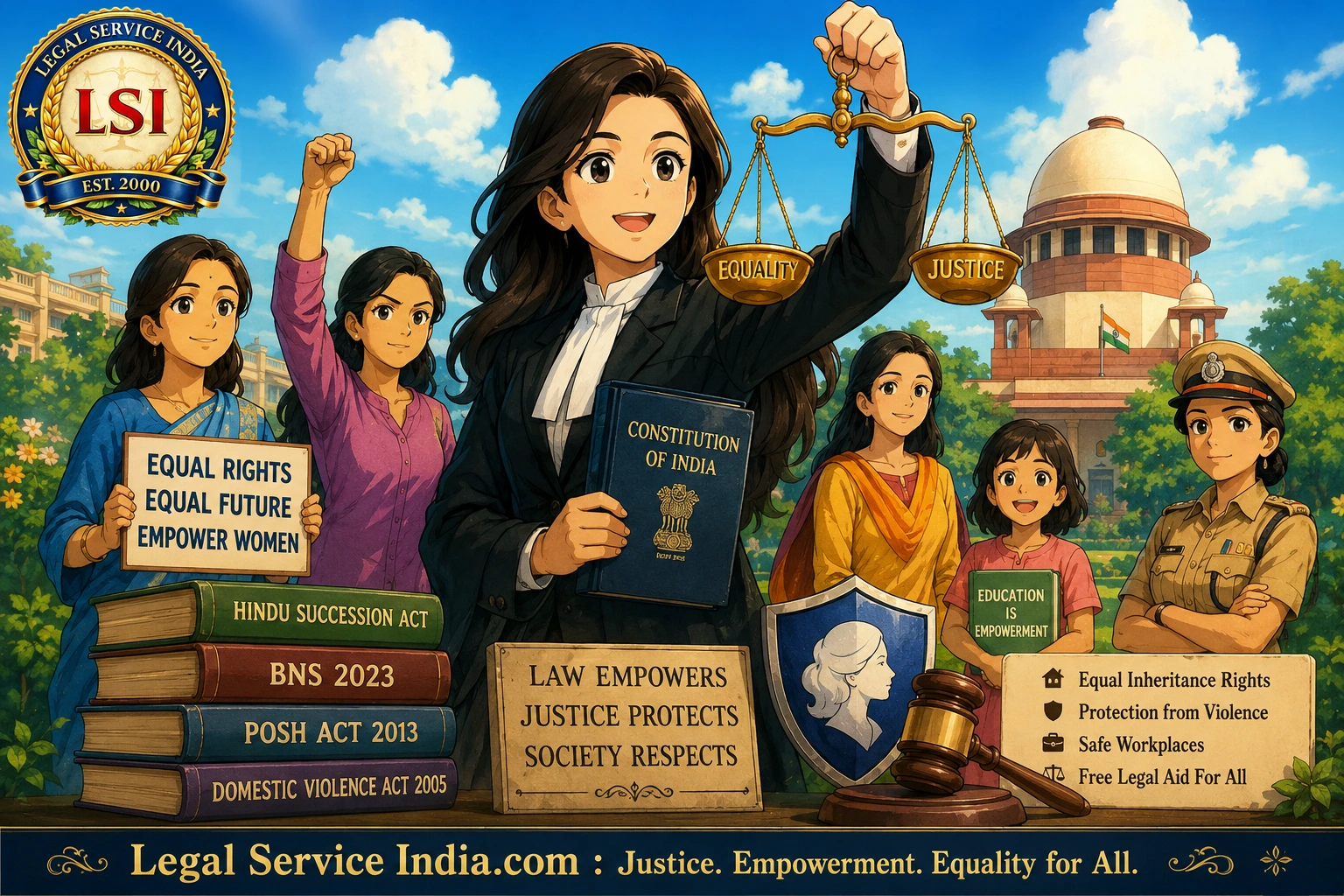
From Marginalisation to Mandate: Evolution of Gender Justice in Indian Law and Women’s Rights
The journey toward gender equality in India has been long, challenging, and difficult. For generations, women were systematically denied the same legal protections and rights given to men. This gender-based marginalisation was deeply rooted in the social and legal fabric, especially seen in inheritance and property rights.
Under the traditional Hindu coparcenary system, women were historically denied birthrights in ancestral property. This patriarchal structure treated daughters as temporary members of their families, often viewed as financial burdens, while sons were seen as the sole permanent coparceners. This system not only kept women financially dependent but also led to their devaluation.
However, this inequitable structure has changed significantly. Driven by constitutional mandates, specifically Article 14 (Equality Before Law) and Article 15 (Prohibition of Discrimination), and supported by progressive laws like the Hindu Succession Act, 1956, the Hindu Adoptions and Maintenance Act, 1956, and recent criminal reforms, the legal landscape has shifted dramatically. Today, Indian jurisprudence actively works to break down patriarchal control in inheritance, criminal law, socio-economic matters, and constitutional rights.
Key Highlights of Gender Justice in India
- Equal inheritance rights for daughters under the Hindu Succession (Amendment) Act, 2005.
- Recognition of daughters as coparceners by birth.
- Enhanced criminal law protections under the Bharatiya Nyaya Samhita (BNS), 2023.
- Workplace safety through the POSH Act, 2013.
- Comprehensive protection against domestic violence.
- Free legal aid available to every woman under Indian law.
I. The Inheritance Sphere: Absolute Coparcenary and Economic Autonomy
The economic disenfranchisement of women under classical personal laws was a major obstacle to true equality. While the original Hindu Succession Act, 1956, was a significant step forward, it preserved the discriminatory joint family coparcenary structure. The real change came with the Hindu Succession (Amendment) Act, 2005, which completely reformed Section 6 of the Act.
Equal Coparcenary Rights
Under the amended Section 6, a daughter of a coparcener is recognised from birth as a coparcener in her own right, holding the same rights and obligations as a son.
The Vineeta Sharma Clarification
Any remaining confusion about retrospective application was settled by the Supreme Court in the landmark case of Vineeta Sharma v. Rakesh Sharma (2020). The court ruled that a daughter’s right to coparcenary is absolute and arises at birth; it does not depend on whether her father was alive or deceased at the time of the 2005 amendment.
Dismantling Financial Dependency
By ensuring unconditional property rights, the modern HSA serves as a powerful tool for economic self-sufficiency, directly challenging centuries of systemic marginalisation and domestic vulnerability.
| Legal Reform | Impact on Women |
|---|---|
| Hindu Succession (Amendment) Act, 2005 | Equal coparcenary rights from birth |
| Section 6 | Daughters receive the same rights and liabilities as sons. |
| Vineeta Sharma v. Rakesh Sharma (2020) | Clarified that rights arise by birth irrespective of the father’s status |
II. The Criminal Sphere: Enhanced Protections Under Modern Jurisprudence
The criminal justice system has undergone a significant change with the introduction of the Bharatiya Nyaya Samhita (BNS), 2023. Moving away from colonial-era classifications, the BNS prioritises offences against women and children, placing them at the forefront in a dedicated Chapter V.
Deceitful Sexual Exploitation (Section 69)
The BNS explicitly makes sexual intercourse obtained through deceitful means or false promises of marriage, employment, or promotion, while hiding one’s identity, a crime. This closes a long-standing gap in consent law.
Stalking and Voyeurism
The law takes a strict, zero-tolerance approach to both physical and cyber-stalking. Intrusive acts like voyeurism are treated as serious violations of personal privacy, updating the law for the digital age.
Victim-Centric Safeguards
The updated procedural framework requires recording a victim’s statement using audio-video means. It also mandates immediate, free first-aid or medical treatment for victims at all public and private medical facilities.
| Provision | Protection Offered |
|---|---|
| Section 69, BNS | Criminalises deceitful sexual exploitation |
| Anti-Stalking Laws | Protection from physical and cyber stalking |
| Voyeurism Provisions | Safeguards privacy and dignity |
| Victim-Centric Procedures | Audio-video statements and free medical treatment |
III. The Socio-Economic Sphere: Dignity at the Workplace and Home
True equality cannot exist without safety and dignity in both work and home environments.
Workplace Equality & Safety (The POSH Act, 2013)
The Sexual Harassment of Women at Workplace (Prevention, Prohibition and Redressal) Act, 2013, establishes the principles from the landmark Vishaka judgement. It makes a safe working environment a fundamental right under Article 21 of the Constitution. By requiring Internal Committees (IC) in workplaces with ten or more employees, it enforces corporate accountability and protects women’s participation in the workforce.
The Domestic Sphere
The Protection of Women from Domestic Violence Act, 2005, provides a strong civil-remedy framework. It goes beyond physical abuse to recognise emotional, verbal, sexual, and economic abuse, ensuring vital residence orders, protection orders, and monetary relief for victims.
| Law | Primary Objective |
|---|---|
| POSH Act, 2013 | Safe and dignified workplace for women |
| Domestic Violence Act, 2005 | Protection against physical, emotional, verbal, sexual, and economic abuse |
Free Legal Aid and Access to Justice
A legal right is useless if the marginalised cannot afford to use it. For a woman facing domestic violence, workplace discrimination, or a property dispute, the financial and systemic barriers to legal action can be overwhelming.
Here, the constitutional mandate of Article 39A (Equal Justice and Free Legal Aid) connects with Section 12(c) of the Legal Services Authorities Act, 1987. Under Indian law, every woman is entitled to free, government-funded legal aid, regardless of her financial status.
To bridge the gap between legal rights and reality, the National Legal Services Authority (NALSA) and State Legal Services Authorities (SALSAs) must implement a proactive, three-part strategy:
1. Grassroots Legal Literacy
Conduct targeted awareness campaigns in rural and semi-urban areas to educate women about their rights under the BNS and the Hindu Succession Act.
2. Interdisciplinary Support Hubs
Transform legal aid desks into comprehensive support centres that provide legal representation alongside mental health counselling, medical aid, and access to government-run shelters.
3. Strategic Litigation Support
Ensure that legal aid clinics assign skilled, experienced lawyers—not just token representation—for complicated civil cases like property disputes or POSH appeals, levelling the playing field.
- Improve awareness through legal literacy campaigns.
- Strengthen integrated support services.
- Ensure experienced legal representation.
- Expand access to justice across rural and urban India.
Conclusion: The Future of Gender Justice in India
The evolution of Indian gender-equality laws marks a shift from a deeply patriarchal, colonial-era system to a progressive, rights-based framework. By securing equal coparcenary rights in ancestral property, restructuring criminal laws to prioritise safety, protecting workplace dignity, and guaranteeing free legal aid, the state has created a strong legal defence for women.
Yet, the journey is far from over. Having progressive laws on paper does not guarantee safety or equality in practice. True gender justice will only come when legal mandates are matched by a deep cultural change. Laws can drive change, but society must dismantle the biases that continue to allow domestic violence, workplace discrimination, and the subtle exclusion of daughters. Ultimately, the success of India’s gender laws hinges on their implementation, ensuring that every woman, from urban offices to rural homes, can access, understand, and assert her rights with confidence and dignity.
Key Takeaways: From Marginalisation to Mandate – The Evolution of Gender Justice in Indian Jurisprudence
The following key takeaways summarise how India’s legal framework has evolved to strengthen women’s rights, gender equality, constitutional protections, inheritance rights, workplace dignity, criminal law safeguards, and access to justice.
- India’s gender justice journey reflects a constitutional commitment to equality, transforming women from marginalised members of society into equal rights-holders under the law.
- The Hindu Succession (Amendment) Act, 2005, revolutionised inheritance rights by granting daughters equal coparcenary rights in ancestral property from birth.
- The Supreme Court’s landmark judgement in Vineeta Sharma v. Rakesh Sharma (2020) firmly established that a daughter’s coparcenary rights are absolute and do not depend on whether her father was alive when the 2005 amendment came into force.
- Economic empowerment through equal property rights is a cornerstone of gender justice, helping women achieve financial independence and reducing long-standing systemic discrimination.
- The Bharatiya Nyaya Samhita (BNS), 2023, introduces stronger protections for women, criminalising deceitful sexual relationships based on false promises and strengthening laws against stalking, cyberstalking, and voyeurism.
- Modern criminal justice reforms prioritise victims’ rights by mandating audio- and video- recording of statements and ensuring immediate, free medical treatment for survivors.
- The POSH Act, 2013, transformed workplace safety by making employers legally responsible for preventing and addressing sexual harassment through mandatory internal committees.
- The Protection of Women from Domestic Violence Act, 2005, recognises multiple forms of abuse, including physical, emotional, verbal, sexual, and economic violence, providing comprehensive civil remedies.
- Article 39A of the Constitution and the Legal Services Authorities Act, 1987, guarantee free legal aid to every woman, irrespective of her income, making justice more accessible.
- NALSA and State Legal Services Authorities play a crucial role in bridging the gap between legal rights and practical access to justice through legal awareness, integrated support services, and quality legal representation.
- India’s legal framework has evolved from a patriarchal, colonial legacy into a rights-based legal system, reflecting constitutional values of equality, dignity, and justice.
- The success of gender justice depends not only on progressive legislation but also on effective implementation, legal awareness, and societal transformation.
- True gender equality requires dismantling deep-rooted social biases, ensuring that every woman—whether in urban cities or rural villages—can confidently exercise her constitutional and legal rights.
- The future of women’s empowerment in India lies in combining strong legal protections with cultural change, making equality a lived reality rather than merely a constitutional promise.
Quick Reference: Major Gender Justice Reforms
| Legal Reform | Key Contribution |
|---|---|
| Hindu Succession (Amendment) Act, 2005 | Equal coparcenary rights for daughters |
| Vineeta Sharma v. Rakesh Sharma (2020) | Confirmed daughters’ birthright in ancestral property |
| Bharatiya Nyaya Samhita (BNS), 2023 | Enhanced criminal law protection for women |
| POSH Act, 2013 | Ensures safer workplaces through mandatory internal committees |
| Protection of Women from Domestic Violence Act, 2005 | Protects women from physical, emotional, verbal, sexual, and economic abuse |
| Article 39A & Legal Services Authorities Act, 1987 | Guarantees free legal aid for every woman |
Summary
This article examines the evolution of gender justice in India, highlighting landmark legal reforms such as the Hindu Succession (Amendment) Act, 2005, Vineeta Sharma v. Rakesh Sharma (2020), the Bharatiya Nyaya Samhita (BNS), 2023, the POSH Act, 2013, the Domestic Violence Act, 2005, and Article 39A on free legal aid.
It explains how constitutional principles, judicial interpretation, and modern legislation have strengthened women’s rights, inheritance equality, workplace safety, criminal law protections, and access to justice while emphasising that meaningful gender equality ultimately depends on effective implementation and social change.

