





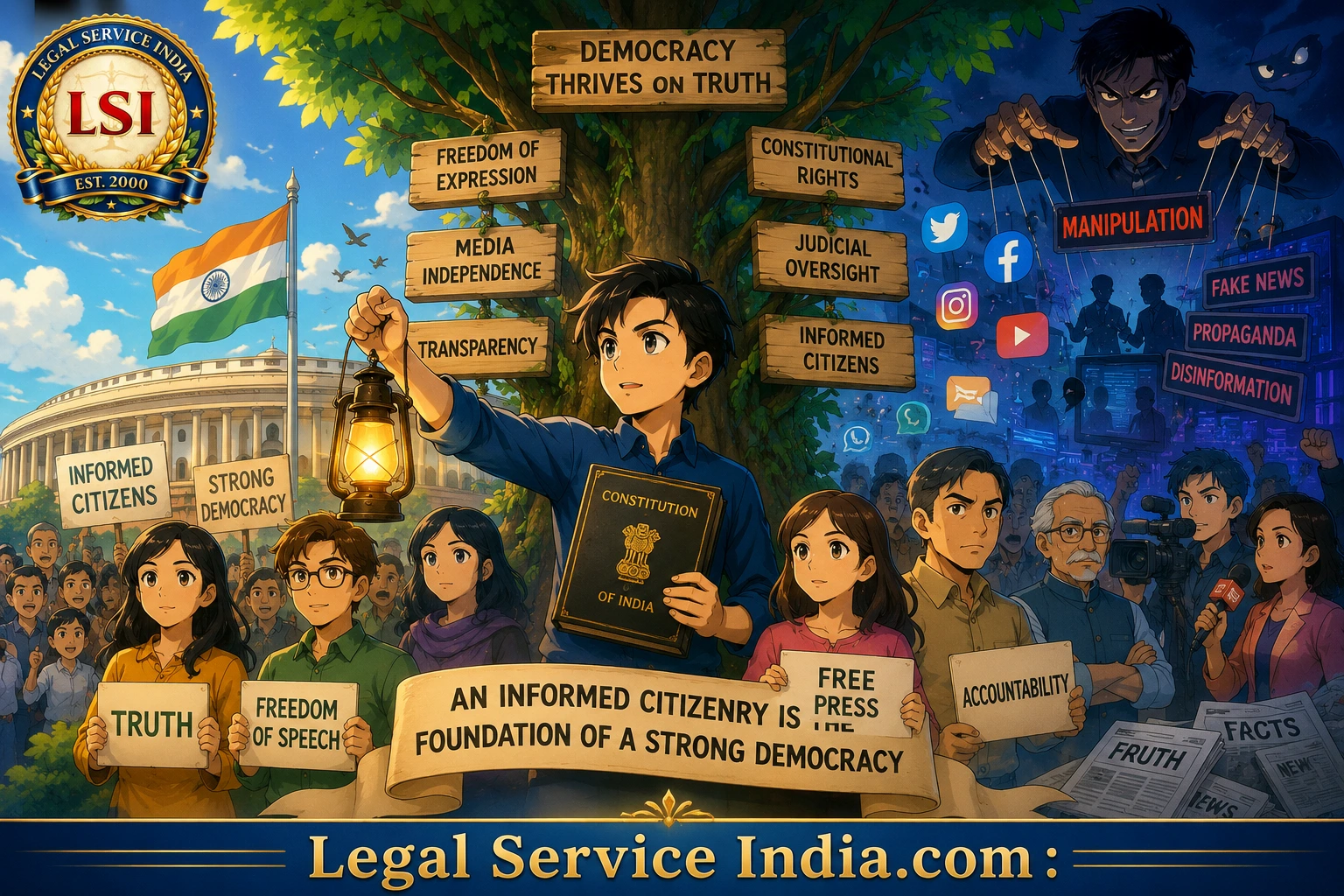
Government-Controlled Narratives: A Tool of Governance or a Threat to Democracy?
Introduction
Information has long been recognized as one of the most formidable instruments of political power. Throughout history, governments have sought not only to govern through laws and institutions but also to shape the narratives through which citizens perceive political reality. From wartime propaganda and public health campaigns to digital communication strategies and state-sponsored media, governments have consistently attempted to influence public opinion. While every government possesses a legitimate interest in communicating policies, maintaining public confidence, and countering misinformation, a critical constitutional question arises: At what point does government communication cease to be public information and become political manipulation?
The distinction is neither merely semantic nor theoretical. In constitutional democracies, the legitimacy of governmental authority depends upon informed consent, electoral accountability, and the free exchange of competing ideas. When governments dominate or manipulate public discourse through selective information, propaganda, or misleading narratives, they risk undermining the very democratic values they are entrusted to protect. Conversely, governments confronted with national emergencies, security threats, or coordinated disinformation campaigns often argue that controlling narratives is essential to preserving social order and public confidence.
This article examines whether government-controlled narratives constitute a legitimate instrument of governance or whether they ultimately threaten constitutional democracy, analyzing historical experiences, constitutional principles, and contemporary challenges in the digital age.
Understanding Government-Controlled Narratives
A government-controlled narrative refers to the deliberate construction, dissemination, or amplification of information by state institutions with the objective of influencing public perception regarding political events, governmental performance, or national priorities. Such narratives may be communicated through official press briefings, public broadcasters, educational institutions, advertising campaigns, or, increasingly, through digital and social media platforms.
Importantly, government-controlled narratives are not inherently illegitimate. Democracies require governments to communicate effectively with citizens regarding public welfare, disaster management, vaccination campaigns, economic policies, and national security. During crises, clear and centralized communication may reduce panic, combat rumors, and facilitate coordinated public action.
However, the constitutional dilemma emerges when governments move beyond informing citizens and begin shaping public opinion through selective disclosure, exaggerated claims, suppression of inconvenient facts, or politically motivated messaging. In such circumstances, communication transforms from governance into propaganda.
Key Characteristics of Government-Controlled Narratives
- Deliberate dissemination of information by state institutions.
- Influence over public perception and opinion.
- Communication through traditional and digital media.
- Potential to inform citizens or manipulate public discourse.
The Democratic Justification for Government Narratives
Supporters of strong governmental communication argue that modern states cannot function effectively without influencing public understanding. Democratic governance depends not only upon law-making but also upon public cooperation. Governments therefore possess a legitimate responsibility to explain policies, defend decisions, and encourage civic participation.
During the COVID-19 pandemic, for example, governments worldwide launched extensive public information campaigns encouraging vaccination, social distancing, and mask usage. These campaigns arguably saved lives by promoting scientifically informed behavior and countering dangerous misinformation circulating online.
Similarly, during natural disasters, military conflicts, or financial crises, centralized governmental communication may prevent panic, maintain public confidence, and facilitate emergency response. Without an authoritative source of verified information, societies become vulnerable to rumor, conspiracy theories, and organized disinformation campaigns.
Moreover, governments frequently confront hostile foreign influence operations intended to destabilize democratic institutions. Strategic communication may therefore serve as a legitimate instrument of national security rather than political manipulation.
From this perspective, government narratives are not inherently incompatible with democracy; rather, they become indispensable when exercised transparently, proportionately, and subject to constitutional accountability.
Why Governments Communicate with Citizens
- Explaining public policies.
- Promoting public welfare initiatives.
- Managing emergencies and disasters.
- Countering misinformation.
- Safeguarding national security.
When Communication Becomes Propaganda
The constitutional concern arises when governments exploit their institutional authority to manufacture consent rather than facilitate informed democratic participation.
Propaganda differs from legitimate public communication because its primary objective is persuasion through manipulation rather than education through truthful disclosure. Governments may selectively present facts, exaggerate achievements, conceal failures, vilify political opponents, or encourage emotionally charged narratives that discourage critical inquiry.
History demonstrates the dangers of such practices. Totalitarian regimes in the twentieth century—including Nazi Germany under Adolf Hitler and the Soviet Union under Joseph Stalin—constructed elaborate propaganda systems that monopolized information, censored dissent, and cultivated personality cults. By controlling public narratives, these regimes systematically eroded democratic institutions and normalized authoritarian rule.
Although contemporary democracies generally avoid such overt censorship, subtler forms of narrative management remain possible. Governments may influence public broadcasters, pressure media organizations, deploy extensive political advertising, or strategically release information to shape electoral perceptions.
The constitutional danger lies not merely in falsehood but in the concentration of informational power. When citizens encounter only one officially sanctioned version of reality, democratic deliberation becomes increasingly illusory.
Communication vs. Propaganda
| Legitimate Public Communication | Government Propaganda |
|---|---|
| Truthful disclosure | Selective disclosure |
| Educates citizens | Manipulates public opinion |
| Encourages informed participation | Manufactures consent |
| Transparent and accountable | Politically motivated messaging |
| Supports democracy | Undermines democratic accountability |
Constitutional Perspectives
Modern constitutional democracies recognize freedom of speech and freedom of the press as essential safeguards against governmental monopolization of information.
In India, Article 19(1)(a) guarantees the freedom of speech and expression, while Article 19(2) permits only reasonable restrictions in narrowly defined circumstances such as national security, public order, and sovereignty. The Supreme Court has repeatedly emphasized that democracy depends upon an informed citizenry capable of evaluating governmental conduct without fear or coercion.
Similarly, the First Amendment to the United States Constitution protects freedom of expression by limiting governmental interference in public discourse. European constitutional systems likewise regard media pluralism and press independence as indispensable components of democratic governance.
Constitutionalism therefore does not prohibit governments from communicating with citizens. Rather, it prevents governments from becoming the exclusive arbiters of truth.
Key Constitutional Safeguards
- Freedom of speech and expression.
- Freedom of the press.
- Media pluralism.
- Judicial oversight.
- Reasonable constitutional restrictions only.
The Digital Age and the Rise of Information Warfare
The emergence of social media has fundamentally transformed the relationship between governments and public opinion.
Digital platforms enable governments to communicate directly with millions of citizens without relying upon traditional media institutions. While this enhances administrative efficiency, it also increases opportunities for narrative control through algorithmic amplification, coordinated messaging, targeted political advertising, and the strategic dissemination of emotionally persuasive content.
Artificial intelligence, deepfake technology, and automated social media accounts further complicate the distinction between authentic governmental communication and manufactured public opinion.
Simultaneously, governments increasingly justify stronger control over digital information by citing the proliferation of fake news, foreign interference, online extremism, and coordinated disinformation campaigns.
This creates a constitutional paradox. Excessive governmental regulation may suppress legitimate dissent, while insufficient regulation may permit misinformation to flourish unchecked. Democratic societies must therefore balance two competing constitutional imperatives: protecting freedom of expression while preserving the integrity of public discourse.
Major Digital Challenges
- Algorithmic amplification.
- Artificial intelligence.
- Deepfake technology.
- Targeted political advertising.
- Fake news and misinformation.
- Foreign interference.
Institutional Safeguards Against Narrative Manipulation
Constitutional democracies employ several institutional mechanisms to prevent governmental communication from degenerating into propaganda.
An independent judiciary serves as the ultimate guardian of constitutional freedoms by reviewing executive actions that threaten free expression.
A free and pluralistic press enables competing narratives to coexist, allowing citizens to evaluate governmental claims critically.
Independent election commissions, information commissions, and auditing institutions enhance transparency by ensuring that public resources are not misused for partisan political messaging.
Civil society organizations, academic institutions, investigative journalists, and fact-checking organizations likewise perform indispensable democratic functions by scrutinizing governmental assertions and exposing misinformation irrespective of its political source.
Ultimately, constitutional accountability depends not upon governmental benevolence but upon robust institutional checks and an informed citizenry.
Institutional Checks and Balances
| Institution | Primary Democratic Role |
|---|---|
| Independent Judiciary | Protects constitutional freedoms |
| Free Press | Provides competing narratives |
| Election Commissions | Ensures fair democratic processes |
| Information Commissions | Promotes transparency |
| Auditing Institutions | Prevents misuse of public resources |
| Civil Society & Fact-Checkers | Scrutinize governmental claims |
Conclusion
Government-controlled narratives occupy an inherently complex position within constitutional democracy. Governments possess both the authority and the responsibility to communicate with citizens, particularly during crises requiring coordinated collective action. Transparent public information campaigns can strengthen democratic governance, improve public welfare, and enhance institutional legitimacy.
Yet the same communicative power can become profoundly dangerous when deployed to suppress dissent, manipulate electoral behavior, monopolize public discourse, or substitute propaganda for truth. Democracy cannot flourish where governments become the exclusive authors of political reality.
The constitutional challenge, therefore, is not to eliminate governmental narratives altogether but to ensure that they remain subject to transparency, judicial oversight, media independence, and public scrutiny. Democracies derive their legitimacy not from the uniformity of opinion but from the freedom of citizens to question, debate, and disagree.
Ultimately, government-controlled narratives are neither inherently democratic nor inherently authoritarian. Their constitutional legitimacy depends upon the manner in which they are exercised. When communication informs citizens, it strengthens democracy; when it manipulates them, it threatens the very constitutional order it claims to protect. In the enduring contest between power and liberty, a democracy survives not because governments control the narrative, but because citizens remain free to challenge it.
Key Takeaways: Government-Controlled Narratives – A Tool of Governance or a Threat to Democracy?
The following key takeaways summarize the constitutional principles, democratic concerns, and modern challenges associated with government-controlled narratives. These points are designed for easy reading while preserving the original text exactly.
Constitutional and Democratic Key Takeaways
- Government-controlled narratives are not inherently unconstitutional. Governments have a legitimate responsibility to communicate public policies, emergency measures, national security concerns, and public welfare initiatives to citizens.
- The constitutional danger begins when communication becomes propaganda. Government messaging crosses constitutional boundaries when it selectively presents facts, suppresses dissent, manipulates public opinion, or prioritizes political advantage over truthful disclosure.
- Democracy depends upon an informed citizenry, not an informed-by-government citizenry. Constitutional democracies thrive when citizens have access to diverse, independent, and competing sources of information.
- Freedom of speech and a free press remain the strongest safeguards against narrative monopolies. Constitutional protections such as Article 19(1)(a) of the Indian Constitution and the First Amendment in the United States prevent governments from becoming the exclusive arbiters of truth.
- History demonstrates the dangers of state-controlled propaganda. Totalitarian regimes have repeatedly used information monopolies to suppress dissent, manufacture public consent, and dismantle democratic institutions.
- Digital technology has fundamentally transformed government communication. Social media, artificial intelligence, deepfakes, algorithmic amplification, and targeted political advertising have significantly expanded governments’ ability to shape public narratives.
- Modern democracies face a constitutional balancing act. Governments must combat misinformation, foreign interference, and fake news without undermining freedom of expression or legitimate political dissent.
- Institutional independence is essential for constitutional accountability. Independent courts, election commissions, information commissions, investigative journalism, civil society organizations, and fact-checking institutions help ensure transparency and prevent abuse of state communication.
- Transparency distinguishes democratic communication from political manipulation. Honest, evidence-based public information strengthens public trust, whereas selective disclosure and misleading messaging weaken democratic legitimacy.
- Government narratives should always remain subject to judicial review, media scrutiny, and public accountability. Constitutional democracy requires continuous oversight of executive communication.
- The concentration of informational power poses a greater threat than isolated misinformation. When governments dominate public discourse and suppress alternative viewpoints, democratic deliberation becomes increasingly illusory.
- Democracy is strengthened through open debate rather than uniform agreement. The constitutional legitimacy of government communication ultimately depends on whether it informs citizens or manipulates them.
Quick Summary Table
| Topic | Key Principle |
|---|---|
| Government Communication | Legitimate when transparent and in the public interest. |
| Propaganda | Begins when communication manipulates rather than informs. |
| Democracy | Requires informed citizens with access to diverse viewpoints. |
| Freedom of Speech | Protects against governmental monopolization of truth. |
| Digital Age | Technology has expanded opportunities for narrative control. |
| Constitutional Accountability | Requires independent institutions and public scrutiny. |
Final Takeaway
Government-controlled narratives are constitutionally legitimate only when they serve the public interest through transparency, accuracy, and accountability. The moment state communication becomes a tool for suppressing dissent, manufacturing consent, or monopolizing political truth, it ceases to strengthen democracy and instead becomes a threat to the constitutional order itself.

