





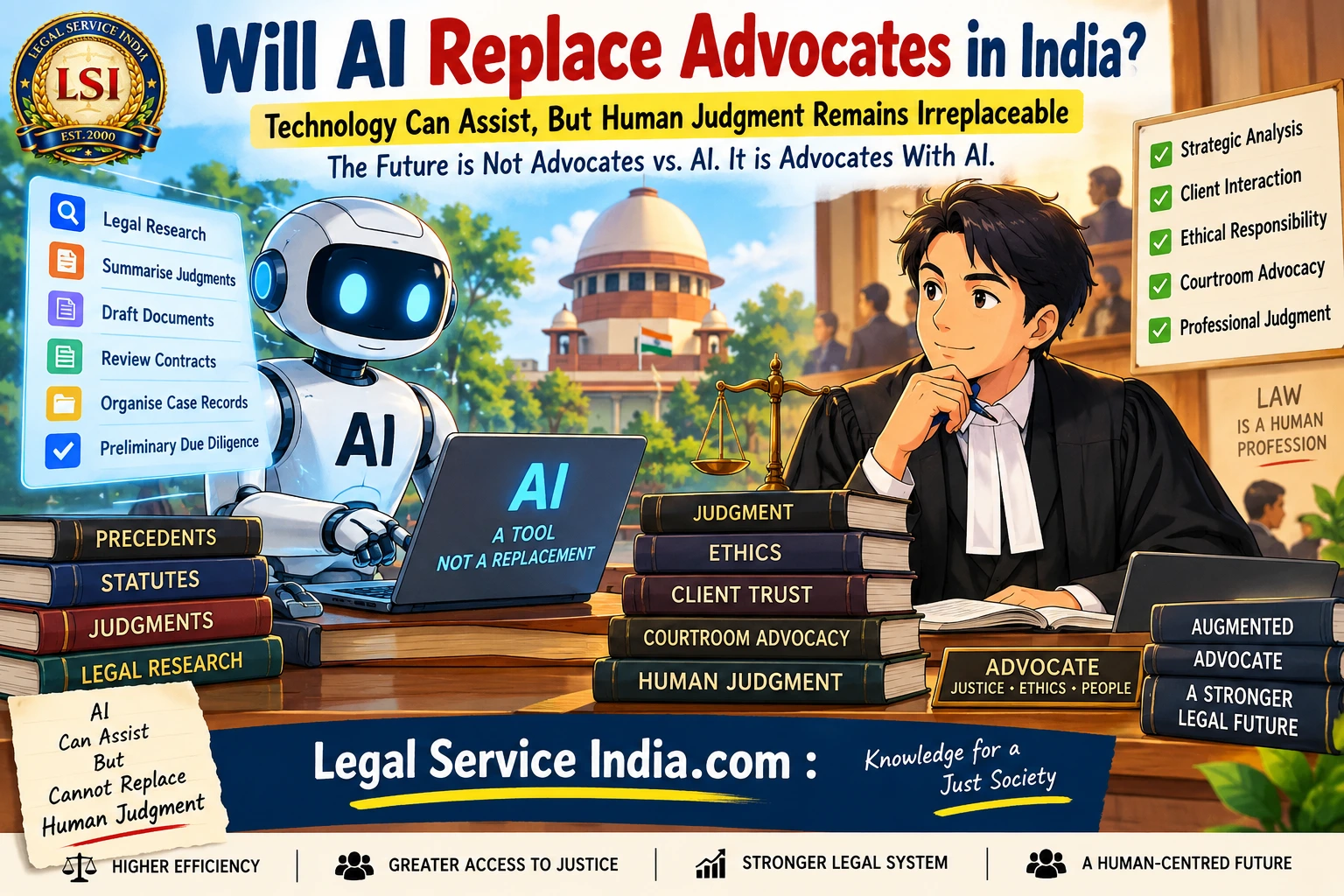
Artificial Intelligence (“AI”) is rapidly changing the way legal work is performed. Tasks that once required hours of manual effort—reviewing lengthy documents, summarising case records, conducting preliminary legal research, translating judgments and preparing first drafts—can now be completed with technological assistance in considerably less time.
This development has led to an inevitable question within the legal fraternity:
Will Artificial Intelligence Eventually Replace Advocates in India?
The answer requires a distinction between assistance and substitution. AI can undoubtedly increase the efficiency of legal professionals. However, the practice of law is not confined to searching precedents or drafting documents. It involves professional judgment, interpretation of facts, strategic decision-making, ethical responsibility, client interaction and courtroom advocacy.
Therefore, rather than viewing the development as “Advocates versus AI,” it is more appropriate to understand AI as a facilitator of legal practice.
I. AI as a Facilitator in the Indian Legal System
The Indian judiciary has itself recognised the potential of technology to improve judicial administration and access to justice.
Several technological initiatives illustrate this approach.
SUPACE
SUPACE (Supreme Court Portal for Assistance in Court’s Efficiency) was introduced to assist the judicial process by facilitating the handling and organisation of case-related information.
Its significance lies in the underlying principle: technology may assist judges in dealing with large volumes of information, but judicial reasoning and decision-making remain human functions.
SUVAS
SUVAS (Supreme Court Vidhik Anuvaad Software) facilitates the translation of judicial decisions into Indian languages.
Such initiatives can substantially improve accessibility to law, particularly in a country where litigants interact with the justice system through numerous regional languages.
Transcription and Digital Courtroom Tools
Technology is also increasingly being used for transcription, recording and management of court proceedings.
These developments demonstrate that the objective of judicial technology is not to replace judges or advocates, but to reduce administrative burdens and improve the efficiency of the justice-delivery system.
Similar benefits are available to advocates. AI may assist in:
- organising lengthy case records and preparing chronologies;
- summarising judgments and documents;
- identifying potentially relevant authorities;
- reviewing contracts and agreements;
- conducting preliminary due diligence; and
- preparing first drafts of legal documents.
However, every such output requires professional verification.
II. The Risk of AI-Generated Legal Errors
One of the most serious concerns surrounding generative AI is its ability to produce incorrect information in an extremely convincing manner. AI systems may occasionally provide inaccurate propositions of law, incorrectly describe judgments, rely upon outdated statutory provisions or even generate authorities and citations that do not exist.
This phenomenon is commonly referred to as an AI “hallucination.”
For an advocate, such an error can have serious consequences.
A pleading filed before a court carries the professional responsibility of the advocate concerned. An advocate cannot avoid responsibility for an incorrect citation or factual assertion merely because the material originated from an AI platform.
Accordingly, the fundamental rule for legal professionals should remain:
AI-Generated Legal Research Is a Starting Point, Not an Authority
Every case citation, statutory provision, quotation and proposition of law generated through AI should be independently verified from reliable and authentic legal sources before being relied upon before a court.
III. Confidentiality, Privilege and Data Protection
The second major concern relates to client confidentiality.
Advocates routinely possess highly sensitive information, including client communications, financial records, medical records, commercial agreements, personal information, litigation strategies and unpublished evidence. The introduction of AI does not dilute the advocate’s professional obligation to protect such information.
Legal professional privilege and confidentiality continue to receive statutory protection under Indian law, including the Bharatiya Sakshya Adhiniyam, 2023, alongside the professional obligations imposed upon advocates.
Further, where personal data is being processed through technological platforms, India’s evolving data-protection framework, including the Digital Personal Data Protection Act, 2023, becomes relevant.
An advocate must therefore exercise caution before uploading confidential documents, client communications or complete case files to public or unverified AI platforms.
The relevant question is not merely:
“Can this AI analyse my document?”
It must also be:
“Where will my client’s information go after I upload it?”
Responsible adoption of AI requires lawyers and law firms to understand how a platform stores, processes, retains and uses the information submitted to it.
IV. Professional Responsibility Cannot Be Delegated to AI
AI may prepare a draft, but it cannot assume responsibility for that draft.
Before any AI-assisted pleading is signed or filed, the advocate must independently examine the factual assertions, applicable statutory provisions, precedents and reliefs sought.
The distinction is fundamental.
| AI Can Assist With | The Advocate Remains Responsible For |
|---|---|
| Drafting | Professional responsibility |
| Legal research assistance | Verification of the law |
| Organising case records | Understanding the facts |
| Identifying potentially relevant authorities | Strategic legal analysis |
Drafting can be assisted. Professional responsibility cannot be outsourced. An advocate whose name and signature appear on a pleading remains professionally accountable for what is placed before the Court.
Therefore, the appropriate legal workflow should be:
| Stage | Legal Workflow |
|---|---|
| 1 | AI Assistance |
| 2 | Advocate Verification |
| 3 | Legal Analysis |
| 4 | Strategic Review |
| 5 | Finalisation |
and never:
AI Output → Direct Filing
V. Can AI Replace Judicial Decision-Making?
The limitations of AI become even more apparent when technology moves from administrative assistance towards actual adjudication.
A judicial decision frequently requires appreciation of evidence, interpretation of competing narratives, assessment of credibility, application of precedent and exercise of judicial discretion.
These functions cannot be reduced merely to information processing.
Technology may assist a court in locating information or managing large records, but the ultimate determination of rights and liabilities requires accountable judicial reasoning.
This distinction becomes particularly important where judicial decisions affect life, liberty, dignity and other fundamental rights.
AI should therefore remain an aid to decision-making rather than the decision-maker itself.
VI. Why Courtroom Advocacy Remains Irreplaceably Human
Anyone who regularly observes court proceedings will recognise that advocacy extends far beyond prepared written submissions.
An advocate may enter the courtroom with ten arguments and ultimately rely upon only two because the questions posed by the Bench reveal where the real controversy lies.
Effective oral advocacy requires the ability to:
- understand the concerns of the Court;
- respond immediately to questions;
- distinguish an adverse precedent;
- modify an argument;
- identify factual weaknesses; and
- determine when pursuing a particular submission may do more harm than good.
These are exercises of judgment rather than information retrieval.
AI can suggest an argument.
It cannot stand before the Bench and take responsibility for making it.
VII. The Human Relationship Between Advocate and Client
The legal profession is also built upon trust.
People generally approach advocates when something significant is at stake—their liberty, family, property, employment, reputation or business.
In such circumstances, the advocate’s responsibility extends beyond explaining statutory provisions.
An advocate must understand the client’s circumstances, separate legally relevant facts from emotional narratives, communicate risks honestly and recommend a course of action consistent with both law and professional ethics.
Technology can process a client’s documents.
It cannot replace the professional relationship between an advocate and the person who has entrusted the advocate with his or her legal problem.
VIII. The Way Forward: The Augmented Advocate
The arrival of AI does not necessarily signal the disappearance of the advocate. It signals a change in the tools available to the advocate.
The lawyer of the future may use AI to conduct preliminary research, organise case records, review documents and prepare initial drafts significantly faster than before.
The time saved through automation can then be directed towards functions where professional expertise matters most—legal strategy, factual analysis, client counselling and courtroom advocacy.
The real distinction in the coming years may therefore not be between AI and advocates, but between advocates who understand how to use AI responsibly and those who do not.
Technology should complement professional ability rather than substitute it.
Artificial Intelligence is likely to become an increasingly important part of Indian legal practice. Its ability to process information rapidly can improve efficiency, accessibility and legal research.
However, speed is not the same as judgment.
The advocate remains responsible for verifying the law, understanding the facts, protecting client confidentiality, developing litigation strategy and ultimately defending the position taken before the Court.
The future of Indian legal practice, therefore, is unlikely to belong to the so-called “Robot Lawyer.”
The Future Belongs to the Augmented Advocate
It belongs to the Augmented Advocate—a legal professional who combines technological efficiency with human judgment, ethical responsibility and courtroom experience.
AI can assist an advocate in finding the law.
AI can assist in organising the facts.
AI can even assist in preparing the first draft.
But the judgment of what to argue, how to argue it, and whether it should be placed before the Court must remain human.
The Future Is Not Advocates Vs. AI. It Is Advocates With AI.
— The future is not advocates vs. AI. It is Advocates with AI.

