Caste System In India: History, Discrimination, Constitution And Reservation
Introduction
India is often celebrated as the world’s largest democracy, a nation founded on the principles of equality, liberty, and justice. Yet, despite remarkable social and economic progress, one institution continues to influence the lives of millions: the caste system. For centuries, caste has shaped social identity, determined opportunities, and influenced how individuals are perceived within society.
While the Constitution of India sought to dismantle caste-based discrimination and establish equal rights for all citizens, the reality remains complex. Legal reforms have transformed many aspects of Indian society, but questions regarding caste, social hierarchy, representation, and discrimination continue to spark debate even today.
This article explores the historical origins of the caste system, its evolution over time, the constitutional response to caste-based inequality, and the continuing relevance of reservation. It also examines whether caste discrimination has truly disappeared or whether it survives in more subtle forms. Ultimately, this article argues that although the visible barriers of caste have weakened, many of its invisible chains continue to influence Indian society.
What Is Caste?
Caste is a social hierarchy system in which people are divided into different groups primarily based on birth. In this system, a person’s social identity, status, occupation, marital opportunities, and sometimes even the respect they receive in society are influenced by the caste into which they are born.
In the context of India, the caste system developed historically through the concepts of varna and jati. The traditional varna system divided society into four major categories:
Brahmins – priests and scholars
Kshatriyas – warriors and rulers
Vaishyas – traders and merchants
Shudras – laborers and service providers
Varna
Traditional Role
Brahmins
Priests and scholars
Kshatriyas
Warriors and rulers
Vaishyas
Traders and merchants
Shudras
Laborers and service providers
Outside this hierarchy were communities that were historically treated as “untouchables”, who today are constitutionally recognised as Dalits or Scheduled Castes.
Many traditional beliefs also connected caste with the concept of karma and rebirth, suggesting that a person’s birth was influenced by actions performed in past lives. Over time, however, the caste system became rigid and evolved into a structure that often created social inequality and discrimination.
Origin And Evolution Of The Caste System
The origin of the caste system in India remains a subject of historical, religious, and sociological debate. Many scholars connect its roots to the ancient varna system mentioned in Hindu scriptures, where society was divided into four broad categories based on duties and occupations.
Initially, this division was believed to be more flexible and linked to work rather than birth. However, over time, the system gradually became hereditary, meaning a person’s caste was determined by birth and remained largely unchanged throughout life.
The concept of karma and rebirth also became associated with caste. According to this belief, an individual’s birth into a particular caste was influenced by actions performed in past lives. While some viewed this as a spiritual explanation of social order, critics argue that such beliefs later contributed to justifying inequality and discouraging resistance against discrimination.
As centuries passed, the caste system evolved into a rigid social hierarchy that deeply influenced social relationships, occupations, marriages, and access to opportunities.
From Division Of Work To Division Of Worth
Many scholars argue that the early caste system was initially connected to the division of labour within society. Different groups performed different functions, such as teaching, governing, trading, and providing services. In theory, these roles were meant to contribute to the smooth functioning of society.
Over time, however, this arrangement became increasingly rigid and hereditary. Occupations and social status began to be determined by birth rather than by an individual’s abilities, interests, or achievements. As a result, caste evolved beyond a mere division of work and gradually became a measure of social worth.
This transformation had profound consequences. People were often judged not by their character or competence but by the caste into which they were born. Access to education, social opportunities, and positions of influence became unevenly distributed. The emphasis on birth over merit reinforced social hierarchies and limited social mobility.
Thus, what may have originated as a functional division of responsibilities eventually developed into a system that assigned different levels of status and dignity to different groups. It is this shift—from a division of work to a division of worth—that lies at the heart of many criticisms of the caste system.
Untouchability And Social Discrimination
One of the most controversial aspects of the caste system was the practice of untouchability. Certain communities were placed outside the traditional caste hierarchy and were subjected to severe social exclusion. They were often denied access to public spaces, temples, educational institutions, and other opportunities available to the rest of society.
The effects of caste-based discrimination extended beyond social interactions. They influenced economic opportunities, access to resources, and participation in public life. As a result, generations of people faced barriers that limited their ability to improve their social and economic conditions.
Although untouchability has been abolished by law and significant social progress has been made, instances of caste-based discrimination continue to be reported in various forms. The persistence of such practices raises important questions about the relationship between legal reform and social change.
My Perspective: The Changing Face Of Caste Discrimination
From my perspective, caste discrimination has not disappeared; it has simply become less visible. In many villages, caste identities are still openly discussed, and people may continue to be identified by caste labels. Such practices demonstrate that caste remains a social reality rather than merely a historical issue.
In urban areas, discrimination often appears in more subtle forms. It may not always be expressed through direct insults or exclusion but through social networks, biases, stereotypes, or unequal opportunities. As a result, many people feel that caste continues to influence social and professional life even when it is not openly acknowledged.
At the same time, it is important to recognise that individuals from all communities work hard to achieve success. However, the continuing dominance of certain groups in various sectors raises important questions about whether social and historical advantages still play a role in shaping opportunities.
Discussions surrounding the GPSC 2023 Class 1 and Class 2 results also reflected broader concerns among some aspirants regarding representation and equal access to opportunities. Whether such concerns are justified or not, they demonstrate that questions of caste, representation, and fairness remain part of public discourse.
In my view, the nature of discrimination has changed over time. It is no longer always explicit, but it can still exist in ways that are difficult to identify and prove. The methods may have changed, but the debate surrounding caste and social equality continues to shape modern India.
Constitutional Response To Caste Discrimination
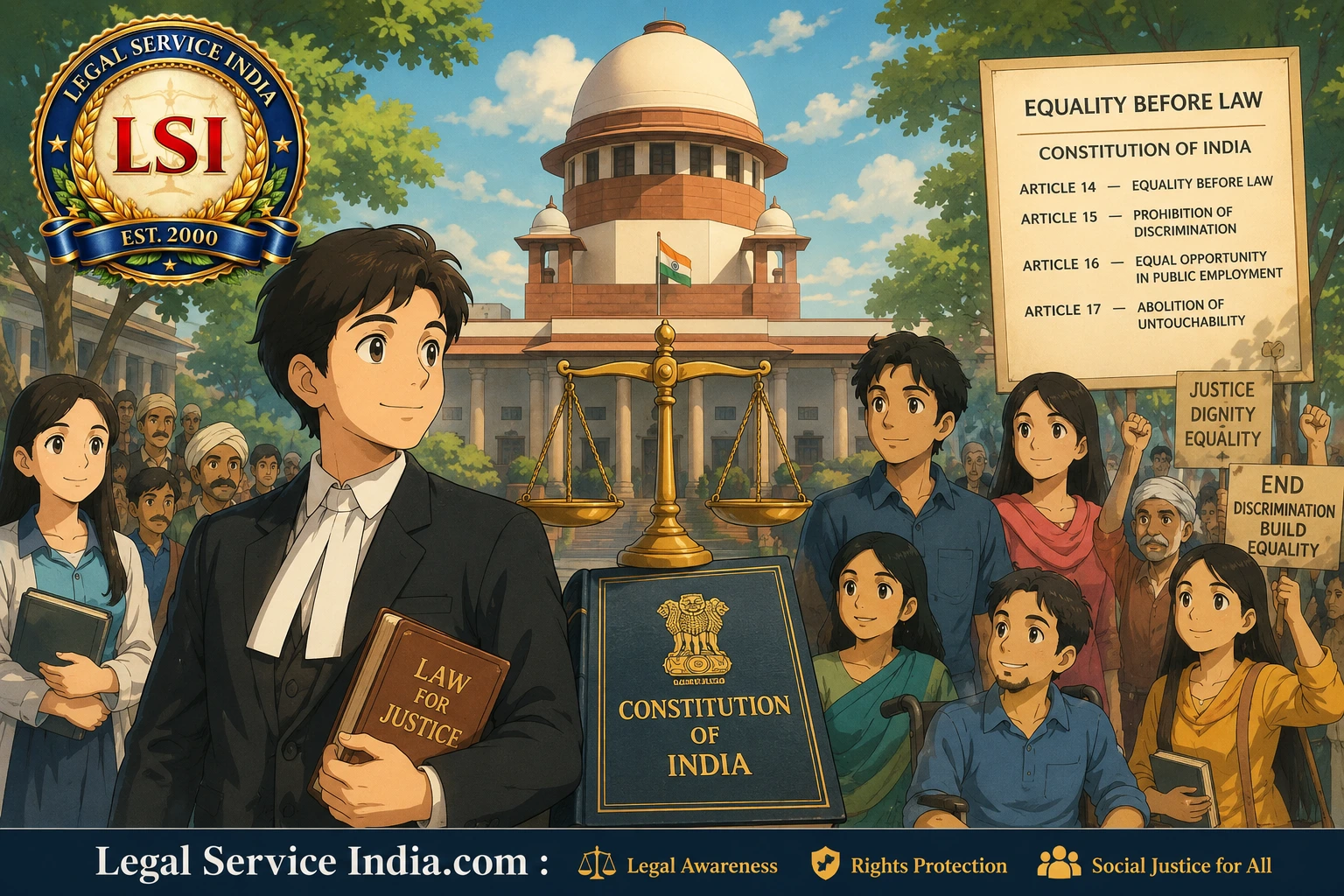
Recognising the deep-rooted social inequalities created by the caste system, the Constitution of India adopted the principles of equality, dignity, and social justice. The Constitution not only guarantees equal rights to all citizens but also provides specific safeguards against caste-based discrimination.
Article 14 – Equality Before The Law
Article 14 guarantees “equality before the law” and “equal protection of the laws” within the territory of India. This provision forms the foundation of the constitutional commitment to equality.
Article 15 – Prohibition Of Discrimination
Article 15(1) prohibits the State from discriminating against any citizen on grounds only of religion, race, caste, sex, place of birth, or any of them. At the same time, Articles 15(4) and 15(5) empower the state to make special provisions for the advancement of socially and educationally backward classes, Scheduled Castes, and Scheduled Tribes.
Article 16 – Equality Of Opportunity In Public Employment
Article 16(1) guarantees equality of opportunity in matters relating to public employment. Article 16(4) further permits the State to make provisions for reservation in appointments or posts in favour of any backward class of citizens that is not adequately represented in public services.
Article 17 – Abolition Of Untouchability
Most significantly, Article 17 abolishes “untouchability” and forbids its practice in any form. The enforcement of any disability arising out of untouchability is declared an offence punishable in accordance with law.
Constitutional Provision
Purpose
Article 14
Equality before law
Article 15
Prohibits discrimination and enables affirmative action
Article 16
Equality in public employment and reservation provisions
Article 17
Abolishes untouchability
Together, these constitutional provisions reflect the vision of the framers of the Constitution to create a society based on equality, dignity, and justice rather than birth-based hierarchy. The Constitution thus serves not merely as a legal document but as an instrument of social transformation aimed at dismantling centuries of caste-based discrimination.
Has The Constitution Succeeded In Eliminating Caste Discrimination?
In my view, the success of constitutional provisions against caste discrimination ultimately depends on the extent to which society accepts and respects constitutional values. Laws can prohibit discrimination, but social change requires people to embrace the principles of equality, dignity, and justice that the Constitution seeks to promote.
The Constitution of India was adopted on November 26, 1949, with the objective of creating a democratic, inclusive, and egalitarian society. However, not everyone welcomed it. For example, on November 30, 1949, the RSS-affiliated publication Organiser criticised the newly adopted Constitution, arguing that it did not adequately reflect ancient Indian legal traditions and expressing admiration for the Manusmriti as a source of law.
Even today, debates continue regarding the nature of the Constitution, secularism, and the direction of Indian society. Some individuals and groups openly criticise constitutional principles or advocate alternative social and political visions. In my opinion, when constitutional values are not fully accepted, the struggle against caste discrimination becomes more difficult. A society cannot effectively implement equality if a significant section of its people does not genuinely believe in the principles on which that equality is based.
Therefore, the elimination of caste discrimination requires more than legal provisions. It requires a broader social commitment to the constitutional ideals of equality, liberty, fraternity, and human dignity. Only when these values are accepted not merely in law but also in public consciousness can caste-based discrimination truly decline.
Reservation: Remedy or Continuing Debate?
First of all, what is reservation? ‘Reservation’ is often understood as a policy aimed at uplifting historically marginalised communities. However, in my view, its purpose extends beyond economic assistance. Reservation is also about representation, dignity, and the inclusion of communities that were excluded from social, educational, and political opportunities for generations.
For this reason, reservation should not be viewed as a favour granted by the state. Rather, it is a constitutional mechanism designed to promote social justice and ensure equal participation in public life. The objective is not merely to improve financial conditions but also to provide members of marginalised communities with recognition, representation, and a sense of belonging within society.
Purpose of Reservation
Aspect
Role of Reservation
Social Justice
Addresses historical exclusion and discrimination.
Representation
Ensures participation in education, employment, and public institutions.
Dignity
Promotes recognition and equal status in society.
Inclusion
Provides opportunities for marginalised communities to participate fully in public life.
Critics often argue that economic advancement should eliminate the need for reservation. However, the experience of many individuals suggests that social discrimination does not always disappear with financial success. A person may become a civil servant, a judge, a professor, or an entrepreneur, yet still encounter prejudice based on caste identity.
Continuing Challenges of Caste Discrimination
Incidents of caste-based discrimination continue to be reported in different parts of India. These range from restrictions on temple entry and social participation to discrimination in marriages, public ceremonies, and access to community resources. Such incidents indicate that while legal equality has been established, social equality remains an unfinished project.
Restrictions on temple entry.
Barriers to social participation.
Discrimination in marriages.
Exclusion from public ceremonies.
Unequal access to community resources.
In my view, as long as caste continues to influence how individuals are treated in society, the debate over reservation will remain relevant. The true purpose of reservation is not merely to provide opportunities but to help create a society in which a person’s dignity is determined by their humanity rather than by their caste.
Conclusion
The caste system has undergone significant changes over the centuries, yet its influence continues to shape Indian society in various ways. While the Constitution of India guarantees equality, dignity, and justice to all citizens, the existence of legal protections alone cannot eliminate discrimination. Social change requires not only laws but also a collective commitment to constitutional values.
Throughout this article, I have argued that caste discrimination has not disappeared; rather, it has changed its form. In many places, discrimination is no longer as open as it once was, but it continues to exist through social attitudes, stereotypes, exclusion, and unequal opportunities. The experiences of many individuals demonstrate that economic success alone does not always free a person from caste-based prejudice.
Reservation and True Equality
In my view, reservation remains relevant as long as caste continues to influence how people are treated in society. True equality cannot be achieved merely by providing equal opportunities on paper; it also requires the removal of social barriers that prevent individuals from enjoying those opportunities with dignity.
Development and Social Justice
Recognise India often speaks of development, modernisation, and progress. However, the true measure of a developed society is not only its economic growth but also its ability to ensure equal respect and dignity for all its citizens. The challenge before India is not simply to break the visible barriers of caste discrimination but also to recognise and overcome the invisible ones.
The Invisible Chains of Caste
Until that happens, the invisible chains of caste will continue to exist, not always in law, but in the minds and practices of society.
Award-Winning Article Written By: Mr Rohan Solanki