





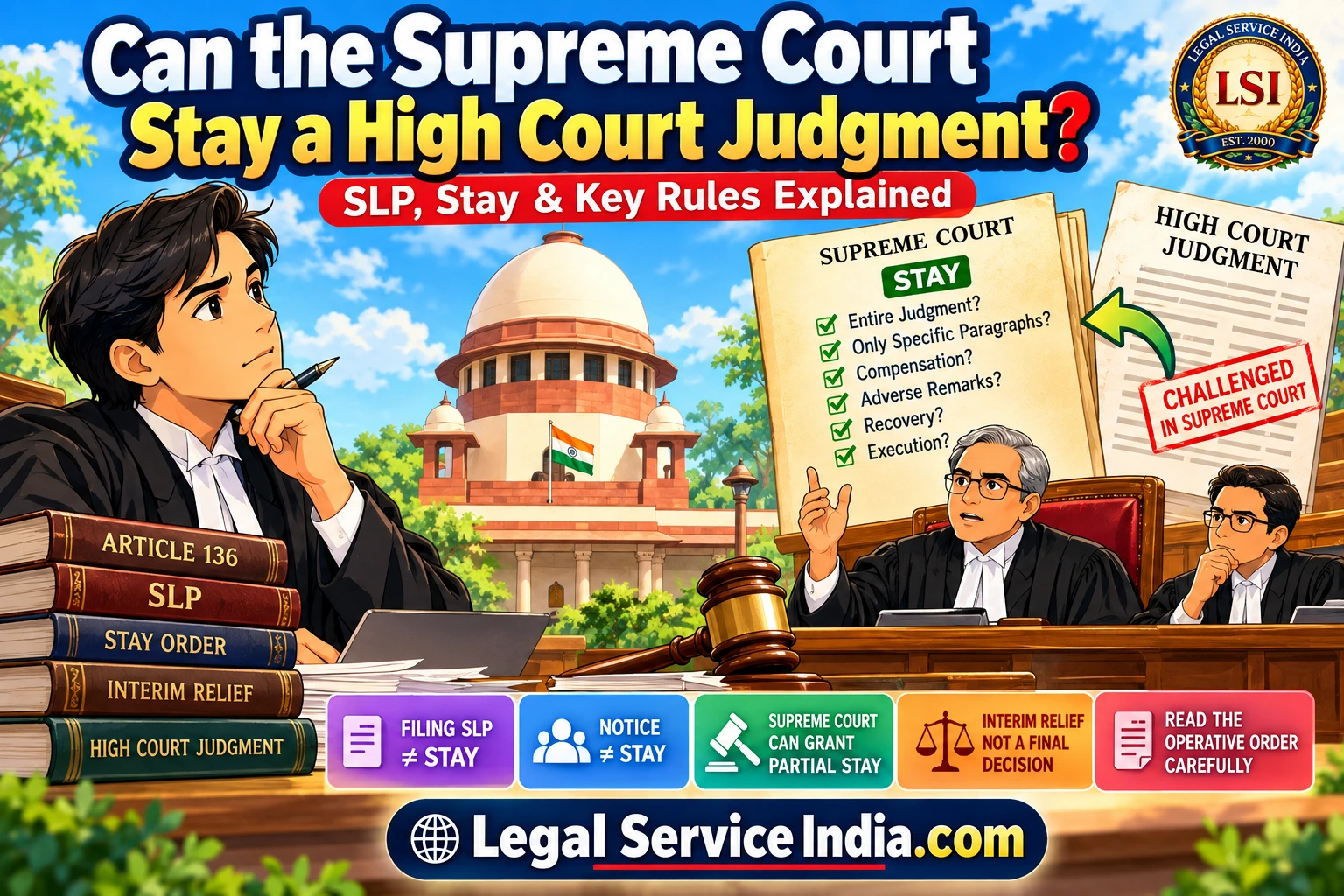
Can the Supreme Court Stay a High Court Judgment?
Introduction
The simple answer is yes. But, as is often the case in constitutional litigation, the simple answer does not tell the whole story.
The Supreme Court can stay the operation of a High Court judgment when a matter is brought before it in an appropriate appeal or Special Leave Petition. However, the Supreme Court does not necessarily have to stay the entire judgment. It may suspend only a particular direction, a particular paragraph, recovery of money, execution of an order, adverse observations, or some other specific consequence.
That distinction has acquired immediate importance because of the Supreme Court’s recent proceedings in Medha Roopam v. Akriti Chaudhary & Ors., arising out of an Allahabad High Court judgment concerning detention under the National Security Act, 1980.
At first sight, reports suggested that the Supreme Court had stayed the Allahabad High Court judgment. But the Supreme Court subsequently revised its interim order and made the position much more precise. The revised order stayed the operation of paragraphs 27 to 33 of the High Court judgment, including the award of costs and strictures against the District Magistrate. It did not, in those words, stay the High Court’s decision quashing the detention.
For lawyers and litigants, there is an important lesson here:
Never assume that a Supreme Court stay means that the entire High Court judgment has ceased to operate. Read the operative portion of the Supreme Court’s order carefully.
That is the real answer to the question: Can the Supreme Court stay a High Court judgment?
Can the Supreme Court Stay a High Court Judgment?
Yes.
The Supreme Court possesses the constitutional power to entertain challenges to High Court judgments and, where the circumstances justify it, grant interim protection against their operation.
One of the principal constitutional routes is Article 136 of the Constitution of India, which gives the Supreme Court discretionary power to grant special leave to appeal from judgments, decrees, determinations, sentences or orders passed by courts and tribunals in India.
But Article 136 is not an ordinary appeal as of right.
A litigant does not enter the appellate jurisdiction of the Supreme Court merely by filing an SLP. The Court first considers whether the case deserves its intervention.
This distinction was explained authoritatively by the Supreme Court in Kunhayammed v. State of Kerala, (2000) 6 SCC 359. The Court explained that an SLP and an appeal represent two different stages of the Supreme Court’s jurisdiction.
Therefore, when a High Court judgment is challenged before the Supreme Court, three different things must not be confused:
- filing an SLP;
- the Supreme Court issuing notice; and
- the Supreme Court granting a stay or other interim protection.
They are legally different.
Three Stages That Must Not Be Confused
| Stage | What It Means | Does It Automatically Stay the High Court Judgment? |
|---|---|---|
| SLP Filed | A party has approached the Supreme Court seeking special leave to appeal. | No |
| Notice Issued | The Supreme Court has issued notice in the matter. | No |
| Stay Granted | The Supreme Court has passed an operative direction staying specified operation or execution. | Yes, to the extent stated in the order |
Does Filing an SLP Automatically Stay a High Court Judgment?
No.
This is perhaps the most important practical point.
A party sometimes believes that once an SLP has been filed before the Supreme Court, the High Court order cannot be implemented.
That is not the law.
The Supreme Court made the position clear in Kunhayammed v. State of Kerala. The filing of a Special Leave Petition does not, by itself, suspend the operation of the judgment challenged before the Supreme Court. The judgment continues to remain effective unless the Supreme Court specifically stays or suspends its operation or execution.
This principle has also been reaffirmed in later Supreme Court decisions referring to Kunhayammed and Khoday Distilleries Ltd. v. Sri Mahadeshwara Sahakara Sakkare Karkhane Ltd., (2019) 4 SCC 376.
Filing an SLP Is Not the Same as Obtaining a Stay
In practical terms:
- SLP filed ≠ stay granted.
- Notice issued ≠ stay granted.
- Matter listed ≠ stay granted.
A stay requires an operative judicial direction.
What Does a Supreme Court Stay Actually Do?
A stay places the operation or implementation of the specified order or direction in abeyance, usually for the period stated by the Court.
It does not necessarily mean that the High Court judgment has been declared wrong.
Nor does an interim stay amount to final appellate adjudication.
A Supreme Court Stay May Be Limited to Particular Directions
Suppose a High Court judgment contains five different directions:
- a declaration of rights;
- release of a person;
- payment of compensation;
- recovery from an officer; and
- adverse observations against an official.
The Supreme Court may decide, at the interim stage, that only the recovery and adverse observations should remain stayed.
The other portions may continue to operate.
This is why the exact language of a Supreme Court order matters enormously.
The Recent Example: Medha Roopam v. Akriti Chaudhary
The recent proceedings involving Gautam Buddh Nagar District Magistrate Medha Roopam provide a useful illustration.
The dispute arose from an Allahabad High Court judgment dated 2 September 2026 concerning the preventive detention of Akriti Chaudhary under the National Security Act.
The Allahabad High Court quashed the detention and granted relief to the detenue. It also awarded compensation and made strong observations concerning the officials involved in the detention process.
The challenge then reached the Supreme Court.
The Supreme Court proceedings were registered as SLP (Crl.) Diary No. 56202/2026, along with connected proceedings including SLP (Crl.) No. 18010/2026.
On 23 September 2026, a Bench comprising Justice Satish Chandra Sharma and Justice Nongmeikapam Kotiswar Singh considered the matter. Notice was issued and interim protection was granted.
But the precise scope of that protection became important.
The Supreme Court Subsequently Revised Its Order
The first version of the order was capable of being understood as staying the operation of the impugned judgment, particularly paragraphs 27 to 33.
That created the impression that the entire High Court judgment, including the decision quashing the detention, had been stayed.
The Supreme Court subsequently revised the wording.
The revised order stated, in substance, that:
- the operation of paragraphs 27 to 33 of the impugned judgment, including the award of costs and strictures, would remain stayed until the matter was heard on merits.
The uploaded research correctly identifies this revised wording as the controlling interim formulation.
Contemporary reporting also confirms that the Supreme Court clarified that the stay was confined to the High Court’s strictures and compensation direction and that the quashing of the detention itself was not stayed.
That clarification is legally significant.
Did the Supreme Court Stay the Entire Allahabad High Court Judgment?
No—not according to the revised order.
This is where the distinction between a headline and a judicial order becomes important.
The revised Supreme Court order stayed:
- paragraphs 27 to 33;
- the award of costs referred to in those paragraphs; and
- the strictures against the District Magistrate.
It did not, on its revised wording, stay the High Court’s quashing of the detention.
The uploaded research therefore correctly cautions against describing the matter as though the entire High Court judgment had been suspended.
This is an excellent example of why lawyers should read the order itself rather than rely solely upon the headline accompanying a court report.
Why Does This Distinction Matter?
It matters because different parts of a judgment can have completely different legal consequences.
A judgment may contain:
A Finding
The Court may hold that an administrative action was unlawful.
Principal Relief
The Court may quash the administrative action.
Consequential Relief
The Court may order compensation.
Recovery Direction
The Court may direct recovery of money from an official.
Adverse Observations
The Court may criticise the conduct of an officer.
Administrative or Service Consequences
The Court may direct that observations be placed on a service record.
There is no rule that all these components must necessarily be stayed together.
The Supreme Court can examine the immediate prejudice arising from a particular direction and grant limited interim protection.
That is precisely what makes the Medha Roopam order important.
A Stay Is Not the Same as Setting Aside a Judgment
This distinction is fundamental.
A stay is ordinarily an interim measure.
Setting aside is a final judicial act.
If the Supreme Court stays a High Court judgment, it does not automatically mean that the Supreme Court has finally concluded that the High Court was wrong.
The Supreme Court may ultimately:
- dismiss the SLP;
- grant leave and dismiss the appeal;
- modify the High Court judgment;
- partly reverse the judgment;
- completely reverse the judgment;
- remand the matter; or
- pass another appropriate final order.
Until that final stage, an interim stay should not be described as a final determination on the merits.
What Is the Difference Between Notice and Stay?
The difference is simple but often misunderstood.
Notice means that the respondent is called upon to respond to the petition.
Stay means that the Court has directed that the operation or implementation of something be suspended to the extent specified.
The Supreme Court can issue notice without granting a stay.
It can also issue notice and grant a limited stay.
The Medha Roopam proceedings illustrate the latter situation: notice was issued, but the stay was directed specifically at identified portions of the High Court judgment.
Can the Supreme Court Stay Only One Paragraph of a High Court Judgment?
Yes.
There is nothing inherently unusual about a court tailoring interim relief to a particular part of an order.
In fact, such precision may be necessary.
Consider a High Court judgment where the first twenty paragraphs contain the Court’s reasoning, paragraph 21 grants the principal relief, paragraphs 22–25 contain consequential directions, and paragraphs 26–30 impose a financial liability.
The Supreme Court may stay only the financial liability.
The rest of the judgment may continue to operate.
Therefore, when somebody says:
“The Supreme Court has stayed the High Court judgment,”
the immediate follow-up question for a lawyer should be:
“Show me the operative part of the Supreme Court’s order. What exactly has been stayed?”
What Principles Govern a Supreme Court Stay?
There is no single statutory formula that automatically determines whether the Supreme Court must grant a stay under Article 136.
The Court exercises judicial discretion.
Depending on the case, it may consider:
- whether the challenge raises a serious and arguable issue;
- the nature of the High Court’s order;
- the prejudice likely to result if the order operates;
- the prejudice to the opposite party if it is stayed;
- whether the injury can subsequently be remedied;
- public interest;
- the need to preserve the subject matter of the litigation; and
- whether refusal of interim protection would effectively make the eventual appeal meaningless.
The familiar expressions prima facie case, balance of convenience and irreparable injury are useful descriptions of interim-relief principles. But they should not be presented as though Article 136 itself contains a rigid three-part statutory test.
The uploaded research correctly makes this qualification.
What About Civil Decrees?
Civil proceedings require an additional qualification.
Where execution of a civil decree is concerned, Order XLI Rule 5 of the Code of Civil Procedure, 1908 provides a specific statutory framework.
The mere filing of an appeal does not automatically operate as a stay of execution.
The appellate court may grant a stay subject to the statutory requirements and appropriate conditions.
This principle should not, however, be mechanically transplanted into every criminal SLP or constitutional proceeding.
The jurisdiction and circumstances differ.
That distinction is important when writing a general article on Can the Supreme Court Stay a High Court Judgment?
Can the Supreme Court Stay Adverse Remarks Against an Officer?
Yes, in an appropriate case.
But there is an important distinction between staying the operation of remarks and expunging those remarks permanently.
The two are not the same.
In the Medha Roopam proceedings, the Supreme Court’s revised interim order stayed the specified paragraphs containing the strictures against the District Magistrate.
That does not mean the observations have been permanently erased.
Whether those observations ultimately survive is a matter for the final adjudication.
The Supreme Court has separately considered the question of expunction of adverse remarks in cases such as State of U.P. v. Mohammad Naim, AIR 1964 SC 703.
| Type of Order | Legal Effect |
|---|---|
| Stay of adverse remarks | Places the specified remarks in abeyance during the period covered by the stay. |
| Expunction of adverse remarks | Concerns the permanent removal or deletion of the remarks from the record. |
An order staying remarks and an order expunging remarks should therefore never be treated as interchangeable.
Can the Supreme Court Stay a Compensation Direction?
Certainly.
A compensation direction may have immediate financial consequences. If the Supreme Court considers that the challenge raises an arguable question and that immediate recovery would cause prejudice, it can stay recovery pending further consideration.
That is precisely the practical significance of the revised interim order in Medha Roopam.
The compensation and related strictures were put on hold while the matter remained pending.
But the stay of recovery does not mean that the Supreme Court has finally ruled that compensation was wrongly awarded.
That question remains separate.
Does the High Court Judgment Lose Its Effect When an SLP Is Filed?
No.
This is where Kunhayammed remains particularly important.
The Supreme Court explained that even after an SLP is filed, the judgment under challenge continues to remain effective unless the Supreme Court specifically stays or suspends its operation or execution.
The filing of an SLP puts the finality of the judgment in jeopardy in the sense explained by the doctrine of merger, but it does not automatically wipe out the judgment.
The Supreme Court’s final appellate order is what ultimately determines whether the High Court judgment survives, is modified or is reversed.
High Courts Remain Constitutional Courts
There is another aspect which should not be overlooked.
The Supreme Court is the apex constitutional court, but High Courts are themselves constitutional courts exercising jurisdiction under Articles 226 and 227.
The Constitution Bench in High Court Bar Association, Allahabad v. State of Uttar Pradesh, 2024 INSC 150 reaffirmed the constitutional position of High Courts and rejected the proposition that interim orders passed by High Courts should automatically lapse after a predetermined period.
That decision should not be misunderstood.
It does not mean that the Supreme Court cannot grant a specific stay against a High Court judgment in a properly instituted proceeding before it.
Rather, it reinforces the constitutional status and independence of High Courts.
What Should a Lawyer Do After an Adverse High Court Judgment?
This is where legal strategy becomes more important than legal theory.
If a client has suffered an adverse High Court judgment and an approach to the Supreme Court is contemplated, the first task is to identify what actually requires protection.
Is it:
- arrest?
- detention?
- demolition?
- recovery?
- execution of a decree?
- cancellation of a licence?
- termination of service?
- attachment of property?
- recovery from salary?
- disciplinary consequences?
- adverse observations?
- implementation of a governmental direction?
The answer should determine the interim prayer.
A carefully drafted SLP should not merely say:
“Stay the impugned judgment.”
Where appropriate, it should identify the particular consequence which requires immediate protection.
That makes the prayer clearer and allows the Supreme Court to grant tailored relief.
The Importance of Reading the Operative Part
In my experience, this is one of the most important habits in Supreme Court practice.
Do not rely upon:
- the newspaper headline;
- a television discussion;
- a social-media post;
- a press release;
- even a detailed legal news report.
Read the order.
The difference may be one sentence.
In the present case, the difference between the original and revised formulation materially changed the understanding of what had been stayed. The revised order specifically identified paragraphs 27 to 33 and the related costs and strictures.
That is not a drafting nicety.
It determines the legal consequences of the order.
A Practical Example
Imagine that a High Court judgment contains the following directions:
| Paragraph | Direction |
|---|---|
| Paragraph 20 | The detention is unconstitutional. |
| Paragraph 21 | The detainee shall be released. |
| Paragraph 22 | The State shall pay compensation. |
| Paragraph 23 | The amount shall be recovered from an officer. |
| Paragraph 24 | Adverse observations are recorded against that officer. |
The Supreme Court could, depending on the circumstances, stay paragraphs 23 and 24 while leaving the principal relief untouched.
In that situation:
- the detention remains quashed;
- the release direction remains effective;
- compensation may remain subject to the order;
- recovery from the officer may be suspended; and
- adverse remarks may be kept in abeyance.
This is why a limited stay is a perfectly meaningful judicial remedy.
What Medha Roopam Teaches Us
The recent case offers several practical lessons.
| No. | Key Lesson |
|---|---|
| First | The Supreme Court can stay the operation of a High Court judgment or specified portions of it. |
| Second | The Supreme Court does not have to suspend the entire judgment. |
| Third | An SLP does not automatically operate as a stay. |
| Fourth | Notice and stay are separate judicial directions. |
| Fifth | The wording of the operative order is more important than the headline. |
| Sixth | An interim stay is not a final adjudication on the merits. |
| Seventh | A revised or clarified order must be read in preference to an earlier formulation when determining the current scope of interim protection. |
The uploaded research correctly emphasises each of these distinctions.
Conclusion
So, can the Supreme Court stay a High Court judgment?
Yes. But the more accurate legal answer is that the Supreme Court can stay the operation of the whole judgment, or only such part of it as the circumstances require.
The recent proceedings in Medha Roopam v. Akriti Chaudhary make the distinction particularly clear. What initially appeared from early reporting to be a stay of the High Court judgment was subsequently clarified through a revised order. The Supreme Court stayed paragraphs 27 to 33, including the costs and strictures, while the High Court’s decision quashing the detention was not stayed in the revised operative wording.
The broader principle is equally important.
A litigant does not obtain a stay merely because an SLP has been filed. Nor does the issuance of notice suspend the judgment. The Supreme Court must actually grant interim protection, and the scope of that protection is determined by the words of the order.
For a practising lawyer, that is not merely a matter of terminology. It can decide whether a person is released, whether money can be recovered, whether property can be attached, whether a government direction can be implemented, or whether adverse judicial observations can presently be acted upon.
My advice to litigants is therefore simple:
Do not ask merely, “Has the Supreme Court stayed the High Court judgment?” Ask the more important question: “Exactly what has the Supreme Court stayed?”
That is where the real legal consequence lies.
Need to Challenge a High Court Judgment Before the Supreme Court?
A High Court judgment can have immediate and serious consequences—whether it concerns arrest, bail, detention, property, recovery, service matters, constitutional rights, criminal proceedings, compensation, or adverse judicial directions.
If you are considering an SLP before the Supreme Court of India, do not assume that merely filing an SLP will stay the High Court order. The real question is whether your case requires urgent interim protection, a stay of the High Court judgment, or a stay of a specific direction or consequence.
The right legal strategy at the beginning can make a significant difference.
Speak Directly to an Experienced Supreme Court Advocate
Adv. Tarun Choudhury
Supreme Court Advocate | 25+ Years of Legal Experience
If you have received an adverse High Court judgment or are facing immediate consequences from a High Court order, seek professional legal assessment before the situation becomes more difficult to reverse.
| Contact | Details |
|---|---|
| 📞 Call | 9650499965 |
| 8851978611 | |
| [email protected] |
Discuss your High Court judgment, SLP strategy and possibility of interim stay with an experienced Supreme Court Advocate.
👉 Early legal assessment can help identify the correct remedy, the appropriate grounds for approaching the Supreme Court, and whether urgent interim relief should be sought.
LegalServiceIndia.com — Legal assistance for matters requiring Supreme Court intervention.
Frequently Asked Questions
1. Can the Supreme Court Stay a High Court Judgment?
Yes. The Supreme Court can stay the operation of a High Court judgment through an appropriate interim order in an appeal or Special Leave Petition under Article 136 of the Constitution. However, the Supreme Court may stay the entire High Court judgment or only specific paragraphs, directions, recovery proceedings or other consequences. The exact scope depends on the wording of the Supreme Court’s order.
2. Does Filing an SLP Automatically Stay a High Court Judgment?
No. Filing a Special Leave Petition (SLP) does not automatically stay a High Court judgment or High Court order. The Supreme Court must specifically grant a stay or other interim protection. The Supreme Court’s decision in Kunhayammed v. State of Kerala, (2000) 6 SCC 359, makes this distinction clear.
3. Can the Supreme Court Stay Only Part of a High Court Judgment?
Yes. The Supreme Court can grant a limited or partial stay of a High Court judgment, including staying a particular paragraph, compensation order, recovery direction, execution proceeding or adverse judicial observation while allowing the remaining parts of the judgment to operate.
4. Does a Supreme Court Stay Mean That the High Court Judgment Is Wrong?
No. A Supreme Court stay of a High Court judgment is generally an interim order and does not amount to a final decision on the merits. The Supreme Court may subsequently uphold, modify, reverse or otherwise dispose of the High Court judgment after hearing the matter fully.
5. Can the Supreme Court Stay Adverse Remarks, Compensation or Directions in a High Court Judgment?
Yes. In an appropriate case, the Supreme Court can stay specific adverse remarks, strictures, compensation directions, recovery orders or other consequential directions contained in a High Court judgment. The recent proceedings in Medha Roopam v. Akriti Chaudhary illustrate how the Supreme Court may confine interim protection to specified paragraphs and consequences rather than staying the entire High Court judgment.
Key Takeaways: Can the Supreme Court Stay a High Court Judgment?
- The Supreme Court can stay a High Court judgment when an appropriate appeal or Special Leave Petition (SLP) is before it and interim protection is justified.
- Filing an SLP does not automatically stay a High Court judgment. A specific Supreme Court order staying or suspending the operation or execution of the High Court order is required.
- The Supreme Court can grant a partial stay. It may stay the entire High Court judgment or only specific paragraphs, directions, compensation, recovery proceedings, execution, or adverse observations.
- Notice is not the same as a stay. Issuance of notice, listing of an SLP, or even consideration of the matter does not by itself suspend the High Court judgment.
- A Supreme Court stay is generally an interim measure, not a final decision on merits. The Supreme Court may ultimately uphold, modify, reverse or otherwise dispose of the High Court judgment.
- The exact wording of the Supreme Court’s operative order is crucial. Lawyers and litigants should determine precisely what has been stayed rather than relying on headlines or general descriptions.
- The recent Medha Roopam v. Akriti Chaudhary proceedings illustrate a limited stay. The revised Supreme Court order stayed paragraphs 27–33 of the Allahabad High Court judgment, including the costs and strictures, rather than staying the High Court judgment in its entirety.
- Article 136 gives the Supreme Court discretionary and extraordinary jurisdiction. An SLP is not an appeal as of right, and the Court decides whether the case warrants its intervention.
- High Courts remain constitutional courts under Articles 226 and 227. The appellate jurisdiction of the Supreme Court does not mean that a High Court judgment automatically ceases to operate when challenged before the Supreme Court.
- For urgent Supreme Court litigation, the real question is often not simply whether a stay is available, but what specific relief needs to be stayed. This may include recovery, execution, detention-related consequences, adverse observations, property action, service consequences or other irreversible steps.
Summary
Can the Supreme Court Stay a High Court Judgment? Yes. The Supreme Court can stay a High Court judgment or specific portions of it through an appropriate interim order, particularly in proceedings under Article 136. However, filing an SLP does not automatically stay the High Court judgment. The Supreme Court may grant a complete or partial stay, and the precise legal effect depends on the operative wording of its order. The recent Medha Roopam v. Akriti Chaudhary proceedings demonstrate why the distinction between a stay of the entire High Court judgment and a stay of specific paragraphs or directions is legally important.
