





Introduction
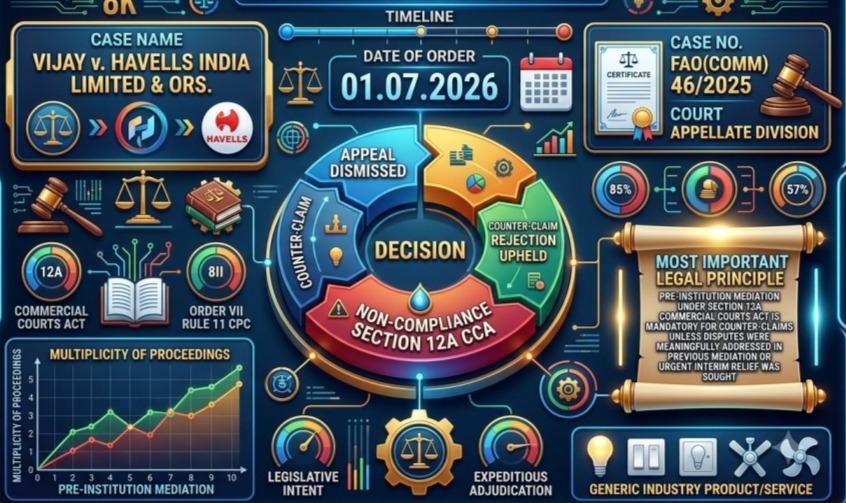
Commercial litigation in India aims for speed and efficiency, with pre-institution mediation under the Commercial Courts Act serving as a key tool to reduce court burden. This Delhi High Court Division Bench ruling addresses an important procedural question: Must a defendant filing a counterclaim in an ongoing commercial suit undergo separate pre-institution mediation?
Factual and Procedural Background
Havells India Limited filed a commercial suit against Vijay. During the suit, inspections occurred under a court-appointed local commissioner. Vijay then filed a counterclaim based on those inspections and the parties’ commercial relationship, alleging the plaintiff’s actions exceeded the court’s order.
The counterclaim was filed without independent pre-institution mediation under Section 12A of the Commercial Courts Act. The original suit itself bypassed mediation due to urgent interim relief sought.
Havells moved an application under Order VII Rule 11 CPC to reject the counterclaim for non-compliance with Section 12A. The commercial court allowed the application and rejected the counterclaim, relying on prior single-judge precedent. Vijay appealed this rejection.
Dispute Before the Court
The core issue was whether a counterclaim in a pending commercial suit requires fresh, independent compliance with Section 12A pre-institution mediation or if it can be treated as part of the main proceedings.
Vijay argued:
- Counter-claims are not separate “suits.”
- No amendment was made to relevant CPC rules for counterclaims.
- Requiring mediation would cause impractical delays given written statement timelines.
Havells contended:
- A counterclaim is like a cross-suit needing its own mediation.
- The original suit skipped mediation due to urgency, making separate compliance necessary.
Reasoning and Analysis of the Court
The Court examined Section 12A of the Commercial Courts Act, 2015, which mandates pre-institution mediation for commercial disputes (except urgent relief cases), as settled by the Supreme Court in Patil Automation (P) Ltd. v. Rakheja Engineers (P) Ltd. (2022) 10 SCC 1.
It reviewed conflicting single-judge views, including
- Anil Kumar Pitti v. Comsol Energy RFA(COMM.) No. 479/2025
- Sanjana Agarwal v. Namoshivai Apparels RFA(COMM.) No.212/2023
- Aditya Birla Fashion and Retail Limited v. Mrs Saroj Tandon CM(M) No. 459/2023
The Division Bench adopted a purposive approach: Section 12A aims for meaningful settlement opportunities, not mere formality.
A counter-claim, while having characteristics of a cross-suit, is meant to avoid multiplicity per CPC Order VIII Rule 6A and cases like Jag Mohan Chawla v. Dera Radha Swami Satsang (1996) 4 SCC 699 and Satyender v. Saroj (2022) 17 SCC 154.
Rigid separate mediation for every counterclaim could frustrate speedy resolution goals of the act.
If disputes were already addressed in prior mediation, further rounds may not be needed. However, where no mediation occurred or new claims were undisclosed, compliance is required.
Here, since the original suit skipped mediation entirely and no prior process covered the counterclaim issues, independent compliance was mandatory.
The court clarified timelines and limitation exclusions under Section 12A prevent prejudice.
Key Principles Highlighted by the Court
- Section 12A mandates pre-institution mediation except in urgent relief cases.
- The purpose of mediation is meaningful settlement, not procedural formality.
- Counterclaims generally function as cross-suits but also help avoid multiplicity of proceedings.
- Separate mediation is unnecessary where the same disputes have already been meaningfully mediated.
- Independent compliance is required where no earlier mediation covered the counterclaim.
Final Decision of the Court
The Division Bench dismissed the appeal. It upheld the commercial court’s rejection of the counter-claim for non-compliance with Section 12A, though providing partly different reasoning focused on the absence of any prior mediation.
Point of Law Settled
The judgment clarifies that counter-claims in commercial suits are subject to Section 12A but adopts a flexible, purpose-driven test: Compliance is satisfied if the disputes were meaningfully addressed in prior mediation between the parties.
This balances mandatory mediation with practical adjudication, likely reducing redundant proceedings while upholding the Act’s settlement goals in future commercial litigation.
Case Summary
| Title of the Case | Vijay vs. Havells India Limited & Ors. |
|---|---|
| Date of Judgment/Order | 01.07.2026 |
| Case Number | FAO(COMM) 46/2025 |
| Neutral Citation | 2026:DHC:5196-DB |
| Name of Court | High Court of Delhi |
| Name of Honorable Judge | Justice Anil Kshetarpal and Amit Mahajan |
| Written By | Advocate Ajay Amitabh Suman, IP Adjutor [Patent and Trademark Attorney], High Court of Delhi |
Quick Takeaways
- The case concerns Section 12A of the Commercial Courts Act, 2015.
- The dispute involved whether a counterclaim requires independent pre-institution mediation.
- The Delhi High Court adopted a purposive interpretation of Section 12A.
- Prior meaningful mediation may satisfy the statutory requirement.
- Where no mediation has taken place, a counterclaim must independently comply with Section 12A.
- The appeal was dismissed, and the rejection of the counter-claim was upheld.
Disclaimer
Images used herein do not reflect actual images used in Judgement, and the same are for illustrative purposes only. Readers are advised not to treat this as a substitute for legal advice, as it may contain errors in perception, interpretation, and presentation.

