





Introduction
Patent law in India gives those who believe a patent has been wrongly granted more than one way to challenge it. A person can go to the Intellectual Property Appellate Board [now High Court] and file what is called a revocation petition. Or, if that person is being sued for infringing a patent, he can fight back in the same court by filing a counterclaim, asking the court to cancel the patent itself. For a long time, the question of whether a party could do both things at the same time, pursue a revocation petition before the Appellate Board and simultaneously raise a counter-claim before the High Court, remained unanswered by the highest court of the land.
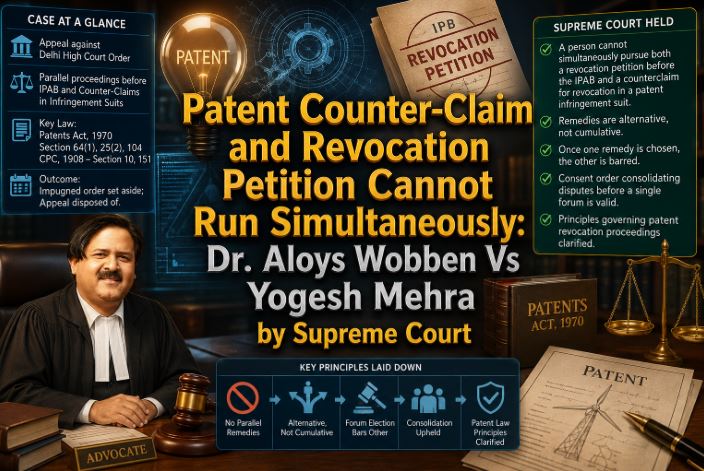
The Supreme Court of India, in Dr Aloys Wobben and Another versus Yogesh Mehra and Others, decided on 2 June 2014, finally settling this important and recurring question. The judgement, delivered by the Honourable Supreme Court of India, laid down clear rules about which remedy survives when a party chooses both. It also clarified the hierarchy and relationship between Section 25 and Section 64 of the Patents Act, 1970, and confirmed the binding force of consent orders passed by the High Court in patent matters. The decision has since become one of the foundational precedents in Indian intellectual property law.
Factual and Procedural Background
Dr Aloys Wobben and His Business Operations
Dr Aloys Wobben, the first appellant, is a scientist and engineer of considerable standing in the field of wind energy. He holds approximately 2,700 patents across more than 60 countries, of which around 100 are registered in India. His manufacturing enterprise, carried on under the name Enercon GmbH, is counted among the three largest wind turbine manufacturers in the world, employing more than 8,000 people globally.
Formation of the Indian Joint Venture
In 1994, Dr Wobben entered into a joint venture in India with Yogesh Mehra and Ajay Mehra, the first and second respondents in the case. The Indian joint venture company was incorporated as Enercon India Limited, later renamed Wind World (India) Limited, with the Mehra brothers serving as its directors. The company was set up to manufacture wind turbines in India and was originally permitted to do so through a series of intellectual property licence agreements granted by Dr Wobben. The last of these agreements was signed on 29 September 2006, superseding all earlier agreements, including those of 1994 and 2000.
Breakdown of Business Relationship
The relationship between the parties broke down. Enercon GmbH terminated the intellectual property licence agreement on 8 December 2008, citing non-fulfilment of obligations by Enercon India Limited. Despite this termination, according to Dr Wobben, Enercon India Limited and the Mehra brothers continued to use his patents and technical know-how without authorisation or payment.
Patent Disputes and Legal Proceedings
Revocation Petitions Before the Appellate Board
In January 2009, Enercon India Limited struck first by filing 19 revocation petitions before the Intellectual Property Appellate Board under Section 64(1) of the Patents Act, 1970, seeking to have Dr Wobben’s patents cancelled.
Patent Infringement Suits Before the Delhi High Court
Responding to this, Dr Wobben filed a series of patent infringement suits before the High Court of Delhi.
| Suit Number/Sequence | Date of Filing |
|---|---|
| First Suit (No. 1349 of 2009) | 27 July 2009 |
| Three Additional Suits | 20 October 2009 |
| Fifth Suit | 28 January 2010 |
| Sixth Suit | 2 July 2010 |
| Seventh Suit | 5 July 2010 |
In all, 10 patent infringement suits were instituted.
Counter-Claims and Additional Revocation Petitions
The respondents, in turn, filed counterclaims in some of those infringement suits, praying for the revocation of the very same patents that were already challenged before the Appellate Board. They also filed 4 additional revocation petitions before the Appellate Board in 2010 and 2011, bringing the total number of revocation petitions to 23.
The result was a sprawling legal battle in which:
- The same patents were challenged before two different forums.
- The challenges were brought by the same parties.
- The grounds of challenge substantially overlapped.
- Parallel proceedings continued simultaneously.
High Court Consent Order and Consolidation of Suits
On 1 September 2010, the High Court passed a consent order, agreed to by both sides, consolidating 8 suits for joint trial before the High Court and fixing a detailed schedule for expedited proceedings.
Key developments following the consent order included the following:
- Consolidation of 8 patent-related suits.
- Agreement by both parties to proceed with a joint trial.
- Adoption of a detailed timetable for speedy adjudication.
- Framing of issues in the consolidated suits on 20 September 2011.
Despite having agreed to this consent order, the respondents continued to pursue their revocation petitions before the Appellate Board.
Parallel Proceedings and Conflicting Forums
By the time the matter reached the Supreme Court, the Appellate Board had already passed orders revoking six of Dr Wobben’s patents, patents that were simultaneously under challenge in the counterclaims pending before the High Court.
| Proceeding Type | Forum | Purpose |
|---|---|---|
| Revocation Petitions | Intellectual Property Appellate Board | Cancellation of patents under Section 64(1) |
| Patent Infringement Suits | High Court of Delhi | Enforcement of patent rights |
| Counter-Claims | High Court of Delhi | Revocation of the same patents challenged before the Appellate Board |
This procedural conflict ultimately required the Supreme Court to determine whether a litigant could simultaneously pursue a revocation petition before the Appellate Board and a counter-claim for revocation before the High Court concerning the same patent.
The Dispute
The core dispute before the Supreme Court was not about the merits of any individual patent but about the procedure itself. The appellants argued that once a defendant in an infringement suit files a counterclaim seeking revocation of a patent, the Appellate Board loses jurisdiction, and only the High Court can decide the question of that patent’s validity.
They further argued that pursuing both a revocation petition before the Appellate Board and a counterclaim before the High Court at the same time was fundamentally impermissible. The appellants also relied upon the consent order of 1 September 2010 to argue that the respondents had already agreed to resolve everything before the High Court and could not therefore continue before the Appellate Board.
The respondents resisted, arguing that both remedies were independently available under Section 64(1) of the Patents Act and that the legislature had provided distinct forums for distinct purposes. They contended that curtailing their right to pursue revocation petitions would deprive them of the broader procedural safeguards that come with proceedings before the appellate board, including more avenues of appeal.
Reasoning and Analysis of the Court
The Court examined Section 64(1) of the Patents Act, 1970, which is the primary provision governing the revocation of patents. He noted that this provision opens with the words “Subject to the provisions contained in this Act” and not with words like “Notwithstanding” or “Without prejudice to”.
This linguistic choice was of critical importance to the court’s entire analysis. The opening phrase means that Section 64 is subservient to all other provisions of the Patents Act. If any other provision of the Act conflicts with Section 64, the other provision prevails.
Three Ways to Challenge a Patent
| Method | Relevant Provision | Forum | Key Features |
|---|---|---|---|
| Post-Grant Opposition | Section 25(2) | Controller of Patents | Must be filed within one year of publication of grant. |
| Revocation Petition | Section 64(1) | Appellate Board | Can be filed directly by a person interested at any point in time. |
| Counter-Claim for Revocation | Section 64(1) read with Section 104 | High Court | Filed by a defendant in an infringement suit. |
The court then identified three distinct ways in which a patent can be challenged once it has been granted under the Patents Act.
- First, under Section 25(2), any person interested can file a notice of opposition before the Controller of Patents within one year of the publication of the grant of a patent. The controller refers this to an opposition board, which examines the matter and gives recommendations. After hearing both sides, the controller passes a final order. This order can then be appealed before the appellate board.
- Second, under Section 64(1), any person interested can file a revocation petition directly before the Appellate Board at any point in time, not limited to the one-year window of Section 25(2).
- Third, again under Section 64(1), a defendant in an infringement suit can file a counter-claim seeking revocation of the patent. This counter-claim is adjudicated by the High Court hearing the infringement suit, as confirmed by Section 104 of the Patents Act.
Who Can Challenge a Patent?
Court explained what kind of person can use each remedy. Under Section 25(1), which operates before the grant of a patent, any person at all can file a representation opposing the grant.
But after the patent is granted, the circle narrows. Under both Section 25(2) and Section 64(1), only a “person interested” can challenge the patent.
The expression “person interested” is defined in Section 2(1)(t) of the Patents Act to mean someone engaged in, or promoting, research in the same field as the invention. The court observed that this is not a static category; someone who was not a “person interested” when the patent was granted may become one later, depending on his activities.
Interpretation of the Word “Or” in Section 64
Turning to the central question, whether a party can simultaneously pursue a revocation petition before the Appellate Board and a counter-claim before the High Court, the court pointed to the use of the word “or” in Section 64(1).
The provision speaks of revocation either on a petition of any person interested before the Appellate Board or on a counterclaim in a suit for infringement before the High Court. The word “or” is plainly disjunctive, not conjunctive.
This means that both remedies cannot be pursued at the same time by the same person for the same purpose. The court accepted this submission fully and without hesitation.
Which Proceeding Gets Priority?
The more difficult question was, when a party has already chosen both remedies (as the respondents had done in this case), which one should be allowed to continue?
The court found no direct answer in the Patents Act itself and therefore turned to accepted principles of law, particularly Section 10 of the Code of Civil Procedure, 1908, which deals with the stay of suits.
Section 10 provides that no court shall proceed with a suit where the matter in issue is also directly and substantially in issue in a previously instituted suit between the same parties before another court of competent jurisdiction.
The court also invoked Section 151 of the Code of Civil Procedure, which preserves the inherent powers of the court to prevent abuse of its process.
Treating a counter-claim as equivalent to an independent suit, which is what it is in law, the court held that the principle of Section 10 applies with full force.
Priority Rule Established by the Court
| Situation | Proceeding That Continues | Proceeding That Cannot Continue |
|---|---|---|
| Revocation petition filed first | Revocation petition before Appellate Board | Subsequent counter-claim |
| Infringement suit and counter-claim filed first | Counter-claim before High Court | Subsequent revocation petition |
This led to a clear and symmetrical rule. Where a revocation petition was filed before an infringement suit was instituted, the revocation petition gets priority and must be allowed to continue. The counter-claim subsequently filed cannot be permitted to proceed.
Conversely, where the infringement suit was filed first and the defendant responded with a counter-claim, the counter-claim gets priority. Any revocation petition filed thereafter by the same party is barred by the principle equivalent to res judicata and cannot be continued.
Application of the Rule to the Facts
Applying this rule to the facts of the case, the court found that out of the 23 revocation petitions filed by the respondents, 19 were filed in January 2009, which was before any infringement suit was instituted by Dr Wobben.
Those 19 petitions, therefore, must be allowed to continue before the appellate board, and the corresponding counterclaims filed in response to the infringement suits cannot be pursued for the same patents.
For the 4 revocation petitions filed after the infringement suits were instituted, the counter-claims already filed in response to those suits must be given priority, and those 4 revocation petitions must be discontinued.
Effect of the Consent Order Dated 1 September 2010
The court went on to address the contention regarding the consent order of 1 September 2010.
Justice Khehar held clearly that the consent order was entirely valid and binding. He noted that where multiple disputes of the same nature exist between the same parties (even if relating to different patents), it is open to the parties to agree, by consent, to resolve all their disputes before a single adjudicatory authority.
Once such consent is given and a court of competent jurisdiction records it, neither party can step outside it to seek relief from any additional forum.
The consent order was recorded by the High Court, which had full statutory jurisdiction to deal with the matter, and the court upheld it in its entirety.
Comparison with Section 124 of the Trade Marks Act, 1999
The court also briefly addressed the comparison drawn by the appellants with Section 124 of the Trade Marks Act, 1999.
That provision explicitly empowers a court to stay an infringement suit pending rectification proceedings before the appellate board.
The appellants argued that the absence of a similar provision in the Patents Act showed a gap in the law.
Justice Khehar noted that this submission was rendered academic by the earlier conclusions, since only one remedy can survive at a time; there is no question of simultaneous proceedings that would need to be stayed.
The Final Decision of the Court
The Supreme Court set aside the impugned order of the High Court of Delhi and disposed of the appeal in the terms elaborated in its judgement. The court declared that the 19 revocation petitions filed by Enercon India Limited in January 2009, being prior in time to the infringement suits, must be allowed to continue before the Appellate Board. The corresponding counter-claims in the infringement suits, to the extent they relate to the same patents, cannot be allowed to proceed.
For the 4 revocation petitions filed after the infringement suits were instituted, the counter-claims already filed have priority, and those revocation petitions cannot be continued. The consent order of 1 September 2010 passed by the High Court was expressly affirmed.
Points of Law Settled in the Case
This judgement settled several important principles of patent law in India.
- The court declared definitively that the word “or” in Section 64(1) of the Patents Act, 1970, is disjunctive, meaning a party cannot simultaneously pursue both a revocation petition before the Appellate Board and a counter-claim before the High Court in respect of the same patent.
- The court also held that Section 64 of the Patents Act, being prefaced by the words “Subject to the provisions contained in this Act”, is subservient to all other provisions of the Act, and any conflict must be resolved in favour of the other provision.
- The court further established that the principle embedded in Section 10 of the Code of Civil Procedure governs the situation where a party has pursued both remedies, with the first-in-time proceeding being the one that survives.
- The court confirmed that a counterclaim in a patent infringement suit is to be treated as an independent suit for all practical purposes.
- Finally, it was held that consent orders passed by the High Court in patent proceedings are fully binding on the parties and cannot be circumvented by continuing parallel proceedings before another forum.
Key Patent Law Principles Established
| Legal Issue | Principle Settled by the Supreme Court |
|---|---|
| Section 64(1) of the Patents Act | The word “or” is disjunctive; parallel revocation and counterclaim proceedings cannot continue simultaneously for the same patent. |
| Hierarchy of Statutory Provisions | Section 64 is subject to other provisions of the Patents Act and must yield where a conflict exists. |
| First-in-Time Rule | The proceeding initiated first survives, based on the principle underlying Section 10 of the Code of Civil Procedure. |
| Nature of Counter-Claim | A counterclaim in a patent infringement suit is treated as an independent suit. |
| Effect of Consent Orders | Consent orders are binding and cannot be bypassed through parallel proceedings. |
Case Details
| Case Title | Dr Aloys Wobben and Another Vs Yogesh Mehra and Others |
|---|---|
| Date of Order | 2 June 2014 |
| Case Number | Civil Appeal No. 6718 of 2013 |
| Citation | AIR 2014 Supreme Court 2210; 2014 (15) SCC 360 |
| Name of Court | Supreme Court of India |
| Name of Honourable Judges | Justice Jagdish Singh Khehar and Justice A.K. Patnaik |
Quick Case Summary
- Appeal allowed in part by the Supreme Court.
- Earlier-filed revocation petitions were permitted to continue.
- Parallel counter-claims relating to the same patents were barred where revocation petitions were first in time.
- Later-filed revocation petitions could not continue once counter-claims had already been instituted.
- The High Court’s consent order dated 1 September 2010 was affirmed.

