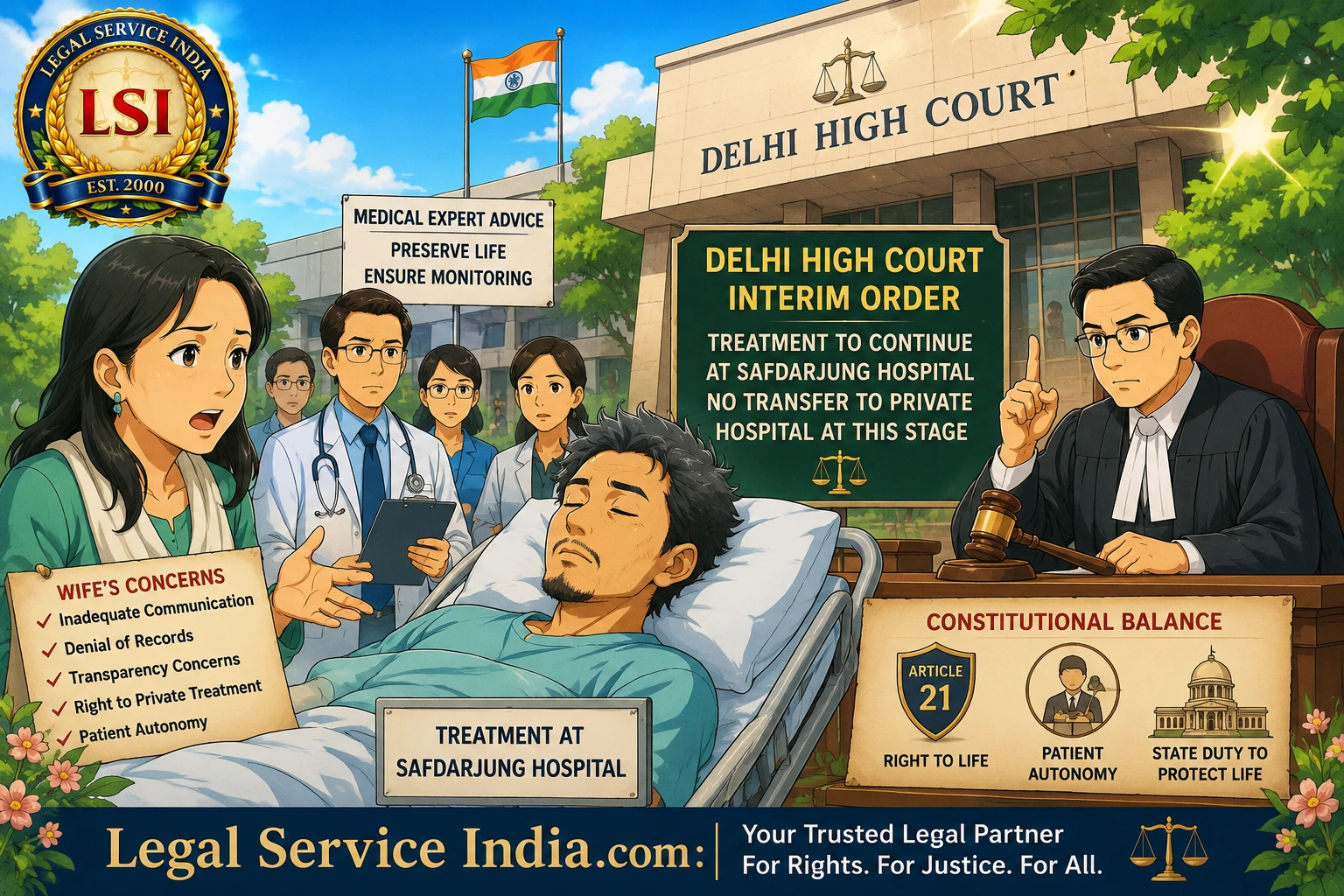
Wife’s Plea Against Sonam Wangchuk’s Hospitalisation: Delhi High Court Refuses Immediate Transfer to Private Hospital, Prioritises Medical Care Over Competing Claims
Introduction
In an extraordinary Sunday sitting, the Delhi High Court was called upon to decide a matter that lay at the intersection of constitutional liberty, patient autonomy, medical ethics, state responsibility, and judicial oversight. The petition was filed by Dr. Gitanjali J. Angmo, wife of noted environmental activist and education reformer Sonam Wangchuk, seeking his immediate transfer from the government-run Safdarjung Hospital to a private medical facility of the family’s choice.
The matter assumed exceptional urgency because Wangchuk had been shifted to Safdarjung Hospital after his health deteriorated during an indefinite hunger strike. His supporters alleged that the hospitalisation was involuntary and politically motivated, while the union government maintained that the intervention was necessary to preserve his life following expert medical advice.
After hearing all parties in a rare Sunday hearing, the Delhi High Court declined to pass an interim direction permitting his transfer to a private hospital. Instead, it directed that Wangchuk would continue receiving treatment at Safdarjung Hospital until further consideration of the matter.
The interim order is significant because it illustrates the constitutional balance courts must maintain between an individual’s autonomy and the state’s duty to protect life under Article 21 of the Constitution.
Citation: Dr. Gitanjali J. Angmo v. Union of India & Ors., W.P.(C) (Delhi High Court), Special Sunday Hearing, Order dated 19 July 2026 (interim proceedings concerning the medical treatment of Sonam Wangchuk).
Case Overview
| Particular | Details |
|---|---|
| Case | Dr Gitanjali J. Angmo v. Union of India & Ors. |
| Court | Delhi High Court |
| Date of Interim Order | 19 July 2026 |
| Nature of Hearing | Special Sunday Hearing |
| Primary Issue | Whether Sonam Wangchuk should be immediately transferred from Safdarjung Hospital to a private hospital chosen by his family. |
| Interim Outcome | Transfer declined; treatment to continue at Safdarjung Hospital. |
Background of the Dispute
The litigation arose against the backdrop of Sonam Wangchuk’s prolonged hunger strike in Delhi.
Wangchuk had been fasting in support of a nationwide movement demanding accountability over the alleged NEET examination paper leak and broader reforms concerning transparency in public examinations. His deteriorating health prompted concerns among doctors and authorities alike.
Earlier, the Delhi High Court had already emphasized that human life is precious and directed authorities to ensure continuous medical monitoring while permitting medical intervention whenever experts considered it necessary to save his life.
Subsequently, on medical advice, Delhi Police shifted Wangchuk from the protest site to Safdarjung Hospital.
This hospitalisation triggered fresh litigation.
Wife’s Grievance Before the High Court
Appearing before the High Court, Wangchuk’s wife challenged the continued treatment of her husband in the government hospital.
Her principal grievances included:
- Inadequate communication regarding Wangchuk’s medical condition.
- Alleged denial of complete access to medical records.
- Apprehension regarding transparency of treatment.
- Desire to have him treated at a private hospital selected by the family.
- Concern that governmental control over his treatment compromised his autonomy.
According to submissions reported during the hearing, the family maintained that they had greater confidence in private medical care and sought judicial permission for his immediate transfer.
Government’s Stand
The union government opposed the prayer.
Its submissions were broadly founded on three propositions.
1. Preservation of Life
The government argued that Wangchuk’s physical condition required specialised monitoring available at Safdarjung Hospital.
2. Public Responsibility
Authorities contended that once a person’s health reaches a critical stage during a public protest, the state cannot remain a silent spectator.
The constitutional obligation under Article 21 obliges the government to take reasonable measures to prevent avoidable loss of life.
3. Medical Necessity
The government maintained that the transfer to Safdarjung Hospital had been undertaken solely on expert medical advice and not for any collateral purpose.
Hospital’s Response
Safdarjung Hospital also responded to allegations levelled by Wangchuk’s family.
The hospital stated that the allegations questioning its transparency and treatment protocols were “not conducive to the smooth management of the patient’s medical care.”
The administration asserted that Wangchuk was receiving appropriate treatment and monitoring in accordance with accepted medical standards.
The Delhi High Court’s Interim Decision
After hearing the rival submissions, the Delhi High Court declined to grant immediate interim relief.
The court held that:
- Sonam Wangchuk shall continue treatment at Safdarjung Hospital.
- No interim direction would be issued permitting transfer to a private hospital at this stage.
- The matter would remain under judicial consideration during subsequent hearings.
The Court therefore maintained the existing medical arrangement while keeping the legal issues open for further adjudication.
Constitutional Questions Raised
Although the court’s order is interim, the litigation raises several important constitutional questions.
1. Patient Autonomy
Modern constitutional jurisprudence recognises that every competent adult possesses the right to make informed decisions regarding medical treatment.
This principle flows from the guarantee of personal liberty under Article 21.
However, the right is not always absolute where competing state interests arise.
2. State’s Duty to Preserve Life
Indian constitutional law equally imposes a positive obligation upon the state to protect life.
When medical experts believe a person’s condition has become life-threatening, authorities may be constitutionally expected to intervene.
The present dispute illustrates the tension between these competing principles.
3. Limits of Judicial Review
Courts ordinarily refrain from substituting judicial opinion for medical expertise.
Where treatment decisions are supported by professional medical advice and there is no prima facie evidence of mala fides or gross negligence, courts generally exercise restraint.
The interim order reflects this traditional judicial approach.
Medical Ethics Versus Individual Consent
The case also revives an enduring debate in medical jurisprudence.
A competent adult generally enjoys the right to refuse medical treatment.
However, prolonged hunger strikes present exceptional ethical dilemmas.
Courts worldwide have repeatedly grappled with questions such as the following:
- Can the State permit an individual to die while protesting?
- Should doctors respect refusal of treatment even where death appears imminent?
- Does preservation of life override personal autonomy?
Indian courts have usually attempted to balance these competing interests rather than adopt an absolutist approach.
Why the Court Did Not Immediately Order Transfer
From a legal perspective, several factors may explain the court’s cautious approach.
- First, there was no immediate medical opinion before the Court demonstrating that Safdarjung Hospital was incapable of providing adequate treatment.
- Secondly, transfer during an unstable medical condition itself may create additional risk.
- Thirdly, the Court was required to avoid passing orders that might inadvertently jeopardize the patient’s health before complete medical evaluation.
- Finally, interim orders generally preserve the existing situation until fuller examination becomes possible.
Significance of the Sunday Hearing
Indian constitutional courts rarely assemble on Sundays except in matters involving extraordinary urgency.
Such special sittings generally occur where delay may irreversibly affect life, liberty, or constitutional rights.
The present hearing, therefore, demonstrates the High Court’s recognition that issues concerning medical treatment, personal liberty, and potential risk to life warrant immediate judicial attention.
Earlier Judicial Concern Over Wangchuk’s Health
This is not the first judicial intervention concerning Wangchuk’s hunger strike.
Only days earlier, the Delhi High Court had directed continuous medical monitoring and observed that every human life is precious, requiring authorities to undertake necessary medical intervention whenever expert advice so required.
The present interim order appears consistent with that earlier judicial approach.
Broader Legal Implications
The outcome of this litigation could influence future cases involving:
- Hunger strikes by political activists.
- Prisoners refusing medical treatment.
- Involuntary hospitalisation.
- Constitutional limits of state intervention.
- Patients’ rights regarding choice of hospital.
- Judicial review of medical decisions.
- Balancing autonomy against preservation of life.
It may also contribute significantly to Indian jurisprudence concerning informed consent and the scope of Article 21.
Key Constitutional Issues at a Glance
| Legal Issue | Question Before the Court |
|---|---|
| Patient Autonomy | Can an individual or family insist upon treatment at a hospital of their choice? |
| Article 21 | Does the state’s duty to protect life justify continued treatment at a government hospital? |
| Medical Expertise | Should courts interfere with treatment decisions supported by medical professionals? |
| Judicial Review | What is the scope of judicial intervention in ongoing medical care? |
| Interim Relief | Should the status quo be maintained until the complete medical and legal examination? |
Conclusion
The Delhi High Court’s interim refusal to transfer Sonam Wangchuk from Safdarjung Hospital does not determine the final rights of the parties. Rather, it reflects judicial caution in a case where constitutional freedoms intersect with urgent medical concerns.
By allowing treatment to continue at the government hospital while keeping the controversy alive for detailed examination, the Court sought to preserve the immediate objective of protecting life without foreclosing future consideration of the family’s concerns.
As the proceedings continue, the Court is expected to address larger constitutional issues surrounding patient autonomy, informed consent, governmental responsibility, and the permissible limits of state intervention during life-threatening public protests.
Whatever the ultimate outcome, this litigation is poised to become an important precedent in Indian constitutional and medical jurisprudence, particularly in defining how courts balance individual liberty with the state’s obligation to safeguard human life.
Key Takeaways
The Delhi High Court’s interim order in the Sonam Wangchuk hospitalization case raises significant constitutional, medical, and legal questions. Below are the key takeaways from the judgment.
| Key Issue | Takeaway |
|---|---|
| Immediate Relief | The Delhi High Court refused to order the immediate transfer of Sonam Wangchuk to a private hospital. |
| Constitutional Issue | The case involves the balance between patient autonomy and the state’s duty to protect life under Article 21. |
| Government’s Position | The union government justified the hospitalization on the basis of expert medical advice. |
| Legal Significance | The final judgment may become an important precedent in constitutional and medical jurisprudence. |
Delhi High Court Refuses Immediate Transfer
In a special Sunday hearing, the Delhi High Court declined to immediately transfer Sonam Wangchuk from Safdarjung Hospital to a private hospital, directing that his treatment continue at the government facility for the time being.
Wife Challenged Government Hospitalisation
Dr. Gitanjali J. Angmo, wife of Sonam Wangchuk, approached the Delhi High Court seeking his transfer to a private hospital, citing concerns over transparency, access to medical records, and patient autonomy.
Article 21 at the Centre of the Dispute
The case raises significant constitutional questions regarding the balance between an individual’s right to personal liberty and medical choice under Article 21 and the state’s duty to preserve human life.
State Defends Medical Intervention
The union government argued that Wangchuk’s hospitalization at Safdarjung Hospital was based solely on expert medical advice and was necessary to safeguard his life during his prolonged hunger strike.
Safdarjung Hospital Rejects Allegations
The hospital informed the court that Sonam Wangchuk was receiving appropriate treatment in accordance with accepted medical standards and denied allegations regarding lack of transparency.
Court Adopts a Cautious Interim Approach
Rather than deciding the merits of the dispute at the interim stage, the Delhi High Court chose to maintain the existing medical arrangement while keeping all legal questions open for future adjudication.
Important Questions on Patient Autonomy
The litigation examines whether a competent adult—or the family acting on his behalf—can insist on treatment at a hospital of their own choice when the state believes immediate medical intervention is essential.
Medical Ethics and Hunger Strikes
The case highlights the complex legal and ethical issues surrounding hunger strikes, including informed consent, refusal of medical treatment, preservation of life, and the constitutional limits of state intervention.
Judicial Review of Medical Decisions
The interim order reflects the long-standing judicial principle that courts ordinarily defer to professional medical opinion unless there is prima facie evidence of mala fide action, arbitrariness, or gross medical negligence.
Rare Sunday Sitting Reflects Exceptional Urgency
The Delhi High Court convened a special Sunday hearing, underscoring the urgency of matters involving life, liberty, medical treatment, and constitutional rights.
Potential Landmark for Constitutional and Medical Jurisprudence
The final decision could become an important precedent on patient rights, involuntary hospitalization, informed consent, judicial oversight of medical treatment, and the scope of Article 21 of the Constitution of India.
Why This Judgement Matters
The case is expected to shape future legal principles governing hunger strikes, emergency medical intervention by the state, patient choice of hospital, and the constitutional balance between individual autonomy and the government’s obligation to protect life.