





Introduction
In West Bengal, penal institutions are officially designated as correctional homes. Their purpose extends beyond safe custody and discipline to encompass care, treatment, and the successful reintegration of prisoners into society.
Female inmates encounter distinct vulnerabilities that differ significantly from those faced by men. A substantial number enter custody following prolonged exposure to poverty, domestic violence, sexual abuse, exploitation, and systemic educational deprivation. Incarceration frequently compounds these pre-existing hardships, adversely impacting their physical and mental health, family cohesion, and post-release employment prospects.
The Alipore Women’s Correctional Home in Kolkata stands as the only facility in West Bengal exclusively designated for female inmates. Data as of September 2026 indicates an inmate population of approximately 409 female prisoners, alongside 34 children co-residing with their mothers. In keeping with its gender-specific mandate, the institution is headed by a female superintendent, ensuring administrative oversight tailored to the needs of women and accompanying minors. Across all correctional facilities in West Bengal, female prisoners total approximately 1,813, with 85 children residing alongside their mothers.
Managing female inmates requires a specialised, gender-responsive approach that balances security with healthcare, legal aid, family preservation, vocational training, and post-release support. In this regard, Alipore serves as a key operational model. The institution has introduced several progressive welfare and communication systems, including a prepaid telephone booth service for monitored family calls, an E-Mulakat video-conferencing facility for secure interactions with legal counsel and relatives, and consular access for foreign nationals in alignment with international human rights standards.
Problems Faced by Women Prisoners
Women prisoners represent an exceptionally vulnerable group whose complex challenges often begin long before incarceration and persist well beyond their release. Prior to entering the correctional system, many face severe socio-economic hardships, substance dependency, and exploitation by criminal networks or drug dealers, alongside widespread histories of physical and sexual abuse. Once incarcerated, these existing vulnerabilities are compounded by institutional stressors, including the fear of violence, inadequate gender-specific physical and mental healthcare, and significant difficulty securing competent legal representation due to widespread poverty.
Inside the correctional facility, health and custodial issues demand distinct administrative care. Female inmates require specialised medical support, particularly regarding maternal health and pregnancy management, alongside structured interventions for trauma and addiction. Furthermore, the institutional environment frequently restricts access to adequate educational, vocational, and skill-building opportunities, limiting inmates’ ability to prepare for post-release self-sufficiency.
Among the most acute emotional burdens faced by incarcerated women is the forced separation from their families and dependent children. This strain reaches a critical point when co-residing young children reach the statutory age limit of six years and must leave the facility, creating severe emotional distress and disrupting vital maternal bonds. Upon release, these women face steep societal hurdles, including intense social stigma, community rejection, limited employment prospects, and a heightened risk of re-exploitation, reinforcing the urgent need for comprehensive post-release rehabilitation and family reunification policies.
Management of Women Prisoners at Alipore
A significant number of women prisoners at Alipore Women’s Correctional Home come from poor and socially disadvantaged backgrounds. Many have had limited educational opportunities.
The administration regularly reviews the cases of prisoners. During the review, prisoners are asked whether they have been able to engage a lawyer. If a prisoner cannot afford a lawyer, she is offered legal assistance through the District Legal Services Authority.
The cases of convicted prisoners are also reviewed carefully. Prisoners are informed about their right to appeal before higher courts. This system is important because poverty should not prevent a prisoner from receiving proper legal assistance or pursuing available legal remedies.
Thus, legal support forms an important part of the management of women prisoners.
Medical Care and Mental Health
Women prisoners have special healthcare requirements. Alipore Women’s Correctional Home has an Outpatient Department (OPD) under the supervision of two medical officers and three visiting specialist doctors.
Every prisoner is medically examined within 24 hours of admission. If a prisoner requires treatment that is not available inside the correctional home, she is referred to outside hospitals in Kolkata, including SSKM, Calcutta Medical College and Hospital, Sambhunath Pandit Hospital and Chittaranjan Shishu Sadan.
Special attention is required for pregnant women and nursing mothers. They need proper antenatal and postnatal care. The presence of children living with their mothers also increases the healthcare responsibilities of the administration.
At present 34 children reside in the correctional home with their mothers. NGOs also provide psychological and family counselling to help women deal with stress, separation and other emotional problems.
Women living with HIV are also provided treatment and monitored through the Calcutta School of Tropical Medicine. They are accommodated in a separate ward.
Food and Special Diet
Proper nutrition is an important part of prison welfare. The kitchen at Alipore Women’s Correctional Home is equipped with a gas oven, and efforts are made to provide food that is both nutritious and suitable for the prisoners.
Special diets are provided to children, elderly prisoners, sick prisoners and others who require medical diets on the advice of medical officers.
The cooking is carried out by women prisoners, with attention to cleanliness and hygiene. Special food menus are also prepared during festivals. This helps maintain cultural traditions and gives prisoners a sense of normality during their period of confinement.
Safety and Security
Security arrangements are particularly important in a women’s correctional home. At Alipore, male officers do not enter the correctional home alone. When a male officer has unavoidable official work inside the premises, he must be accompanied by a female warder or female officer.
The keys of the wards remain with female warders during the day. After the wards and enclosures are locked at night, the keys are handed over to the Chief Controller until the following morning.
At the same time, attention is also given to the everyday needs and dignity of prisoners. Looking glasses and combs are provided in the wards, and married Hindu inmates may receive vermillion if they wish to use it.
Remission, Parole and Contact with Family
Under the West Bengal Correctional Services Act, 1992, eligible prisoners are granted remission based on conduct and sentence length:
- Ordinary Remission: Convicted prisoners serving rigorous imprisonment for over three months (excluding those sentenced under the NDPS Act) receive 4 days per month. Female prisoners aged 45 years or older receive an enhanced rate of 6 days per month.
- Special Remission & Parole: Additional remission may be awarded for exemplary conduct or exceptional duties. Eligible prisoners may also apply for parole through competent authorities for emergency situations or family needs.
- Family Interaction: Inmates are permitted to send and receive letters, as well as hold weekly 20-minute interviews with family or legal representatives.
Vocational Training and Employment Skills
Correctional administration should prepare prisoners for life after release. Alipore Women’s Correctional Home has therefore developed several vocational activities.
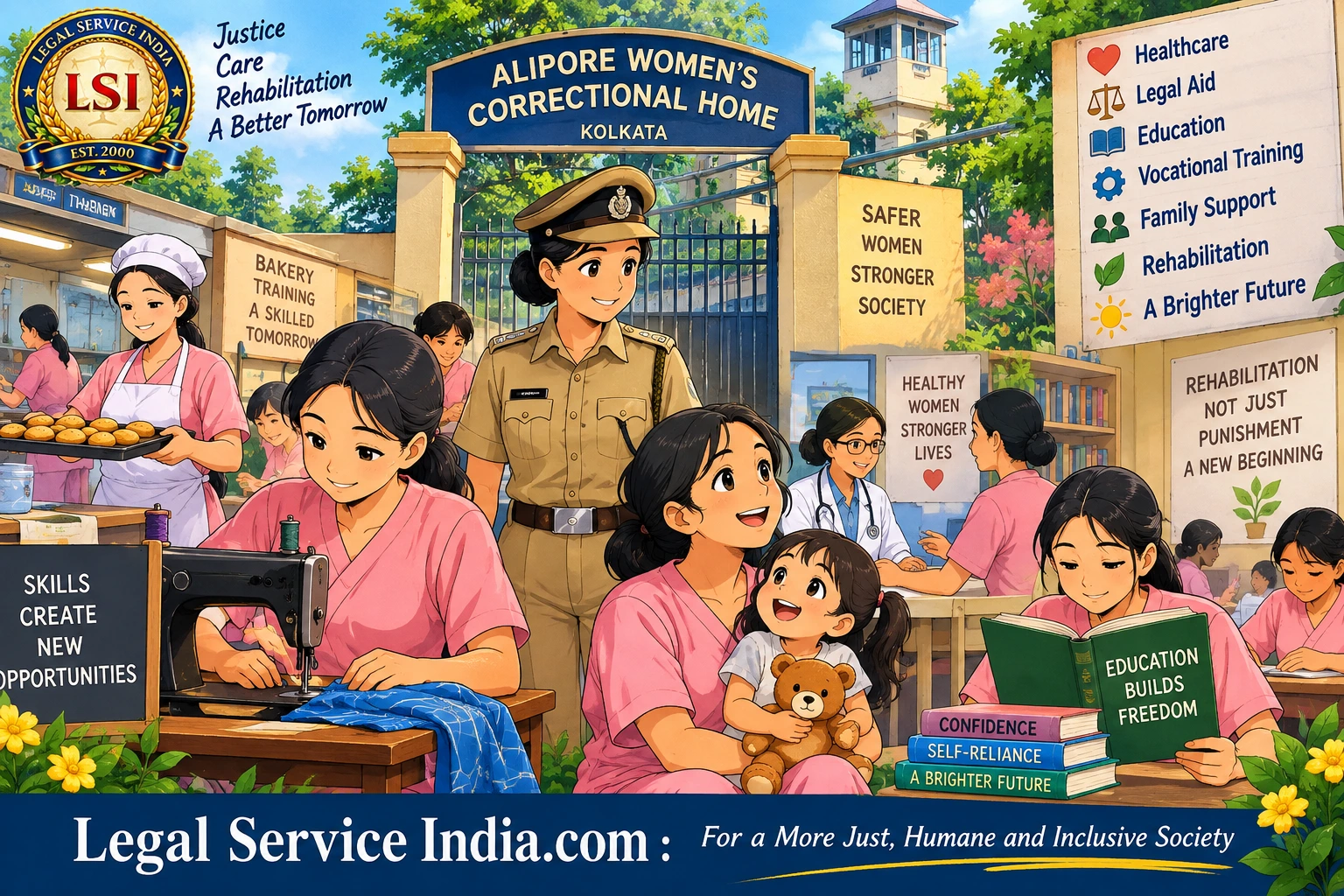
The correctional home has a bakery unit producing cakes, biscuits, garlic bread, bread and pizzas. Some prisoners working in the bakery have received training from institutions such as Taj Bengal and the Institute of Hotel Management.
To help incarcerated women build practical skill sets for financial independence after release, the institution collaborates closely with non-governmental organisations to deliver targeted vocational training. Through these partnerships, inmates learn various practical trades, including stitching, embroidery, candle-making, mushroom cultivation, and the production of sanitary napkins.
These activities give women practical skills that can help them earn a livelihood after release.
Women prisoners have also participated in dance-drama performances in public places within West Bengal and other states. Such activities can improve confidence, creativity and social skills.
The larger objective is rehabilitation. If a woman can obtain employment after release, she may become financially independent and may be less likely to return to crime.
Education, Library and Cultural Activities
Education is another important part of rehabilitation. Interested prisoners can obtain books from the correctional home library. Adult education is provided with the help of NGOs and educated inmates.
Women prisoners who wish to continue their education are given opportunities to pursue higher qualifications. According to reports, some inmates have passed their secondary examination, and one inmate appeared for the higher secondary examination.
Prisoners are also provided opportunities for recreation, games, reading newspapers and participating in cultural activities.
Religious and cultural festivals and important occasions such as Saraswati Puja, Eid, Durga Puja, International Women’s Day and Rabindra Jayanti are observed in the correctional home.
These activities help maintain a connection with society and culture and contribute to the emotional well-being of prisoners.
Care of Children Living with Their Mothers
One of the most sensitive aspects of managing women prisoners is the care of children who live with their mothers inside the correctional home.
At Alipore Women’s Correctional Home, children living with their mothers or grandmothers are treated as non-prisoner inmates. The administration follows the guidelines of the Supreme Court of India laid down in R.D. Upadhyay v. State of A.P. and Others, dated 13 April 2006, concerning children living with their mothers in correctional homes.
The children are provided special medical diets and educational support. An NGO runs an informal school inside the correctional home. The school has toys and a children’s library so that the children’s mental and educational development is not neglected.
There is also a “Shishu Alay”, an Integrated Child Development Services (ICDS) Centre run by the Social Welfare Department of the Government of West Bengal.
The basic principle is that a child should not be treated as a prisoner merely because the child’s mother is in prison.
Support After Release
The responsibility of the correctional home does not necessarily end when a prisoner receives a release order. Efforts are made to ensure that a family member comes to receive the released woman and that she reaches home safely.
However, some women may have no family support. There are cases in which prisoners were unable to remember their addresses because of amnesia and their families could not be traced. In such situations, after efforts to locate their families failed, the women were sent through proper procedures to government homes with the assistance of the Social Welfare Department.
In one case, a woman who was paralysed in the lower part of her body was not received by her family after release. A safe place was arranged for her in a government home through the Social Welfare Department.
These examples show that rehabilitation is not simply about releasing a prisoner. For vulnerable women, safe reintegration into society may require continued institutional support.
Also Read: Can America Reform the Supreme Court? Latest 5–4 Ruling Reignites Term Limits Debate
A Correctional Approach Based on Care and Rehabilitation
The management of Alipore Women’s Correctional Home is described as being based on the West Bengal Jail Code, the West Bengal Correctional Services Act, 1992, and various government and court orders and guidelines.
The administration seeks to maintain a balance between discipline and welfare. Along with security, attention is given to the educational, moral, cultural and vocational development of women prisoners.
This approach is important because imprisonment should not permanently destroy a person’s ability to return to society. Education, healthcare, family contact, vocational training and counselling can help women rebuild their lives.
Need for More Women’s Correctional Homes
There is only one correctional home exclusively for women in West Bengal, located in Kolkata. At the same time, around 1,813 women prisoners are accommodated in different correctional homes across the state.
This situation highlights the need for more women’s correctional homes with adequate infrastructure, healthcare facilities, educational opportunities and vocational training.
Where men and women are accommodated in the same correctional home, women may have to remain in separate and restricted areas. More dedicated facilities could provide women prisoners with better access to healthcare, education, recreation, counselling and rehabilitation programmes.
Scope for Operational Improvement
To strengthen rehabilitation, future policy should move beyond traditional vocational trades and introduce market-aligned skill training such as digital literacy and financial management, supported by corporate placement pipelines and e-commerce channels for inmate-produced goods. Consistent mental health care can be ensured by appointing full-time resident clinical psychologists specialising in trauma-informed therapy and addiction treatment, rather than relying solely on periodic NGO visits. In addition, institutionalising halfway homes and structured transitional housing in partnership with the Social Welfare Department would provide a vital safety net for destitute or socially rejected women upon release, ensuring that rehabilitative gains achieved during incarceration translate into sustainable reintegration within the community.
To improve hygiene, sanitation, and living conditions in correctional barracks, prison floors should, wherever feasible, be upgraded from plain cement to tiles or other smooth, washable flooring, which can be cleaned, disinfected, and maintained more effectively. Equally important, prisoners suffering from contagious or infectious diseases should be provided with appropriate medical care and, where medically necessary, separate, adequately furnished accommodation with proper isolation facilities to reduce the risk of infection spreading to other prisoners. Such measures would improve health and sanitation standards while also promoting human dignity, humane treatment, and constitutional safeguards in prison administration.
Conclusion
The management of female prisoners demands a framework that extends far beyond custodial security and discipline. Incarcerated women present complex social, physical, and psychological needs rooted in histories of poverty, domestic abuse, exploitation, and family separation—vulnerabilities that set them apart from male inmates.
The Alipore Women’s Correctional Home illustrates a holistic penal approach. By integrating legal aid, specialised healthcare, mental health counselling, tailored nutrition, structured family contact, vocational training, education, and post-release support, it offers a functional blueprint for reform. Crucially, this approach prioritises the welfare of pregnant women, nursing mothers, and co-residing children, ensuring that young minors are protected from the detrimental environments of incarceration through adequate education, healthcare, and developmental care.
With 409 female inmates at Alipore and approximately 1,813 across West Bengal as of September 2026, the data underscores an urgent need to expand institutional capacity. Establishing additional dedicated women’s correctional facilities equipped with specialised infrastructure and medical care is essential to ensure safe, dignified, and humane conditions statewide.
Ultimately, effective correctional management must aim not merely to confine but to preserve human dignity, address gender-specific needs, build self-reliance, and prepare women for a safe, productive return to society. This remains the core mandate of a truly reformative correctional system.

