Introduction
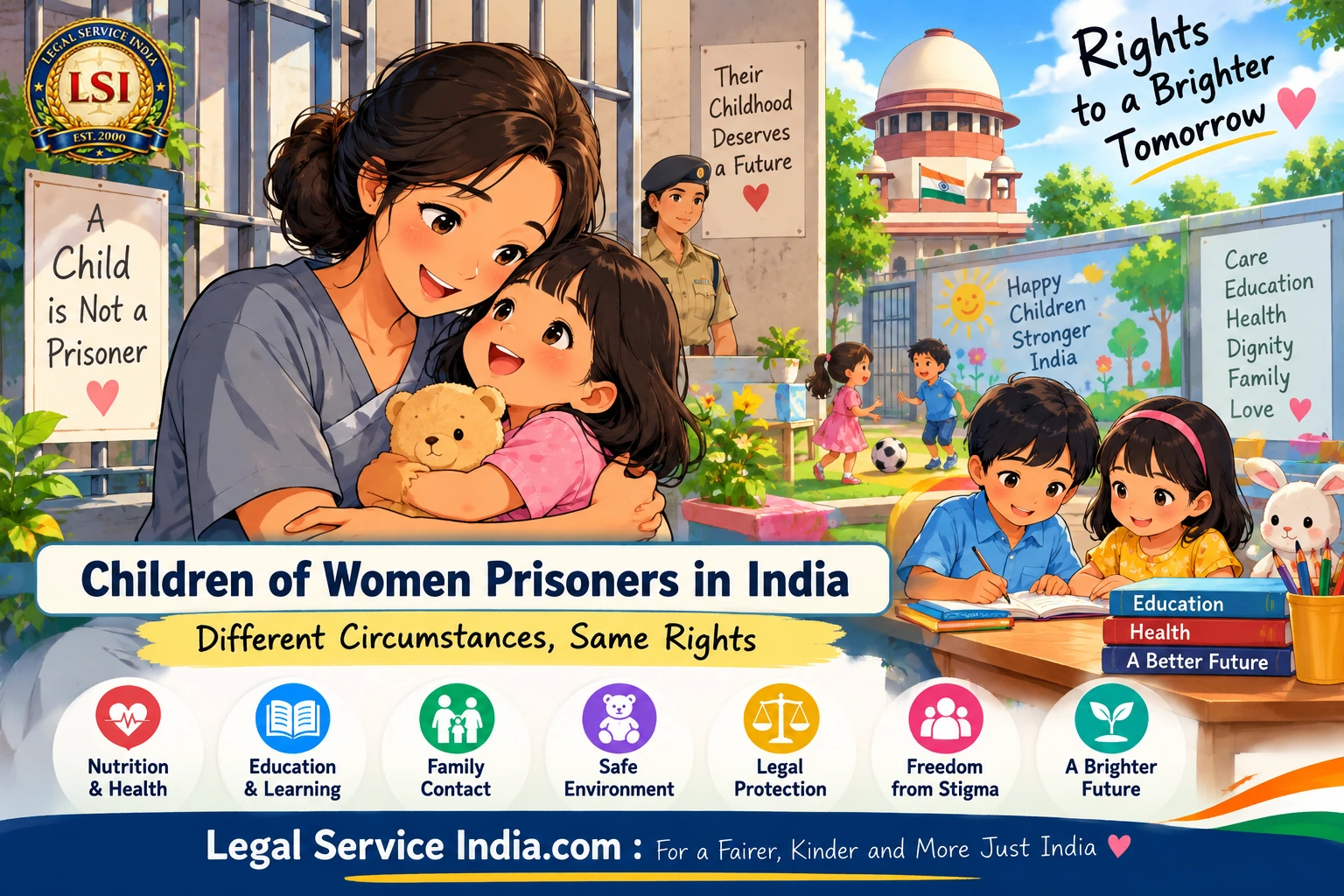
When a woman is arrested or imprisoned, her young child may enter prison with her or, in some cases, be born there. The child has committed no offence and must never be treated as a prisoner. Yet, by living with an incarcerated mother, the child can be exposed to restricted surroundings, lack of open space, stigma, separation from family, emotional stress and limited educational and recreational opportunities. The basic principle should therefore be simple: the punishment of a mother must never become the punishment of her child.
The latest available NCRB data for 31 December 2024 show that 1,196 women prisoners were living with 1,397 children across India. Of these women, 933 were undertrials accompanied by 1,096 children, while 243 convicted women were accompanied by 272 children and 20 women in the “other” category by 29 children. These figures show why child protection must remain an important part of prison administration. They also underline the importance of reducing unnecessary detention of women, particularly undertrial prisoners who have not been convicted.
The Child Is Not a Prisoner
The legal position in India is clear. In the landmark judgement of R.D. Upadhyay v. State of Andhra Pradesh, (2007) 15 SCC 337, the Supreme Court recognised children living with imprisoned mothers as separate rights-holders. The Court made it clear that such a child cannot be treated as an undertrial or convict. The child is entitled, as a matter of right, to food, shelter, medical care, clothing, education and recreation.
The Supreme Court’s Directions Include:
- A woman prisoner may keep her child with her until the child reaches six years of age.
- After six years, the child should ordinarily be placed with a suitable relative/surrogate or an appropriate Social Welfare Department institution, taking the mother’s wishes into account.
- As far as possible, the child should remain in the same town or city so that the relationship with the mother can continue.
- Children separated from their mothers should have regular visitation, including the possibility of weekly meetings under the court’s guidelines.
- Children must receive adequate food, clothing, clean drinking water, medical care, vaccination and regular health monitoring.
- Prisons should provide creches and nurseries, education and recreational opportunities.
- The sleeping arrangements for mother and child must be clean, safe and hygienic.
- If a child is born in prison, the birth must be registered, but the birth certificate should not disclose that the child was born in prison; only the locality/address is to be mentioned.
- Pregnant prisoners should receive proper antenatal and postnatal care, and, wherever possible, arrangements should be made for delivery outside prison.
These are not merely welfare measures. They flow from the child’s basic rights to dignity, health, development and family relationships.
The Six-Year Limit Must Be Handled with Care
The age of six is an important legal safeguard, but separation at that age can be emotionally difficult. The process should therefore begin well before the child turns six. Prison authorities should identify the child’s future carer, consult the mother, verify the safety of the proposed placement and coordinate with the District Child Protection Unit and other child-welfare authorities.
A child should not simply be removed from the mother on the sixth birthday and sent to an unfamiliar institution. The best interests of the child should guide the transition. Wherever a safe and suitable family member is available, family-based care should ordinarily be preferred, subject to child-protection requirements.
Nutrition, Health and Early Childhood Care
The first six years of life are critical for physical and brain development. A prison nursery should therefore not be treated as merely a place where children are kept while their mothers work. It should function as a child-development space.
Every Child Should Receive:
- nutritious and age-appropriate food;
- milk and other dietary supplements wherever medically required;
- regular health examinations;
- complete immunisation;
- growth monitoring;
- dental and eye examinations;
- mental health and psychosocial support where required;
- clean drinking water and sanitation;
- adequate sleeping arrangements;
- toys, books and age-appropriate learning material;
- safe indoor and outdoor play areas; and
- access to preschool education and Anganwadi services.
The R.D. Upadhyay judgement specifically required creches and nurseries and recognised the importance of education and recreation for children living in prisons.
Education and a Normal Childhood
A prison should not become a child’s world. Wherever security and the child’s best interests permit, children should have opportunities to attend appropriate schools or preschool programmes outside the correctional home. They should be able to participate in sports, cultural activities, educational visits and age-appropriate social activities.
Children should also have access to books, computers and educational technology where appropriate. Contact with grandparents, siblings and other close family members should be encouraged when it is safe and beneficial.
The aim should be to create as normal a childhood as possible, despite the mother’s incarceration.
Protection from Stigma
One of the greatest dangers is the stigma attached to being the child of a prisoner. A child must never be made to feel that he or she is responsible for the mother’s alleged or proven offence.
Officials, teachers, healthcare workers and other persons dealing with these children should maintain confidentiality and use respectful language. The child’s school records and official documents should not unnecessarily reveal the mother’s imprisonment or the child’s residence in a correctional home.
The Supreme Court’s direction that a birth certificate should not disclose that a child was born in prison is particularly important in protecting the child’s dignity and future.
Mothers’ Rights Are Closely Linked to Children’s Rights
Protecting children also requires protecting their mothers. A large proportion of women living with children in prison are undertrial prisoners. The latest 2024 data show that 933 of the 1,196 women living with children were undertrials.
This makes speedy judicial review, effective legal aid and timely consideration of bail particularly important. Every unnecessary day of detention can also mean another day of a child’s restricted life.
Undertrial women should therefore receive prompt legal assistance, regular case review and information about their legal rights. Where the law permits bail or other non-custodial measures, courts and authorities should carefully consider the welfare of dependent children.
The Supreme Court’s continuing proceedings in Re: Inhuman Conditions in 1382 Prisons, W.P. (C) No. 406 of 2013, have repeatedly addressed overcrowding, healthcare, legal aid and Under-Trial Review Committees. The Court has also specifically referred to the need to implement the earlier R.D. Upadhyay directions concerning children of women prisoners.
Recent Supreme Court Oversight
The issue has not ended with the 2006 judgement. In the continuing Re: Inhuman Conditions in 1382 Prisons proceedings, the Supreme Court has monitored compliance with prison-reform measures, including issues concerning children of women prisoners. In a 2018 order, the Court noted that despite the earlier R.D. Upadhyay judgement, there was insufficient evidence of compliance and directed attention to the requirements concerning children of women prisoners.
The Court continued to monitor prison conditions in later years. In its 2024 proceedings, reports from several states, including West Bengal, were considered in relation to continuing prison-reform issues.
The Local Picture
West Bengal’s experience illustrates the importance of implementing these safeguards at the ground level. NCRB’s 2023 data recorded 170 women prisoners living with 214 children in West Bengal, placing the state second nationally after Uttar Pradesh in the number of women prisoners living with children.
The same NCRB data recorded 25,774 prisoners against a sanctioned capacity of 21,476 in West Bengal, an occupancy rate of about 120%. Overcrowding affects the overall prison environment and makes it more difficult to provide adequate space, healthcare, sanitation, recreation and child-friendly facilities.
West Bengal has also attracted judicial attention concerning pregnant prisoners and children in correctional homes. In 2024, the Supreme Court took cognisance of issues concerning pregnancies and births in West Bengal prisons, demonstrating that the protection of mothers and children remains a live constitutional and administrative concern.
The authorities therefore need to ensure that every correctional home housing mothers with children has adequate child-care arrangements, trained female staff, medical support, nutrition, preschool facilities, safe play areas and effective arrangements for maintaining family contact.
The New National Prison-Reform Framework
Prison administration is a state subject, but the Union Government has been strengthening the national framework. The Ministry of Home Affairs prepared the Model Prisons and Correctional Services Act, 2023, and circulated it to States and Union Territories in May 2023 for adoption with suitable modifications. The MHA has also issued subsequent advisories and amendments concerning prison administration and implementation of Supreme Court directions.
This provides an opportunity for states to move beyond the traditional idea of a prison as a place of confinement and develop child-sensitive and gender-responsive correctional institutions.
What Should Be Done
A stronger system for children living with imprisoned mothers should include:
| Priority Area | Recommended Safeguard |
|---|---|
| Child-Care Planning | Individual child-care plans for every child entering a correctional home. |
| Child Protection | Immediate registration with child-welfare authorities without treating the child as an offender. |
| Health | Regular health and developmental assessments by qualified medical professionals. |
| Early Childhood Care | Functional creches and nurseries with trained carers. |
| Education | Anganwadi and preschool services inside or near correctional homes. |
| Recreation | Safe outdoor play areas and regular recreational activities. |
| Nutrition | Nutritious, age-specific diets supervised by medical and nutrition professionals. |
| Schooling | Regular schooling outside prison, wherever feasible and in the child’s best interests. |
| Mental Health | Counselling and psychological support for both mothers and children. |
| Family Contact | Regular family visits and meaningful contact with grandparents and siblings. |
| Transition at Six | Advance planning before the child turns six, rather than sudden separation. |
| Family-Based Care | Family-based care wherever safe and suitable, instead of institutionalisation as the first option. |
| Legal Aid | Effective legal aid and speedy case review for mothers who are undertrial. |
| Independent Oversight | Regular inspections by judicial authorities, Boards of Visitors, Human Rights Commissions and child-protection authorities. |
| Data and Follow-Up | Proper data collection and follow-up after children leave the correctional home. |
Conclusion
Children living with imprisoned mothers are innocent children, not prisoners. Their presence inside a correctional home should never deprive them of the rights enjoyed by other children. India already has a strong legal foundation through the Supreme Court’s decision in R.D. Upadhyay v. State of Andhra Pradesh and its continuing prison-reform jurisprudence. The challenge now is to ensure that these safeguards are implemented uniformly and effectively.
The latest NCRB figures show that more than 1,300 children were living with their imprisoned mothers at the end of 2024. Each number represents a real child whose future must not be determined by the circumstances of the mother’s imprisonment.
The goal should therefore be clear: a child may temporarily live inside a prison, but the child must never be allowed to grow up as a prisoner. We must ensure that every such child receives nutrition, healthcare, education, love, family contact, recreation, dignity and a safe transition to life outside prison.