





Introduction
Trademark disputes often involve not just competing business interests but also the authority of courts to enforce their orders. The Delhi High Court’s judgment dated 02 July 2026 in Jain Shikanji Pvt. Ltd. v. Satish Kumar Jain highlights the serious consequences of willfully disobeying court injunctions in intellectual property matters.
In this case, a company and its director faced contempt proceedings for continuing to use a similar trademark despite a clear injunction. The ruling is significant for businesses, trademark owners, legal practitioners, and litigants, as it demonstrates the judiciary’s firm stance against parties who flout court orders through evasion or delay tactics. It serves as a strong reminder that apologies alone may not suffice when there is repeated defiance, while also balancing justice with limited relief in appropriate cases. The decision strengthens the rule of law in commercial and IP litigation.
Factual and Procedural Background
The dispute began when Satish Kumar Jain filed a commercial suit seeking a permanent and mandatory injunction against trademark infringement and passing off for his mark “JAIN SHIKANJI / JAIN SHIKANJI PVT. LTD.” Jain Shikanji Pvt. Ltd., incorporated in November 2019, was the defendant in the suit.
On 05 November 2022, the trial court (commercial court) granted an interim injunction restraining the defendant company from using the mark “JAIN SHIKANJI” or any deceptively similar mark. The defendant’s appeal against this order was dismissed by the High Court on 01 March 2023.
Despite the injunction, the plaintiff alleged continued violation. After issuing a notice and receiving a reply, the plaintiff filed an application under Order XXXIX Rule 2A CPC for contempt. On 03 June 2023, the trial court held the company’s director, Mr. Anubhav Jain, guilty of willful disobedience. It ordered attachment of properties for six months and civil imprisonment for eight weeks, directing him to surrender within 15 days.
The defendant challenged this before the High Court. While an initial stay on surrender was granted, the Division Bench dismissed the appeal on 17 September 2025, upheld the contempt findings, and directed surrender. A special leave petition and review petition before the Supreme Court and High Court were withdrawn.
Mr. Anubhav Jain did not surrender and allegedly remained untraceable. He later filed an application with an unconditional apology affidavit. The trial court rejected it on 01 June 2026, issued fresh warrants, and imposed costs of Rs. 5 lakhs. The present petition under Article 227 challenged this order.
Case Timeline
| Date | Event |
|---|---|
| November 2019 | Jain Shikanji Pvt. Ltd. incorporated. |
| 05 November 2022 | The trial court granted an interim injunction. |
| 01 March 2023 | The Delhi High Court dismissed the appeal against the injunction. |
| 03 June 2023 | The director was held guilty of willful disobedience under Order XXXIX Rule 2A CPC. |
| 17 September 2025 | The division bench upheld contempt findings and directed surrender. |
| 01 June 2026 | The trial court rejected the apology, issued fresh warrants, and imposed Rs. 5 lakh in costs. |
| 02 July 2026 | Delhi High Court decided the present petition. |
Dispute Before the Court
The main issue was whether the trial court erred in rejecting the unconditional apology and issuing fresh warrants of arrest, attachment of properties, and costs for continued disobedience.
Petitioner’s Contentions
- Mr. Anubhav Jain intended to comply.
- His non-appearance was unintentional and due to stress.
- He should have been allowed to appear through video conferencing.
- The coercive directions should be set aside.
- The unconditional apology should be accepted.
Respondent’s Contentions
- The petitioner deliberately defied judicial orders.
- There were repeated violations of the injunction.
- The petitioner attempted to mislead the court.
- The trial court and Division Bench orders had already attained finality.
- No interference under Article 227 was warranted.
Reasoning and Analysis of the Court
The High Court examined the entire chronology and found no legal or factual infirmity in the impugned order. It relied on the principle that contempt proceedings under Order XXXIX Rule 2A CPC are meant to uphold the dignity of the court and ensure compliance with injunctions, especially in ongoing commercial suits.
The Court noted serious observations from earlier judgments: the defendant had willfully violated the injunction, given false undertakings, and continued business under the disputed mark. Despite multiple opportunities and directions from the trial court and division bench to surrender and purge the contempt, Mr. Anubhav Jain absconded and failed to appear even when the matter was passed over.
The Court rejected the plea of stress as a valid excuse for non-compliance with judicial orders. It also addressed the video conferencing request, observing that while permissible in normal circumstances, it was not acceptable when higher courts had specifically directed physical surrender to enforce punishment. The petitioner could not selectively choose the mode of appearance while defying the substance of the orders.
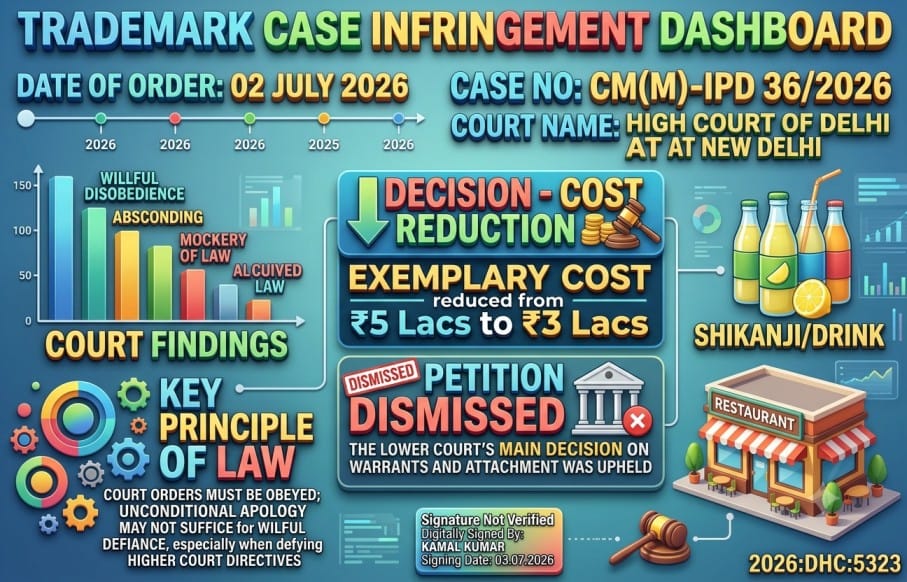
The judgment emphasizes that unconditional apologies must be bona fide and backed by genuine remorse and compliance. Here, the conduct showed the opposite—an attitude of defiance. However, considering the petitioner’s request during arguments, the Court exercised discretion to reduce the exemplary costs from Rs. 5 lakhs to Rs. 3 lakhs, payable within two weeks.
Key Observations of the Court
- Order XXXIX Rule 2A CPC exists to enforce compliance with injunctions.
- Willful disobedience cannot be excused by delay tactics or evasion.
- Stress is not a valid justification for ignoring court orders.
- Video conferencing cannot replace physical surrender when specifically directed by the court.
- An unconditional apology must reflect genuine remorse and actual compliance.
- Courts retain discretion to modify ancillary directions such as costs in appropriate circumstances.
Final Decision of the Court
The High Court dismissed the petition under Article 227. It upheld the trial court’s order dated 01 June 2026, including fresh warrants of arrest and attachment of properties. The exemplary costs were reduced to Rs. 3 lakhs to be paid to the respondent within two weeks. The petition and pending application were disposed of accordingly.
Point of Law Settled
This judgment reaffirms that willful disobedience of court orders in trademark and commercial matters attracts strict consequences, including civil imprisonment and property attachment under Order XXXIX Rule 2A CPC. It clarifies that mere filing of an unconditional apology is insufficient if the contemnor shows continued defiance, evasion, or lack of genuine remorse. Courts can reject such apologies and enforce coercive measures. At the same time, it shows limited judicial discretion to modify ancillary directions like costs when parties show willingness to comply at the appellate stage. The ruling will guide future contempt cases, discouraging delay tactics and reinforcing respect for judicial authority in IP litigation.
Case Summary
| Title of the Case | Jain Shikanji Pvt. Ltd. Vs Satish Kumar Jain |
|---|---|
| Date of Judgment/Order | 02 July 2026 |
| Case Number | CM(M)-IPD 36/2026 |
| Neutral Citation | 2026:DHC:5323 |
| Name of Court | High Court of Delhi |
| Name of Honorable Judge | Jyoti Singh, J. |
| Written By | Advocate Ajay Amitabh Suman, IP Adjutor (Patent and Trademark Attorney), High Court of Delhi |
Key Legal Takeaways
- Willful violation of trademark injunctions may result in contempt proceedings.
- Order XXXIX Rule 2A CPC empowers courts to order civil imprisonment and attachment of property.
- Repeated defiance of court orders weakens the credibility of an unconditional apology.
- Courts expect complete compliance with judicial directions before considering equitable relief.
- The judgment reinforces judicial authority in intellectual property and commercial litigation.
Disclaimer
Images used herein do not reflect actual images used in Judgement, and the same are for illustrative purposes only. Readers are advised not to treat this as a substitute for legal advice, as it may contain errors in perception, interpretation, and presentation.

