





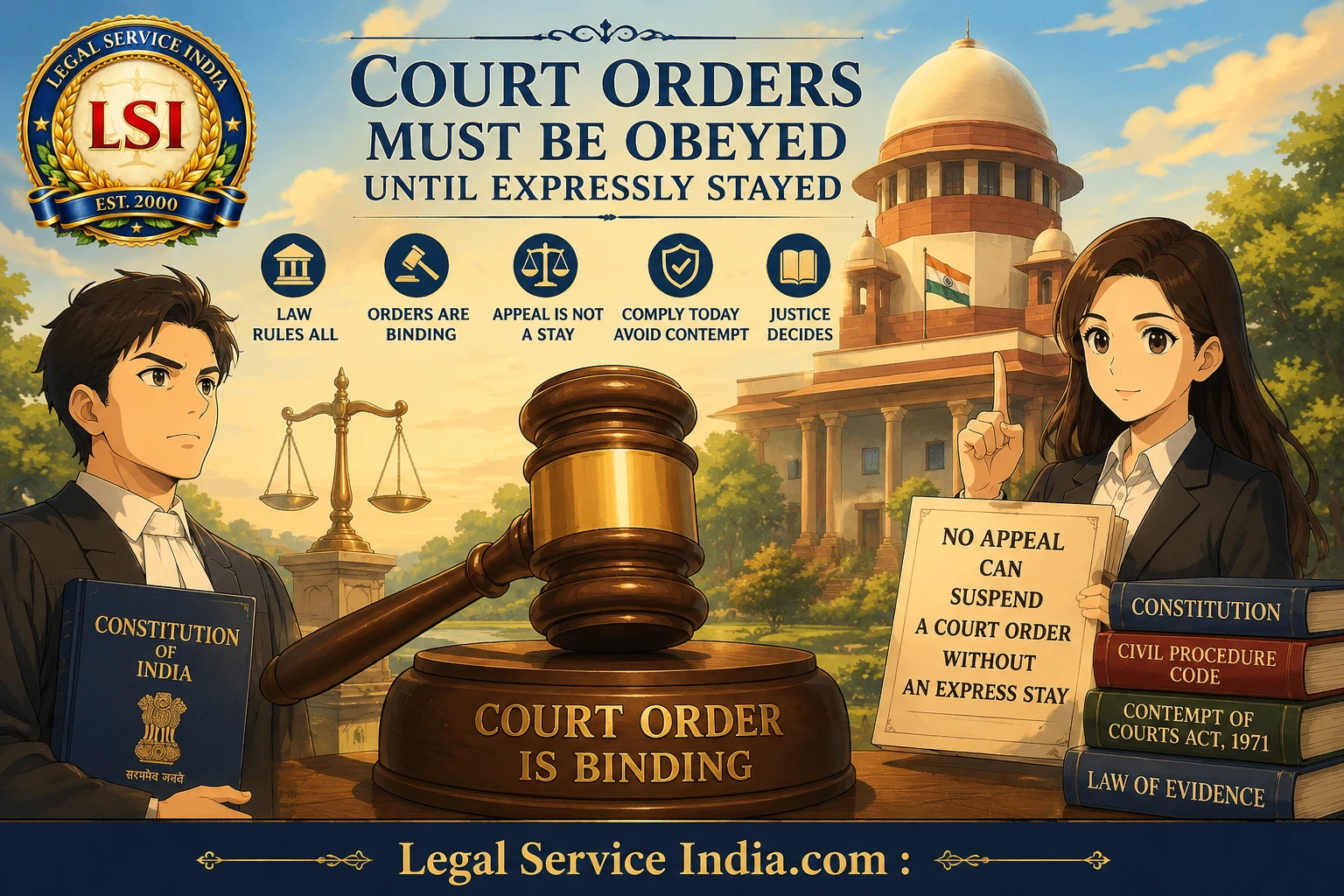
The Binding Force of Court Orders in India: Compliance Until Expressly Stayed
The proposition that a valid court order must be obeyed in full — verbatim — unless and until its operation is expressly stayed by a competent higher court is among the most foundational principles of Indian jurisprudence. This article traces that principle from its constitutional moorings in Articles 141, 226, 227, and 215 of the Constitution of India through landmark Supreme Court pronouncements in Kamalakshi Finance Corporation (1991) and a continuous line of authority down to Celir LLP (2024). It examines the doctrine across revenue and departmental compliance, civil execution, constitutional writ jurisdiction, and contempt law and draws practical guidance for the private litigants, advocates and state functionalities alike.
I. Introduction: The Imperative of Compliance
The rule of law in a constitutional democracy rests not merely on the pronouncement of judicial orders but on their faithful, timely, and complete execution. An order that is pronounced but not obeyed is, in practical terms, no order at all — it becomes a pious declaration, hollow of effect, mocking the very institution that pronounced it.
The Supreme Court of India has, across decades, repeatedly affirmed that the binding character of a court order is not suspended by a party’s dissatisfaction, by the pendency of an appeal, or by a departmental or administrative decision to challenge the order before a higher forum.
The principle may be stated simply:
- An order passed by a court of competent jurisdiction is operative from the moment of its pronouncement.
- It must be obeyed literally and in full by every person and authority to whom it is directed.
- The obligation continues until a court of competent jurisdiction expressly stays its operation.
- Nothing short of an express stay granted by a superior court can relieve a party of its obligation to comply.
Core Proposition
A court order must be obeyed verbatim from the date of its pronouncement. Mere filing of an appeal, revision, or SLP — without an express stay — does not suspend its binding force. Disobedience in the absence of a stay is actionable as civil contempt under Section 2(b) of the Contempt of Courts Act, 1971.
Key Principles at a Glance
| Principle | Position in Law |
|---|---|
| Effect of a Court Order | Operative from the moment it is pronounced. |
| Filing of Appeal | Does not automatically suspend the order. |
| Filing of Revision | Does not relieve the party from compliance. |
| Filing of SLP | Does not stay the operation of the impugned order. |
| Requirement for Non-Compliance | An express stay by a competent superior court is necessary. |
| Consequence of Disobedience | May amount to civil contempt under Section 2(b) of the Contempt of Courts Act, 1971. |
Why This Principle Matters
- Preserves the authority and dignity of courts.
- Ensures certainty and finality in judicial proceedings.
- Protects litigants from administrative or departmental defiance.
- Strengthens constitutional governance and the rule of law.
- Prevents judicial orders from becoming ineffective during appellate challenges.
II. Constitutional Foundations
A. Article 141 — Law Declared by the Supreme Court
Article 141 of the Constitution provides that the law declared by the Supreme Court shall be binding on all courts within the territory of India. This has been construed not merely as a rule of precedent for the future but as a mandate of immediate compliance: every court, tribunal, and authority subordinate to the Supreme Court is bound to follow its decisions and orders, and any failure to do so is a constitutional dereliction.
State of U.P. v. Synthetics & Chemicals Ltd. — (1991) 4 SCC 139 [Supreme Court of India]
Article 141 is not merely a rule of precedent. It is a constitutional directive. All courts and tribunals in India — including administrative tribunals and revenue authorities — are bound to follow the law as declared by the Supreme Court. Any authority that knowingly departs from a Supreme Court ruling acts in breach of the Constitution itself.
| Constitutional Provision | Key Principle |
|---|---|
| Article 141 | Law declared by the Supreme Court is binding on all courts and tribunals in India. |
| Effect | Immediate and mandatory compliance by subordinate authorities. |
| Violation | Departure from Supreme Court law constitutes a breach of constitutional duty. |
B. Articles 226 and 227 — High Court’s Supervisory Jurisdiction
Under Articles 226 and 227, the High Court exercises original and supervisory jurisdiction over all courts and tribunals within its territorial limits. Orders passed by the High Court are binding on all inferior courts, tribunals, and administrative bodies within the state.
The Allahabad High Court in Mohan Lal Santwani [(2022) 449 ITR 476 (All)] articulated the constitutional architecture with precision:
“Just as judgements and orders of the Supreme Court have to be faithfully obeyed and carried out throughout the territory of India under Article 141 of the Constitution, so should be judgements and orders of the High Court by all inferior courts and tribunals subject to supervisory jurisdiction within the State under Articles 226 and 227.”
- High Courts exercise supervisory jurisdiction over subordinate courts and tribunals.
- Orders of the High Court are binding within the state.
- Administrative authorities are equally bound by High Court directions.
- Faithful implementation is a constitutional obligation, not a matter of discretion.
C. Article 215 — High Court as Court of Record
Article 215 declares every High Court to be a court of record, possessing the power to punish for contempt of itself. This provision gives the compliance obligation a direct constitutional enforcement mechanism: disobedience of a High Court order is punishable as contempt of the court of record.
The power to punish for contempt is inherent and cannot be ousted by any subordinate legislation.
| Article | Constitutional Effect |
|---|---|
| Article 215 | Every High Court is a court of record. |
| Contempt Power | Authority to punish disobedience of its orders. |
| Nature of Power | Inherent constitutional power that cannot be removed by subordinate legislation. |
D. Article 300A — Right to Property
Where non-compliance results in continued retention of property contrary to a court order, a distinct constitutional violation arises. Article 300A provides that no person shall be deprived of his property save by authority of law.
Once a court directs the return of property, any further retention is without authority of law and is an independent constitutional wrong.
- Article 300A protects the right to property.
- Property can be deprived only by authority of law.
- Retention of property after a court-ordered return is unconstitutional.
- Such retention constitutes an independent constitutional violation.
III. The Leading Authority: Kamalakshi Finance Corporation
Union of India v. Kamalakshi Finance Corporation Ltd — 1991 (55) ELT 433 (SC) = 1991 (9) TMI 72 (SC) (1992) 1 SCC 648
[Supreme Court of India, 1991]
The principles of judicial discipline require that the orders of the higher appellate authorities should be followed unreservedly by the subordinate authorities. The mere fact that the order of the appellate authority is not acceptable to the Department, or that it is the subject matter of an appeal, can furnish no ground for not following it unless its operation has been suspended by a competent court.
Kamalakshi Finance Corporation is the locus classicus on the verbatim compliance doctrine in Indian law. The facts arose in a Central Excise dispute where the revenue department declined to implement an appellate order on the ground that it had filed — or intended to file — a further appeal.
The Supreme Court firmly rejected this position and laid down four clear propositions:
- Judicial discipline and propriety are essential and significant facets of the administration of justice.
- Orders of higher appellate authorities must be followed unreservedly by all subordinate authorities.
- Neither disagreement with the order, nor the pendency of a further appeal, relieves the subordinate authority of its obligation to comply.
- The sole exception: the operation of the order must have been stayed by a court of competent jurisdiction.
Key Principles from Kamalakshi Finance
| Principle | Legal Position |
|---|---|
| Judicial Discipline | Mandatory for the proper administration of justice. |
| Binding Nature of Orders | Higher appellate orders must be followed unreservedly. |
| Pendency of Appeal | Not a valid ground for non-compliance. |
| Disagreement with Decision | Does not permit subordinate authorities to ignore the order. |
| Only Exception | A valid stay granted by a competent court. |
The word ‘unreservedly’ used by the court is significant. It admits of no qualification, no condition, and no postponement. Compliance is not optional; it is not a matter of administrative convenience; it is a constitutional and legal imperative.
IV. Revenue and Departmental Compliance — Further Authorities
The following judicial precedents reinforce the principle that revenue and departmental authorities must promptly and faithfully comply with appellate and judicial orders unless a competent superior court grants a stay.
A. Collector of Central Excise, Kanpur v. Krishna Carbon Paper Co.
AIR 1988 SC 2223; 1988 (9) TMI 50 (SC) [Supreme Court of India, 1988]
Revenue must obey appellate orders unless stayed. The revenue authority cannot decline to implement an appellate order on the ground that it disagrees with the decision or intends to pursue a further appeal. The obligation to comply is immediate and unconditional, subject only to an express stay by a superior court.
This case predates Kamalakshi by three years and demonstrates the deep roots of the principle in Indian revenue jurisprudence. The Court emphasised that no departmental process — internal review, reference to a higher officer, or pendency of an appeal — can suspend the binding character of an appellate order.
B. Shri Vallabh Glass Works Ltd. v. Union of India
AIR 1984 SC 971; 1984 (3) TMI 64 (SC) [Supreme Court of India, 1984]
Delay in implementing relief is harassment. Non-implementation of a court or appellate authority’s order is not merely a technical lapse. Where relief has been granted and its implementation is unduly delayed or resisted, it amounts to harassment of the successful party and a violation of their legitimate expectation of justice.
Vallabh Glass Works introduced the timeliness dimension to the compliance doctrine. It is not enough that an order is eventually obeyed; it must be obeyed promptly. Undue delay in giving effect to an appellate or court order is itself a wrong, capable of generating liability and attracting the court’s coercive jurisdiction.
C. Commissioner of Customs & C. Ex., Ahmedabad v. Kumar Cotton Mills Pvt. Ltd.
2005 (1) TMI 114 (SC) [Supreme Court of India, 2005]
Implementation of appellate orders cannot be stalled by departmental processes. Even where the department has set in motion an internal review, issued a show cause notice, or contemplated a further appeal, none of these processes can justify withholding compliance with a subsisting appellate order.
This decision is particularly significant for practitioners in customs, excise, and GST disputes. Departmental authorities occasionally use procedural mechanisms — show-cause notices, internal reviews, references to head offices — as pretexts for non-implementation of appellate relief. The Supreme Court firmly forecloses all such manoeuvres.
D. Commissioner of Income Tax v. Smt. Anjum M.H. Ghaswala
(2001) 252 ITR 1 (SC) [Supreme Court of India, 2001]
Courts and authorities must act in strict conformity with the orders passed by superior courts. Where a party obtains a positive direction from a High Court or tribunal, the authority to whom the direction is addressed must act in strict conformity with the terms of the direction. Any departure from the terms of the order constitutes non-compliance and is actionable.
E. State of U.P. v. Harish Chandra & Ors. — Principle of Immediate Effect
(1996) 9 SCC 309 [Supreme Court of India, 1996]
An administrative order or instruction that conflicts with a subsisting court order cannot prevail. The court order operates with immediate effect and displaces any contrary executive action. The State cannot issue instructions to its subordinate officers to act in derogation of a court’s direction on the ground that it disagrees with the direction or intends to challenge it.
Key Principles Emerging from These Decisions
| Case | Core Principle |
|---|---|
| Krishna Carbon Paper Co. | Appellate orders must be obeyed unless specifically stayed. |
| Vallabh Glass Works | Delay in implementation amounts to harassment and denial of justice. |
| Kumar Cotton Mills Pvt. Ltd. | Departmental reviews and procedural steps cannot justify non-compliance. |
| Anjum M.H. Ghaswala | Authorities must strictly follow the terms of superior court directions. |
| Harish Chandra | Court orders take immediate effect and override contrary executive instructions. |
Compliance Doctrine in Revenue Administration
- Appellate orders are binding on subordinate authorities.
- Compliance is mandatory unless a competent court grants a stay.
- Internal departmental reviews cannot suspend implementation.
- Administrative instructions cannot override judicial directions.
- Relief granted by courts and tribunals must be implemented promptly.
- Delay or refusal to comply may attract judicial intervention and liability.
V. High Court Authorities
A. Mohan Lal Santwani v. Union of India — (2022) 449 ITR 476 (All) [Allahabad High Court, 2022]
Judicial discipline and propriety are the two significant facets of the administration of justice. The principles of judicial discipline require that orders of the higher appellate authorities are followed unreservedly by subordinate authorities. Unless a stay is obtained from a higher forum, the mere fact of filing an appeal or SLP will not entitle the authority not to comply with the order of the High Court. Mere filing of an appeal or SLP does not result in the assailed judgement or order becoming inoperative and unworthy of being complied with.
This decision of the Allahabad High reaffirmed all four limbs of the Kamalakshi doctrine and added the constitutional dimension. The reference to SLPs is equally important: even a special leave petition filed before the Supreme Court does not stay the High Court order. A specific stay application must be moved and granted by the Apex Court.
B. Rabiya Bee, Mehrunissa, Mumtaz v. Principal Commissioner of Customs (Airport) — 2016 (7) TMI 1162 (Madras HC) [Madras High Court, 2016]
The appellate order having attained finality since no stay was obtained from any higher authority, the non-implementation was arbitrary and illegal. Three independent grounds sustained the writ petition:
- The Kamalakshi principle of binding appellate orders.
- The doctrine of finality and legitimate expectation under Article 14.
- The right to property under Article 300A.
Goods are directed to be released within three weeks.
Rabiya Bee is perhaps the most comprehensive High Court exposition of the compliance doctrine. The three-pronged constitutional and legal analysis — judicial discipline, Article 14, and Article 300A — demonstrates that non-compliance with a subsisting court order is simultaneously a breach of administrative law, a constitutional wrong, and a dereliction of judicial discipline.
C. Contempt Jurisdiction — High Courts
| Case | Court & Year | Key Principle |
|---|---|---|
| Baradakanta Mishra v. Registrar of Orissa HC — AIR 1974 SC 710 | Supreme Court of India, 1974 | Judicial officers refusing to follow High Court judgements commit serious contempt. |
| Delhi Judicial Service Assn. v. State of Gujarat — AIR 1991 SC 2176 | Supreme Court of India, 1991 | Disobedience of court orders strikes at the root of the rule of law. |
Baradakanta Mishra v. Registrar of Orissa HC — AIR 1974 SC 710 [Supreme Court of India, 1974]
A judicial officer who refuses to follow or deliberately acts contrary to the judgement of the High Court commits a serious act of contempt. Respect for the authority of a superior court is the bedrock of the judicial hierarchy. Any conduct that undermines the authority of a superior court — whether by open defiance or by subtle circumvention — cannot be countenanced.
Delhi Judicial Service Assn. v. State of Gujarat — AIR 1991 SC 2176 [Supreme Court of India, 1991]
Disobedience of a court order strikes at the very root of the rule of law. It is not merely an affront to the court whose order is disobeyed; it is an affront to the constitutional order of which courts are the guardians. The court has not only the power but also the duty to vindicate its authority and protect its orders from being rendered infructuous.
VI. Contempt Of Court — Disobedience Without A Stay
A. Celir LLP v. Sumati Prasad Bafna — 2024 INSC 978; MANU/SC/1343/2024 [Supreme Court of India, 2024] Circumvention as Contempt
The authority of courts must be respected not only in the letter of their orders but also in the broader spirit of the proceedings before them. Any contumacious conduct of the parties to bypass or nullify the decision of the court or render it ineffective would amount to contempt sans any prohibitory order or direction to such effect.
Celir LLP is the most recent Supreme Court pronouncement on the compliance doctrine. The court went beyond the literal text of court orders to hold that conduct designed to circumvent the spirit of a court’s decision — even in the absence of an explicit prohibition — can constitute contempt. This is a significant expansion: technical compliance while defeating the object of an order is not sufficient.
B. Statutory Framework — Section 2(b), Contempt of Courts Act, 1971
Civil contempt is defined under Section 2(b) of the Contempt of Courts Act, 1971, as wilful disobedience to any judgement, decree, direction, order, writ, or other process of a court, or wilful breach of an undertaking given to a court. The Supreme Court has construed ‘wilful’ broadly:
- Wilfulness does not require mala fide intent; deliberate non-compliance — knowing that an order exists and is operative — is sufficient.
- A party cannot plead ignorance of the order after it has been formally communicated or where the party was present when it was pronounced.
- Non-compliance on advice of counsel is not a defence; the obligation to comply rests on the party.
| Case | Citation | Legal Principle |
|---|---|---|
| Asharam v. Ram Gopal | AIR 1958 SC 243 | Deliberate failure to comply with a known order is sufficient for civil contempt. |
| Rama Narang v. Ramesh Narang | (1995) 2 SCC 513 | Failure to comply with a clear and unambiguous order constitutes contempt. |
| Gurbaksh Singh v. State of Punjab | AIR 1955 SC 320 | Contempt jurisdiction is inherent to the authority of courts. |
Asharam v. Ram Gopal — AIR 1958 SC 243 [Supreme Court of India, 1958]
For civil contempt it is not necessary to establish any dishonest or improper motive. It is sufficient to show that the party against whom the order was made, having knowledge of the order, deliberately failed to comply with it. The test is deliberateness, not dishonesty.
Rama Narang v. Ramesh Narang — (1995) 2 SCC 513 [Supreme Court of India, 1995]
Where an order of court is clear and unambiguous and a party is aware of its terms, failure to comply with it is contempt. The court will not be astute to accept explanations that are in substance attempts to escape compliance with a clear judicial direction.
Gurbaksh Singh v. State of Punjab — AIR 1955 SC 320 [Supreme Court of India, 1955]
The jurisdiction to enforce obedience to a court’s order through contempt proceedings is an inherent part of the court’s authority. This jurisdiction exists independently of statute and is coextensive with the court’s existence as a court of law. No party can be permitted to act in defiance of a subsisting court order with impunity.
C. Filing Of SLP Does Not Operate As Stay
A point of frequent confusion in practice is whether filing a Special Leave Petition before the Supreme Court automatically stays the High Court order. The answer is unequivocally in the negative:
“Mere filing of SLP before the Supreme Court cannot be considered a stay. The HC order can be challenged through an SLP in the SC, but nobody can refuse to comply with the order on the pretext that he is going to challenge it. Unless the order is stayed by the SC, it has to be obeyed.”
Saurabh Chaudri v. Union of India — (2003) 11 SCC 146 [Supreme Court of India, 2003]
The filing of a special leave petition does not, by itself, operate as a stay of the impugned order. The petitioner must specifically apply for and obtain a stay order from this Court. Until such time as a stay is granted, the impugned order remains operative, and all parties are bound by its terms.
Key Legal Principles Summary
| Principle | Legal Position |
|---|---|
| Binding Nature of Appellate Orders | Subordinate authorities must comply unless a valid stay exists. |
| Effect of Filing Appeal/SLP | Mere filing does not suspend operation of the judgement. |
| Requirement of Stay Order | A specific stay must be granted by the higher court. |
| Civil Contempt | Wilful non-compliance with a subsisting order constitutes contempt. |
| Circumvention of Orders | Defeating the spirit of an order may also amount to contempt. |
| Constitutional Protection | Article 14 and Article 300A support enforcement of binding judicial orders. |
VII. Civil Execution and Writ Remedies for Non-Compliance
A. Execution Under Order XXI, Code of Civil Procedure, 1908
Where a court’s order or decree is not complied with, the decree-holder has the right to initiate execution proceedings under Order XXI CPC. The following modes are available:
- Attachment and sale of movable or immovable property of the judgement debtor (Order XXI Rules 41-57).
- Arrest and detention of the judgement debtor in civil prison for non-payment of a money decree (Order XXI Rule 37).
- Appointment of a receiver for property (Order XL CPC).
- Delivery of possession of immovable property (Order XXI Rules 35-36).
Janak Raj v. Gurdial Singh — AIR 1967 SC 608 [Supreme Court of India, 1967]
An execution court has a duty to give effect to the decree as passed. It cannot go behind the decree or sit in judgement over its correctness. The executing court must execute the decree as it stands, and any challenge to the decree must be made before the court that passed it or before a superior court in appropriate proceedings.
B. Writ of Mandamus Under Article 226
Where a public authority or state instrumentality fails to implement a court or appellate order, the aggrieved party may seek a writ of mandamus under Article 226 compelling compliance. As illustrated in Rabiya Bee (supra), a mandamus will issue where the following occurs:
- An appellate order has attained finality, and no stay has been obtained by the authority.
- The authority has unreasonably withheld or delayed implementation.
- The authority has imposed conditions or pre-conditions not contemplated by the order.
Comptroller & Auditor General of India v. K.S. Jagannathan — AIR 1987 SC 537 [Supreme Court of India, 1987]
The High Court under Article 226 is entitled to issue a writ of mandamus directing a statutory authority to exercise its powers in a particular manner where it is shown that the authority has refused or failed to perform a public duty cast upon it by law, including the duty to comply with the orders of a superior court or appellate authority.
C. Article 300A and Property Rights
Vidya Devi v. State of H.P. — (2020) 2 SCC 569 [Supreme Court of India, 2020]
Article 300A embodies the fundamental right of citizens to hold and enjoy their property without arbitrary executive interference. Where a court has directed the restoration of property and the direction is not implemented, the state or authority stands in the position of an illegal detainer — a constitutional wrongdoer — and the High Court may intervene under Article 226 to enforce the direction.
D. Consequences of Non-Compliance — Summary
| Case / Citation | Court / Year | Key Principle / Ratio |
|---|---|---|
| Contempt of Court | Civil contempt under Section 2(b), Contempt of Courts Act, 1971 | Imprisonment, fine or both. Purged by compliance. Adverse impact on all pending proceedings. |
| Execution (Order XXI CPC) | Attachment and sale; arrest; delivery of possession | Property attached and sold; judgement debtor imprisoned; possession delivered by court bailiff. |
| Writ of Mandamus (Article 226) | High Court directs compliance peremptorily | Peremptory direction issued; further disobedience = fresh contempt before HC. |
| Article 300A Violation | Deprivation of property without authority of law | Constitutional wrong; mandamus and damages; the High Court may direct immediate release. |
| Costs and Damages | Exemplary costs awarded for wilful non-compliance | Heavy costs; consequential compensation in appropriate cases. |
| Adverse Inference | Courts draw adverse inference against non-compliant parties. | Credibility destroyed; outcome of proceedings adversely affected. |
VIII. Judicial Discipline and Hierarchical Compliance
Beyond the obligation owed by parties to a lis, the verbatim compliance doctrine has an important institutional dimension: the obligation of subordinate courts and tribunals to follow the decisions of superior courts.
East India Commercial Co. Ltd. v. Collector of Customs, Calcutta — AIR 1962 SC 1893 [Supreme Court of India, 1962]
It is the duty of subordinate courts to implicitly follow the decisions of higher courts and not to question their authority or act in a manner inconsistent with their rulings. The administration of justice requires a clear hierarchical structure in which inferior courts accept and apply the law as declared by superior courts.
Sundarjas Kanyalal Bhathija v. Collector, Thane — (1990) 3 SCC 396 [Supreme Court of India, 1990]
A subordinate court is bound by the decisions of the High Court, of which it is an inferior court, and by the decisions of the Supreme Court. It has no choice in the matter. If a subordinate court finds that a High Court or Supreme Court decision does not cover the case before it, it may say so. But if the case is covered, the decision must be followed.
Commissioner of Customs (Import), Mumbai v. Dilip Kumar & Co. — (2018) 9 SCC 1 [Supreme Court of India, 2018]
It is settled law that every court and tribunal in this country is bound to act in accordance with the law declared by the Supreme Court under Article 141 of the Constitution. A plain reading of Article 141 makes it clear that the law declared by the Supreme Court shall be binding on all courts within the territory of India.
IX. Comprehensive Case Law Compendium
| Case / Citation | Court / Year | Key Principle / Ratio |
|---|---|---|
| Kamalakshi Finance Corp. 1991 (55) ELT 433 (SC) | Supreme Court, 1991 | Locus classicus. Orders of higher authorities must be followed unreservedly. An appeal without a stay does not suspend the order. |
| Krishna Carbon Paper Co. AIR 1988 SC 2223 | Supreme Court, 1988 | Revenue must obey appellate orders unless stayed. Intent to appeal is no excuse. |
| Shri Vallabh Glass Works AIR 1984 SC 971 | Supreme Court, 1984 | Delay in implementing relief is harassment. Timely compliance is obligatory. |
| Kumar Cotton Mills 2005 (1) TMI 114 (SC) | Supreme Court, 2005 | Appellate orders cannot be stalled by departmental processes or internal reviews. |
| Anjum M.H. Ghaswala (2001) 252 ITR 1 (SC) | Supreme Court, 2001 | Authorities must act in strict conformity with directions. Any departure is non-compliance. |
| Harish Chandra & Ors. (1996) 9 SCC 309 | Supreme Court, 1996 | Administrative instructions conflicting with court orders cannot prevail. A court order displaces contrary executive action. |
| Mohan Lal Santwani (2022) 449 ITR 476 (All) | Allahabad HC, 2022 | A comprehensive restatement of Kamalakshi with a constitutional basis. An SLP without a stay does not suspend an HC order. |
| Rabiya Bee 2016 (7) TMI 1162 (Mad) | Madras HC, 2016 | Three-pronged analysis: judicial discipline + Article 14 + Article 300 A. Mandamus issued for non-implementation. |
| Celir LLP v. Bafna 2024 INSC 978 | Supreme Court, 2024 | Spirit of court proceedings protected. Circumvention of order, even without explicit breach, = contempt. |
| Asharam v. Ram Gopal AIR 1958 SC 243 | Supreme Court, 1958 | Civil contempt = deliberate non-compliance. Dishonesty or bad faith is not required. |
| Rama Narang v. Ramesh Narang (1995) 2 SCC 513 | Supreme Court, 1995 | Clear order + party awareness = contempt if not complied with. Evasive explanations rejected. |
| Saurabh Chaudri v. UOI (2003) 11 SCC 146 | Supreme Court, 2003 | Filing SLP does not operate as a stay. The order must be obeyed until the stay is actually granted by the Supreme Court. |
| Gurbaksh Singh v. Punjab AIR 1955 SC 320 | Supreme Court, 1955 | Contempt jurisdiction is inherent in a court’s authority. Defiance of court order cannot be permitted with impunity. |
| Baradakanta Mishra AIR 1974 SC 710 | Supreme Court, 1974 | A judicial officer who defies a High Court order commits serious contempt of court. |
| Delhi Judicial Service Assn. AIR 1991 SC 2176 | Supreme Court, 1991 | Disobedience is an affront to constitutional order. The court has a duty to vindicate its authority. |
| Janak Raj v. Gurdial Singh AIR 1967 SC 608 | Supreme Court, 1967 | The executing court must execute the decree as passed. Cannot question correctness in execution. |
| CAG v. K.S. Jagannathan AIR 1987 SC 537 | Supreme Court, 1987 | A mandamus under Article 226 lies to compel compliance with a superior court’s order by public authority. |
| Vidya Devi v. State of H.P. (2020) 2 SCC 569 | Supreme Court, 2020 | Non-return of property despite court order = deprivation without authority of law under Article 300A. |
| East India Commercial Co. AIR 1962 SC 1893 | Supreme Court, 1962 | Subordinate courts must implicitly follow superior court decisions. Hierarchical compliance is mandatory. |
| Sundarjas Kanyalal Bhathija (1990) 3 SCC 396 | Supreme Court, 1990 | If a case is covered by a higher court ruling, the subordinate court has no choice but to follow it. |
| Dilip Kumar & Co. (2018) 9 SCC 1 | Supreme Court, 2018 | Article 141 binds all courts and tribunals. Departure from SC ruling is a constitutional breach. |
| Synthetics & Chemicals Ltd. (1991) 4 SCC 139 | Supreme Court, 1991 | Article 141 is a constitutional directive, not merely a rule of precedent. Revenue authorities are equally bound. |
X. Practitioner’s Checklist
For the Advocate Advising a Client Who Has Obtained a Favourable Appellate or Court Order
- Obtain a certified copy of the order immediately and serve it formally — by registered post and/or process server — on the opposing party and the relevant authority.
- Note the operative directions precisely. The order must be obeyed verbatim, not merely in substance or approximation. Check whether the order specifies a timeline for compliance.
- If no timeline is specified, a compliance period of 30 days from the date of communication is generally treated as reasonable.
- Verify whether any stay has been obtained from a superior court. Absence of a stay is the critical preliminary fact to establish before initiating contempt.
- If no stay exists and compliance is not forthcoming: file a contempt petition under the Contempt of Courts Act, 1971.
Annex:- certified copy of the order;
- proof of communication/service;
- evidence of non-compliance.
- Simultaneously, consider an execution petition under Order XXI CPC if the order amounts to a decree.
- Where the respondent is a public authority, file a writ petition under Article 226 for mandamus, relying on Rabiya Bee, Kamalakshi Finance Corporation, and Mohan Lal Santwani.
- Claim exemplary costs and, where quantifiable loss has resulted from non-compliance, claim consequential damages within the contempt or writ petition.
For the Advocate Advising a Client Who Has Lost Before an Appellate Authority
- File an appeal or SLP immediately to preserve limitation — but do not advise non-compliance on the basis of the appeal alone.
- CRITICALLY: File a specific, formal application for stay of the operation of the order along with, or immediately after, filing the appeal. Do not assume the appeal itself provides any protection.
- If the order requires immediate compliance (e.g., release of property, payment of money, vacation of land), apply for an ad interim stay before the returnable date. Move on urgently if necessary.
- If no stay is obtained, advise the client to comply with the order fully — even while pursuing the appeal — to avoid contempt liability. The appeal can later restore the position if successful.
- Document all compliance steps in writing: receipts, records of payment, photographs of property delivered, and so forth.
XI. Conclusion
The verbatim compliance doctrine is not a technicality of procedural law. It is the operational expression of the rule of law itself. A judicial order that can be disobeyed with impunity — on the pretext of an appeal or out of departmental dissatisfaction — is not a judicial order at all. It is a suggestion. The entire edifice of constitutional adjudication rests on the premise that court orders are obeyed.
The Supreme Court in Kamalakshi Finance Corporation (1991), the Allahabad High Court in Mohan Lal Santwani (2022), the Madras High Court in Rabiya Bee (2016), and the Supreme Court again in Celir LLP (2024) have left no room for doubt. The principle is settled, clear, and absolute in its application:
An order of a court of competent jurisdiction is binding and operative from the moment of its pronouncement. It must be obeyed verbatim by all parties, authorities, and subordinate courts to whom it is directed, until a court of competent jurisdiction expressly stays its operation. Mere filing of an appeal, revision, or SLP does not suspend the order. Disobedience in the absence of a stay constitutes civil contempt under Section 2(b) of the Contempt of Courts Act, 1971, and may additionally give rise to execution proceedings, a writ of mandamus, a claim under Article 300A of the Constitution, and an award of exemplary costs.
The constitutional foundation of this rule — in Articles 141, 215, 226, and 227 — gives it a primacy that no subordinate legislation, departmental instruction, or administrative preference can override. To disobey a court order is not merely to wrong the successful party; it is to injure the constitutional order and to undermine the faith of the citizen in the justice delivery system. As the Supreme Court observed in Delhi Judicial Service Assn, the court has not only the power but also the duty to vindicate its authority and protect its orders from being rendered infructuous.

