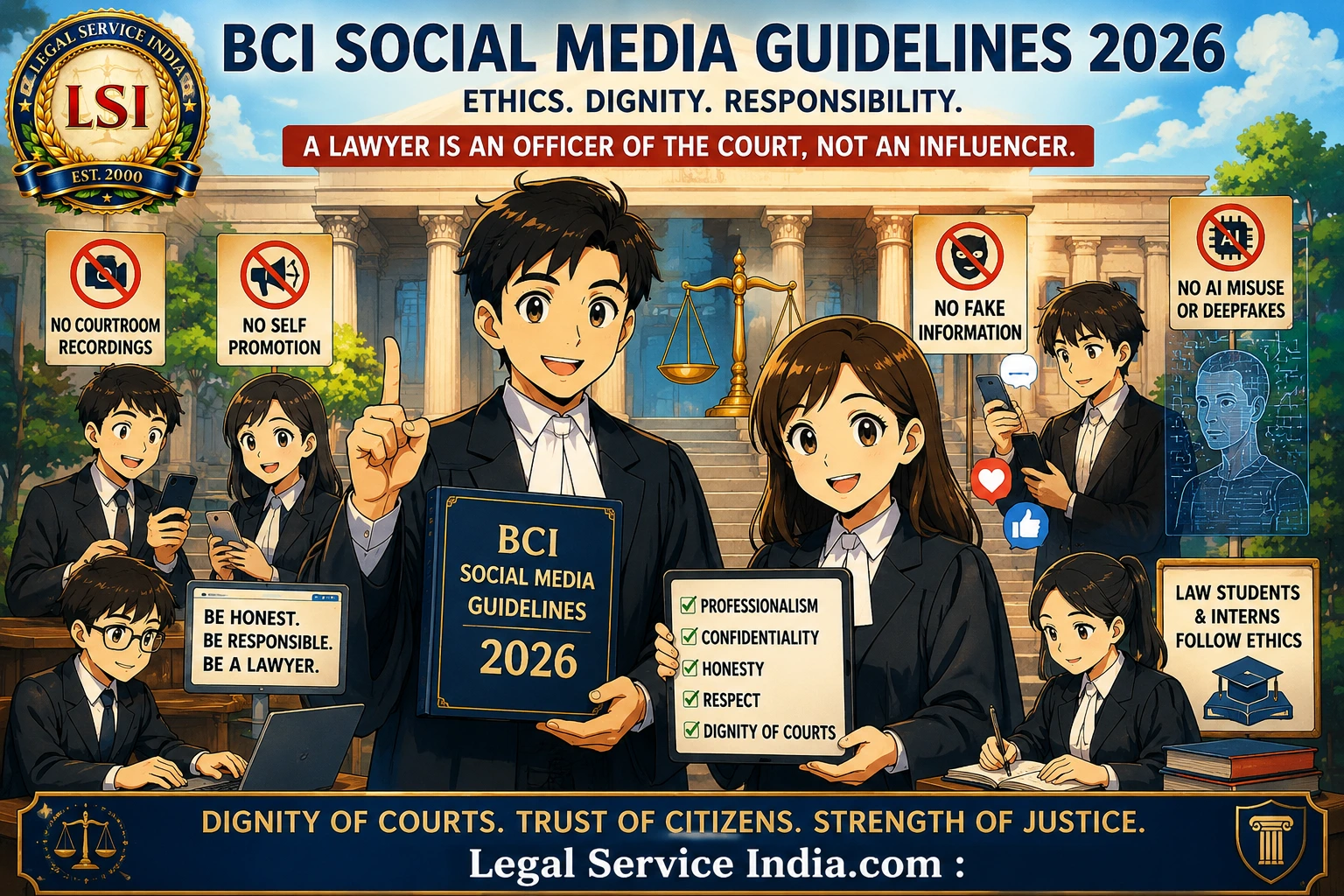
Bar Council of India Social Media Guidelines for Lawyers (2026): A Simple Explanation of the New BCI Circular
On 17 July 2026, the Bar Council of India (BCI)—the statutory body that regulates lawyers in India—issued a detailed circular about how advocates, law students and interns should behave on social media. It’s a long, formal document, but the message underneath it is simple: courts are not content, and being a lawyer is not a personal brand to be monetised on Instagram and YouTube.
This article breaks the circular down into everyday language so that anyone — whether a law student, a client, a journalist, or simply a curious citizen — can understand what has changed and why.
Table of Contents
- Why Did the BCI Feel the Need to Do This?
- The Core Idea: A Lawyer Is Not an Ordinary Business
- What Exactly Are Lawyers, Students and Interns Being Told to Avoid?
- Inside the Courtroom
- Editing and Circulating Court Footage
- Self-Promotion and Advertising
- Confidentiality and Honesty
- What About AI, Deepfakes and Voice Cloning?
- Does This Change Existing Law?
1. Why Did the BCI Feel the Need to Do This?
Over the past couple of years, India has seen a boom in “legal content” online — reels from inside courtrooms, dramatic reenactments of hearings, lawyers posing in their robes for Instagram, and self-styled “legal influencers” offering confident-sounding advice to millions of strangers. Some of it is harmless. Some of it is not.
The BCI says it noticed a troubling pattern: people recording and circulating clips from live-streamed court proceedings, editing them with mocking captions or dramatic music, and turning judges, opposing lawyers or litigants into punchlines. It also noticed fake court judgements, invented legal “success stories”, and non-lawyers giving out legal advice as if they were qualified to practise.
Two other things pushed this circular along. First, the Kerala High Court Advocates’ Association had already warned its own members about filming inside court premises. Second — and this is a striking coincidence of timing — just three days before this circular, the Supreme Court issued notice in a public interest petition (Anil Pandey & Another v. Bar Council of India) raising almost identical concerns about lawyers using social media for advertising and self-promotion. The BCI clarifies that its own process had already been underway since June 2026, and this circular is its considered response — not something knocked together overnight.
Although styled as a circle, it reflects the Bar Council of India’s interpretation and enforcement of existing statutory and ethical obligations under the Advocates Act, 1961, and the Bar Council of India Rules governing professional conduct and etiquette. Rather than creating an entirely new regulatory framework, it operationalises and reinforces existing professional standards in the context of digital and social media conduct.
Key Reasons Behind the Circular
| Issue | Concern Raised by BCI |
|---|---|
| Live-stream recordings | Edited and circulated with sensational or mocking content. |
| Fake legal information | False judgements, fabricated success stories and misleading legal advice. |
| Advertising | Increasing trend of lawyers using social media for self-promotion. |
| Professional ethics | Need to preserve the dignity of courts and the legal profession. |
2. The Core Idea: A Lawyer Is Not an Ordinary Business
The circular repeatedly comes back to one idea: the legal profession is not a shop, and a courtroom is not a film set. Lawyers are officially treated as “officers of the court”, meaning they carry public responsibilities that go beyond simply earning fees. The Supreme Court itself has previously ruled that the legal profession is legally unique and cannot be compared to an ordinary consumer service.
Because of that, conduct which might be perfectly fine for anyone else — say, filming a fun clip of your workplace — can still be considered improper for a lawyer, simply because a lawyer’s public conduct is tied to the dignity of the courts they serve.
In many sectors, commercial advertising is standard practice. However, Indian legal ethics draw a sharp distinction here. Unlike ordinary businesses, advocates are formally recognised as officers of the court who play an integral role in the administration of justice. Because the law is viewed as a noble profession centred on public service rather than a commercial trade, public solicitation is prohibited to prevent the commodification of justice, protect vulnerable litigants from misleading promises, and preserve public faith in the integrity of the legal system.
Core Principles Highlighted by the BCI
- The legal profession is not a commercial business.
- Lawyers are officers of the court.
- The dignity of courts must always be preserved.
- Professional conduct extends beyond the courtroom.
- Public confidence in the justice system must remain protected.
3. What Exactly Are Lawyers, Students and Interns Being Told to Avoid?
The circular sets out a long list of behaviours advocates are now formally advised to refrain from. In plain terms, here are the big ones:
Inside the Courtroom
- No reels, videos or promotional photos inside court premises, courtrooms, corridors or chambers in a way that looks undignified.
- No filming of proceedings — physical, virtual or hybrid — unless the court’s own rules specifically allow it, or written court permission has been obtained.
- No wearing robes, gowns or bands for public photos, reels or “lawyer lifestyle” content outside of proper occasions.
Editing and Circulating Court Footage
- No clipping, editing or captioning live-streamed hearings to mock, ridicule or sensationalise judges, lawyers, litigants or witnesses.
- The circular is blunt about this: live-streaming exists so the public can see justice being done — not so someone can turn a hearing into entertainment or a viral clip.
Self-Promotion and Advertising
- No content that amounts to disguised advertising, client solicitation, or “look how influential I am” branding.
- No guaranteed-outcome marketing — phrases like “guaranteed bail”, “divorce in a few days”, “sure acquittal” or “instant relief” are specifically called out as misleading.
- No using the court building, case files, robes or client documents as props for personal branding or follower-chasing content.
Confidentiality and Honesty
- No disclosing client details, case strategy, settlement talks or privileged conversations online.
- No fake judgements, fabricated case citations, invented “client success stories”, or claims of appearances and results that never actually happened.
- No buying fake followers, fake reviews or bot engagement to look more credible than one actually is.
Summary of Prohibited Conduct
| Category | Examples |
|---|---|
| Courtroom Conduct | Filming, reels, promotional photos, and unauthorised recordings. |
| Social Media Content | Mocking court proceedings, viral edits, and sensational captions. |
| Advertising | Guaranteed results, solicitation, and branding using court premises. |
| Professional Ethics | Disclosure of confidential information, fake judgements, and fabricated success stories. |
4. What About AI, Deepfakes and Voice Cloning?
This is one of the more forward-looking parts of the circular. The BCI has explicitly prohibited creating, uploading, forwarding or monetising AI-generated images, deepfake videos, voice-cloned audio, face-swapped visuals or any synthetic content that depicts — or pretends to depict — a judge, a court, a lawyer, a litigant, a witness or a court proceeding.
Where a lawyer does use AI tools to help create legitimate content (say, a summary or a poster), the circular says that use should be disclosed where it is material, rather than passed off as authentic recorded material.
5. Does This Change Existing Law?
A common question that arises is whether these rules rewrite the legal landscape. The short answer is no. This circular is mostly clarificatory; it does not create entirely new offences from scratch but rather supplements and extends existing professional ethics into the digital realm. It reinforces long-standing misconduct principles by applying them to modern online behaviour. Crucially, it does not replace or override individual court rules—the specific live-streaming and security protocols of the Supreme Court or various High Courts continue to take absolute priority.
To ground these guidelines, the BCI relies heavily on foundational statutory provisions and landmark rulings, including:
Statutory Framework and Landmark Judgements
| Legal Authority | Purpose |
|---|---|
| Statutory Framework | Section 35 (disciplinary powers) and Section 49(1)(c) of the Advocates Act, 1961, alongside the Standards of Professional Conduct and Etiquette under Part VI, Chapter II of the Bar Council of India Rules. |
| The Non-Commercial Nature of Law | The Supreme Court’s ruling in Bar of Indian Lawyers v. D.K. Gandhi (2024), affirming that the legal profession is sui generis and distinct from ordinary commercial businesses. |
| Practice Beyond Courtrooms | Bar Council of India v. A.K. Balaji (2018), confirming that professional ethics apply equally to out-of-court non-litigation work, including chambers and advice. |
| Live-Streaming Safeguards | Swapnil Tripathi v. Supreme Court of India (2018), which authorised live-streaming for transparency but strictly banned using the footage for commercial, promotional, or satirical entertainment. |
6. What Does This Mean for Law Students and Interns?
Students and interns are not left out. Law colleges and internship providers are being asked to run a short orientation on “digital ethics, court decorum, confidentiality and professional responsibility” and to obtain a written undertaking from students before their internships begin, promising not to record or circulate anything from chambers, courts or client work.
Importantly, the circular acknowledges that students often act out of curiosity or excitement rather than bad intent. Its stated approach for first-time, minor lapses is to counsel and educate rather than punish — reporting and disciplinary action are reserved for conduct that is deliberate, repeated, or genuinely damaging.
Responsibilities of Law Students and Interns
- Attend orientation on digital ethics and professional responsibility.
- Maintain confidentiality of client information and court proceedings.
- Refrain from recording or sharing court or chamber activities.
- Sign a written undertaking before beginning internships.
- Follow professional conduct even while using personal social media accounts.
7. What Happens If Someone Breaks These Rules?
The circular sets out a graded, proportionate response rather than a one-size-fits-all punishment:
Minor Breaches
Minor breaches — a first careless post, an incomplete disclaimer — will typically mean counselling and a request to correct or delete the content.
Serious Breaches
Serious breaches — repeated misuse, misleading claims, disclosure of case details — may be reported to the concerned Bar Association or State Bar Council for formal reference.
Aggravated Breaches
Aggravated breaches — fake judgements, deepfakes, voice cloning, privacy violations, scandalising content — can trigger formal disciplinary proceedings under the Advocates Act, 1961, and in serious cases, referral for contempt of court, civil action, or criminal complaint.
The circular is careful to say that a mere complaint or an anonymous screenshot is not, by itself, proof of guilt. Anyone accused is entitled to a fair process and a chance to explain themselves before any action is taken.
Disciplinary Framework
| Nature of Breach | Likely Action |
|---|---|
| Minor Breach | Counselling and request to edit or remove the content. |
| Serious Breach | Reference to the concerned Bar Association or State Bar Council. |
| Aggravated Breach | Formal disciplinary proceedings, contempt proceedings, civil action or criminal complaint. |
8. How Will This Actually Be Enforced?
Rather than leaving this as a one-off warning letter, the BCI has proposed a structure to make sure the rules are actually followed:
- State Bar Councils and Bar Associations are asked to set up a simple online complaint portal or a dedicated email address for reporting misuse.
- A Digital Ethics Committee (or nodal officer) will receive complaints, verify them, and decide whether the matter needs counselling, a warning, or escalation to a disciplinary committee.
- Every new advocate may, going forward, be asked to sign a standalone sworn affidavit at the time of enrolment, acknowledging these standards — separate from the ordinary enrolment paperwork, so it isn’t just a buried clause nobody reads.
- The BCI intends to eventually turn these principles into a formal chapter of the Bar Council of India Rules, though the circular already applies as an immediate professional direction in the meantime.
Proposed Enforcement Mechanism
| Authority | Role |
|---|---|
| State Bar Councils | Receive complaints and initiate appropriate action. |
| Bar Associations | Assist in reporting and maintaining professional discipline. |
| Digital Ethics Committee | Verify complaints and recommend counselling, warnings or disciplinary proceedings. |
| New Advocates | May be required to submit a sworn affidavit acknowledging digital ethics obligations. |
9. What This Circular Does NOT Do
It’s worth being clear about the limits of this circular, because the BCI itself is careful to spell these out:
- It does not ban legal education or legal awareness content. Lawyers, teachers and students can still explain legal concepts publicly — the concern is with content that crosses into advertising, misinformation or impersonation.
- It does not override the rules of any individual court. Where a High Court or the Supreme Court has its own rules on recording, live-streaming or courtroom conduct, those rules continue to apply and take priority.
- It does not create a new ground to deny someone enrolment as an advocate. A social media complaint, by itself, cannot be used to block or delay a person’s enrolment.
- It does not turn every social media mistake into a criminal case. The circular refers to other laws (like the IT Act or the Data Protection Act) only where facts genuinely warrant it — not as a default threat for ordinary lapses.
Quick Summary
| What the Circular Does | What the Circular Does Not Do |
|---|---|
| Regulates professional conduct on social media. | Does not ban legal education content. |
| Protects the dignity of courts. | Does not prohibit responsible legal awareness. |
| Discourages misleading advertising. | Does not override Supreme Court or High Court rules. |
| Provides a disciplinary framework. | Does not automatically create criminal liability. |
10. The Constitutional Balance: Freedom of Speech
A circular regulating digital expression inevitably raises constitutional questions regarding the right to freedom of speech and expression under Article 19(1)(a) of the Constitution of India. It is vital to note that the Circular does not extinguish an advocate’s constitutional right to speak or critique the law. Rather, it seeks to reasonably regulate professional conduct when an individual acts, posts, or presents themselves online, specifically in their capacity as an advocate. As with any professional regulation, the question of whether specific restrictions cross the line or remain strictly proportionate will ultimately remain subject to judicial scrutiny.
11. The Bigger Picture
Strip away the legal language, and the circular is really making one point: the freedom lawyers have to speak, teach and build a public profile online does not cancel out the older, quieter duties that come with being an officer of the court — duties of dignity, confidentiality, honesty and restraint.
“An advocate shall, at all times, comport himself in a manner befitting his status as an officer of the Court, a privileged member of the community, and a gentleman.”
— Bar Council of India Rules, Chapter II, Part VI
That sentence was written long before Instagram reels existed. The BCI’s circular is essentially saying that the sentiment behind it hasn’t expired — it has simply moved online.
Key Takeaways
- The Bar Council of India has issued comprehensive social media guidelines for advocates, law students and interns.
- The circular reinforces existing professional ethics instead of creating an entirely new legal framework.
- Lawyers must avoid promotional content, misleading advertisements and misuse of courtroom recordings.
- AI-generated deepfakes, voice cloning and synthetic courtroom content involving judges, lawyers or litigants are expressly prohibited.
- Professional obligations relating to confidentiality, dignity and honesty continue to apply on digital platforms.
- The circular introduces a graded disciplinary mechanism ranging from counselling to formal disciplinary proceedings.
- Law students and interns are expected to follow digital ethics and confidentiality requirements during internships.
- The guidelines do not prohibit genuine legal education or legal awareness content.
- Individual rules framed by the Supreme Court and High Courts continue to prevail wherever applicable.
- The circular seeks to preserve public confidence in the administration of justice while adapting professional ethics to the digital age.
BCI Circular at a Glance
| Topic | Summary |
|---|---|
| Date of Circular | 17 July 2026 |
| Issued By | Bar Council of India (BCI) |
| Applies To | Advocates, Law Students and Interns |
| Main Objective | Maintain professional ethics and dignity on digital and social media platforms. |
| Key Restrictions | Advertising, courtroom filming, misleading legal claims, disclosure of confidential information, AI deepfakes and synthetic court content. |
| Permitted Activities | Legal education, legal awareness and responsible academic discussion consistent with professional ethics. |
| Enforcement | Counselling, disciplinary proceedings, and referral to Bar Councils where appropriate. |
Frequently Asked Questions (FAQs)
Can lawyers still post on social media?
Yes. The circular does not prohibit advocates from using social media. It regulates professional conduct and discourages misleading advertising, sensational content and unethical practices.
Are legal education videos banned?
No. The circular specifically does not prohibit genuine legal education or legal awareness content.
Can lawyers record court proceedings?
No, unless recording is specifically permitted under the relevant court rules or written permission has been obtained.
Are AI-generated courtroom videos allowed?
The circular expressly prohibits creating, uploading, forwarding or monetising AI-generated deepfakes, voice cloning, face-swapped visuals and similar synthetic content depicting judges, courts, lawyers, litigants, witnesses or court proceedings.
Does the circular create new criminal offences?
No. The circular primarily clarifies and reinforces existing professional ethics and disciplinary obligations rather than creating entirely new offences.
Does the circular override Supreme Court or High Court rules?
No. Individual court rules relating to recording, live-streaming and courtroom conduct continue to prevail.
What happens if a lawyer violates the guidelines?
Depending on the seriousness of the misconduct, the response may range from counselling and warnings to disciplinary proceedings, contempt action or other legal proceedings where warranted.
Conclusion
The Bar Council of India’s 2026 circular represents an important effort to align traditional professional ethics with the realities of the digital era. While technology, artificial intelligence and social media continue to transform the legal profession, the circular reiterates that the foundational duties of advocates—dignity, integrity, confidentiality and responsibility—remain unchanged. Rather than restricting legitimate legal education or public engagement, it seeks to ensure that professional conduct online reflects the same standards expected inside the courtroom, thereby preserving public confidence in the administration of justice.
(This article is a simplified explainer of BCI Circular No. BCI:D:4657/2026 dated 17.07.2026, prepared for general understanding. It is not a substitute for reading the full circular or for professional legal advice on any specific situation.
Key Takeaways: Bar Council of India (BCI) 2026 Social Media Guidelines for Lawyers
The Bar Council of India (BCI) has issued comprehensive 2026 Social Media Guidelines regulating how advocates, law students, and legal interns use platforms such as Instagram, YouTube, Facebook, X (Twitter), and LinkedIn in connection with their professional activities.
The circular reinforces that the legal profession is a noble profession, not a commercial business. Advocates are officers of the court and must maintain the dignity, integrity, and independence of the justice delivery system both offline and online.
Quick Summary of Key Takeaways
| Topic | Key Takeaway |
|---|---|
| Social Media Regulation | BCI has introduced comprehensive guidelines governing advocates’, law students’, and interns’ use of social media. |
| Professional Ethics | The legal profession remains a noble profession and not a commercial business. |
| Advertising Restrictions | Misleading legal advertisements and promotional branding are prohibited. |
| Courtroom Content | Recording, editing, or sensationalising court proceedings is prohibited. |
| Artificial Intelligence | AI-generated deepfakes, voice cloning, and synthetic courtroom content are prohibited. |
| Confidentiality | Client confidentiality and privileged communications must always be protected. |
| Legal Education | Genuine legal awareness and educational content continue to be permitted. |
| Disciplinary Action | A graded disciplinary framework has been introduced for violations. |
Major Highlights of the BCI Guidelines
- The Bar Council of India (BCI) has issued comprehensive 2026 Social Media Guidelines regulating how advocates, law students, and legal interns use platforms such as Instagram, YouTube, Facebook, X (Twitter), and LinkedIn in connection with their professional activities.
- The circular reinforces that the legal profession is a noble profession, not a commercial business. Advocates are officers of the court and must maintain the dignity, integrity, and independence of the justice delivery system both offline and online.
- Lawyers are prohibited from using courtrooms, court premises, robes, client files, or legal proceedings for promotional content, branding, influencer marketing, or social media monetisation.
- The BCI has expressly warned against misleading legal advertisements, including claims such as “Guaranteed Bail”, “Instant Divorce”, “Sure Acquittal”, or other promises of legal outcomes that violate professional ethics.
- The circular strictly prohibits recording, editing, or sensationalising court proceedings, including misuse of live-streamed hearings through reels, memes, dramatic edits, or mocking captions targeting judges, lawyers, litigants, or witnesses.
- Recognising emerging technology risks, the BCI has specifically banned AI-generated deepfakes, voice cloning, face-swapped videos, and synthetic courtroom content depicting judges, advocates, litigants, witnesses, or court proceedings for misleading, promotional, or monetised purposes.
- The guidelines reaffirm advocates’ continuing duty to protect client confidentiality, prohibiting disclosure of privileged communications, litigation strategy, settlement discussions, or confidential client information on digital platforms.
- The circular also targets the spread of fake judgements, fabricated case citations, false success stories, fake reviews, and purchased followers, reinforcing that honesty and professional integrity remain fundamental obligations.
- Importantly, the BCI clarifies that the circular does not prohibit legal education or public legal awareness content. Lawyers, teachers, and students may continue publishing educational material, provided it does not amount to advertising, solicitation, misinformation, or impersonation.
- Law students and interns are now expected to undergo digital ethics orientation and provide written undertakings regarding confidentiality, courtroom decorum, and responsible social media conduct before commencing internships.
- Enforcement will follow a graded disciplinary approach, beginning with counselling for minor violations and extending to disciplinary proceedings, contempt action, civil liability, or criminal complaints for serious misconduct involving privacy breaches, fabricated content, or deepfake technology.
- The circular builds upon existing legal principles under the Advocates Act, 1961, the Bar Council of India Rules, and landmark Supreme Court decisions, demonstrating that it clarifies and strengthens existing ethical obligations rather than creating an entirely new legal regime.
- The BCI further proposes institutional mechanisms, including Digital Ethics Committees, online complaint portals, and formal declarations by newly enrolled advocates, signalling that digital professionalism will become an integral part of legal practice in India.
- Ultimately, the 2026 BCI Circular reflects the legal profession’s transition into the digital era while reaffirming that professional ethics, dignity of the judiciary, confidentiality, and public trust remain paramount irrespective of the platform used.
BCI Guidelines at a Glance
| Area | Requirement |
|---|---|
| Advocates | Maintain dignity, integrity, confidentiality, and professional ethics on social media. |
| Law Students & Interns | Follow digital ethics, confidentiality obligations, and responsible online conduct. |
| Advertising | No misleading legal advertisements or solicitation of clients. |
| Court Proceedings | No recording, editing, or sensationalising hearings without permission. |
| Artificial Intelligence | No deepfakes, AI voice cloning, or synthetic courtroom content. |
| Confidentiality | Client information and litigation strategy must remain confidential. |
| Compliance | Violations may attract counselling, disciplinary proceedings, contempt action, civil liability, or criminal proceedings where applicable. |